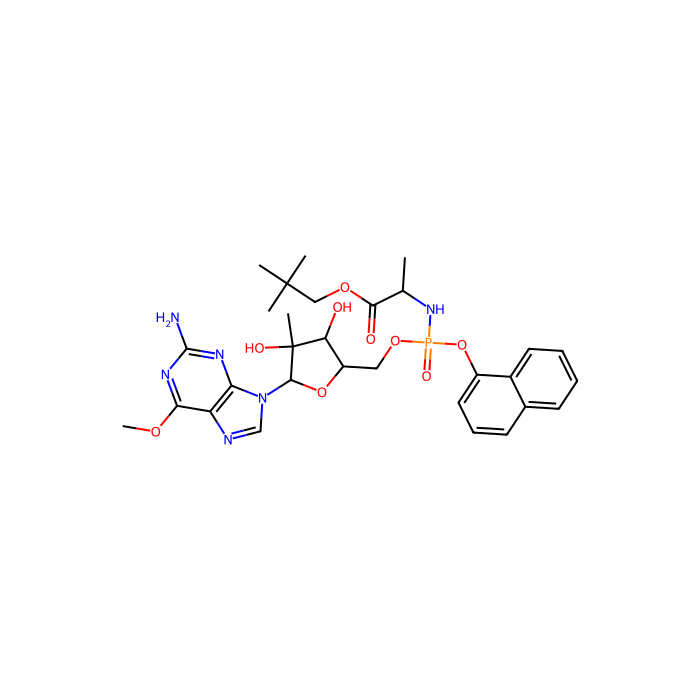
BMS 986094 | 2,2-dimethylpropyl (2S)-2-[({[(2R,3R,4R,5R)-3,4-dihydroxy-5-(2-imino-6-methoxy-3,9-dihydro-2H-purin-9-yl)-4-methyloxolan-2-yl]methoxy}(naphthalen-1-yloxy)phosphoryl)amino]propanoate | 2,2-dimethylpropyl (2S)-2-[[[(2R,3R,4R,5R)-5-(2-amino-6-methoxy-purin-9-yl)-3,4-dihydroxy-4-methyl-tetrahydrofuran-2-yl]methoxy-(1-naphthyloxy) Show more
Spezifikationen & Reinheit
≥98%(HPLC)
Biochemische und physiologische Mechanismen
Potent hepatitis C virus (HCV) replication inhibitor (EC50= 35 nM). Is rapidly metabolized in primary human hepatocytes to 2'-C-methyl guanosine triphosphate, an inhibitor of HCV RNA-dependent RNA polymerase NS5b. Displays 10-fold reduction in potency in
Storage
Store at -20°C
Verschickt in
Ice chest + Ice pads
Dieses Produkt erfordert Kühlkettenversand. Grundversand und andere Economy-Optionen sind nicht verfügbar.
Aktionsart
INHIBITOR
Mechanismus der Wirkung
Hepatitis C virus NS5B RNA-dependent RNA polymerase inhibitor
This compound belongs to the class of organic compounds known as alpha amino acid esters. These are ester derivatives of alpha amino acids.
External Descriptors
Not available
1. Djoumbou Feunang Y, Eisner R, Knox C, Chepelev L, Hastings J, Owen G, Fahy E, Steinbeck C, Subramanian S, Bolton E, Greiner R, and Wishart DS. ClassyFire: Automated Chemical Classification With A Comprehensive, Computable Taxonomy. Journal of Cheminformatics, 2016, 8:61.
Zertifikate (CoA, COO, BSE/TSE und Analyse-Diagramm)
C of A & Other Certificates(BSE/TSE, COO):
Analytical Chart:
Chemische und physikalische Eigenschaften
Löslichkeit
Solvent:DMSO, Max Conc. mg/mL: 65.86, Max Conc. mM: 100; Solvent:ethanol, Max Conc. mg/mL: 65.86, Max Conc. mM: 100
Molekulargewicht
658.600 g/mol
XLogP3
2.800
Hydrogen Bond Donor Count
4
Hydrogen Bond Acceptor Count
14
Rotatable Bond Count
13
Exact Mass
658.252 Da
Monoisotopic Mass
658.252 Da
Topological Polar Surface Area
202.000 Ų
Heavy Atom Count
46
Formal Charge
0
Complexity
1100.000
Isotope Atom Count
0
Defined Atom Stereocenter Count
5
Undefined Atom Stereocenter Count
1
Defined Bond Stereocenter Count
0
Undefined Bond Stereocenter Count
0
The total count of all stereochemical bonds
0
Covalently-Bonded Unit Count
1
Lösungsrechner
Molarity Calculator
Determine the necessary mass, volume, or concentration for preparing a solution.
Dilution Calculator
Determine the dilution needed to prepare a stock solution.
Reconstitution Calculator
Bewertungen
Kundenbewertungen
Application Protocols
No item-specific, validated protocols are provided in the Product Data. The following are general, literature-informed procedures for handling small-molecule stocks for biochemical or cell-based assays; adapt to your system.
General DMSO stock preparation
Equilibrate vial to room temperature in a desiccator. Briefly centrifuge to collect contents.
Add anhydrous DMSO to reach a target stock (e.g., 10–50 mM depending on solubility). Vortex and sonicate gently until fully dissolved. If needed, warm to 25–30°C; avoid higher temperatures.
Filter through 0.2 µm PTFE into low-bind tubes. Aliquot in single-use portions. Store at −20°C or below.
Biochemical assay dilution
Prepare assay buffer (e.g., HEPES 50 mM, NaCl 100 mM, MgCl2 as needed, pH 7.5). Add compound from DMSO stock to achieve final DMSO ≤1–2% v/v. Mix gently and use immediately.
Cell-based assay seeding
Prepare dosing solutions by serial dilution in culture medium maintaining constant DMSO across conditions (e.g., 0.1–0.5% v/v). Dose cells promptly; avoid extended preincubation of compound in aqueous media.
Sample stabilization for LC–MS
Quench biological samples with cold organic solvent (e.g., acetonitrile 3:1 v/v), vortex, and snap-freeze on dry ice. Store extracts at −80°C pending analysis.
Always verify solubility, absence of precipitation, and assay tolerance to DMSO for your specific model.
Biological Roles
Item-specific biological details are not provided in the Product Data. The following is literature-based, provided for research context only and not as a statement about this specific lot.
Literature/general context
BMS-986094 is described in the literature as a phosphoramidate (ProTide) prodrug designed to deliver a guanosine monophosphate analog intracellularly. After cellular uptake, sequential enzymatic steps (carboxylesterases, cathepsin A, HINT1) unmask the monophosphate, which is then phosphorylated to the active triphosphate by host kinases.
The resulting nucleotide analog triphosphate can act as a substrate/competitor for viral RNA-dependent RNA polymerases, enabling studies of polymerase selectivity, incorporation efficiency, and chain termination mechanisms in vitro.
Cell biology utility: tool for dissecting nucleotide metabolism, transporter involvement (e.g., OATP/ENT/CNT families where applicable), and intracellular nucleotide pool perturbations.
Off-target assessments (research context): mitochondrial polymerase interactions and nucleotide pool imbalances are often investigated with this class to understand cytotoxicity mechanisms; such studies should be conducted under appropriate safety review.
Important note
No medical or clinical claims are made. This product is for research use only, and any biological role described here is provided to guide experimental design and hypothesis generation.
Buffer Applications
This item is a small-molecule research compound rather than a buffering agent. Therefore, it is not used to set or maintain pH directly.
Practical guidance for assay buffers (general/literature)
Stock preparation: dissolve in anhydrous DMSO to make a concentrated master stock (e.g., 10–50 mM as solubility permits), then dilute into assay buffer immediately before use.
Buffer choice: near-neutral buffers such as HEPES, MOPS, or phosphate (pH 6.8–7.4) are commonly compatible with polymerase or cell-based assays, but excessive exposure to aqueous media may promote prodrug hydrolysis—minimize pre-incubation time.
Final DMSO percentage: maintain ≤1–2% v/v in enzyme or cell assays unless tolerance has been validated.
Additives: include serum proteins or carrier proteins judiciously to mitigate nonspecific binding; avoid strong nucleophiles or high concentrations of primary amines that could attack activated phosphorus centers.
Filtration: after dilution, 0.2 µm filtration (PTFE or PES) can reduce particulates; validate recovery to ensure no adsorption losses.
If buffer performance (solubility/precipitation) is uncertain, perform a small solubility screen across buffer pH and ionic strengths with rapid LC–MS checks.
Green Alternatives
Context
While BMS-986094 itself is a fixed structure, greener choices can be made in solvent selection and sample handling.
Greener solvent considerations (general guidance)
Prefer water-buffer systems whenever chemically feasible and compatible with assay stability; minimize exposure time to reduce hydrolysis.
For stock solutions, DMSO is commonly used; although not “green,” it is relatively low-toxicity and recyclable compared with chlorinated solvents.
Avoid DMF and NMP where possible due to reproductive toxicity concerns; if high solvency is required, consider safer high-permittivity alternatives such as Cyrene (dihydrolevoglucosenone) or propylene carbonate for certain workflows, after verifying solubility and stability.
Comparison (general)
DMSO: acceptable EHS profile, good solvency; ensure closed-loop handling to limit emissions.
Ethanol/IPA: greener but may not dissolve sufficient quantities or may promote side reactions; assess case-by-case.
Propylene carbonate/Cyrene: bio-derived options; viscosity and reactivity may limit use—pilot small-scale tests recommended.
Operational green practices
Prepare concentrated master stocks to minimize solvent volumes in assays (reduces waste).
Use microscale assay formats (96/384-well) to reduce compound and solvent consumption.
Apply solvent recycling where infrastructure exists, and segregate halogen-free organic waste for optimized disposal.
Note: Any switch in solvent should be qualified for analytical integrity and compound stability prior to broad adoption.
Pharmaceutical Uses
Item-specific pharmacopeial status and excipient roles
Not specified for this item; refer to CoA/Spec Sheet.
General research/manufacturing context (no therapeutic claims)
BMS-986094 has been studied in the literature as a nucleotide prodrug. In a research and development setting, such compounds may be used as:
Reference standards for analytical method development (e.g., stability-indicating HPLC/LC–MS) during preclinical formulation studies.
Model compounds in prodrug formulation screening (solid dispersion, lipid-based systems) to improve solubility and stability for in vitro testing.
Controls in metabolism and transport studies (hepatic S9/microsomes, hepatocytes) to qualify bioanalytical workflows.
Preformulation considerations (general):
Hygroscopicity and moisture sensitivity necessitate low-water processing and desiccated packaging.
Solid-state characterization (XRPD, DSC, TGA) helps define handling and storage for stability studies.
DMSO stock handling with single-use aliquots reduces freeze–thaw stress and hydrolysis.
Regulatory note
This product is supplied strictly for research use only. It is not an API, not GMP-certified, and not intended for human or veterinary use.
Physical Properties
Item-specific physicochemical data
Appearance: Not specified for this item; refer to CoA/Spec Sheet.
Molecular weight: Not specified for this item; refer to CoA/Spec Sheet.
Molecular formula: Not specified for this item; refer to CoA/Spec Sheet.
Melting point, boiling point, density, refractive index: Not specified for this item; refer to CoA/Spec Sheet.
Aqueous solubility, logP/logD, pKa: Not specified for this item; refer to CoA/Spec Sheet.
Literature/General expectations for phosphoramidate nucleotide prodrugs (context only)
Physical state: typically solid at ambient temperature (often crystalline or amorphous powders).
Solubility: frequently soluble in polar aprotic organic solvents (DMSO, DMF, NMP; literature), variably soluble in methanol/ethanol, and of limited solubility in water at neutral pH due to the lipophilic masking groups.
Stability profile: phosphoramidate linkages can hydrolyze in aqueous media, especially under strongly basic or acidic conditions; improved stability in dry, aprotic conditions (literature).
pKa: purine base N1 is weakly basic/acidic depending on substitution; overall molecule exhibits multiple ionizable centers but presents as neutral/zwitterionic in organic media due to masking (literature, qualitative).
Practical notes
For analytical work, stocks are commonly prepared in anhydrous DMSO and stored frozen to minimize hydrolysis (general practice; verify solubility with the specific lot).
Quality and Grades
Item-specific quality data
Grade/purity: Not specified for this item; refer to CoA/Spec Sheet.
Stabilizers/inhibitors: Not specified for this item; refer to CoA/Spec Sheet.
Guidance on interpreting quality for small-molecule research standards
For reference and screening compounds, typical quality indicators include assay purity by HPLC/UPLC, identity confirmation by HRMS and 1H/13C NMR, and water/volatile content by Karl Fischer/TGA. If chiral centers are present (common for phosphoramidate amino acid esters and ribose), enantiomeric/diastereomeric ratios are often reported.
Low-peroxide and low-residual-solvent specifications are desirable for stability and bioassay consistency; verify against the lot CoA. If UV cutoff/spectral data are needed (e.g., for LC-UV quantitation), consult the CoA.
Stabilizer implications: phosphoramidates are usually shipped without stabilizers; however, rigorous drying and inert packaging (desiccant, moisture barrier) improve shelf life. If the item includes any stabilizer, ensure it is compatible with downstream assays.
Documentation
For publication-grade work, retain the lot-specific CoA and, when necessary, acquire additional orthogonal identity data (2D NMR, optical rotation, chiral HPLC) to confirm stereochemical integrity.
Reaction and Applications
This catalog item is primarily a research small molecule, not a general-purpose synthetic reagent. Accordingly, its value lies in biochemical and pharmacological research rather than in routine bench transformations.
Research applications (literature/general)
Tool compound for studying nucleotide prodrug activation pathways: assessment of carboxylesterase, cathepsin A, and HINT1-mediated unmasking of phosphoramidate groups leading to intracellular monophosphate delivery.
Probe for polymerase biochemistry: guanosine analog triphosphate formation and incorporation by viral RNA-dependent RNA polymerases; kinetic assays for selectivity vs host polymerases (in vitro biochemical systems).
ADME/metabolism studies: stability in plasma/S9/microsomes, species differences in prodrug cleavage, and identification of metabolites by LC–MS/MS.
Analytical reference standard: development/validation of LC–MS bioanalytical methods (extraction recovery, matrix effects, calibration curve stability) in support of in vitro studies.
Practical tips
Prepare fresh working solutions from frozen DMSO stocks immediately before assays to limit hydrolysis.
Include esterase/nuclease inhibitors in sample handling as appropriate for biological matrices; snap-freeze aliquots to quench metabolism.
Use internal standards (stable-isotope labeled where possible) for accurate quantitative analysis.
Note: Specific reaction chemistry (e.g., cross-couplings, Grignard) is not typically relevant for this compound in end-user labs. Focus on assay design, stability, and controlled handling.
Reaction Conditions
End-user reaction chemistry is generally not the primary application for this compound. However, for handling and analytical transformations, the following literature-informed guidance may be useful.
General handling/stability experiments (literature context)
Hydrolysis kinetics: assess in buffered aqueous solutions (pH 5–8) at 25–37°C; monitor by LC–MS to determine half-life. Avoid extremes of pH where phosphoramidate cleavage accelerates rapidly.
Enzymatic activation assays: incubate with purified carboxylesterases, cathepsin A, and HINT1 or with cellular lysates; typical conditions 30–37°C, buffered at pH 7.2–7.4, time course 5–120 min, analyze by LC–MS/MS.
Chemical stability in organic media: evaluate in anhydrous DMSO or acetonitrile at ambient temperature; minimize water content to suppress slow background hydrolysis.
Analytical conditions (examples; adjust as needed)
LC: C18 reversed-phase, gradients of water (0.1% formic acid or ammonium acetate) and acetonitrile/methanol; column temps 30–40°C; detection by UV (purine chromophore) and/or MS.
MS: ESI positive and negative modes can both provide informative ions for phosphoramidates and purines; optimize source conditions to avoid in-source fragmentation.
Note
No specific synthetic reaction yields/temperatures for making BMS-986094 are provided here; consult primary literature for detailed preparative chemistry if needed.
Safety and Handling
Item-specific safety information
GHS classification, signal word, pictograms, H-statements: Not specified for this item; refer to SDS.
Storage conditions (from Product Data): Store at −20°C. Shipped in ice chest with ice pads.
General laboratory safety guidance (consult SDS for authoritative instructions)
Personal protective equipment: lab coat, nitrile gloves, and splash-resistant safety glasses as a minimum. Handle powders in a fume hood or ventilated enclosure to avoid inhalation of dust or aerosols.
Incompatibilities: phosphoramidate prodrugs are susceptible to hydrolysis; avoid prolonged exposure to moisture, strong acids/bases, and strong nucleophiles. Keep away from oxidizing agents until compatibility is established.
Special risks: many nucleotide analog prodrugs are biologically active. Avoid skin contact and ingestion. Prevent environmental release; collect waste in clearly labeled containers for organic hazardous disposal.
First-aid overview: in case of skin or eye contact, rinse with water for at least 15 minutes and remove contaminated clothing; seek medical attention. If inhaled, move to fresh air; if symptomatic, seek medical advice. If swallowed, rinse mouth; do not induce vomiting unless directed by medical personnel.
Thermal hazards: avoid heating; decomposition may produce phosphorus oxides, nitrogen oxides, and heteroaromatic fragments (general for phosphoramidates).
Always defer to the product-specific SDS for detailed handling, exposure limits, and spill/accidental release procedures.
Solvent Selection
Applicability to this compound class
BMS-986094 is a lipophilic phosphoramidate nucleotide prodrug; solvent choice strongly influences stability and assay performance.
General/literature-based solvent guidance (verify with your lot)
Primary stock solvent: anhydrous DMSO is commonly used due to high solvating power for polar, high-MW organophosphorus nucleoside prodrugs.
Alternative solvents: DMF or NMP can be effective for concentrated stocks; methanol or ethanol may dissolve moderate amounts but can participate in transesterification under basic conditions (use caution).
Aqueous media: direct dissolution in water/buffer may be limited and can accelerate hydrolysis of the phosphoramidate; instead, prepare a DMSO stock and dilute into buffer immediately before use to the lowest feasible final DMSO percentage (e.g., ≤1–2% v/v in biochemical assays; general practice).
pH considerations: avoid strong acid/base. Near-neutral buffers (pH 6.5–7.5) reduce chemical degradation relative to extremes (literature trend for ProTides).
Small comparison (literature context)
DMSO: maximal solubility, good stability when dry; hygroscopic—use dry, sealed vials.
DMF/NMP: similar to DMSO; higher boiling points facilitate long incubations but complicate removal.
Aqueous buffer: physiologically relevant but may shorten chemical half-life; minimize exposure time.
Practical tips
Warm gently (room temperature) and vortex/sonicate to aid dissolution; avoid heating above ambient to prevent decomposition.
Filter sterilization (0.2 µm PTFE) is generally compatible for cell-based assays after dilution.
Storage and Reconstitution
Item-specific instructions (from Product Data)
Storage: Store at −20°C.
Shipping: Ice chest with ice pads.
General reconstitution and handling guidance
Upon receipt, keep the container sealed and allow it to equilibrate to room temperature in a desiccator before opening to prevent moisture condensation.
If provided as a solid: prepare concentrated stocks in anhydrous DMSO. For long-term storage, dispense single-use aliquots into moisture-tight, low-bind tubes. Avoid repeated freeze–thaw cycles.
If provided as a solution: verify solvent and concentration on the label/CoA. Store tightly capped under inert atmosphere if possible; protect from moisture.
Stability considerations: phosphoramidate prodrugs can hydrolyze in aqueous media; minimize time in water/buffer and prepare working solutions immediately before use. Protect from light if the label/CoA indicates photosensitivity; otherwise, store in the dark as good laboratory practice.
Thawing: thaw frozen aliquots at room temperature, mix gently to homogeneity, and use promptly. Do not heat above ambient. Discard any aliquot showing precipitation, discoloration, or unexpected LC–MS impurities.
Specifications not provided
Exact shelf life, assay purity, water content, and stabilizers: Not specified for this item; refer to CoA/Spec Sheet.
This product is supplied for research use only.
Structure and Identity
Item-specific identifiers from Product Data
SKU: B288763
Product name: BMS 986094
CAS: 1234490-83-5 (as provided)
InChIKey: 436251 (as provided; not a standard-length InChIKey)
SMILES: Not specified for this item; refer to CoA/Spec Sheet.
Not specified for this item; refer to CoA/Spec Sheet
Molecular formula: Not specified for this item; refer to CoA/Spec Sheet.
Molecular weight: Not specified for this item; refer to CoA/Spec Sheet.
Literature/General description (for context; verify against CoA)
BMS-986094 is reported in the literature as a phosphoramidate nucleotide prodrug of a guanosine analog used in research on viral RNA-dependent RNA polymerases. Typical structural features include:
A purine (guanine-derived) heteroaromatic base.
A modified ribose (2'-C-substitution is commonly reported for this class) bearing a masked monophosphate as a phosphoramidate (ProTide) moiety.
The phosphoramidate typically features an aryl group and an amino acid ester, conferring lipophilicity for cell entry.
2D structure (verbal): a bicyclic purine ring attached (N9-glycosidic bond) to a substituted furanose ring; the 5'-position is derivatized to a P(V) center (P=O) bound to an aryl O- and an amino acid–derived N-substituent (phosphoramidate), completing a tetrahedral phosphorus with appropriate leaving groups upon enzymatic unmasking.
Note: Exact stereochemistry, protecting groups, and substituent identities should be confirmed against the certificate of analysis for this catalog item.
Synthetic Utility
As supplied, BMS-986094 is an end-use research compound rather than a general synthetic building block. Nevertheless, understanding its structural elements can aid medicinal chemistry or metabolite synthesis campaigns.
Literature/general synthetic perspective
Functional group ensemble: purine base, modified ribose (stereochemically defined), and a phosphoramidate prodrug moiety bearing aryl/alkyl substituents and an amino acid ester.
Retrosynthetic logic for analogs:
Assemble the nucleoside core via glycosylation of a protected purine with a suitably protected ribose (Vorbrüggen-type conditions) to control anomeric configuration.
Introduce 2'-C substitution (where relevant) by radical or organometallic addition to ribose derivatives before glycosylation, or by late-stage C–H functionalization on protected nucleosides (literature routes vary).
Install the phosphoramidate (ProTide) using chlorophosphoramidates or phosphorochloridates derived from the chosen aryl and amino acid ester; couple to the 5'-hydroxyl under base and then deprotect selectively.
Stereocontrol:
Phosphorus center can be stereogenic; diastereoselective installation and/or chromatographic separation may be required to access a single Sp/Rp isomer, which often impacts biological activity.
Use in synthesis workflows
Employed as a reference comparator when preparing close analogs or stable-labeled variants for bioanalytical studies.
Not typically used as a reagent or coupling partner in unrelated synthetic sequences due to complexity and cost.
Target Specificity
This product is not an antibody, protein, or engineered biological with defined antigen/epitope targeting in the supplied Product Data. Therefore, traditional “target specificity” fields (antigen, clone, isotype, species reactivity) do not apply.
Research context (literature)
As a small-molecule nucleotide prodrug, literature studies often evaluate biochemical selectivity toward viral RNA-dependent RNA polymerases versus host polymerases. Such information is assay- and system-dependent and should be derived from primary publications for the specific experimental setup.
For this catalog item, no target-binding specifications are provided; refer to the CoA or contact technical support for any available characterization data.
Wir verwenden Cookies, um die ordnungsgemäße Funktion der Website sicherzustellen und, soweit zulässig, Ihr Nutzererlebnis zu verbessern. Sie können Ihre Einstellungen jederzeit unter „Einstellungen“ verwalten. Weitere Informationen finden Sie in unserer Cookie-Richtlinie.
Dürfen wir Sie über Rabattaktionen informieren?
Später erinnern
Vielen Dank! Bitte überprüfen Sie Ihren E-Mail-Posteingang, um zu bestätigen.
Products are supplied to verified businesses, institutions, and qualified professionals for research and development use only. Not for use in humans, animals, diagnosis, or therapy.