This compound belongs to the class of organic compounds known as anilides. These are organic heterocyclic compounds derived from oxoacids RkE(=O)l(OH)m (l not 0) by replacing an OH group by the NHPh group or derivative formed by ring substitution.
External Descriptors
Anilide herbicides
1. Djoumbou Feunang Y, Eisner R, Knox C, Chepelev L, Hastings J, Owen G, Fahy E, Steinbeck C, Subramanian S, Bolton E, Greiner R, and Wishart DS. ClassyFire: Automated Chemical Classification With A Comprehensive, Computable Taxonomy. Journal of Cheminformatics, 2016, 8:61.
Determine the necessary mass, volume, or concentration for preparing a solution.
Dilution Calculator
Determine the dilution needed to prepare a stock solution.
Reconstitution Calculator
Bewertungen
Kundenbewertungen
Application Protocols
The following are general protocols for preparing and using butachlor analytical standards; adjust to your lab’s SOPs and CoA details. This product is for research use only.
Primary stock solution (typical):
Weigh an appropriate mass of neat solid/liquid standard (per CoA assay) quickly to minimize exposure. Dissolve in HPLC-grade acetonitrile or methanol to prepare a 1–10 mg/mL primary stock. Record exact concentration corrected for purity.
Intermediate and working standards:
Prepare serial dilutions in acetonitrile or methanol; for LC injections, bring to a water-miscible diluent (e.g., 50:50 ACN:water) while keeping analyte above solubility limit. For GC, dilute in iso-octane/hexane.
Calibration curve:
Prepare at least 5–8 levels spanning expected sample concentrations. Include a solvent blank and, if applicable, matrix-matched calibrators.
Internal standards:
Use an isotopically labeled analog where available to correct for matrix effects and recovery. If unavailable, use a structurally similar surrogate and document limitations.
Quality control:
Include continuing calibration verification (CCV), laboratory control spikes (LCS), and duplicates. Track recovery and ion ratios.
Storage and handling during use:
Store working solutions in amber autosampler vials at 4–10 C if run spans >24 h; minimize freeze–thaw of concentrated stocks by aliquoting.
Always follow your method validation guidance (e.g., SANTE, AOAC, EPA) for acceptance criteria.
Biological Roles
Item-specific biological data are not provided. The following is general literature context for butachlor as a herbicidal active ingredient; it is presented to aid researchers in environmental and biochemical studies and is not a medical or clinical claim.
Mode of action (literature): Butachlor is classified among very-long-chain fatty acid (VLCFA) synthesis inhibitors in plants, disrupting cell division and elongation in susceptible weed species, especially in paddy rice systems.
Organismal selectivity: Activity is predominantly herbicidal; mode-of-action specificity is associated with plant enzyme targets involved in lipid elongation pathways. It does not function as a biological buffer or metabolic intermediate in standard biochemistry.
Environmental behavior (literature, qualitative):
Hydrophobic character promotes sorption to soils and sediments; mobility depends on organic matter content.
Degradation may occur via hydrolysis, photolysis, and microbial pathways to more polar metabolites; rates depend on pH, light, and microbial communities.
Biomonitoring relevance: Analytical standards are used to quantify butachlor and its residues in environmental and food matrices to support exposure assessment and regulatory monitoring.
Note: For toxicological endpoints, organismal effects, and regulatory thresholds, consult authoritative databases and regulatory dossiers. This product is for research use only and not intended for any form of agricultural application or in vivo use.
Buffer Applications
Not typically applicable. Butachlor is a neutral, hydrophobic herbicidal analyte and is not used to prepare biological buffers or as a buffering component.
Practical note for analysts:
When preparing LC working solutions that will be injected into buffered mobile phases, ensure the diluent is miscible (e.g., acetonitrile:water). Avoid high-pH buffers that could promote hydrolysis of the amide/alpha-chloroacetyl functionality. Volatile, MS-compatible buffers (e.g., ammonium formate/acetate, pH ~3–6) are commonly used in LC–MS workflows, provided they are validated for butachlor retention and detection.
Green Alternatives
For an analytical standard, the primary levers for “greenness” are solvent selection, method design, and waste minimization rather than substitution of the analyte itself.
Greener choices and trade-offs (general guidance):
Solvents for LC standards:
Prefer methanol or ethanol (where method-compatible) over acetonitrile to reduce environmental impact; however, ACN often affords superior extraction efficiency and chromatographic performance for multi-residue methods.
Solvents for GC standards:
Heptane/iso-octane may be preferable to dichloromethane or toluene from a safety standpoint; ensure instrument/liner compatibility and response stability.
Sample preparation:
Miniaturize extractions and move to micro-QuEChERS or dispersive SPE with reduced solvent volumes.
Explore solid-phase microextraction (SPME) or stir-bar sorptive extraction (SBSE) for water monitoring to minimize solvent use.
Waste management:
Segregate halogenated vs non-halogenated wastes. Use reusable glassware and validated cleaning procedures to reduce disposables.
Illustrative comparison (method-level):
Conventional: 10–15 mL ACN QuEChERS per sample; LC–MS/MS with high-flow water/ACN mobile phases.
Greener alternative: Micro-QuEChERS (1–2 mL ACN) with isotopically labeled internal standard; UHPLC with reduced flow (≤0.3 mL/min) and shorter columns to cut solvent consumption by >60%.
Caveat: Any solvent substitution must maintain analyte stability and method performance (recovery, precision, matrix effects). Validate changes before routine use.
Pharmaceutical Uses
Not applicable. Butachlor is an agricultural herbicide and is not used as an excipient or processing aid in pharmaceutical formulations.
Analytical relevance only:
In pharmaceutical or environmental laboratories, butachlor standards may be handled solely for analytical method development (e.g., interference studies, selectivity checks) and instrument qualification. No pharmacopeial monograph application is typical for this compound.
Compliance note:
This product is designated For research use only and is not intended for human or veterinary applications.
Physical Properties
Item-specific physicochemical specifications (e.g., density, refractive index, UV cutoff) are not supplied with this listing.
Appearance: Not specified for this item; refer to CoA/Spec Sheet.
Melting/Freezing point: Not specified for this item; refer to CoA/Spec Sheet.
Boiling point: Not specified for this item; refer to CoA/Spec Sheet.
Density: Not specified for this item; refer to CoA/Spec Sheet.
Solubility (qualitative, literature):
Sparingly soluble in water; highly soluble in common organic solvents used for pesticide analysis (e.g., acetonitrile, methanol, acetone, dichloromethane, hexane/iso-octane).
Volatility (general): Low to moderate volatility relative to light solvents; manageable for GC with appropriate conditions.
Lipophilicity (literature, qualitative): Hydrophobic (chloroacetanilide with 2,6-diethylphenyl and butoxymethyl groups), favoring partition into organic phases and nonpolar sorbents.
Acid–base properties: Neutral amide; no ionizable groups in the environmental/analytical pH range; behaves as a nonionic organic compound in extraction/partitioning workflows.
Stability (general handling): Typically stable in neutral, anhydrous organic solvents. Hydrolysis can be promoted by strong base or prolonged exposure to moisture and heat; protect from strong alkali and extended high-temperature exposure.
Important: For any numeric or certificate-grade physical specifications, consult the product’s CoA/Spec Sheet. Values above are general literature characterizations intended to aid method planning.
Quality and Grades
Grade/Purity (this item): Not specified for this item; refer to CoA/Spec Sheet.
What “Standard” implies for this listing:
The term “Standard” indicates intended use as an analytical reference material for calibration, system suitability, and method validation in residue analysis, environmental monitoring, and QA/QC workflows.
Such materials are typically accompanied by documentation (CoA) detailing identity confirmation (e.g., NMR/LC-MS/GC-MS), purity assessment, and—where applicable—assigned purity/assay values or mass fraction for quantitative use.
Documentation to expect/verify:
CoA with batch-specific purity/assay, analytical method(s) used, and uncertainty (if certified). Any assigned concentration for solution standards should also be documented (this listing does not state that the product is a solution; verify on CoA).
UV background/LC suitability:
For LC applications, low non-volatile residue and known UV response are important; refer to CoA/Spec Sheet for absorbance or chromatographic behavior if provided. Not specified for this item.
Stabilizers:
No stabilizer is indicated in Product Data. If stabilizers are present in certain lots or solution standards, they will be disclosed on the CoA/Spec Sheet.
Traceability and use:
For regulated testing (e.g., pesticide residues), ensure calibration standards are traceable and meet your method’s validation criteria (matrix-matched calibration, internal standards, etc.).
Bottom line: Use the batch CoA as the authoritative source for purity/assay and any uncertainty when preparing calibration curves.
Reaction and Applications
This product is supplied as an analytical standard of butachlor; it is not typically used as a reagent in synthetic transformations. Accordingly, the most relevant “applications” are analytical rather than preparative chemistry.
Analytical applications (general/literature):
Calibration and quantitation of butachlor in:
Environmental waters, sediments, and soils (LC–MS/MS, GC–MS).
Agricultural commodities and food matrices via QuEChERS LC–MS/MS multi-residue methods.
Occupational/indoor dust or surface wipe samples in exposure studies.
Method validation and QA/QC:
Preparation of multi-analyte calibration curves; determination of LOD/LOQ, linearity, accuracy, precision, recovery, and matrix effects.
Use as a spike for surrogate/analyte recovery checks and proficiency testing.
Identification/confirmation:
Optimize two transitions in MRM (LC–MS/MS) or use characteristic ions and retention indices in GC–MS for confirmation per SANTE/ISO guidance (ion ratio tolerances, retention time windows).
Practical tips:
Use amber autosampler vials; minimize residence time at elevated tray temperatures.
Verify carryover and adsorption on injector/needle washes—nonpolar analytes can exhibit memory effects; use strong washes (e.g., ACN/isopropanol) between runs.
For GC work, test different liners (deactivated wool vs single gooseneck) to balance analyte transfer and prevent discrimination.
Note: If you require butachlor as a synthetic substrate, procure a bulk reagent-grade material rather than the analytical standard.
Reaction Conditions
Not directly applicable to this product’s intended use as an analytical standard. No item-specific reaction conditions are provided.
Analytical method conditions (general/literature) that may be relevant:
LC–MS/MS (reverse-phase):
Column: C18, 2.1 × 100 mm, sub-2–3 µm.
Mobile phase: Water (0.1% formic acid or 5 mM ammonium formate) / acetonitrile gradient to high organic (70–95%) for elution of nonpolar analytes.
Injection solvent: High organic (≥50% ACN) to prevent peak distortion for hydrophobic compounds.
GC–MS or GC–ECD:
Nonpolar or mid-polar columns (e.g., 5% phenyl–95% dimethylpolysiloxane). Temperature program starting 70–100 C with ramp to 280–300 C as appropriate.
Solvent: Iso-octane/hexane or toluene; inlet conditions optimized to avoid discrimination.
Sample preparation (QuEChERS, literature):
ACN extraction with MgSO4/NaCl partitioning; d-SPE cleanup with PSA/C18/GCB as needed based on matrix.
These conditions are general guidelines to help plan analysis; validate and optimize for your specific instrumentation, matrix, and performance criteria.
Safety and Handling
Authoritative safety and hazard classifications for this item are not provided in the Product Data; always consult the SDS provided with the shipment for definitive information.
GHS classification, signal word, pictograms, H-statements: Not specified for this item; refer to SDS.
General hazard profile (literature, for butachlor as a chloroacetanilide herbicide):
May cause irritation to skin/eyes upon contact; avoid inhalation/ingestion. Potential aquatic environmental hazard; minimize releases to drains.
Personal protective equipment (good laboratory practice):
Wear lab coat, safety glasses or splash goggles, and suitable chemical-resistant gloves (e.g., nitrile). Use in a fume hood to control vapors/aerosols during dilutions and transfers.
Incompatibilities and reactivity (general):
Avoid strong bases and strong oxidants. Hydrolysis can be promoted under alkaline conditions and at elevated temperatures; avoid prolonged heating.
First-aid overview (general guidance; defer to SDS):
Skin: Wash with soap and water. Remove contaminated clothing.
Eyes: Rinse cautiously with water for several minutes; remove contact lenses if present and easy.
Inhalation: Move to fresh air; seek medical advice if symptoms persist.
Ingestion: Rinse mouth; do not induce vomiting unless directed by medical personnel.
Spill/leaks: Absorb with inert material (vermiculite, spill pads), collect for disposal. Avoid discharge to the environment.
Waste: Dispose of contents/container according to local regulations for organic pesticide residues and analytical standards.
Note: Risk management measures should follow your institutional EHS procedures and the SDS.
Solvent Selection
Butachlor is a neutral, hydrophobic chloroacetanilide; solvent choices for standards and sample preparation should reflect its nonpolar character and analytical method.
Stock/working standard preparation (analytical practice):
LC–MS/LC–UV: Acetonitrile or methanol are common. For enhanced solubility and injector/fraction compatibility, a 50:50 acetonitrile:water or methanol:water diluent (with 0.1% formic acid only if compatible with your detection) can be used for working solutions. Avoid high water content that risks precipitation at low µg/mL.
GC–MS/GC–ECD: Iso-octane, hexane, or toluene are widely used. Acetone or ethyl acetate may be employed depending on autosampler and liner materials.
Extraction/cleanup (general, literature):
QuEChERS-type acetonitrile extraction followed by d-SPE is commonly used for food/environmental matrices. Nonpolar phases (C18, graphitized carbon black) can aid cleanup of coextractives.
Solvent miscibility and polarity (general):
Miscible with most organic solvents (ACN, MeOH, acetone, DCM). Poorly soluble in water.
Stability considerations:
Avoid strongly basic solvents or buffers (risk of hydrolysis). Prepare standards with HPLC-grade, anhydrous solvents. Store in amber glass to minimize photolysis.
Comparison (selection tips):
Acetonitrile vs methanol: ACN often provides better peak shape and recovery in QuEChERS extracts; MeOH may increase elution strength in RP-LC but can reduce response for certain detectors—optimize per method.
Hexane/iso-octane (GC) minimize polarity and can enhance injector compatibility; toluene offers higher solvency if needed but may broaden early-eluting peaks.
Storage and Reconstitution
Storage conditions (this item): Room temperature (per Product Data). Protect from light. Store in a tightly closed, chemically compatible, amber container.
Shipping: Shipped under normal conditions (per Product Data).
Stability considerations:
Keep dry and avoid prolonged exposure to heat and strong bases. For solution standards, use dry, HPLC-grade solvents, and minimize headspace oxygen and light.
Reconstitution/Preparation of solutions:
Solvents: Acetonitrile or methanol for LC; iso-octane/hexane/toluene for GC, depending on method.
Concentration: Choose appropriate stock concentration (e.g., 1–10 mg/mL) based on solubility and assay requirements; correct for purity using CoA values. Specific concentration is not specified for this item; refer to CoA/Spec Sheet.
Procedure: Allow the container to equilibrate to room temperature before opening to prevent condensation. Weigh/transfer quickly, cap promptly, and vortex/sonicate gently to ensure dissolution.
Aliquoting:
Prepare small aliquots of concentrated stock to avoid repeated freeze–thaw and to limit air/light exposure.
In-use stability:
Verify stability in autosampler conditions; replace working solutions periodically according to your laboratory’s SOPs. If signal drift or degradation is observed, prepare fresh solutions.
Documentation:
Record preparation dates, solvent lot numbers, and calculated concentrations (purity-corrected). Retain CoA with batch number for traceability.
Note: For any item-specific shelf-life or certified concentration (for solution standards), consult the batch CoA/Spec Sheet.
Structure and Identity
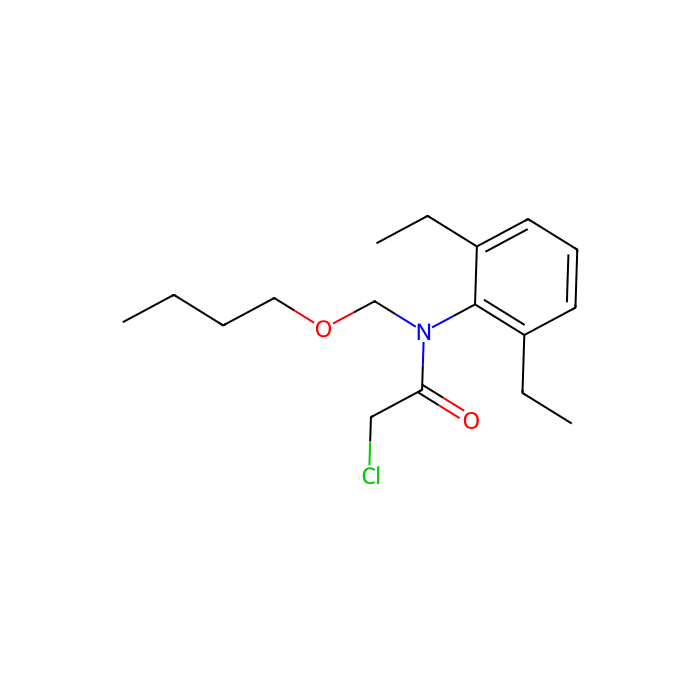
Butachlor Standard (CAS 23184-66-9) is an analytical reference material for the chloroacetanilide herbicide butachlor, used to calibrate and QA/QC analytical methods.
Item identifiers (this product):
CAS: 23184-66-9 (literature-confirmed identifier for butachlor)
CID: 31677 (literature; PubChem compound record for butachlor)
InChIKey: Not specified for this item; refer to CoA/Spec Sheet.
SMILES: Not specified for this item; refer to CoA/Spec Sheet.
Molecular formula: Not specified for this item; refer to CoA/Spec Sheet.
Molecular weight: Not specified for this item; refer to CoA/Spec Sheet.
Structural class and features (general/literature description):
Anilide (acetanilide) framework bearing a 2-chloroacetyl moiety (–CO–CH2Cl).
N,N-disubstituted amide: the anilide nitrogen is substituted by a butoxymethyl group (–CH2–O–nBu) and bonded to a 2,6-diethylphenyl ring.
Aromatic ring: monosubstituted by two ortho ethyl groups (2,6-diethyl), increasing hydrophobicity and steric bulk.
No stereocenters; molecule is achiral and conformationally flexible in the side chains.
2D structure in words (literature): a 2,6-diethylphenyl ring attached via the anilide nitrogen to a 2-chloroacetyl group; the anilide nitrogen also bears a –CH2–O–n-butyl substituent.
Notes:
This listing is for an analytical standard; exact structural identifiers (SMILES/InChI) specific to the item’s documentation should be taken from the accompanying CoA/Spec Sheet.
Synthetic Utility
Limited relevance. As supplied, this product is intended as an analytical reference standard rather than a synthetic reagent or building block.
General chemical reactivity (literature context for the compound class):
Functional groups: N,N-disubstituted anilide bearing an alpha-chloroacetyl moiety and a butoxymethyl substituent.
Potential transformations (not typical for analytical use):
N-dealkylation or hydrolysis of the amide under forcing conditions (acid/base or enzymatic) to generate metabolites; used in environmental fate studies rather than preparative synthesis.
Nucleophilic displacement at the alpha-chloroacetyl position is theoretically possible but hindered by the amide conjugation and sterics; not commonly exploited in synthesis for this substrate.
Recommendation:
If your goal is to perform synthetic modifications or derivatizations, source a non-standard, bulk reagent-grade material specifically intended for synthesis and not an analytical standard.
Target Specificity
Not applicable. This product is a small-molecule analytical standard and not a biological targeting reagent (e.g., antibody, inhibitor with defined biomolecular affinity profile for purified targets within a biological assay context).
For analytical chemistry, “specificity” refers to the method’s ability to unambiguously identify/quantify butachlor in the presence of matrix components. Achieve specificity via chromatographic resolution, accurate mass or MRM transitions, and concordant ion ratios/retention times according to your method validation guidelines.
Wir verwenden Cookies, um die ordnungsgemäße Funktion der Website sicherzustellen und, soweit zulässig, Ihr Nutzererlebnis zu verbessern. Sie können Ihre Einstellungen jederzeit unter „Einstellungen“ verwalten. Weitere Informationen finden Sie in unserer Cookie-Richtlinie.
Shall we send you a message when we have discounts available?
Remind me later
Thank you! Please check your email inbox to confirm.
Products are supplied to verified businesses, institutions, and qualified professionals for research and development use only. Not for use in humans, animals, diagnosis, or therapy.

 E1520114