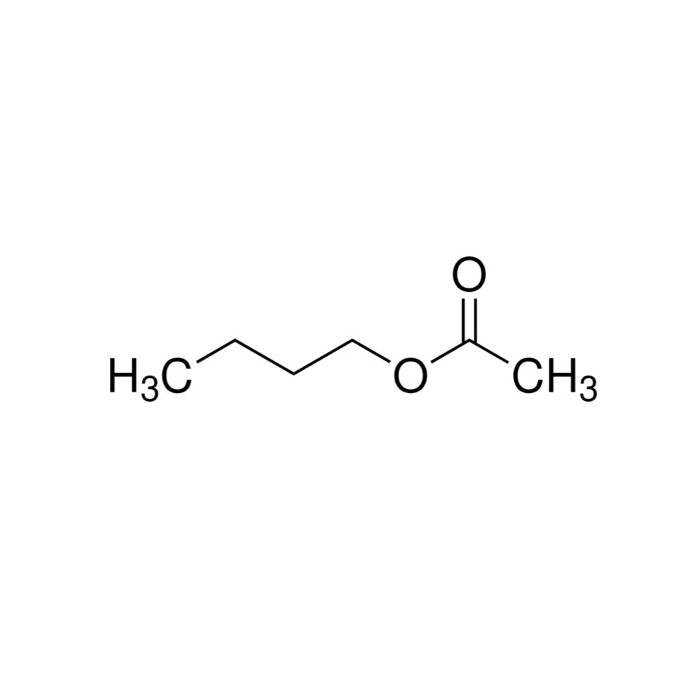
Butyl acetate - Ultra dry,≥99%,water≤50 ppm , CAS No.123-86-4

CAS: 123-86-4 Cat. No.: B1521140 Summenformel: C6H12O2 Molekulargewicht: 116.16 Beilstein Registry Number: 1741921 EG-Nummer: 204-658-1
Zu bestellen verfügbar
GRADE & PURITY Ultra dry ? Ultra-dry grade with extremely low water content, packaged to exclude moisture. Use for moisture-sensitive reactions and air-free chemistry. ≥99% water≤50 ppm
Storage
Room temperature,Desiccated
Shipped In
FedEx DG Service
★
Size
Deutschland (EU)
USA*
Price
Qty
100ml
B1521140-100ml
Auf Bestellung · 8–12 Wochen
69,33€
500ml
B1521140-500ml
Auf Bestellung · 8–12 Wochen
121,40€
Enter a quantity for the sizes you want to add.
🧪
Why this grade

Ultra dry,≥99%,water≤50 ppm Ultra dry for sensitive chromatographic and analytical workflows requiring minimal baseline interference.

🌡

Storage & shipping

Room temperature,Desiccated Ships FedEx DG Service Check lot-specific COA for exact specifications.

📋

Quality documents

SDS, COA, datasheet, and spec sheet available for download. Lot-specific COA accessible via lot number lookup.

📚

Literature proof

Cited in 239 peer-reviewed publications across chromatography, organic synthesis, and cross-coupling reactions.

Specifications

Spezifikationen & Reinheit
Ultra dry,≥99%,water≤50 ppm
Storage
Room temperature,Desiccated
Verschickt in
FedEx DG Service
Note
Ultra dry
Reinheit
≥99%
Namen und Kennungen
Kanonisches LächelnCCCCOC(=O)C
IUPAC Namebutyl acetate
InChIKeyDKPFZGUDAPQIHT-UHFFFAOYSA-N
INCHI1S/C6H12O2/c1-3-4-5-8-6(2)7/h3-5H2,1-2H3
Isomere SMILES CCCCOC(=O)C
WGK Deutschland 1
RTECS AF7350000
UN-Nummer 1123
Verpackungsgruppe III
Molekulargewicht 116.16
Beilstein 1741921
Reaxy-Rn 1741921
Reaxys-RN_link_address https://www.reaxys.com/reaxys/secured/hopinto.do?context=S&query=IDE.XRN=1741921&ln=

Documentation

📋 Safety Data Sheet (SDS)

Comprehensive hazard, handling, storage, and regulatory compliance document.

Download SDS →

✅ Certificate of Analysis (COA)

Lot-specific quality data. Enter your lot number to retrieve the exact COA.

Look up COA →

📊 Datasheet

Quick-reference summary of product specifications and applications.

View datasheet →

🔬 Specification Sheet

Full quality attributes and acceptance criteria for this grade.

View spec sheet →

Advanced Data

Taxonomic Classification

Taxonomy Tree

KingdomOrganic compounds
SuperclassOrganic acids and derivatives
KlasseCarboxylic acids and derivatives
SubclassCarboxylic acid derivatives
Intermediate Tree Nodes Not available
Direct ParentCarboxylic acid esters
Alternative Parents Monocarboxylic acids and derivatives  Organic oxides  Hydrocarbon derivatives  Carbonyl compounds  
Molecular FrameworkAliphatic acyclic compounds
Substituents Carboxylic acid ester - Monocarboxylic acid or derivatives - Organic oxygen compound - Organic oxide - Hydrocarbon derivative - Organooxygen compound - Carbonyl group - Aliphatic acyclic compound
BeschreibungThis compound belongs to the class of organic compounds known as carboxylic acid esters. These are carboxylic acid derivatives in which the carbon atom from the carbonyl group is attached to an alkyl or an aryl moiety through an oxygen atom (forming an ester group).
External Descriptors an ester
3D-Struktur
Interaktives chemisches Strukturmodell


Zertifikate (CoA, COO, BSE/TSE und Analyse-Diagramm)
C of A & Other Certificates(BSE/TSE, COO):
Analytical Chart:

Find and download the COA for your product by matching the lot number on the packaging.

3 results found

Lot NumberCertificate TypeDatumArtikel
F2615333Certificate of AnalysisJun 18, 2026 B1521140
F2615340Certificate of AnalysisJun 18, 2026 B1521140
F2615341Certificate of AnalysisJun 18, 2026 B1521140
Chemische und physikalische Eigenschaften
Brechungsindex1.395
Flammpunkt (°F)80.6 °F - closed cup
Flammpunkt (°C)27 °C - closed cup
Siedepunkt (°C)126°C
Schmelzpunkt (°C)-78°C
Molekulargewicht116.160 g/mol
XLogP31.800
Hydrogen Bond Donor Count0
Hydrogen Bond Acceptor Count2
Rotatable Bond Count4
Exact Mass116.084 Da
Monoisotopic Mass116.084 Da
Topological Polar Surface Area26.300 Ų
Heavy Atom Count8
Formal Charge0
Complexity68.900
Isotope Atom Count0
Defined Atom Stereocenter Count0
Undefined Atom Stereocenter Count0
Defined Bond Stereocenter Count0
Undefined Bond Stereocenter Count0
The total count of all stereochemical bonds0
Covalently-Bonded Unit Count1
FAQs und Artikel
Preparation Methods and Precautions for Silane Coupling Agent Primer Solutions
Application and Selection Guide for Alkyd Resin Coatings: Advantages, Limitations, Formulation Control, and Modification Directions
Guide to Selecting Polyurethane Coating Systems: Application Analysis for Wood, Flooring, Plastics, Automotive, and Industrial Protection
Fluorocarbon Resin Coating Formulation Design: Resin Selection, Supporting Systems, and Key Application Control Points
Key Control Points in Polyurethane Coating Formulation Design and Application
Silicone Resin Coating Formulation Design: From Application Conditions to Matching Resins, Pigments and Fillers, Curing, and Substrates
Applications and Selection of Acrylic Resins in Coatings: Analysis of Architectural, Industrial, and Supporting Materials
VC/VAc Resins and Their Modification: An Analysis of VC/VAc Vinyl Resins for Coatings and Inks
Application Positioning, Scenario Selection, and Key Use Considerations for Chlorinated Rubber Resin in Coatings
Formulation Design of Chlorinated Rubber Coatings: Component Synergy and Performance Control
Applications and Selection of Polyester Resins in Industrial Coatings: Powder, Coil, Baking, Packaging, and Metal Coating Scenarios
How to Select Vinyl-Related Resins: Building Formulation Judgment Based on Substrate, Performance Targets, and Failure Risks
What Is Chlorinated Rubber Resin? An Analysis of Structural Characteristics, Chlorination Modification, and Coating Film-Formation Mechanisms
Applicability Boundaries, Failure Risks, and Alternative System Selection for Chlorinated Rubber Resin in Coatings
Mechanism, Diagnosis, and Control of Coating Lifting: Solvent Penetration, Film Swelling, and Interlayer Instability
Resin Polarity in Coating Formulations: From Molecular Structure to Dissolution, Compatibility, Interfacial Interactions, and Formulation Design
Solvents, Co-solvents, and Solubilization Systems in Home and Personal Care Formulations: Classification, Functions, and Selection Guide
Application of Conductive Carbon Black in Coatings: Selection Criteria, Dispersion Control, and Conductive Network Construction
Citations of This Product
Lösungsrechner
Bewertungen

Kundenbewertungen

Häufig gestellte Fragen

What is the purity of this product?
This product is supplied at ≥99% purity (chemical assay). Lot-specific values are stated on the Certificate of Analysis.
What does Ultra dry mean?
Ultra dry indicates that the material has been processed and tested for moisture-sensitive chemistry. Specifications focus on the impurities that affect performance in that application — for example, metal content for electronics, particle size for batteries, refractive index for optics, or moisture content for moisture-sensitive processes.
How should this product be stored?
Store at room temperature, desiccated. Keep the container tightly closed with desiccant — the material is moisture-sensitive.
How is this product shipped?
This product is classified as dangerous goods and ships via FedEx DG Service. Ground and other economy services are not available, and delivery to some destinations or address types may be restricted.
What are the CAS number, molecular formula and molecular weight?
The CAS Number is 123-86-4, the molecular formula is C6H12O2, and the molecular weight is 116.16 g/mol. InChIKey DKPFZGUDAPQIHT-UHFFFAOYSA-N.
What documentation is provided?
Available product documentation, including Certificates of Analysis (COA), Safety Data Sheets (SDS), and specification sheets, is shown in the product document area. Document availability and access follow the current site policy.

Shall we send you a message when we have discounts available?

Remind me later

Thank you! Please check your email inbox to confirm.

Oops! Notifications are disabled.