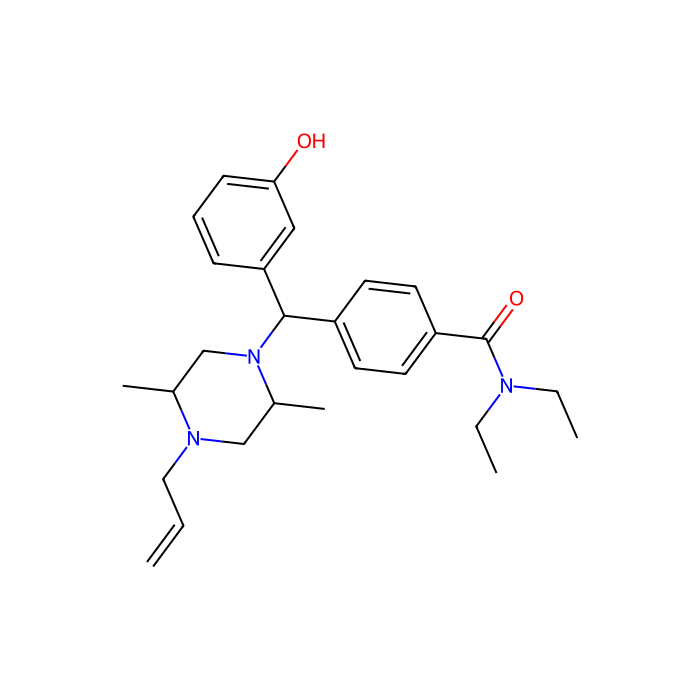
BW 373U86 - Moligand™, ≥99%(HPLC) , Agonist of δ receptor;Agonist of κ receptor;Agonist of μ receptor, CAS No.155836-50-3, Agonist of δ receptor;Agonist of κ receptor;Agonist of μ receptor

CAS: 155836-50-3 Cat. No.: B286785 Summenformel: C27H37N3O2 Molekulargewicht: 435.61
Zu bestellen verfügbar
GRADE & PURITY Moligand™ ? Moligand™ — Aladdin's line of ligands and bioactive small molecules. Use for receptor, pathway, and binding studies needing defined small-molecule tools. ≥99%(HPLC)
Synonyms
4-[(R)-((2S,5R)-4-allyl-2,5-dimethyl-1-piperazinyl)-(3-hydroxyphenyl)-methyl]-N,N-diethylbenzamide | 4-[(R)-((2S,5R)-4-allyl-2,5-dimethyl-1-piperazinyl)(3-hydroxyphenyl)-methyl]-N,N-diethylbenzamide | 4-[(R)-((2S,5R)-4-allyl-2,5-dimethyl-1-piperazinyl)(3-
Storage
Store at 2-8°C
Shipped In
Wet ice
★
Size
Deutschland (EU)
USA*
Price
Qty
10mg
B286785-10mg
Auf Bestellung · 8–12 Wochen
562,21€
Enter a quantity for the sizes you want to add.
🧪

Why this grade

Moligand™, ≥99%(HPLC) Moligand™ for sensitive chromatographic and analytical workflows requiring minimal baseline interference.

🌡

Storage & shipping

Store at 2-8°C Ships Wet ice Check lot-specific COA for exact specifications.

📋

Quality documents

SDS, COA, datasheet, and spec sheet available for download. Lot-specific COA accessible via lot number lookup.

📚

Literature proof

Cited in 0 peer-reviewed publications across chromatography, organic synthesis, and cross-coupling reactions.

Specifications

Synonyme
4-[(R)-((2S,5R)-4-allyl-2,5-dimethyl-1-piperazinyl)-(3-hydroxyphenyl)-methyl]-N,N-diethylbenzamide | 4-[(R)-((2S,5R)-4-allyl-2,5-dimethyl-1-piperazinyl)(3-hydroxyphenyl)-methyl]-N,N-diethylbenzamide | 4-[(R)-((2S,5R)-4-allyl-2,5-dimethyl-1-piperazinyl)(3-
Spezifikationen & Reinheit
Moligand™, ≥99%(HPLC)
Biochemische und physiologische Mechanismen
Potent, selective non-peptideδ-opioid receptor agonist. Kivalues are 1.8, 15 and 34 nM forδ,μandκreceptors respectively. Centrally active following systemic administrationin vivo.
Storage
Store at 2-8°C
Verschickt in
Wet ice
Dieses Produkt erfordert Kühlkettenversand. Grundversand und andere Economy-Optionen sind nicht verfügbar.
Note
Moligand™
Aktionsart
AGONIST
Mechanismus der Wirkung
Agonist of δ receptor;Agonist of κ receptor;Agonist of μ receptor
Reinheit
≥99%(HPLC)
Namen und Kennungen
Kanonisches LächelnCCN(CC)C(=O)C1=CC=C(C=C1)C(C2=CC(=CC=C2)O)N3CC(N(CC3C)CC=C)C
IUPAC Name4-[(R)-[(2S,5R)-2,5-dimethyl-4-prop-2-enylpiperazin-1-yl]-(3-hydroxyphenyl)methyl]-N,N-diethylbenzamide
InChIKeyLBLDMHBSVIVJPM-YZIHRLCOSA-N
INCHI1S/C27H37N3O2/c1-6-16-29-18-21(5)30(19-20(29)4)26(24-10-9-11-25(31)17-24)22-12-14-23(15-13-22)27(32)28(7-2)8-3/h6,9-15,17,20-21,26,31H,1,7-8,16,18-19H2,2-5H3/t20-,21+,26-/m1/s1
Isomere SMILES CCN(CC)C(=O)C1=CC=C(C=C1)[C@H](C2=CC(=CC=C2)O)N3C[C@H](N(C[C@@H]3C)CC=C)C
Alternative CAS-Nummer 150428-54-9
MeSH-Eintrag (+-)(1(S),2alpha,5beta)-4-((2,5-dimethyl-4-(2-propenyl)-1-piperazinyl)(3-hydroxyphenyl)methyl)-N,N-diethylbenzamide hydrochloride;(+-)-4-((alpha-R*)-alpha-((2S*,5R*)-4-allyl-2,5-dimethyl-1-piperazinyl)-3-hydroxybenzyl)-N,N-diethylbenzamide;4-((2,5-dimethy
Molekulargewicht 435.61
Reaxy-Rn 8513997
Reaxys-RN_link_address https://www.reaxys.com/reaxys/secured/hopinto.do?context=S&query=IDE.XRN=8513997&ln=

Documentation

📋 Safety Data Sheet (SDS)

Comprehensive hazard, handling, storage, and regulatory compliance document.

Download SDS →

✅ Certificate of Analysis (COA)

Lot-specific quality data. Enter your lot number to retrieve the exact COA.

Look up COA →

📊 Datasheet

Quick-reference summary of product specifications and applications.

View datasheet →

🔬 Specification Sheet

Full quality attributes and acceptance criteria for this grade.

View spec sheet →

Advanced Data

Taxonomic Classification

Taxonomy Tree

KingdomOrganic compounds
SuperclassBenzenoids
KlasseBenzene and substituted derivatives
SubclassDiphenylmethanes
Intermediate Tree Nodes Not available
Direct ParentDiphenylmethanes
Alternative Parents Benzamides  Benzoyl derivatives  N-alkylpiperazines  Aralkylamines  1-hydroxy-4-unsubstituted benzenoids  1-hydroxy-2-unsubstituted benzenoids  Tertiary carboxylic acid amides  Trialkylamines  Amino acids and derivatives  Azacyclic compounds  Organopnictogen compounds  Organooxygen compounds  Organic oxides  Hydrocarbon derivatives  
Molecular FrameworkAromatic heteromonocyclic compounds
Substituents Diphenylmethane - Benzamide - Benzoic acid or derivatives - Benzoyl - 1-hydroxy-4-unsubstituted benzenoid - 1-hydroxy-2-unsubstituted benzenoid - Aralkylamine - N-alkylpiperazine - Phenol - 1,4-diazinane - Piperazine - Tertiary carboxylic acid amide - Amino acid or derivatives - Carboxamide group - Tertiary aliphatic amine - Tertiary amine - Carboxylic acid derivative - Azacycle - Organoheterocyclic compound - Organic nitrogen compound - Amine - Hydrocarbon derivative - Organic oxide - Organopnictogen compound - Organic oxygen compound - Organonitrogen compound - Organooxygen compound - Aromatic heteromonocyclic compound
BeschreibungThis compound belongs to the class of organic compounds known as diphenylmethanes. These are compounds containing a diphenylmethane moiety, which consists of a methane wherein two hydrogen atoms are replaced by two phenyl groups.
External Descriptors Not available
3D-Struktur
Interaktives chemisches Strukturmodell


Zugehörige Ziele (menschlich)
OPRD1 Tclin Delta-type opioid receptor (6 Activities)
Activity TypeActivity Value -log(M)Mechanism of ActionActivity ReferencePublications (PubMed IDs)
OPRK1 Tclin Kappa-type opioid receptor (3 Activities)
Activity TypeActivity Value -log(M)Mechanism of ActionActivity ReferencePublications (PubMed IDs)
OPRM1 Tclin Mu-type opioid receptor (3 Activities)
Activity TypeActivity Value -log(M)Mechanism of ActionActivity ReferencePublications (PubMed IDs)
ABL1 Tclin Tyrosine-protein kinase ABL (18331 Activities)
Activity TypeRelationActivity valueUnitsAction TypeJournalPubMed IddoiAssay Aladdin ID
ADRB2 Tclin Beta-2 adrenergic receptor (11824 Activities)
Activity TypeRelationActivity valueUnitsAction TypeJournalPubMed IddoiAssay Aladdin ID
ADRA2A Tclin Alpha-2a adrenergic receptor (9450 Activities)
Activity TypeRelationActivity valueUnitsAction TypeJournalPubMed IddoiAssay Aladdin ID
AGTR1 Tclin Type-1 angiotensin II receptor (5176 Activities)
Activity TypeRelationActivity valueUnitsAction TypeJournalPubMed IddoiAssay Aladdin ID
OPRM1 Tclin Mu opioid receptor (19785 Activities)
Activity TypeRelationActivity valueUnitsAction TypeJournalPubMed IddoiAssay Aladdin ID
OPRD1 Tclin Delta opioid receptor (15096 Activities)
Activity TypeRelationActivity valueUnitsAction TypeJournalPubMed IddoiAssay Aladdin ID
OPRK1 Tclin Kappa opioid receptor (16155 Activities)
Activity TypeRelationActivity valueUnitsAction TypeJournalPubMed IddoiAssay Aladdin ID
KCNH2 Tclin HERG (29587 Activities)
Activity TypeRelationActivity valueUnitsAction TypeJournalPubMed IddoiAssay Aladdin ID
GSK3B Tclin Glycogen synthase kinase-3 beta (11785 Activities)
Activity TypeRelationActivity valueUnitsAction TypeJournalPubMed IddoiAssay Aladdin ID
CSNK1D Tchem Casein kinase I delta (4546 Activities)
Activity TypeRelationActivity valueUnitsAction TypeJournalPubMed IddoiAssay Aladdin ID
CYP2D6 Tclin Cytochrome P450 2D6 (33882 Activities)
Activity TypeRelationActivity valueUnitsAction TypeJournalPubMed IddoiAssay Aladdin ID
S1PR1 Tclin Sphingosine 1-phosphate receptor Edg-1 (5806 Activities)
Activity TypeRelationActivity valueUnitsAction TypeJournalPubMed IddoiAssay Aladdin ID
CDK2 Tchem Cyclin-dependent kinase 2 (9050 Activities)
Activity TypeRelationActivity valueUnitsAction TypeJournalPubMed IddoiAssay Aladdin ID
GLP1R Tclin Glucagon-like peptide 1 receptor (111429 Activities)
Activity TypeRelationActivity valueUnitsAction TypeJournalPubMed IddoiAssay Aladdin ID
CYP1A2 Tchem Cytochrome P450 1A2 (26471 Activities)
Activity TypeRelationActivity valueUnitsAction TypeJournalPubMed IddoiAssay Aladdin ID
C5AR1 Tclin C5a anaphylatoxin chemotactic receptor (2677 Activities)
Activity TypeRelationActivity valueUnitsAction TypeJournalPubMed IddoiAssay Aladdin ID
CYP2C9 Tchem Cytochrome P450 2C9 (32119 Activities)
Activity TypeRelationActivity valueUnitsAction TypeJournalPubMed IddoiAssay Aladdin ID
CYP2C19 Tchem Cytochrome P450 2C19 (29246 Activities)
Activity TypeRelationActivity valueUnitsAction TypeJournalPubMed IddoiAssay Aladdin ID
CYP3A4 Tclin Cytochrome P450 3A4 (53859 Activities)
Activity TypeRelationActivity valueUnitsAction TypeJournalPubMed IddoiAssay Aladdin ID
AURKA Tchem Serine/threonine-protein kinase Aurora-A (10240 Activities)
Activity TypeRelationActivity valueUnitsAction TypeJournalPubMed IddoiAssay Aladdin ID
U2OS (164939 Activities)
Activity TypeRelationActivity valueUnitsAction TypeJournalPubMed IddoiAssay Aladdin ID
CX3CR1 Tchem C-X3-C chemokine receptor 1 (1686 Activities)
Activity TypeRelationActivity valueUnitsAction TypeJournalPubMed IddoiAssay Aladdin ID
FPR2 Tchem Lipoxin A4 receptor (3472 Activities)
Activity TypeRelationActivity valueUnitsAction TypeJournalPubMed IddoiAssay Aladdin ID
FFAR4 Tchem G-protein coupled receptor 120 (2999 Activities)
Activity TypeRelationActivity valueUnitsAction TypeJournalPubMed IddoiAssay Aladdin ID
TDP1 Tchem Tyrosyl-DNA phosphodiesterase 1 (345557 Activities)
Activity TypeRelationActivity valueUnitsAction TypeJournalPubMed IddoiAssay Aladdin ID
BRD4 Tchem Bromodomain-containing protein 4 (13122 Activities)
Activity TypeRelationActivity valueUnitsAction TypeJournalPubMed IddoiAssay Aladdin ID
HPGD Tchem 15-hydroxyprostaglandin dehydrogenase [NAD+] (24926 Activities)
Activity TypeRelationActivity valueUnitsAction TypeJournalPubMed IddoiAssay Aladdin ID
GPR35 Tchem G-protein coupled receptor 35 (2643 Activities)
Activity TypeRelationActivity valueUnitsAction TypeJournalPubMed IddoiAssay Aladdin ID
OPRD1 Tclin Opioid receptors; mu & delta (1530 Activities)
Activity TypeRelationActivity valueUnitsAction TypeJournalPubMed IddoiAssay Aladdin ID
TRIM24 Tchem Transcription intermediary factor 1-alpha (2087 Activities)
Activity TypeRelationActivity valueUnitsAction TypeJournalPubMed IddoiAssay Aladdin ID
BRPF1 Tchem Peregrin (2217 Activities)
Activity TypeRelationActivity valueUnitsAction TypeJournalPubMed IddoiAssay Aladdin ID
HEK-293T (167025 Activities)
Activity TypeRelationActivity valueUnitsAction TypeJournalPubMed IddoiAssay Aladdin ID
Zugehörige Ziele (nicht menschlich)
Aplnr Apelin receptor (201 Activities)
Activity TypeRelationActivity valueUnitsAction TypeJournalPubMed IddoiAssay Aladdin ID
Mapk1 MAP kinase ERK2 (650 Activities)
Activity TypeRelationActivity valueUnitsAction TypeJournalPubMed IddoiAssay Aladdin ID
Hdac6 Histone deacetylase 6 (222 Activities)
Activity TypeRelationActivity valueUnitsAction TypeJournalPubMed IddoiAssay Aladdin ID
Fgfr3 Fibroblast growth factor receptor 3 (21 Activities)
Activity TypeRelationActivity valueUnitsAction TypeJournalPubMed IddoiAssay Aladdin ID
Cavia porcellus (23802 Activities)
Activity TypeRelationActivity valueUnitsAction TypeJournalPubMed IddoiAssay Aladdin ID
Mus musculus (284745 Activities)
Activity TypeRelationActivity valueUnitsAction TypeJournalPubMed IddoiAssay Aladdin ID
Rattus norvegicus (775804 Activities)
Activity TypeRelationActivity valueUnitsAction TypeJournalPubMed IddoiAssay Aladdin ID
lef Anthrax lethal factor (7585 Activities)
Activity TypeRelationActivity valueUnitsAction TypeJournalPubMed IddoiAssay Aladdin ID
rep Replicase polyprotein 1ab (378 Activities)
Activity TypeRelationActivity valueUnitsAction TypeJournalPubMed IddoiAssay Aladdin ID
Gpr119 Glucose-dependent insulinotropic receptor (270 Activities)
Activity TypeRelationActivity valueUnitsAction TypeJournalPubMed IddoiAssay Aladdin ID
SARS-CoV-2 (38078 Activities)
Activity TypeRelationActivity valueUnitsAction TypeJournalPubMed IddoiAssay Aladdin ID
Wirkungsmechanismen
Zertifikate (CoA, COO, BSE/TSE und Analyse-Diagramm)
C of A & Other Certificates(BSE/TSE, COO):
Analytical Chart:
Chemische und physikalische Eigenschaften
LöslichkeitSolvent:1eq. HCl, Max Conc. mg/mL: 43.56, Max Conc. mM: 100
Molekulargewicht435.600 g/mol
XLogP34.600
Hydrogen Bond Donor Count1
Hydrogen Bond Acceptor Count4
Rotatable Bond Count8
Exact Mass435.289 Da
Monoisotopic Mass435.289 Da
Topological Polar Surface Area47.000 Ų
Heavy Atom Count32
Formal Charge0
Complexity600.000
Isotope Atom Count0
Defined Atom Stereocenter Count3
Undefined Atom Stereocenter Count0
Defined Bond Stereocenter Count0
Undefined Bond Stereocenter Count0
The total count of all stereochemical bonds0
Covalently-Bonded Unit Count1
Lösungsrechner
Bewertungen

Kundenbewertungen

Application Protocols

No item-specific, validated application protocols are provided in the Product Data for this listing.

  • Product Data: Manufacturer Applications field is empty for this item.

General guidance (research use only; adapt to your SOPs):

  • Stock preparation: Dissolve in DMSO to 10 mM; aliquot and store at 2–8°C or frozen as appropriate to minimize freeze–thaw (verify compound stability for your lot).
  • Binding assays: Perform radioligand displacement with membranes expressing DOR; include nonspecific binding controls and a known DOR antagonist to confirm specificity.
  • Functional assays: Use cAMP inhibition (Gi/o pathway), β-arrestin recruitment, or GTPγS binding assays with matched vehicle controls. Maintain constant DMSO across wells.

For detailed, item-specific parameters (concentrations, incubation times, readouts), consult the lot CoA and build internal validation data.

Biological Roles

Literature characterizes BW 373U86 as a selective ligand for the delta-opioid receptor (DOR), one of the three classical opioid receptors (μ, δ, κ), which are Gi/o-coupled GPCRs. No therapeutic or clinical claims are made here; the following is research context only.

  • Receptor pharmacology (literature/general):

    • Target: δ-Opioid receptor (OPRD1). Reported to act as a DOR agonist in recombinant systems and tissue preparations.
    • Signaling: Engagement of DOR typically inhibits adenylyl cyclase via Gi/o, reduces intracellular cAMP, modulates ion channels (e.g., GIRK activation, Ca2+ channel inhibition), and can recruit β-arrestins leading to receptor internalization and potential biased signaling.
  • Research uses:

    • Benchmark/positive-control ligand in DOR binding assays (radioligand displacement) and functional assays (cAMP inhibition, BRET/HTRF G-protein activation, β-arrestin recruitment, ERK phosphorylation), enabling pharmacological profiling and structure–activity studies.
    • Tool compound for dissecting DOR-mediated pathways in neuronal and non-neuronal models, with attention to species, receptor expression level, and assay configuration.
  • Selectivity considerations (literature/general):

    • Selectivity over μ and κ receptors is context-dependent; assay system choice (species, receptor density, signaling readout) can influence apparent potency/efficacy. Include orthogonal controls (selective DOR antagonist; μ/κ ligands) to confirm on-target effects.
  • Practical notes:

    • Maintain low final DMSO. Include vehicle controls and time-course studies to capture desensitization/internalization dynamics that are common with GPCR agonists.
Buffer Applications

BW 373U86 itself is not a buffer component. However, it is commonly applied in receptor pharmacology assays that utilize defined buffer systems.

  • Typical assay buffers (general guidance):

    • Binding assays: HEPES- or Tris-based buffers (e.g., 50 mM Tris-HCl, pH 7.4) with salts (NaCl, MgCl2), protease inhibitors as needed, and low protein to minimize nonspecific binding. Include 0.1% BSA to reduce adsorption losses where compatible.
    • Functional assays: HBSS or PBS supplemented with HEPES (10–20 mM) at pH 7.3–7.4 for live-cell cAMP or BRET/HTRF readouts. Maintain osmolality and ionic strength.
  • Practical considerations:

    • Final organic solvent content (e.g., DMSO) should be minimized (≤0.1–0.5% v/v) and matched across wells.
    • Filtration (0.22 µm) of buffers prevents particulates that can interfere with fluorescence/HTRF.
    • For compounds with basic centers, slightly acidic pH (6.8–7.2) can improve solubility during stock dilution; ensure receptor function is retained under these conditions.
  • Not item-specific:

    • Exact buffer recipes, pH windows, and additives for BW 373U86 are Not specified for this item; refer to your assay SOPs and the CoA/SDS for compatibility.
Green Alternatives

Green chemistry considerations are generally applied to solvents and large-scale reagents. BW 373U86 is a research-scale bioactive ligand used at micro- to milligram quantities; “greener alternatives” are therefore more about solvent and process choices than replacing the molecule itself.

  • Greener handling choices (general):

    • Prefer aqueous buffers for final assay dilutions; minimize DMSO to the lowest compatible level.
    • If organic dissolution is required, consider ethanol as a lower-toxicity cosolvent (where solubility and assay biology allow) instead of higher-toxicity amide solvents.
    • Use minimal volumes, microplate formats, and accurate dispensing to reduce waste.
  • End-of-life and waste:

    • Segregate DMSO/organic waste for appropriate disposal; avoid drain disposal.
    • Rinse consumables with minimal solvent prior to disposal to reduce residual bioactive content.
  • Comparison table (general guidance):

    • DMSO: High solvency, excellent for stocks; moderate environmental impact; keep usage low.
    • Ethanol: More benign but may limit solubility; evaluate for your assay.

There are no direct “green substitute molecules” for BW 373U86 since its utility is target-specific. Focus on greener solvents, right-sizing experiments, and robust stock management to minimize waste.

Pharmaceutical Uses

No pharmacopeial status or excipient role is provided for this item. The following describes common research-only uses for such ligands; no therapeutic or clinical claims are made.

  • Research and development context (general):

    • Reference standard/control: Used as a benchmark DOR ligand in discovery programs to validate assays, calibrate potency/efficacy windows, and cross-compare batch performance.
    • Target engagement studies: Applied in receptor occupancy, signaling bias exploration, and desensitization/internalization assessments in preclinical models.
    • SAR support: Serves as a comparator in structure–activity relationship campaigns targeting δ-opioid receptor selectivity and efficacy profiles.
  • Manufacturing/formulation relevance:

    • Not indicated for formulation as a drug product or excipient. No compendial monograph is known for this research chemical.
  • Compliance note:

    • For research use only. Not for human or veterinary use, not for diagnostic procedures. Handle under institutional chemical hygiene plans and dispose per regulations.
Physical Properties

Item-specific physicochemical specifications have not been provided for this catalog entry.

  • Product Data (item-specific):

    • Appearance: Not specified for this item; refer to CoA/Spec Sheet.
    • Molecular Weight: Not specified for this item; refer to CoA/Spec Sheet.
  • Typical physicochemical considerations (literature/general for small-molecule opioid ligands):

    • State: Often isolated as a crystalline solid or amorphous powder; salt forms may be used to enhance handling and solubility (verify for this item).
    • Ionization: Many DOR ligands contain basic nitrogens (pKa of conjugate acid commonly in the ~7–10 range, literature), enabling good solubility in aqueous buffers under mildly acidic conditions.
    • Solubility practice: Stocks are commonly prepared in anhydrous DMSO (e.g., 10 mM) and diluted into assay buffers; final DMSO is typically kept ≤0.1–0.5% v/v to minimize cellular effects (general guidance).
    • Lipophilicity: Optimized DOR ligands often exhibit moderate-to-high logP/logD, aiding membrane permeability; exact values for this item are not specified here.
  • Do not treat the above as item specifications. For authoritative numerical properties (mp, bp, density, UV cutoff, water/peroxide/metal limits, refractive index), consult the item’s CoA/Spec Sheet and SDS.

Quality and Grades
  • Item-specific grade: Moligand™

    • Moligand™ denotes a research-grade small-molecule ligand suitable for screening, target validation, and mechanistic studies. Emphasis is typically on bioassay suitability (e.g., purity by LC–MS/HPLC) rather than chromatographic UV-cutoff performance.
  • What this means in practice (general expectations):

    • Purity: Intended to support biological assays; purity is generally established by HPLC/LC–MS. Exact purity specification, impurity profile, and counter-ion (if salt) are Not specified for this item; refer to CoA/Spec Sheet.
    • Identity: Confirmed by MS and/or NMR; details Not specified for this item; refer to CoA/Spec Sheet.
    • Residual solvents/metals/peroxides/water: Not specified for this item; refer to CoA/Spec Sheet.
  • Batch documentation and QC recommendations:

    • Request the batch CoA for numerical purity, analytical method, and results (e.g., HPLC trace). For structure-sensitive assays, consider orthogonal confirmation (NMR, HRMS) on receipt.
    • For cell-based work, assess endotoxin only if relevant to your application; such testing is not assumed for small molecules unless stated on the CoA.
  • Stabilizers/additives:

    • None are stated in the Product Data. If stabilizers or salt forms are used for this lot, they will appear on the CoA/SDS. Always account for salt stoichiometry when preparing molar stocks.
Reaction and Applications

This product is supplied as a bioactive small-molecule ligand for research and screening. It is not typically used as a general synthetic reagent or solvent.

  • Applicable laboratory uses (research-only):

    • Probe for delta-opioid receptor (DOR) pharmacology in binding and functional assays (literature/general).
    • Tool compound for signaling pathway studies (e.g., cAMP modulation via Gi/o, β-arrestin recruitment), subject to confirmation of target engagement in your system.
  • Not typically applicable:

    • As a catalyst, base, nucleophile/electrophile in preparative organic synthesis.
    • As a chromatography solvent or additive.
  • Practical tips (general):

    • Prepare accurate DMSO stocks and avoid freeze–thaw cycling. Validate concentration by UV or quantitative NMR where feasible.
    • Use matched negative controls (vehicle-only) and, if appropriate, orthogonal DOR ligands to benchmark assay performance.

For item-specific application examples or performance metrics, refer to the Manufacturer Applications section in the catalog or the lot-specific CoA where available.

Reaction Conditions

This product is not intended as a synthetic reagent; therefore, standard organic reaction conditions are not typically applicable.

  • General guidance for solution preparation (not a chemical reaction):

    • Dissolution: Prepare concentrated stocks in anhydrous DMSO with gentle warming (≤37°C) and vortexing if needed. Avoid strong heating.
    • Dilution: Add stock to assay buffer with thorough mixing to avoid local supersaturation; maintain consistent final DMSO across controls and treatments.
    • Filtration: If particulate matter is observed, pass working solutions through a low-protein-binding 0.22 µm filter.
  • Not provided for this item:

    • Any catalytic conditions, temperature profiles, or yields relevant to chemical synthesis.

Refer to your assay SOPs for incubation times, temperatures, and plating densities that match your biological system.

Safety and Handling

Safety data specific to this item have not been provided. Handle as a potentially bioactive small molecule.

  • Product Data (item-specific):

    • GHS Classification: Not specified for this item; refer to SDS.
    • Signal Word: Not specified for this item; refer to SDS.
    • Hazard (H) Statements: Not specified for this item; refer to SDS.
    • Pictograms: Not specified for this item; refer to SDS.
    • Storage Conditions: Store at 2–8°C
    • Shipped In: Wet ice
  • General laboratory precautions (defer to SDS as authoritative):

    • PPE: Lab coat, safety glasses, and suitable chemical-resistant gloves. Avoid inhalation, ingestion, and skin contact.
    • Engineering controls: Work in a fume hood when weighing or preparing solutions. Prevent aerosol formation.
    • Incompatibilities: Avoid strong oxidizers and strong acids/bases unless conditions are controlled; check SDS for specific incompatibilities.
    • First aid (general): In case of exposure, rinse affected area with water; seek medical attention as needed. If inhaled, move to fresh air. If ingested, rinse mouth and do not induce vomiting unless directed by medical personnel.
    • Environmental: Avoid release to the environment; collect waste in appropriate organic waste streams.
  • Special considerations for receptor ligands (general):

    • These compounds may be pharmacologically active at low concentrations. Minimize exposure, double-bag waste, and decontaminate work surfaces after use.
Solvent Selection

BW 373U86 is a bioactive small molecule used in receptor assays rather than as a bulk reaction solvent.

  • Practical dissolution strategy (general for screening ligands):

    • Primary solvent: Anhydrous DMSO is commonly used to prepare concentrated stocks (e.g., 10 mM), enabling accurate microvolume dispensing for HTS and pharmacology assays.
    • Aqueous buffers: Following DMSO stock preparation, dilute into assay buffer (e.g., HBSS, PBS, HEPES-buffered saline) to the desired working concentration, keeping final DMSO ≤0.1–0.5% v/v to mitigate solvent effects.
    • Alternative cosolvents: DMF or ethanol can be used for challenging cases; verify assay tolerance. Surfactants (e.g., 0.01% Tween-20) may help prevent precipitation/adsorption in low-protein buffers.
  • Solubility notes:

    • Item-specific solubility is Not specified for this item; refer to CoA/Spec Sheet. If poor aqueous solubility is encountered, consider acidifying the buffer slightly (if the compound contains basic nitrogens) or using cyclodextrin vehicles.
  • Comparison (general):

    • DMSO vs ethanol: DMSO provides superior solvating power and stability for many nitrogenous ligands; ethanol may be preferable for biological systems highly sensitive to DMSO but offers lower solubility ceilings.
  • Adsorption and carryover:

    • To reduce loss on plastics at low nM concentrations, pre-rinse tips/plates with working solution or include 0.1% BSA where compatible.
Storage and Reconstitution
  • Product Data (item-specific):

    • Storage Conditions: Store at 2–8°C
    • Shipped In: Wet ice
  • Reconstitution and handling (general guidance for small-molecule ligands; verify with your lot’s CoA/SDS):

    • Solvent: Prepare concentrated stocks in anhydrous DMSO to a convenient molarity (e.g., 10 mM). If the item is provided as a salt, account for counter-ion when calculating molarity.
    • Aliquoting: Dispense single-use aliquots to avoid repeated freeze–thaw and adsorption losses at low concentrations.
    • Working solutions: Dilute stocks into assay buffer immediately before use. Keep final DMSO ≤0.1–0.5% v/v unless your assay demonstrates tolerance.
    • Stability: Item-specific stability, light sensitivity, and shelf-life are Not specified for this item; refer to CoA/Spec Sheet. As a precaution, protect solutions from light and use within the same day.
  • Container and materials:

    • Use amber vials or wrap tubes in foil to limit photodegradation if applicable. Prefer low-binding plastics or silanized glass for sub-µM work.
  • Research use note:

    • For research use only. Not for human or veterinary use. Dispose of solutions and consumables per institutional chemical hygiene and local regulations.
Structure and Identity

Brief overview: BW 373U86 is a bioactive small molecule commonly used as a selective delta-opioid receptor (DOR) ligand in receptor pharmacology and screening studies (literature). Item-specific identifiers from Product Data are limited; see below.

  • Product Data (item-specific):

    • SKU: B286785
    • Product Name: BW 373U86
    • CAS: 155836-50-3
    • PubChem CID: 119029
    • InChIKey: 195173 (as provided)
    • SMILES: Not specified for this item; refer to CoA/Spec Sheet.
    • Molecular Formula: Not specified for this item; refer to CoA/Spec Sheet.
    • Molecular Weight: Not specified for this item; refer to CoA/Spec Sheet.
    • Grade/Purity: Moligand™
  • Structural features (literature/general):

    • Compound class: non-peptide opioid receptor ligand (reported DOR agonist, literature).
    • Typical features in this class include arylamide/arylalkylamine motifs designed to engage opioid receptor binding pockets; exact functional groups and stereochemistry should be confirmed from the item’s CoA/SDS or authoritative databases.
  • 2D structural description (literature/general):

    • Reported as a multi-ring, aryl–amide/aryl–amine framework optimized for δ-opioid receptor selectivity; likely contains one or more basic nitrogen atoms that are protonated under physiological pH, enhancing receptor engagement. Precise atom connectivity, substituent pattern, and stereochemical descriptors should be verified from the certificate of analysis.
  • Identity confirmation guidance (general):

    • Recommend verifying by 1H/13C NMR, HRMS, and, if available, chiral HPLC where stereochemistry is relevant. For bioassays, LC–MS purity profiling and counter-ion identification (if salt form) are prudent.
Synthetic Utility

BW 373U86 is supplied as a finished bioactive ligand and is not commonly used as a building block or reagent in synthetic chemistry.

  • Not typically applicable:

    • It does not function as a general electrophile/nucleophile, catalyst, or protecting group reagent in standard organic synthesis workflows.
  • Where it may be relevant (general):

    • As a reference compound during medicinal chemistry optimization of δ-opioid receptor ligands, informing SAR through comparative bioassays rather than through direct participation in chemical transformations.
  • If chemical modification is intended (user-driven research):

    • Derivatization strategies (e.g., amide coupling, aryl substitution, linker installation) are conceptual and depend on the true structure and functional groups of the molecule. Such strategies should be designed only after confirming exact structure and available handles via CoA/SDS and spectral data.

No item-specific reactivity, named-reaction compatibility, or functional-group profile has been provided; consult primary literature and perform pilot experiments if synthetic derivatization is planned.

Target Specificity

Item-specific target data (e.g., receptor/antigen name, selectivity profile, Ki/EC50 values, species reactivity) are not provided in the Product Data for this catalog entry.

  • Product Data: Not specified for this item; refer to CoA/Spec Sheet.

Note: While literature commonly discusses BW 373U86 in the context of the delta-opioid receptor, Aladdin provides no item-specific potency/selectivity data here. Users should verify target engagement in their system using appropriate positive/negative controls and, where possible, orthogonal assay modalities.

Shall we send you a message when we have discounts available?

Remind me later

Thank you! Please check your email inbox to confirm.

Oops! Notifications are disabled.