Carbasalate Calcium Carbasalate calcium (Iromin, Alcacyl, Omegin, Rheomin, Solupsan) is an analgesic, antipyretic, and anti-inflammatory drug as well as a platelet aggregation inhibitor.
In vivo
Calcium carbasalate is an analgesic, antipyretic, and anti-inflammatory drug which seems to cause less gastroduodenal mucosal damage than aspirin in laboratory animals. Carbasalate was found to be well tolerated and is a platelet aggregation inhibitor.
Carbasalate calcium (Iromin, Alcacyl, Omegin, Rheomin, Solupsan) is an analgesic, antipyretic, and anti-inflammatory drug as well as a platelet aggregation inhibitor.
Storage
Store at -20°C
Verschickt in
Ice chest + Ice pads
Dieses Produkt erfordert Kühlkettenversand. Grundversand und andere Economy-Optionen sind nicht verfügbar.
This compound belongs to the class of organic compounds known as acylsalicylic acids. These are o-acylated derivatives of salicylic acid.
External Descriptors
Not available
1. Djoumbou Feunang Y, Eisner R, Knox C, Chepelev L, Hastings J, Owen G, Fahy E, Steinbeck C, Subramanian S, Bolton E, Greiner R, and Wishart DS. ClassyFire: Automated Chemical Classification With A Comprehensive, Computable Taxonomy. Journal of Cheminformatics, 2016, 8:61.
Determine the necessary mass, volume, or concentration for preparing a solution.
Dilution Calculator
Determine the dilution needed to prepare a stock solution.
Reconstitution Calculator
Bewertungen
Kundenbewertungen
Application Protocols
No vendor-tested bioassay protocols are provided for this small molecule. Typical research workflows include:
Preparation of aqueous stock solutions: weigh under dry conditions, dissolve in pre-cooled water or buffer immediately prior to use, filter, and use promptly to limit hydrolysis.
Hydrolysis kinetics experiment: incubate defined concentrations in buffered media at set pH/temperature; take aliquots over time; quench (e.g., rapid cooling/acidification), and quantify acetylsalicylate/salicylate/urea by HPLC-UV.
Dissolution profiling: use USP-style apparatus in appropriate media; sample at defined intervals; analyze by UV or HPLC with calibration curves.
These are general research procedures. Adjust conditions to your method and consult the literature for detailed parameters. For any regulated application, follow applicable compendial methods. This product is for research use only.
Biological Roles
General, literature-based context (no medical claims):
Carbasalate Calcium delivers acetylsalicylate in a water-soluble salt form; in aqueous environments, the acetyl ester can hydrolyze to salicylate and acetate. Thus, its biological fate in non-enzymatic systems is dominated by ester cleavage driven by pH and temperature.
Salicylate (the deacetylated product) is a classical phenolic carboxylate that participates in acid–base equilibria (phenolic pKa of salicylic acid ~13, carboxyl pKa ~3 for the parent acid; literature). In buffered aqueous media at neutral pH, it exists predominantly as the carboxylate anion.
The Ca2+ counterion contributes ionic strength and may interact with carboxylate-rich biomaterials or chelators; however, it is generally displaced by competing cations/chelators in complex matrices.
Urea is a neutral, highly water-soluble amide that engages in extensive hydrogen bonding; it can modulate solvation and crystallization behavior and is commonly used as a protein denaturant at high concentrations (literature), though this product is not intended for biological applications.
This product is supplied strictly for research use. For biochemical experiments, confirm hydrolytic stability/time scales under the specific buffer, temperature, and ionic conditions relevant to your system.
Buffer Applications
Carbasalate Calcium is not a buffering agent and is not typically used to establish or maintain pH in laboratory buffers.
If included in buffered systems (e.g., dissolution or hydrolysis studies), choose buffers with minimal nucleophilicity at the working pH to limit ester hydrolysis (e.g., phosphate vs. amine-rich buffers), and verify stability by analytical monitoring.
The compound may slightly influence ionic strength and calcium activity; if calcium-sensitive assays are used, account for free Ca2+ and potential chelation by buffer components (e.g., EDTA will capture Ca2+).
For routine buffering tasks, select established buffer systems (phosphate, acetate, citrate, Tris, HEPES) appropriate to the target pH range.
Green Alternatives
This product is a solid salt/complex rather than a solvent or reagent routinely replaced on green-chemistry grounds. Nevertheless, greener choices can be made in how it is handled and, when appropriate, in the selection of related materials.
Preferred media: water is the greenest solvent for dissolution and analytical workflows; avoid unnecessary use of chlorinated solvents or high-boiling polar aprotics when aqueous systems suffice.
Alternative substrates (depending on research goal):
Sodium salicylate (no acetyl group) offers increased hydrolytic stability in water and may simplify waste treatment when acetyl functionality is not required.
Acetylsalicylic acid (ASA) can be used where organic media are acceptable; it reduces aqueous hydrolysis but sacrifices water solubility.
Comparison (literature-based, qualitative):
Carbasalate Calcium: high water solubility; susceptible to hydrolysis; enables aqueous processing.
ASA: lower water solubility; better stability in neutral water; often requires organic cosolvents.
Sodium salicylate: very high water solubility; lacks acetyl group (different reactivity profile).
Green handling tips:
Prepare only the amount needed; dispose of aqueous solutions promptly to minimize degradation byproducts.
Employ room-temperature aqueous methods and avoid energy-intensive drying or reflux where possible.
Pharmaceutical Uses
Context for formulation science (no therapeutic/clinical claims; this product is for research use only):
Carbasalate Calcium is historically known as a salt/co-crystal form that increases the aqueous solubility of acetylsalicylate via calcium counterion and urea co-former. Such forms are studied to improve dissolution rate and to tailor solid-state properties (e.g., hygroscopicity, compressibility).
Research applications include: comparative dissolution profiling versus acetylsalicylic acid; polymorph/co-crystal screening; salt selection studies; and excipient compatibility testing under ICH stability conditions (humidity/temperature).
Analytical development: HPLC/UV methods often resolve acetylsalicylate, salicylate (hydrolysis product), and urea. Mass-balance and impurity profiling (free salicylic acid, acetate) are commonly assessed.
Manufacturing science: insights into wet granulation vs. dry blending feasibility, moisture sensitivity, and impact of Ca2+ on disintegrants/binders can be evaluated in non-clinical formulation trials.
Important: This material is not an API-grade product and is not intended for human use. For any regulated applications, obtain pharmacopeial monographs and source GMP-compliant material with full regulatory documentation.
Physical Properties
Item-specific (from Product Data)
Appearance: Not specified for this item; refer to CoA/Spec Sheet.
General/literature values (for reference; not item specifications)
Physical form: typically a solid ionic complex (calcium salt with urea), often encountered as a crystalline powder.
Solubility: reported to be markedly more water-soluble than acetylsalicylic acid due to salt formation and urea complexation; readily soluble in water; lower solubility in nonpolar organic solvents (literature).
Ionization: carboxylate groups are deprotonated and paired to Ca2+ (salt form). Phenolic OH is acetylated (ester), reducing acidity relative to salicylate (literature).
Partitioning: expected low logP for the salt complex; behaves as a polar, ionic assembly in aqueous media (literature qualitative assessment).
Thermal behavior: salicylate salts and urea complexes may soften/decompose before a sharp melt; acetyl groups can hydrolyze with heat and moisture to salicylate + acetate (literature observation).
Hygroscopicity: ionic organic salts can be moisture-sensitive; protect from ambient humidity to limit hydrolysis (practical guidance).
Because detailed numeric specifications (mp, bp, density, nD, UV cutoff, water content, metal content) are not provided for this item, consult the CoA/Spec Sheet for exact values required for method development or QC.
Quality and Grades
Item-specific (from Product Data)
Grade/purity: Not specified for this item; refer to CoA/Spec Sheet.
Guidance on grades (general context)
Research grade materials of organic salts/complexes are typically suitable for synthetic, analytical, and materials R&D. Where applicable, specialized grades (e.g., HPLC grade for solvents, API grade for regulated manufacturing) specify additional controls such as UV absorbance profiles, trace metals, residual solvents, and bioburden.
For Carbasalate Calcium, important quality attributes may include: assay (content), identity (IR/NMR), counterion content (Ca), stoichiometry with urea, residual solvents, water content (Karl Fischer), and limits on free salicylic acid/acetylsalicylic acid (related substances). UV profile can be relevant for spectrophotometric assays near 230–300 nm.
Stabilizers: None are listed for this item. If stabilizers or inhibitors are critical to your method, verify on the CoA/Spec Sheet.
Regulatory note: This product is supplied for research use only. It is not intended for human or veterinary use, nor for diagnostic or clinical applications.
For method-critical applications (e.g., dissolution studies, excipient compatibility, release testing), source the current lot-specific CoA to confirm specifications and analytical methods.
Reaction and Applications
As a calcium salt of acetylsalicylate complexed with urea, Carbasalate Calcium finds use primarily in research contexts where a water-soluble acetylsalicylate source is desirable.
Hydrolysis studies: model substrate for investigating ester hydrolysis kinetics of acetylsalicylates in buffered aqueous media; allows evaluation of pH/ionic-strength effects on deacetylation to salicylate (literature context).
Complexation/ion-pairing: the Ca2+ counterion and urea co-former enable studies in crystal engineering, salt/Co-crystal formation, and counterion effects on dissolution and stability.
Analytical standards: can be employed to develop/validate HPLC/UV methods to simultaneously quantify acetylsalicylate, salicylate, and urea in aqueous matrices.
Acyl transfer reactivity: while the acetyl group is labile under nucleophilic/basic conditions, non-enzymatic acetyl transfer to strong nucleophiles is generally limited in bulk solution; hydrolysis to acetate dominates. Control pH and temperature to modulate reaction pathways.
Calcium source: limited use as a specialized organic-soluble calcium donor in polar media; however, more conventional calcium salts (CaCl2, Ca(OAc)2) are preferred for reactivity.
Practical tips:
Minimize exposure to elevated pH and heat to reduce ester cleavage during handling.
Prepare aqueous solutions immediately before use; monitor by HPLC for hydrolysis products in time-course experiments.
Use glass or inert plasticware; avoid prolonged contact with strong bases or metal catalysts that promote transesterification/hydrolysis.
Reaction Conditions
General, literature-based guidance for common transformations involving Carbasalate Calcium or its components (verify experimentally for your system):
Hydrolysis (aqueous):
Conditions: water or buffered solutions, 20–50°C; rate increases with pH (base-catalyzed) and temperature.
Conditions: typical esterification of salicylic acid in organic solvents with DCC/DMAP or Fischer conditions; protect phenolic OH as needed.
Solid-state work:
Co-crystal screening with urea analogs (e.g., thiourea) via solvent-drop grinding or slurry in ethanol/water mixtures at room temperature, then PXRD/DSC characterization.
Solvent notes: Water is preferred for dissolution; DMSO or DMF can assist for stock solutions but may not prevent hydrolysis. Avoid strong bases if retention of the acetyl group is required.
Yields and kinetics are system-specific; consult primary literature for quantitative parameters under closely matched conditions.
Safety and Handling
Item-specific (from Product Data)
Storage conditions: Store at -20°C
Shipping: Ice chest + Ice pads
GHS classification, signal word, pictograms, H-statements: Not specified for this item; refer to SDS.
General safety considerations (literature/practice; defer to SDS for authoritative guidance)
Likely hazards: organic salt of acetylsalicylate may cause irritation to eyes/skin/respiratory tract upon contact with dust; ingestion/large exposures can be harmful. Avoid dust generation and inhalation.
Hydrolysis: aqueous solutions can hydrolyze to salicylate and acetate, especially at elevated pH/temperature. Hydrolysis may change pH and irritancy profile.
Incompatibilities: strong acids/bases (accelerated hydrolysis), strong oxidizers. Avoid prolonged exposure to moisture and heat.
PPE: lab coat, safety glasses, nitrile gloves; use a dust mask or handle in a fume hood if powders become airborne. Employ good hygiene practices.
First aid (overview):
Inhalation: move to fresh air; seek medical attention if symptoms persist.
Skin/eye contact: rinse with plenty of water for at least 15 minutes; remove contaminated clothing; seek medical advice if irritation continues.
Ingestion: rinse mouth; do not induce vomiting; seek medical attention.
Spill handling: avoid dust; sweep up with minimal dust generation; place in suitable container for disposal according to local regulations.
Always consult the product SDS for definitive hazard classification, exposure limits, and emergency procedures.
Solvent Selection
Carbasalate Calcium is an ionic organic salt complex and behaves as a polar, water-preferring solid.
Polarity class: polar/ionic; best handled in aqueous or highly polar protic media.
Aqueous behavior (literature): high water solubility compared to acetylsalicylic acid; dissolution facilitated by gentle stirring and slightly basic pH, though base accelerates hydrolysis of the acetyl ester.
Organic solvents: limited solubility in nonpolar media (hexanes, toluene). Partial solubility may be observed in polar aprotic solvents with hydrogen-bond donors present (e.g., DMSO, DMF) but verify experimentally.
Practical selection:
For solution prep and analytical work: water is preferred; adjust pH minimally to avoid hydrolysis.
For NMR: D2O may be used recognizing hydrolysis; DMSO-d6 can dissolve the salt but may display exchange with urea NH and gradual ester cleavage on standing.
When to choose alternatives: if nonaqueous conditions are required, consider using acetylsalicylic acid (ASA) or its neutral derivatives; if a water-soluble salicylate without acetyl group is acceptable, sodium salicylate offers higher hydrolytic stability in water.
Always filter freshly prepared aqueous solutions (0.2–0.45 µm) to remove particulates before quantitative work.
Storage and Reconstitution
Item-specific (from Product Data)
Storage: Store at -20°C
Shipping: Ice chest + Ice pads
Best practices (general guidance)
Protect from moisture and light. Store in a tightly closed container with desiccant. Minimize freeze–thaw cycles by aliquoting if frequent access is expected.
Shelf life: without item-specific data, consult the CoA for retest date. Inspect visually for caking/discoloration; verify identity/assay before critical use.
Reconstitution
Solvent: cold, high-purity water is preferred for immediate use. Alternatively, aqueous buffer at the lowest effective ionic strength and near-neutral pH reduces base-catalyzed hydrolysis; avoid strong bases.
Concentration: prepare only what is needed for the experiment. Because acetyl groups hydrolyze in water, make fresh solutions and use promptly. If stability is required, store solutions at 2–8°C for the shortest feasible time and verify by HPLC prior to use.
Filtration: sterile-filter through 0.2–0.45 µm if particulate-free solutions are required.
Always refer to the lot-specific CoA and SDS for definitive storage limits, stability data, and handling instructions. Research use only.
Structure and Identity
Item-specific (from Product Data)
Product name: Carbasalate Calcium (SKU: C413060)
CAS: 5749-67-7
PubChem CID: 21975
InChIKey: 391738 (as provided; note: atypical format; refer to CoA/Spec Sheet for definitive identifier)
Molecular formula: Not specified for this item; refer to CoA/Spec Sheet.
Molecular weight: Not specified for this item; refer to CoA/Spec Sheet.
Literature identifiers/structure (for reference only; not item specifications)
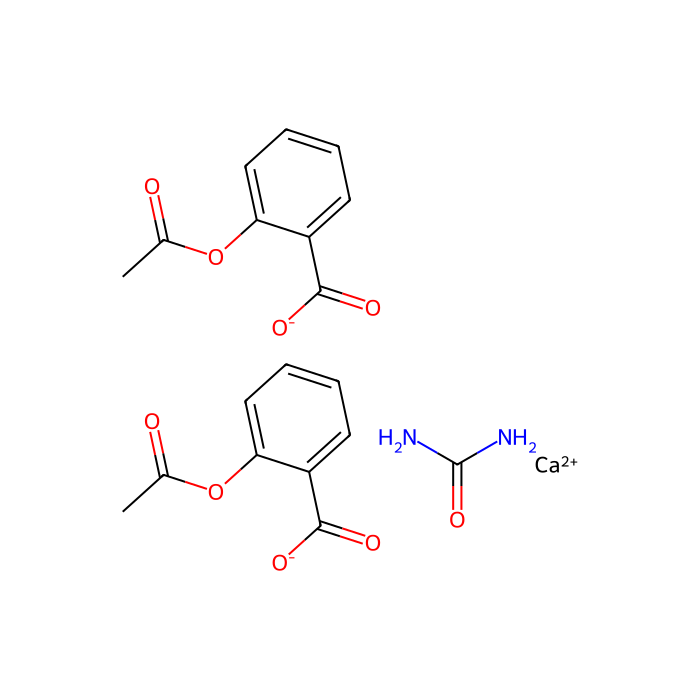
Common description: Calcium di(acetylsalicylate)–urea complex (1:1 complex of Ca(acetylsalicylate)2 with urea)
Structural features (descriptive, literature-based)
Comprises two acetylsalicylate anions (each: salicylic acid bearing an O-acetyl group) coordinated to Ca2+; a neutral urea molecule associates via hydrogen bonding/ion-pairing.
Functional groups: aromatic rings (phenyl), ester (O-acetyl), carboxylate anions, amide (urea), and an alkaline-earth metal center (Ca2+).
2D description: two para-esterified salicylate scaffolds (ortho-hydroxybenzoate O-acetylated) each contribute a carboxylate that ion-pairs with Ca2+. A discrete urea (H2N–CO–NH2) co-crystallizes, typically interacting via H-bonds to carboxylate/phenolic oxygens.
Note: Structural and identifier details marked “literature” are provided for context and should be verified against the item’s CoA/SDS for regulated use.
Synthetic Utility
While not a mainstream synthetic building block, Carbasalate Calcium can serve as a convenient, water-compatible source of acetylsalicylate for specific research tasks.
Hydrolysis/derivatization: controlled hydrolysis yields salicylate, which can be further transformed (e.g., esterification to salicylate esters, acylations on the phenolic OH after deacetylation). The acetyl group can be a tracer for studying acyl migration vs. hydrolysis in aqueous media.
Counterion exchange: ion exchange with Na+, K+, or organic cations (e.g., tetrabutylammonium) can generate alternative salicylate salts with tailored solubility for phase-transfer or extraction studies.
Coordination chemistry: Ca2+ association offers a platform for probing metal–carboxylate coordination and competitive binding with chelators; urea provides hydrogen-bond donors for supramolecular assembly experiments.
Analytical chemistry: acts as a reference material to validate methods that quantify acetylsalicylate vs. salicylate in complex matrices, including forced degradation studies.
For retrosynthetic planning, the salicylate core is accessible from salicylic acid; however, Carbasalate Calcium itself is generally prepared via neutralization of acetylsalicylic acid with Ca2+ sources in the presence of urea, forming the salt/co-crystal complex (literature practice).
Target Specificity
Not applicable. Carbasalate Calcium is a small-molecule salt/complex and is not an antibody, ligand-directed probe, or targeted biologic. No antigen/epitope, clone, or species reactivity information applies.
Häufig gestellte Fragen
How should this product be stored?
Store at ?20 °C. Freezer storage is required to maintain the specified shelf life.
How is this product shipped?
This product ships in an insulated container with ice pads. Unpack on arrival and transfer it to the storage condition stated above.
What is the purity of this product?
This product is supplied at ≥97% purity (chemical assay). Lot-specific values are stated on the Certificate of Analysis.
What are the CAS number, molecular formula and molecular weight?
The CAS Number is 5749-67-7, the molecular formula is C19H18CaN2O9, and the molecular weight is 458.43 g/mol. InChIKey VYMUGTALCSPLDM-UHFFFAOYSA-L.
What documentation is provided?
Available product documentation, including Certificates of Analysis (COA), Safety Data Sheets (SDS), and specification sheets, is shown in the product document area. Document availability and access follow the current site policy.
Wir verwenden Cookies, um die ordnungsgemäße Funktion der Website sicherzustellen und, soweit zulässig, Ihr Nutzererlebnis zu verbessern. Sie können Ihre Einstellungen jederzeit unter „Einstellungen“ verwalten. Weitere Informationen finden Sie in unserer Cookie-Richtlinie.
Dürfen wir Sie über Rabattaktionen informieren?
Später erinnern
Vielen Dank! Bitte überprüfen Sie Ihren E-Mail-Posteingang, um zu bestätigen.
Products are supplied to verified businesses, institutions, and qualified professionals for research and development use only. Not for use in humans, animals, diagnosis, or therapy.

 K2209405