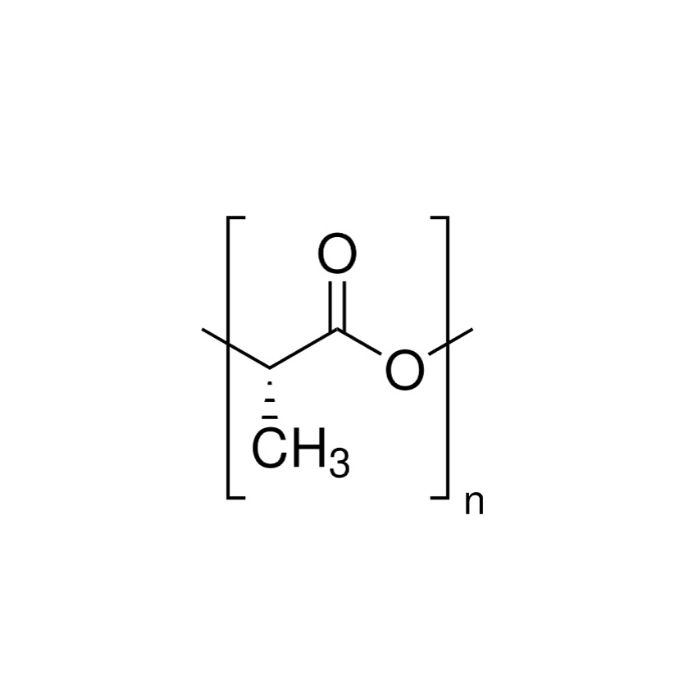
Poly(L-lactide)(PLLA) - ester terminated,Intrinsic viscosity:3.3-4.3 dL/g(0.1% in CHCL3 at 25℃) , CAS No.33135-50-1

CAS: 33135-50-1 Cat. No.: P477740 Summenformel: -(C6H8O4)n-
Zu bestellen verfügbar
GRADE & PURITY ester terminated,Intrinsic viscosity:3.3-4.3 dL/g(0.1% in CHCL3 at 25℃)
Synonyms
Resomer® L 210 S | L-Lactide polymer | PLA | Poly(L-Lactic acid)
Storage
Store at 2-8°C
Shipped In
Wet ice
★
Size
Deutschland (EU)
USA*
Price
Qty
1g
P477740-1g
—
3 Auf Lager
86,69€
5g
P477740-5g
—
1 Auf Lager
277,59€
25g
P477740-25g
Auf Bestellung · 8–12 Wochen
928,39€
Enter a quantity for the sizes you want to add.
🧪
Why this grade

ester terminated,Intrinsic viscosity:3.3-4.3 dL/g(0.1% in CHCL3 at 25℃) for sensitive chromatographic and analytical workflows requiring minimal baseline interference.

🌡

Storage & shipping

Store at 2-8°C Ships Wet ice Check lot-specific COA for exact specifications.

📋

Quality documents

SDS, COA, datasheet, and spec sheet available for download. Lot-specific COA accessible via lot number lookup.

📚

Literature proof

Cited in 14 peer-reviewed publications across chromatography, organic synthesis, and cross-coupling reactions.

Übersicht

Resomer® L 210 S, Poly(L-lactide) (PLLA), a high-performance bio-based polymer, can be prepared from corn starch. Its properties include biodegradability, hydrophobicity, and excellent composting characteristics. 

Application:

Biodegradable, biocompatible, and bioresorbable polymer composed of L-Lactide. This semi-crystalline material has been used in the fabrication of research medical devices and research tissue engineering solutions, such as orthopedic or soft tissue fixation devices. Degradation of this materials has been thoroughly studied and has been shown to be safely resorbed by the body after implantation. Modification of molecular weight and polymer composition allows for control of the degradation rate and mechanical stability of the polymer. PLLA can be used as a resorbable implant material for potential usage in biomedical applications. It can also be used in the formation of composite ceramic material for biological applications.

Specifications

Synonyme
Resomer® L 210 S | L-Lactide polymer | PLA | Poly(L-Lactic acid)
Spezifikationen & Reinheit
ester terminated,Intrinsic viscosity:3.3-4.3 dL/g(0.1% in CHCL3 at 25℃)
Rechtliche Informationen
RESOMER is a registered trademark of Evonik Rohm GmbH
Storage
Store at 2-8°C
Verschickt in
Wet ice
Dieses Produkt erfordert Kühlkettenversand. Grundversand und andere Economy-Optionen sind nicht verfügbar.
Hinweis
end group: decyl ester
Namen und Kennungen
Pubchem Sid
Pubchem Sid Url
https://pubchem.ncbi.nlm.nih.gov/substance/508816230
Kanonisches Lächeln
CC1C(=O)OC(C(=O)O1)C
IUPAC Name
3,6-dimethyl-1,4-dioxane-2,5-dione
InChIKey
JJTUDXZGHPGLLC-UHFFFAOYSA-N
INCHI
1S/C6H8O4/c1-3-5(7)10-4(2)6(8)9-3/h3-4H,1-2H3
Isomere SMILES
CC1C(=O)OC(C(=O)O1)C
Alternative CAS-Nummer
26161-42-2
Reaxy-Rn
82121
Reaxys-RN_link_address
https://www.reaxys.com/reaxys/secured/hopinto.do?context=S&query=IDE.XRN=82121&ln=

Documentation

📋 Safety Data Sheet (SDS)

Comprehensive hazard, handling, storage, and regulatory compliance document.

Download SDS →

✅ Certificate of Analysis (COA)

Lot-specific quality data. Enter your lot number to retrieve the exact COA.

Look up COA →

📊 Datasheet

Quick-reference summary of product specifications and applications.

View datasheet →

🔬 Specification Sheet

Full quality attributes and acceptance criteria for this grade.

View spec sheet →

Advanced Data

Taxonomic Classification

Taxonomy Tree

KingdomOrganic compounds
SuperclassOrganoheterocyclic compounds
KlasseDioxanes
Subclass1,4-dioxanes
Intermediate Tree Nodes Not available
Direct Parent1,4-dioxanes
Alternative Parents Dicarboxylic acids and derivatives  Lactones  Carboxylic acid esters  Oxacyclic compounds  Organic oxides  Hydrocarbon derivatives  Carbonyl compounds  
Molecular FrameworkAliphatic heteromonocyclic compounds
Substituents Dicarboxylic acid or derivatives - Para-dioxane - Lactone - Carboxylic acid ester - Oxacycle - Carboxylic acid derivative - Organic oxygen compound - Organic oxide - Hydrocarbon derivative - Organooxygen compound - Carbonyl group - Aliphatic heteromonocyclic compound
BeschreibungThis compound belongs to the class of organic compounds known as 1,4-dioxanes. These are organic compounds containing 1,4-dioxane, an aliphatic six-member ring with two oxygen atoms in ring positions 1 and 4.
External Descriptors a small molecule
3D-Struktur
Interaktives chemisches Strukturmodell


Zertifikate (CoA, COO, BSE/TSE und Analyse-Diagramm)
C of A & Other Certificates(BSE/TSE, COO):
Analytical Chart:

Find and download the COA for your product by matching the lot number on the packaging.

4 results found

Lot NumberCertificate TypeDatumArtikel
K2528378Certificate of AnalysisNov 18, 2025 P477740
K2528379Certificate of AnalysisNov 18, 2025 P477740
E2423084Certificate of AnalysisMay 16, 2024 P477740
E2423085Certificate of AnalysisMay 16, 2024 P477740
Chemische und physikalische Eigenschaften
Schmelzpunkt (°C)180 °C
Molekulargewicht144.120 g/mol
XLogP30.600
Hydrogen Bond Donor Count0
Hydrogen Bond Acceptor Count4
Rotatable Bond Count0
Exact Mass144.042 Da
Monoisotopic Mass144.042 Da
Topological Polar Surface Area52.600 Ų
Heavy Atom Count10
Formal Charge0
Complexity155.000
Isotope Atom Count0
Defined Atom Stereocenter Count0
Undefined Atom Stereocenter Count2
Defined Bond Stereocenter Count0
Undefined Bond Stereocenter Count0
The total count of all stereochemical bonds0
Covalently-Bonded Unit Count1
FAQs und Artikel
Citations of This Product
Lösungsrechner
Bewertungen

Kundenbewertungen

Verwandte Produkte

Resomer® L 206 S, Poly(L-lactide), ester terminated
Poly(L-lactide) - viscosity ~2.0dL/g, 0.1% (w/v) in chloroform(25°C)
Poly(L-lactide)(PLLA) - ester terminated,Characteristic viscosity:0.8-1.2 dL/g(0.1% in CHCL3 at 25℃) , CAS No.33135-50-1
Poly(L-lactide) - average Mₙ 20,000, PDI ≤1.1
Poly(L-lactide), thiol terminated - average Mₙ 2,500, PDI ≤1.2
Poly(L-lactide), 2-bromoisobutyryl terminated - average Mₙ 10,000, PDI ≤1.1
Poly(L-lactide), amine terminated - average Mₙ 2,500, PDI ≤1.3
Poly(L-lactide)(PLLA) - average Mₙ 10,000, PDI ≤1.1 , CAS No.33135-50-1
Poly(L-lactide), thiol terminated - average Mₙ 5,000, PDI ≤1.2
Poly(L-lactide) 2-hydroxyethyl, methacrylate terminated - average Mₙ 5,500, PDI ≤1.2
Poly(L-lactide), 2-bromoisobutyryl terminated - average Mₙ 5,500, PDI ≤1.1
Poly(L-lactide) 2-hydroxyethyl, methacrylate terminated - average Mₙ 2,000, PDI ≤1.1
Poly(L-lactide) - mol wt 85,000-160,000 , CAS No.26161-42-2
Poly(L-lactide) N-2-hydroxyethylmaleimide terminated - average Mₙ 5,000, PDI <1.2
Poly(L-lactide) N-2-hydroxyethylmaleimide terminated - average Mₙ 2,000, PDI ≤1.2
Poly(L-lactide), azide terminated - average Mₙ 5,000, PDI <1.2
Poly(L-lactide) - average Mₙ 5,000, PDI ≤1.2
Poly(L-lactide), propargyl terminated - average Mₙ 5,000, PDI ≤1.1
Poly(L-lactide)-block-poly(ethylene glycol)methyl ether - PLLA average Mₙ ~5,000, PEG average Mₙ ~5,000
Methoxy poly(ethylene glycol)-b-poly(L-lactide) - 2k-5k
Methoxy poly(ethylene glycol)-b-poly(L-lactide) - 5k-10k

Shall we send you a message when we have discounts available?

Remind me later

Thank you! Please check your email inbox to confirm.

Oops! Notifications are disabled.