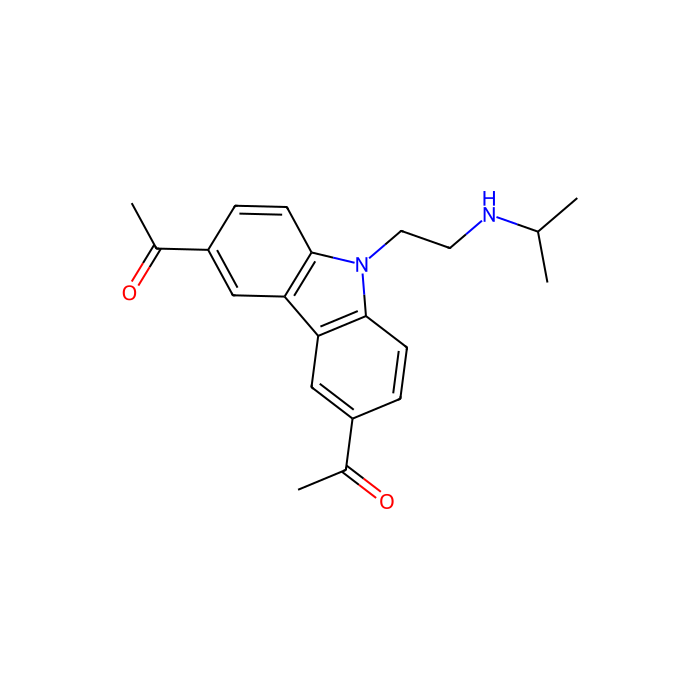
CBL0137 CBL0137 (Curaxin-137) is an inhibitor of the histone chaperone FACT (facilitates chromatin transcription) that simultaneously suppresses NF-κB and activates p53 with EC50 of 0.47 μM and 0.37 μM, respectively.
Pentaerythritol, sodium salt | 1,1'-{9-[2-(propan-2-ylamino)ethyl]-9H-carbazole-3,6-diyl}diethanone | 1-[6-acetyl-9-[2-(isopropylamino)ethyl]carbazol-3-yl]ethanone | cbl0137 | CBL-0137 | CBL-0137; CBL 0137; Curaxin 137 | Curaxin 137 | CBLC137 | 1,1'-(9-(2-(Isopropylamino)ethyl)-9H-carbazole-3,6-diyl)diethanone | 3,6-diacetyl-9-(2-isopropy Show more
Spezifikationen & Reinheit
≥98%
Biochemische und physiologische Mechanismen
CBL0137 (Curaxin-137) is an inhibitor of the histone chaperone FACT (facilitates chromatin transcription) that simultaneously suppresses NF-κB and activates p53 with EC50 of 0.47 μM and 0.37 μM, respectively.
Storage
Store at -20°C
Verschickt in
Ice chest + Ice pads
Dieses Produkt erfordert Kühlkettenversand. Grundversand und andere Economy-Optionen sind nicht verfügbar.
This compound belongs to the class of organic compounds known as carbazoles. These are compounds containing a three ring system containing a pyrrole ring fused on either side to a benzene ring.
External Descriptors
Not available
1. Djoumbou Feunang Y, Eisner R, Knox C, Chepelev L, Hastings J, Owen G, Fahy E, Steinbeck C, Subramanian S, Bolton E, Greiner R, and Wishart DS. ClassyFire: Automated Chemical Classification With A Comprehensive, Computable Taxonomy. Journal of Cheminformatics, 2016, 8:61.
Determine the necessary mass, volume, or concentration for preparing a solution.
Dilution Calculator
Determine the dilution needed to prepare a stock solution.
Reconstitution Calculator
Bewertungen
Kundenbewertungen
Application Protocols
No tested, item-specific application protocols are provided in this listing.
Item-specific recommendations
Recommended concentrations, exposure times, and assay formats: Not specified for this item; refer to CoA/Spec Sheet.
General research-use guidance (background only)
Stock preparation: Dissolve in DMSO to a convenient concentration (e.g., 10–50 mM), aliquot, and store at –20°C protected from light. Thaw just before use.
Cell-based assays: Begin with a broad concentration range (e.g., low nanomolar to low micromolar) and refine based on viability and pathway readouts; maintain constant vehicle controls.
Biochemical assays: Verify compound integrity and concentration before use (e.g., LC–MS, quantitative NMR), and assess nonspecific assay interference (e.g., fluorescence quenching) where relevant.
All procedures must be optimized by the user. This product is for research use only.
Biological Roles
Research context (literature/general; no therapeutic claims): CBL0137 is widely cited as a member of the curaxin class of small molecules that modulate chromatin function and transcription by interacting with the histone chaperone complex FACT (Facilitates Chromatin Transcription; composed primarily of SSRP1 and SUPT16H).
Reported biochemical activities (literature)
FACT modulation: Enhances chromatin engagement/trapping of FACT on destabilized nucleosomes (“c-trapping”), thereby altering transcriptional dynamics in multiple gene programs.
Transcriptional reprogramming: Associated with activation of stress response pathways and suppression of certain inducible transcription factors; reported effects include p53 pathway activation and inhibition of NF-κB- and HSF1-driven transcription in various cellular models.
DNA/chromatin interaction: Planar polyaromatic character is consistent with DNA intercalation-like behavior reported for curaxins, which contributes to chromatin effects without canonical DNA damage signatures at research concentrations.
Experimental utility
Tool compound for dissecting FACT-dependent processes, nucleosome stability, and transcriptional regulation.
Employed in cell-based assays, reporter systems, and biochemical target engagement studies (e.g., pull-downs, ChIP- or CUT&RUN-style workflows assessing FACT occupancy), subject to laboratory validation.
Caveats
Cellular responses can be context-dependent; concentration, exposure time, and cell lineage markedly influence outcomes.
Always corroborate on-target effects using orthogonal methods (e.g., genetic knockdown of FACT components) to distinguish primary from downstream effects.
Note: All uses are for research only; consult primary literature and the item’s CoA for assay-suitable handling details.
Buffer Applications
This product is not a buffer reagent. However, buffer considerations are relevant for preparing working solutions for biochemical/cell-based assays.
Item-specific buffer data
Buffer compatibility and pH stability: Not specified for this item; refer to CoA/Spec Sheet and perform pilot tests.
General guidance (practice/literature)
Vehicle: Prepare concentrated stocks in DMSO, then dilute into assay buffers (e.g., PBS, HEPES-buffered saline, or complete cell culture medium) with vigorous mixing to avoid precipitation.
Final DMSO content: Maintain a constant vehicle percentage across controls and treatments (commonly ≤0.1–0.5% v/v in cell assays, subject to cell-line tolerance).
Surfactants: If precipitation occurs at low DMSO, minimal amounts of nonionic surfactant (e.g., 0.01–0.05% Tween 80 or Pluronic F-68) may help solubilization; validate that additives do not alter assay readouts.
Filtration: Use 0.22 µm PES or PTFE filters for sterile working solutions when required; avoid cellulose acetate if adsorption is observed.
Stability checks
Inspect solutions over assay-relevant timeframes for turbidity or color change; replace solutions if precipitation forms.
For precise buffer compositions and stability limits, use the lot-specific CoA/SDS and verify empirically under your assay conditions.
Green Alternatives
“Green alternatives” typically compares solvents or reagents with functional interchangeability. CBL0137 is a specific bioactive research probe rather than a general-purpose solvent or reagent; therefore, there are no direct green substitutes that preserve the same biological activity.
Context
Replacing CBL0137 with another compound will likely change biological target engagement and experimental outcomes.
Greener handling practices (general)
Minimize DMSO concentration in working solutions consistent with assay tolerance to reduce solvent burden.
Scale experiments appropriately to reduce chemical use and waste.
Use closed microplate systems or sealed vials to limit VOC emissions when volatile co-solvents are used.
Implement waste segregation to streamline solvent recovery and compliant disposal.
If solvent choice is flexible for your assay
Prefer DMSO over higher-toxicity aprotic solvents (e.g., NMP) when compatible.
Consider aqueous-compatible delivery strategies (e.g., cyclodextrin carriers) to lower organic solvent content, after validating that they do not perturb the assay.
Conclusion
There is no green “drop-in” alternative for the compound itself. Focus sustainability efforts on solvent minimization, right-sizing experiments, and responsible waste management.
Pharmaceutical Uses
This product is supplied strictly for research use only (non-GMP). No clinical, diagnostic, or therapeutic applications are supported or implied.
Item-specific regulatory/compendial status
Pharmacopeial listing (USP/EP/JP): Not specified for this item; refer to CoA/Spec Sheet.
GMP status: Not applicable; research use only.
Relevant roles in pharmaceutical R&D (general)
Reference standard or tool compound for nonclinical studies investigating chromatin regulation and FACT-associated biology.
Potential positive/negative control in target engagement assays, reporter assays, and mechanistic studies during early discovery.
Analytical development: May be used to develop/validate LC–MS or HPLC methods (retention, stability, impurity profiling) for curaxin-class compounds.
Formulation notes for research settings (not for human use)
Prepare DMSO stock solutions and dilute into assay-compatible vehicles; consider co-solvents/excipients (e.g., PEG400, cyclodextrins) only after verifying no assay interference.
Store aliquots to minimize freeze–thaw cycles and maintain consistent concentration across study arms.
All usage is limited to laboratory research by qualified professionals. Refer to institutional policies and the SDS for handling and disposal.
Physical Properties
Only limited, item-specific physical property data are provided in this listing.
Item-specific values
Appearance: Not specified for this item; refer to CoA/Spec Sheet.
Molecular Weight: Not specified for this item; refer to CoA/Spec Sheet.
Commonly referenced properties (literature/general; for context only, not item specifications)
CBL0137 is typically handled as a hydrophobic/aromatic small molecule; working stocks are commonly prepared in polar aprotic solvents such as DMSO for biochemical assays.
Aqueous solubility is often limited for similar curaxin-class compounds; actual solubility and extinction coefficients must be verified per lot via CoA.
Unavailable/unspecified parameters for this item (use CoA/SDS for authoritative values)
Melting point: Not specified for this item; refer to CoA/Spec Sheet.
Boiling point: Not applicable/not determined for solids; Not specified for this item; refer to CoA/Spec Sheet.
Density, refractive index, logP/logD, pKa: Not specified for this item; refer to CoA/Spec Sheet.
UV-Vis maxima, molar absorptivity: Not specified for this item; refer to CoA/Spec Sheet.
Practical note
Confirm solvent choice and workable concentrations empirically. Prepare small test solutions and inspect for clarity/precipitation before scaling.
Quality and Grades
Item-specific grade/purity
Grade/Purity: Not specified for this item; refer to CoA/Spec Sheet.
How to interpret grade (general guidance for bioactive small molecules)
For screening/reference compounds, key quality attributes typically include: identity confirmation (1H NMR/LC–MS), purity by HPLC/UPLC (area %), residual solvent profile, and, when relevant, salt form/stoichiometry and water content (KF).
If “screening” or “bioactive” grade is indicated on the CoA, it usually implies high chemical purity suitable for in vitro/in-cellulo research, but not necessarily formulated for GMP or clinical use.
UV profile and stabilizers
Stabilizers/inhibitors: Not specified for this item; refer to CoA/Spec Sheet.
If low-UV absorbance is required for analytics, confirm UV cutoff and chromatographic background on the CoA.
What to check on receipt (practical tips)
Verify lot-specific purity and identity on the CoA; record appearance, mass, and intact container seal.
For hygroscopic or air-/light-sensitive compounds (if noted on CoA), minimize exposure; purge headspace with inert gas if recommended by the manufacturer.
If the salt form matters (free base vs. hydrochloride, etc.), confirm exact form and molecular weight on the CoA before preparing solutions or calculating concentrations.
Reaction and Applications
This item is supplied as a bioactive small molecule standard for research and screening, not as a synthetic reagent. As such, it is not typically used to promote or participate in classical synthetic transformations.
Applicability to chemical reactions
Not typically applicable to named organic reactions (e.g., cross-coupling, reductions). No catalytic or stoichiometric reagent role is expected.
Used as a reference compound or probe in biochemical and cell-based studies interrogating chromatin-associated processes and transcriptional regulation (see Biological Roles).
Employed in assay development/validation for target engagement and pathway modulation studies.
Practical guidance
Focus efforts on solution preparation, stability, and accurate dosing rather than reaction optimization. Validate concentration by an orthogonal method where possible (e.g., quantitative NMR or calibrated UV–Vis if an extinction coefficient is available from literature or CoA).
For experimental chemistry workflows, please refer to the Biological Roles and Application Protocols sections for considerations more relevant to this compound’s typical research use.
Reaction Conditions
Not typically applicable. CBL0137 is a bioactive tool compound rather than a reagent or substrate used in standard organic reactions.
If chemical manipulation is attempted for analytical purposes (general)
Stability assessments can be conducted under controlled conditions (e.g., forced degradation under heat, light, oxidative, or acidic/basic environments) to inform handling; design these studies per ICH Q1A(R2)-style stress testing principles where relevant.
Any derivatization or conjugation conditions must be developed de novo and validated analytically; no item-specific conditions are provided.
For experimental use cases, please refer instead to Solvent Selection, Biological Roles, and Storage & Reconstitution.
Safety and Handling
Safety information specific to this item is limited in the current listing. Treat as a hazardous laboratory chemical and consult the SDS for authoritative guidance.
GHS/CLP information (item-specific)
Signal Word: Not specified for this item; refer to SDS.
Hazard Statements (H-): Not specified for this item; refer to SDS.
Pictograms: Not specified for this item; refer to SDS.
GHS Classification: Not specified for this item; refer to SDS.
General laboratory precautions (good practice; not item-specific)
Use in a chemical fume hood; avoid inhalation, ingestion, and skin/eye contact.
Recommended PPE: lab coat, safety glasses, and appropriate chemically resistant gloves (e.g., nitrile); consider double-gloving when handling DMSO solutions.
Avoid contact with oxidizers and strong acids/bases unless compatibility is established; use dedicated, clean glassware and solvent-resistant plasticware.
Prevent environmental release; dispose of waste per institutional and regulatory requirements.
First-aid overview (defer to SDS for details)
Skin/eye contact: Immediately rinse with water for ≥15 minutes; remove contaminated clothing.
Inhalation: Move to fresh air; seek medical attention if symptoms occur.
Ingestion: Rinse mouth; obtain medical attention.
Special considerations
Bioactive small molecules can have potent cellular effects at low concentrations; minimize exposure and practice meticulous hygiene.
Prepare and handle concentrated DMSO stocks carefully to prevent carry-through dermal exposure via solvent transport.
Solvent Selection
This product is a bioactive small molecule; solvent choice is driven by assay type and required working concentrations rather than reaction chemistry.
Item-specific solvent data
Solubility and preferred solvents: Not specified for this item; refer to CoA/Spec Sheet.
General dissolution guidance for similar compounds (literature/practice)
Stock solutions: Commonly prepared in anhydrous DMSO (e.g., 10–50 mM) to facilitate dilution into aqueous assay media. Filter-sterilize if sterility is required.
Aqueous compatibility: To minimize precipitation, add the DMSO stock slowly to vigorously mixed buffer or culture medium; maintain final DMSO typically ≤0.1–0.5% v/v for cell-based assays, as tolerated by the system.
Alternative solvents: DMF or ethanol may be used for initial dissolution if supported by CoA/solubility testing; confirm compatibility with downstream assays.
Practical checks
Perform a small-scale solubility check at target concentration and temperature. Look for turbidity or microprecipitation after dilution into buffer/media.
Adsorptive loss: Use low-bind polypropylene tubes and minimize contact with untreated polystyrene when preparing low-nanomolar solutions.
When to choose alternatives
If high-concentration aqueous stocks are required, consider cyclodextrin inclusion or co-solvent systems (e.g., DMSO + PEG400) after verifying assay tolerance; validate that these excipients do not confound readouts.
Reconstitution (item-specific details not provided)
Recommended solvent, concentration, and diluent compatibility: Not specified for this item; refer to CoA/Spec Sheet.
General best practices for bioactive small molecules (background guidance)
Reconstitution: Prepare concentrated stock solutions in dry DMSO under clean conditions. Vortex and, if needed, gently warm (e.g., to room temperature) to aid dissolution; avoid prolonged heating.
Aliquoting: Divide stock into single-use aliquots (amber vials or light-protective microtubes) to avoid repeated freeze–thaw cycles.
Storage: Keep aliquots tightly sealed at –20°C or below; minimize headspace and consider inert gas overlay if the compound is air/moisture sensitive (check CoA/SDS).
Handling: Allow frozen aliquots to reach room temperature before opening to prevent moisture condensation; promptly return unused aliquots to –20°C.
Stability monitoring: Periodically verify integrity by HPLC/LC–MS if stocks are stored for extended periods. Discard any solution showing precipitation, discoloration, or anomalous assay behavior.
Always defer to the lot-specific CoA/SDS for definitive instructions and stability limits.
Structure and Identity
Brief overview: CBL0137 is a bioactive, research-use-only small molecule commonly classified in the literature as a chromatin/FACT modulator (curaxin class). Item-specific identifiers are limited in this listing.
Item-specific identifiers (from Product Data)
SKU: C412428
Product Name: CBL0137
CAS: 1197996-80-7
PubChem CID: 44519124
InChIKey: 162529 (as provided)
Molecular Formula: Not specified for this item; refer to CoA/Spec Sheet.
SMILES: Not specified for this item; refer to CoA/Spec Sheet.
Structural features (literature/general description)
Reported as a planar, polycyclic, heteroaromatic small molecule in the “curaxin” family.
Literature describes DNA-interacting physicochemical character compatible with chromatin engagement.
Typically represented as a fused-ring aromatic scaffold bearing basic nitrogen functionality; exact atom connectivity should be taken from primary literature or CoA.
Notes
For definitive structure descriptors (InChI, SMILES, exact stereochemistry), consult the item’s CoA/Spec Sheet or authoritative databases. No item-specific structural specifications beyond the identifiers above are provided here.
Synthetic Utility
CBL0137 is provided as a defined, bioactive small molecule for use as a research probe, not as a building block or reagent. Therefore, it has limited relevance to synthetic methodology development.
Not typically applicable
It is not commonly employed as a coupling partner, protecting group reagent, catalyst, or stoichiometric reagent in organic synthesis.
If analytical/synthetic work is pursued (general guidance)
Impurity tracking: Develop gradient HPLC/UPLC methods to resolve potential degradation products; confirm identity by LC–MS and NMR.
Derivatization for SAR: Any structural modification for structure–activity relationship studies should be guided by primary literature; this is beyond the scope of the supplied research-use product.
For laboratory research, focus on solution preparation, assay design, and data quality rather than employing this compound in synthetic transformations.
Target Specificity
Item-specific, validated target specificity data are not provided in this listing.
Item-specific details
Target, binding constants, and selectivity: Not specified for this item; refer to CoA/Spec Sheet and primary literature.
Literature context (for background only; not item certification)
CBL0137 is widely described as a modulator of the FACT complex (SSRP1/SUPT16H) impacting chromatin-dependent transcription; quantitative affinity/kinetics vary by assay and are not provided here.
Users should consult peer-reviewed sources and perform in-house validation (e.g., target engagement assays, genetic controls) to establish specificity under their experimental conditions.
Wir verwenden Cookies, um die ordnungsgemäße Funktion der Website sicherzustellen und, soweit zulässig, Ihr Nutzererlebnis zu verbessern. Sie können Ihre Einstellungen jederzeit unter „Einstellungen“ verwalten. Weitere Informationen finden Sie in unserer Cookie-Richtlinie.
Dürfen wir Sie über Rabattaktionen informieren?
Später erinnern
Vielen Dank! Bitte überprüfen Sie Ihren E-Mail-Posteingang, um zu bestätigen.
Products are supplied to verified businesses, institutions, and qualified professionals for research and development use only. Not for use in humans, animals, diagnosis, or therapy.

 L2307321