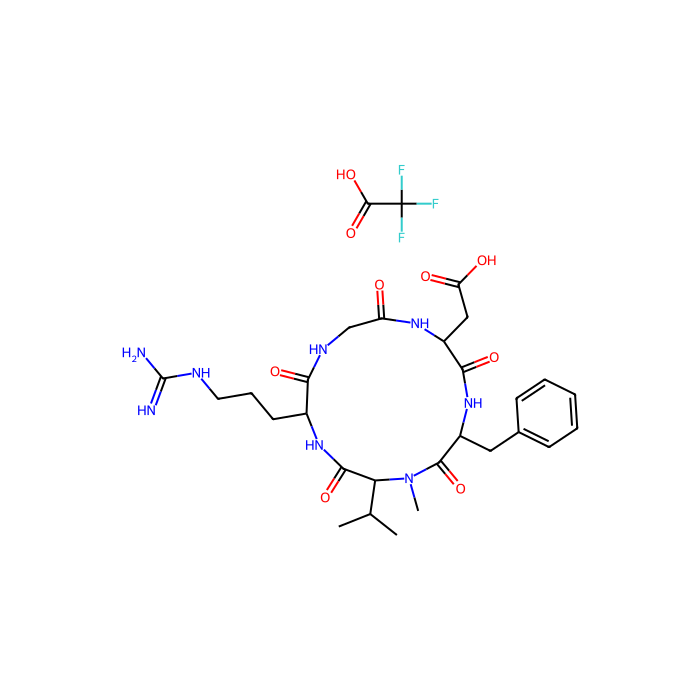
10mM in DMSO for sensitive chromatographic and analytical workflows requiring minimal baseline interference.
🌡
Storage & shipping
Store at -80°C Ships Dry ice packs + Cold packs Check lot-specific COA for exact specifications.
📋
Quality documents
SDS, COA, datasheet, and spec sheet available for download. Lot-specific COA accessible via lot number lookup.
📚
Literature proof
Cited in 0 peer-reviewed publications across chromatography, organic synthesis, and cross-coupling reactions.
Übersicht
Information
Cilengitide trifluoroacetate Cilengitide (EMD 121974, NSC 707544) is a potent integrin inhibitor for αvβ3 receptor and αvβ5 receptor with IC50 of 4.1 nM and 79 nM in cell-free assays, respectively; ~10-fold selectivity against gpIIbIIIa. Phase 2. In vitro
Cilengitide is a cyclized pentapeptide peptidomimetic designed to compete for the arginine-glycine-aspartic acid (RGD) peptide sequence that regulates integrin-ligand binding. Cilengitide selectively and potently blocks the ligation of theαvβ3 andαvβ5 integrins to provisional matrix proteins such as vitronectin, fibronectin, fibrinogen, von Willebrand factor, osteopontin, and others. Cilegitide inhibits angiogenesis in vitro. 10 μM Cilengitide completely inhibits attachment of BAE, BME and HUVE cells on vitronectin and fibronectin. Cilengitide inhibits in vitro angiogenesis of BAE cells on three-dimensional collagen and fibrin gels pretreated with FGF-2(or VEGF-A) with IC50 of 15 μM and 8 μM, 4 μM and 3 μM, respectively. Cilengitide blocks proliferation and induces apoptosis of endothelial cells as well as differentiation of human endothelial precursor cells (EPCs). 50 μg/mL Cilengitide completely inhibits the proliferation of human microvascular endothelial cell line HMEC-1 and leads to apoptosis in ~30% cells. 1.0 μM Cilengitide treating for 9 days inhibits the proliferation of EPCs by nearly 40%. 1 μM Cilengitide inhibits the differentiation of EPCs by more than 80% at 14 days. Cilengitide inhibits adhesion and induces apoptosis of tumor cells. 25 μg/mL Cilengitide causes detachment of DAOY cells (medulloblastoma) and U87MG cells (glioblastoma) from vitronectin and tenascin by more than 60%. 25 μg/mL Cilengitide induces a nearly 50% apoptosis rate of these cells.
In vivo
Cilengitide is activity against tumor growth and angiogenesis as single-agent. 100 μg Cilengitide induces a significant decrease in the number of CD 31+ vessels seen in tumors (2/high-power field) compared with control tumors (56/high-power field). 100 μg Cilengitide increases cellular apoptosis in the brain tumors of animals (2.2% apoptotic cells/high-power field) compared with those receiving the inactive peptide (1.7% cells/high-power field). Cilengitide treatment results in prolonged survival of the mice bearing melanoma xenografts M21 compared with control treatment group. (36.5 vs 17.3 days). Cilengitide can augment the therapeutic benefit associated with cytotoxic agents including chemotherapy and radiation therapy in tumor models. Cilengitide (250 mg/dose) alone does not alter tumor growth of breast cancer xenografts when compared with untreated mice, but combined modality RIT (CMRIT) using RIT and six doses of Cilengitide (250 mg/dose) increases efficacy of treatment, with the cure rate for mice that receives only RIT increasing from 15 to 53%. CMRIT significantly increases apoptosis of tumor and endothelial cells 5 days, and decreases tumor proliferation. Cell Data
Cilengitide (EMD 121974, NSC 707544) is a potent integrin inhibitor for αvβ3 receptor and αvβ5 receptor with IC50 of 4.1 nM and 79 nM in cell-free assays, respectively; ~10-fold selectivity against gpIIbIIIa. Phase 2.
Storage
Store at -80°C
Verschickt in
Dry ice packs + Cold packs
Dieses Produkt erfordert Kühlkettenversand. Grundversand und andere Economy-Optionen sind nicht verfügbar.
Produkteigenschaften
ALogP
-0.565
HBD-Zahl
6
Rotationsfähige Bindung
11
Namen und Kennungen
PubChem CID
129626550
Molekulargewicht
702.68
Documentation
📋 Safety Data Sheet (SDS)
Comprehensive hazard, handling, storage, and regulatory compliance document.
Zertifikate (CoA, COO, BSE/TSE und Analyse-Diagramm)
C of A & Other Certificates(BSE/TSE, COO):
Analytical Chart:
Chemische und physikalische Eigenschaften
DMSO (mg/ml) Maximale Löslichkeit
100
DMSO (mM) Maximale Löslichkeit
142.3122901
Wasser (mg/ml) Maximale Löslichkeit
8
Wasser (mM) Maximale Löslichkeit
11.38498321
Lösungsrechner
Molarity Calculator
Determine the necessary mass, volume, or concentration for preparing a solution.
Dilution Calculator
Determine the dilution needed to prepare a stock solution.
Reconstitution Calculator
Bewertungen
Kundenbewertungen
Häufig gestellte Fragen
How should this product be stored?
Store at ?80 °C. Ultra-low temperature storage is required to maintain the specified shelf life.
How is this product shipped?
This product ships frozen with dry ice and cold packs. Unpack on arrival and transfer it to the storage condition stated above; handle dry ice with insulated gloves in a ventilated area.
What are the CAS number, molecular formula and molecular weight?
The CAS Number is 199807-35-7, the molecular formula is C29H41F3N8O9, and the molecular weight is 702.68 g/mol.
What documentation is provided?
Available product documentation, including Certificates of Analysis (COA), Safety Data Sheets (SDS), and specification sheets, is shown in the product document area. Document availability and access follow the current site policy.
Wir verwenden Cookies, um die ordnungsgemäße Funktion der Website sicherzustellen und, soweit zulässig, Ihr Nutzererlebnis zu verbessern. Sie können Ihre Einstellungen jederzeit unter „Einstellungen“ verwalten. Weitere Informationen finden Sie in unserer Cookie-Richtlinie.
Shall we send you a message when we have discounts available?
Remind me later
Thank you! Please check your email inbox to confirm.
Products are supplied to verified businesses, institutions, and qualified professionals for research and development use only. Not for use in humans, animals, diagnosis, or therapy.