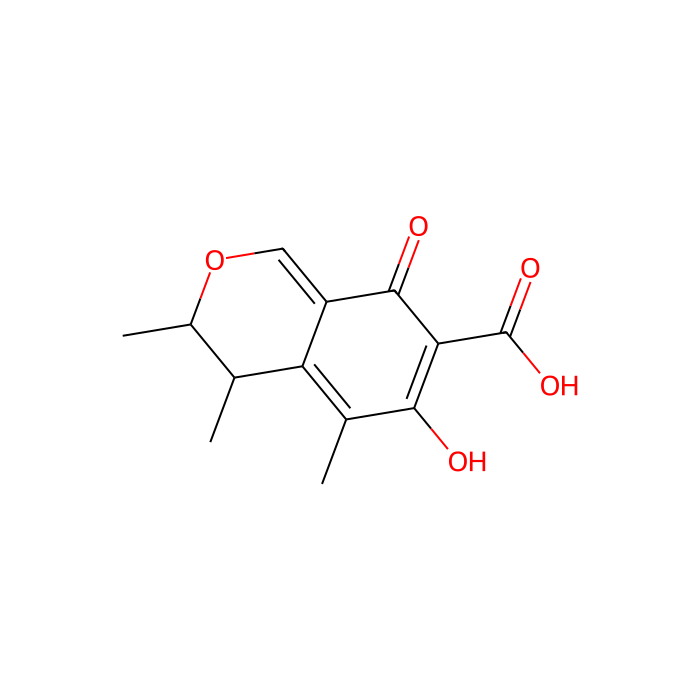
Citrinin - Moligand™, ≥98% , CAS No.518-75-2

CAS: 518-75-2 Cat. No.: C113853 Summenformel: C13H14O5 Molekulargewicht: 250.25 Beilstein Registry Number: 5282243 EG-Nummer: 208-257-2
Zu bestellen verfügbar
GRADE & PURITY Moligand™ ? Moligand™ — Aladdin's line of ligands and bioactive small molecules. Use for receptor, pathway, and binding studies needing defined small-molecule tools. ≥98%
Synonyms
HY-101232 | (3R,4S)-8-hydroxy-3,4,5-trimethyl-6-oxo-4,6-dihydro-3H-isochromene-7-carboxylic acid | CITRININ [MI] | CHEBI:48707 | KBioSS_000931 | Citrinin, 98% | KBio2_003499 | (3R-trans)-4,6-dihydro-8-hydroxy-3,4,5-trimethyl-6-oxo-3H-2-benzopyran-7-carbox
Storage
Store at -20°C,Argon charged
Shipped In
Ice chest + Ice pads
★
Size
Deutschland (EU)
USA*
Price
Qty
1mg
C113853-1mg
Auf Bestellung · 8–12 Wochen
102,31€
5mg
C113853-5mg
—
3 Auf Lager
357,42€
Enter a quantity for the sizes you want to add.
🧪

Why this grade

Moligand™, ≥98% Moligand™ for sensitive chromatographic and analytical workflows requiring minimal baseline interference.

🌡

Storage & shipping

Store at -20°C,Argon charged Ships Ice chest + Ice pads Check lot-specific COA for exact specifications.

📋

Quality documents

SDS, COA, datasheet, and spec sheet available for download. Lot-specific COA accessible via lot number lookup.

📚

Literature proof

Cited in 10 peer-reviewed publications across chromatography, organic synthesis, and cross-coupling reactions.

Übersicht

Citrinin is a mycotoxin capable of inducing mitochondrial permeability transition. Citrinin also inhibits microtubule polymerization

Specifications

Synonyme
HY-101232 | (3R,4S)-8-hydroxy-3,4,5-trimethyl-6-oxo-4,6-dihydro-3H-isochromene-7-carboxylic acid | CITRININ [MI] | CHEBI:48707 | KBioSS_000931 | Citrinin, 98% | KBio2_003499 | (3R-trans)-4,6-dihydro-8-hydroxy-3,4,5-trimethyl-6-oxo-3H-2-benzopyran-7-carbox
Spezifikationen & Reinheit
Moligand™, ≥98%
Biochemische und physiologische Mechanismen
Mycotoxin. Tubulin polymerization inhibitor. Prevents mitotic spindle formation. Induces cell cycle arrest at G2/M phase and apoptosis. Shows nephrotoxic effects in vivo. Orally active.
Storage
Store at -20°C,Argon charged
Verschickt in
Ice chest + Ice pads
Dieses Produkt erfordert Kühlkettenversand. Grundversand und andere Economy-Optionen sind nicht verfügbar.
Note
Moligand™
Hinweis
Wherever possible, you should prepare and use solutions on the same day. However, if you need to make up stock solutions in advance, we recommend that you store the solution as aliquots in tightly sealed vials at -20°C. Generally, these will be useable for up to one month. Before use, and prior to opening the vial we recommend that you allow your product to equilibrate to room temperature for at least 1 hour. Need more advice on solubility, usage and handling? Please visit our frequently asked questions (FAQ) page for more details.
Reinheit
≥98%
Namen und Kennungen
Pubchem Sid528772287
Kanonisches LächelnCC1C(OC=C2C1=C(C(=C(C2=O)C(=O)O)O)C)C
IUPAC Name(3R,4S)-6-hydroxy-3,4,5-trimethyl-8-oxo-3,4-dihydroisochromene-7-carboxylic acid
InChIKeyCBGDIJWINPWWJW-IYSWYEEDSA-N
INCHI1S/C13H14O5/c1-5-7(3)18-4-8-9(5)6(2)11(14)10(12(8)15)13(16)17/h4-5,7,14H,1-3H3,(H,16,17)/t5-,7-/m1/s1
Isomere SMILES C[C@@H]1[C@H](OC=C2C1=C(C(=C(C2=O)C(=O)O)O)C)C
WGK Deutschland 3
RTECS DJ2275000
UN-Nummer 3462
Molekulargewicht 250.25
Beilstein 5282243
Reaxy-Rn 7975720
Reaxys-RN_link_address https://www.reaxys.com/reaxys/secured/hopinto.do?context=S&query=IDE.XRN=7975720&ln=

Documentation

📋 Safety Data Sheet (SDS)

Comprehensive hazard, handling, storage, and regulatory compliance document.

Download SDS →

✅ Certificate of Analysis (COA)

Lot-specific quality data. Enter your lot number to retrieve the exact COA.

Look up COA →

📊 Datasheet

Quick-reference summary of product specifications and applications.

View datasheet →

🔬 Specification Sheet

Full quality attributes and acceptance criteria for this grade.

View spec sheet →

Advanced Data

Taxonomic Classification

Taxonomy Tree

KingdomOrganic compounds
SuperclassOrganoheterocyclic compounds
KlasseBenzopyrans
SubclassNot available
Intermediate Tree Nodes Not available
Direct ParentBenzopyrans
Alternative Parents Vinylogous esters  Vinylogous acids  Ketones  Oxacyclic compounds  Monocarboxylic acids and derivatives  Enols  Carboxylic acids  Organic oxides  Hydrocarbon derivatives  
Molecular FrameworkAliphatic heteropolycyclic compounds
Substituents Benzopyran - Vinylogous ester - Vinylogous acid - Ketone - Oxacycle - Monocarboxylic acid or derivatives - Enol - Carboxylic acid - Carboxylic acid derivative - Organic oxygen compound - Organic oxide - Hydrocarbon derivative - Organooxygen compound - Carbonyl group - Aliphatic heteropolycyclic compound
BeschreibungThis compound belongs to the class of organic compounds known as benzopyrans. These are organic compounds containing a benzene ring fused to a pyran ring. Pyran a six-membered heterocyclic, non-aromatic ring, made up of five carbon atoms and one oxygen atom and containing two double bonds.
External Descriptors Not available
3D-Struktur
Interaktives chemisches Strukturmodell


Zertifikate (CoA, COO, BSE/TSE und Analyse-Diagramm)
C of A & Other Certificates(BSE/TSE, COO):
Analytical Chart:

Find and download the COA for your product by matching the lot number on the packaging.

3 results found

Lot NumberCertificate TypeDatumArtikel
K2103582Certificate of AnalysisAug 11, 2025 C113853
C2517016Certificate of AnalysisMar 06, 2025 C113853
H2527077Certificate of AnalysisMar 06, 2025 C113853
Chemische und physikalische Eigenschaften
LöslichkeitSlightly soluble in water. Soluble in dilute alkaline solutions. Soluble in methanol, ethanol, acetonitrile
Empfindlichkeitlight sensitive & Moisture sensitive
Schmelzpunkt (°C)170-179°C
Molekulargewicht250.250 g/mol
XLogP31.700
Hydrogen Bond Donor Count2
Hydrogen Bond Acceptor Count5
Rotatable Bond Count1
Exact Mass250.084 Da
Monoisotopic Mass250.084 Da
Topological Polar Surface Area83.800 Ų
Heavy Atom Count18
Formal Charge0
Complexity536.000
Isotope Atom Count0
Defined Atom Stereocenter Count2
Undefined Atom Stereocenter Count0
Defined Bond Stereocenter Count0
Undefined Bond Stereocenter Count0
The total count of all stereochemical bonds0
Covalently-Bonded Unit Count1
Citations of This Product
Referenzen
1. Qian Yang, Yanjing Guo, He Wang, Zhi Luo, Ying Chen, Mengyun Jiang, Huan Lu, Bernal E. Valverde, Sheng Qiang, Reto Jörg Strasser, Shiguo Chen.  (2023)  Action of the fungal compound citrinin, a bioherbicide candidate, on photosystem II.  PEST MANAGEMENT SCIENCE,  80  (1): (133-148).  [PMID:37103431] [10.1002/ps.7513]
2. Hu Xiaopeng, Xia Yide, Liu Yiwei, Zhao Faqiong, Zeng Baizhao.  (2021)  Determination of patulin using dual-dummy templates imprinted electrochemical sensor with PtPd decorated N-doped porous carbon for amplification.  MICROCHIMICA ACTA,  188  (5): (1-9).  [PMID:33797604] [10.1007/s00604-021-04812-2]
3. Li Z., Liu Y., Li Y., Lin F., Wu L..  (2020)  Screening and identification of Monascus strains with high‐yield monacolin K and undetectable citrinin by integration of HPLC analysis and pksCT and ctnA genes amplification.  JOURNAL OF APPLIED MICROBIOLOGY,  129  (5): (1410-1418).  [PMID:32357272] [10.1111/jam.14689]
4. Yanqing Liu, Hongwu Wang, Su Yao, Peijie Zhu.  (2018)  Detection of trace amounts of citrinin in dried orange peel by using an optimized extraction method coupled with ultra-performance liquid chromatography–tandem mass spectrometry.  BIOMEDICAL CHROMATOGRAPHY,  32  (8): (e4237).  [PMID:29517126] [10.1002/bmc.4237]
5. Hongcheng Gao, Zhenzhen Xie, Shihao Xu, Changlong Jiang.  (2025)  MUA-modified Au nanocluster-driven fluorescence sensor for chromatographic test strips-based visual detection of patulin.  SPECTROCHIMICA ACTA PART A-MOLECULAR AND BIOMOLECULAR SPECTROSCOPY,      [PMID:39826168] [10.1016/j.saa.2025.125736]
6. Sai Zhang, Ruixi Yang, Yaping Wang, Qinqin Gao, Langhong Wang, Guisheng Zhou, Qinglin Sheng.  (2024)  Multifunctional fluorescence sensor based on nitrogen-doped carbon dots and its application for toxoflavin detection.  MICROCHEMICAL JOURNAL,      [PMID:] [10.1016/j.microc.2024.112168]
7. Hai Chi, Yue Xiao, Xuefei Wen, Houqi Ning, Xingzhong Zhang, Hongrui Chen, Jie Tang.  (2025)  An electrochemical sensor employing a molecularly imprinted-aptamer synergistic recognition strategy based on Cu-Zr bimetallic MOF-818 for the highly sensitive detection of zearalenone.  Food Bioscience,      [PMID:] [10.1016/j.fbio.2025.107243]
8. Tao Liao, Dan Hou, Hao Huang, María Belén Camarada, Xiaoning Liao.  (2025)  A novel ratiometric molecularly imprinted electrochemical sensor based on Ag and ionic liquid co-functionalized MXene for highly sensitive and selective detection of patulin.  SENSORS AND ACTUATORS B-CHEMICAL,      [PMID:] [10.1016/j.snb.2025.138943]
9. Yifei He, Xiaoshuo Zhang, Lei Shi, Baizhao Zeng.  (2025)  Preparation of a low-toxic biomass-derived carbon dots-based magnetic molecular imprinting electrochemiluminescence sensor for the rapid separation and highly sensitive detection of zearalenone.  FOOD CHEMISTRY,      [PMID:41317587] [10.1016/j.foodchem.2025.147330]
10. Xiao Yue, Wen Xuefei, Zhang Xingzhong, Chen Hongrui, Tang Jie, Chi Hai, Li Liman, Thanapop Soteyome.  (2026)  Dual-functional monomers synergistically facilitate the assembly of a CoNiZn@C-based molecularly imprinted electrochemical sensor for highly sensitive detection of zearalenone.  MICROCHIMICA ACTA,  193  (7): (503).  [PMID:] [10.1007/s00604-026-08220-2]
Lösungsrechner
Bewertungen

Kundenbewertungen

Shall we send you a message when we have discounts available?

Remind me later

Thank you! Please check your email inbox to confirm.

Oops! Notifications are disabled.