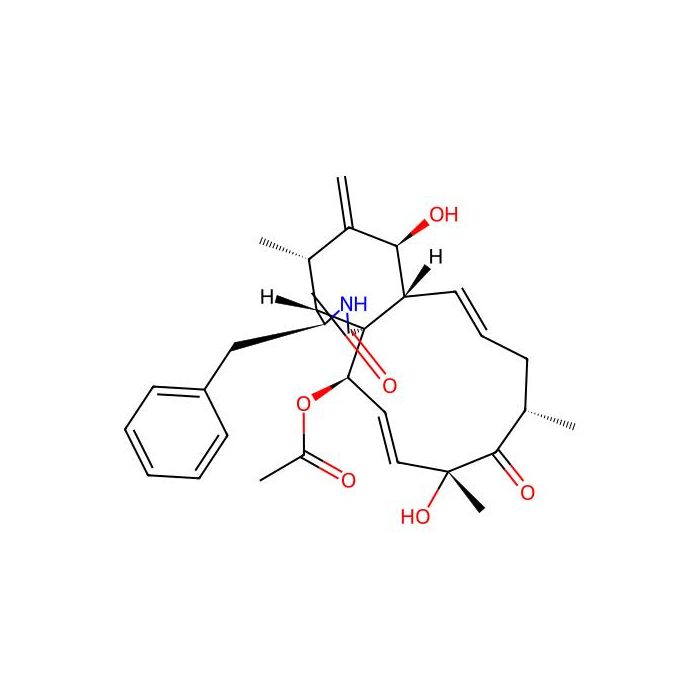
Cytochalasin D - Moligand™, 10 mM in DMSO , CAS No.22144-77-0

CAS: 22144-77-0 Cat. No.: C1499977 Summenformel: C30H37NO6 Molekulargewicht: 507.62 Beilstein Registry Number: 1632828 EG-Nummer: 244-804-1
Zu bestellen verfügbar
QUALITÄT & REINHEIT Moligand™ ? Moligand™ — Aladdin's line of ligands and bioactive small molecules. Use for receptor, pathway, and binding studies needing defined small-molecule tools. 10 mM in DMSO
Storage
Store at -80°C
Shipped In
Dry ice packs + Cold packs
★
Größe
Deutschland (EU)
USA*
Preis
Menge
1ml
C1499977-1ml
Auf Bestellung · 8–12 Wochen
891,95€
Enter a quantity for the sizes you want to add.

Übersicht

Cytochalasin D (Zygosporin A) is a potent actin polymerization inhibitor, could be derived from fungus. Cytochalasin D has cell-permeable activity. Cytochalasin D inhibits the G-actin–cofilin interaction by binding to G-actin. Cytochalasin D also inhibits the binding of cofilin to F-actin and decreases the rate of both actin polymerization and depolymerization in living cells. Cytochalasin D can reduce exosome release, in turn reducing the amount of survivin present in the tumour environment. Cytochalasin D induces phosphorylation and cytoplasmic retention of Yap .

Spezifikationen

Spezifikationen & Reinheit
Moligand™, 10 mM in DMSO
Storage
Store at -80°C
Verschickt in
Dry ice packs + Cold packs
Dieses Produkt erfordert Kühlkettenversand. Grundversand und andere Economy-Optionen sind nicht verfügbar.
Note
Moligand™
Namen und Kennungen
Isomere SMILES
C[C@H]1C/C=C/[C@H]2[C@@H](C(=C)[C@H]([C@@H]3[C@@]2([C@@H](/C=C/[C@@](C1=O)(C)O)OC(=O)C)C(=O)N[C@H]3CC4=CC=CC=C4)C)O
WGK Deutschland
3
RTECS
GZ4850000
UN-Nummer
3172
Verpackungsgruppe
I
Molekulargewicht
507.62
Beilstein
1632828
Reaxys
25133796
Reaxys-RN_link_address
https://www.reaxys.com/reaxys/secured/hopinto.do?context=S&query=IDE.XRN=25133796&ln=

Erweiterte Daten

Zertifikate (CoA, COO, BSE/TSE und Analyse-Diagramm)
C of A & Other Certificates(BSE/TSE, COO):
Analytical Chart:
Sicherheit und Gefahren (GHS)
Piktogramm(e)
GHS06,   GHS08
Signal
Danger
Gefahrenhinweise

H300:Fatal if swallowed

H361:Suspected of damaging fertility or the unborn child

Sicherheitshinweise

P280:Wear protective gloves/protective clothing/eye protection/face protection.

P321:Specific treatment (see ... on this label).

P405:Store locked up.

P501:Dispose of contents/container to an approved waste disposal plant.

P264:Wash hands [and …] thoroughly after handling.

P270:Do not eat, drink or smoke when using this product.

P330:Rinse mouth.

P203:Obtain, read and follow all safety instructions before use.

P301+P316:IF SWALLOWED: Get emergency medical help immediately.

P318:if exposed or concerned, get medical advice.

WGK Deutschland
3
RTECS
GZ4850000
Reaxys
25133796
Reaxys-RN_link_address
https://www.reaxys.com/reaxys/secured/hopinto.do?context=S&query=IDE.XRN=25133796&ln=
Klasse
6.1
FAQs und Artikel
Mechanisms of Action, Research Applications, and Cold-Induced Effects of Colchicine: An Overview
The uPA/uPAR System in Cell Migration and Microenvironment Remodeling
Cytoskeleton in Cell Structure Maintenance, Migration, and Disease Mechanisms
Exosome-Related Ingredients in Skincare Products: Sources and Preparation, Quality Control, Evidence of Efficacy, and Safety Assessment
Receptor Signaling Regulation of Actin Dynamics and Its Role in Cell Behavior and Disease
Mechanisms by Which PDRN Participates in Skin Repair: A2A Receptor-Related Signaling, Nucleotide Salvage, and Extracellular Matrix Remodeling
Molecular Composition, Signal Transduction Mechanisms, and Targeted Regulatory Strategies of the Hippo Signaling Pathway
Why Have YAP/TAZ–TEAD Become a New Breakthrough Point in the Hippo Pathway?
Citations of This Product
Lösungsrechner
Bewertungen

Kundenbewertungen

Dürfen wir Sie über Rabattaktionen informieren?

Später erinnern

Vielen Dank! Bitte überprüfen Sie Ihren E-Mail-Posteingang, um zu bestätigen.

Hoppla! Benachrichtigungen sind deaktiviert.