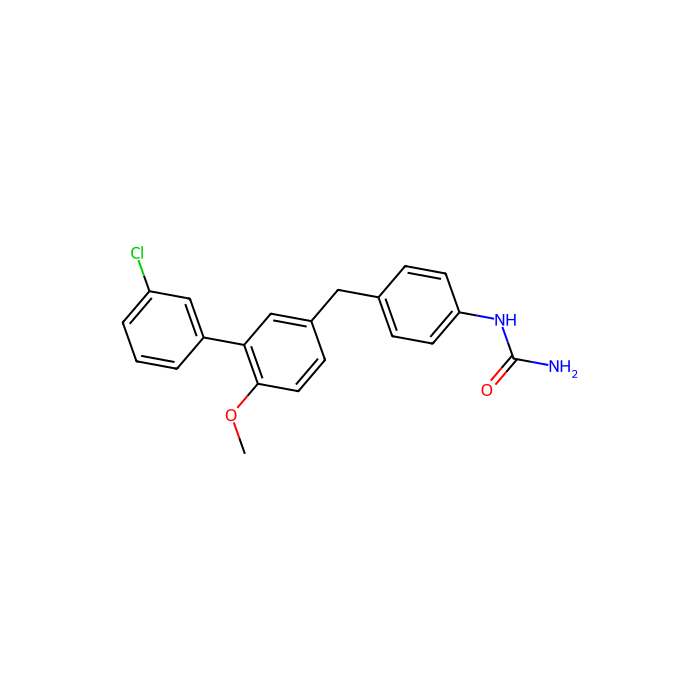
D159687 is a selective PDE4D inhibitor. D159687 has a procognitive profile as it improved memory in the novel object recognition test but no antidepressant or anxiolytic benefit.
Spezifikationen
Synonyme
[4-(3'-chloro-6-methoxy-biphenyl-3-ylmethyl)-phenyl]-urea | Urea, N-(4-((3'-chloro-6-methoxy(1,1'-biphenyl)-3-yl)methyl)phenyl)- | D159687 | D-159687 | Urea, N-[4-[(3'-chloro-6-methoxy[1,1'-biphenyl]-3-yl)methyl]phenyl]- | [4-[[3-(3-chlorophenyl)-4-methoxyphenyl]methyl]phenyl]urea | [4-[[3-(3-chlorophenyl)-4-methoxy-phenyl]methyl]phenyl]u Show more
Spezifikationen & Reinheit
≥98%
Biochemische und physiologische Mechanismen
D159687 is a selective PDE4D inhibitor. D159687 has a procognitive profile as it improved memory in the novel object recognition test but no antidepressant or anxiolytic benefit.
D159687 is a brain-penetrant, orally available, highly potent and selective negative allosteric modulator (NAM) against phosphodiesterase 4 (PDE4) subtype PDE4D (hPDE4D7 IC50 = 27 nM; PDE4A1/B1/C1 IC50 = 2.50/1.47/6.80 μM; IC50 ≥29 μM against PDE1/2/3/5/7/8/9/10/11 subtypes). Comparing to Rolipram, D159678 offers similar in vivo efficacy on long-term memory formation by novel object recognition test (MED = 3 μg/kg mouse iv., 1 μg/kg rat p.o.), while being more effective in the scopolamine-impaired Y-maze tests (D159678/Rolipram MED = 0.1/1 μg/kg mouse iv. or 30/100 μg/kg mouse p.o.) and much less emetic in shrews/dog/monkeys (by 100-/3000-/500-fold).
Storage
Store at -20°C
Verschickt in
Ice chest + Ice pads
Dieses Produkt erfordert Kühlkettenversand. Grundversand und andere Economy-Optionen sind nicht verfügbar.
This compound belongs to the class of organic compounds known as diphenylmethanes. These are compounds containing a diphenylmethane moiety, which consists of a methane wherein two hydrogen atoms are replaced by two phenyl groups.
External Descriptors
Not available
1. Djoumbou Feunang Y, Eisner R, Knox C, Chepelev L, Hastings J, Owen G, Fahy E, Steinbeck C, Subramanian S, Bolton E, Greiner R, and Wishart DS. ClassyFire: Automated Chemical Classification With A Comprehensive, Computable Taxonomy. Journal of Cheminformatics, 2016, 8:61.
Wir verwenden Cookies, um die ordnungsgemäße Funktion der Website sicherzustellen und, soweit zulässig, Ihr Nutzererlebnis zu verbessern. Sie können Ihre Einstellungen jederzeit unter „Einstellungen“ verwalten. Weitere Informationen finden Sie in unserer Cookie-Richtlinie.
Dürfen wir Sie über Rabattaktionen informieren?
Später erinnern
Vielen Dank! Bitte überprüfen Sie Ihren E-Mail-Posteingang, um zu bestätigen.
Products are supplied to verified businesses, institutions, and qualified professionals for research and development use only. Not for use in humans, animals, diagnosis, or therapy.

 B2421213