This compound belongs to the class of organic compounds known as d-alpha-amino acids. These are alpha amino acids which have the D-configuration of the alpha-carbon atom.
External Descriptors
Other amino acids
1. Djoumbou Feunang Y, Eisner R, Knox C, Chepelev L, Hastings J, Owen G, Fahy E, Steinbeck C, Subramanian S, Bolton E, Greiner R, and Wishart DS. ClassyFire: Automated Chemical Classification With A Comprehensive, Computable Taxonomy. Journal of Cheminformatics, 2016, 8:61.
Determine the necessary mass, volume, or concentration for preparing a solution.
Dilution Calculator
Determine the dilution needed to prepare a stock solution.
Reconstitution Calculator
Bewertungen
Kundenbewertungen
Application Protocols
No manufacturer-validated application protocols are provided for this catalog entry.
General research-use guidance (literature-informed)
Preparation of aqueous stock: dissolve the required mass in sterile deionized water or buffer (typically pH 5–6 for improved stability), filter-sterilize through 0.22 μm if sterility is required. Record concentration gravimetrically to avoid volumetric errors due to partial solubility.
Chiral control experiments: when used as a stereochemical control versus L-glutamine, prepare matched-concentration stocks and confirm identity by chiral HPLC.
Peptide synthesis: for iterative couplings, use protected derivatives (e.g., Boc-/Fmoc-D-Gln) rather than the free amino acid; follow standard SPPS or solution-phase protocols.
Note
For specific, validated procedures, consult primary literature or institutional SOPs. This product is designated for research use only (per Product Data).
Biological Roles
Context for D-Glutamine in biochemistry, provided for research perspective only.
General amino acid role (literature)
Glutamine is a key nitrogen donor and carbon source in metabolism; it participates in transamidation reactions and serves as a precursor to nucleotides and other biomolecules. These roles are typically attributed to the L-enantiomer in biological systems.
D- vs L-enantiomers (literature)
The D-form is not commonly incorporated into proteins by ribosomal synthesis but is valuable in studying stereospecificity of enzymes and transporters. D-amino acids can modulate peptide stability toward proteases and are used as stereochemical controls in biochemical assays.
D-glutamine may undergo enzymatic processing by certain racemases or amidases with varying efficiency, enabling comparative kinetics studies against the L-form.
Cell wall and microbial context (literature)
While D-glutamic acid is a well-known constituent of bacterial peptidoglycan, D-glutamine serves primarily as a research probe to dissect amidase/racemase pathways and is not a standard structural component.
Experimental considerations
Use carefully controlled stereochemistry in experiments; small contaminations of the opposite enantiomer can confound results. Verify ee by chiral HPLC or derivatization methods (e.g., Marfey’s analysis).
Note: This section conveys general biochemical knowledge and does not imply any medical or clinical use.
Buffer Applications
Relevance of D-Glutamine to buffer systems.
Applicability
D-Glutamine is not a standard buffering agent. Its acid–base groups (pKa ~2.2 and ~9.1; literature) confer minimal buffering near physiological pH compared with dedicated buffers (HEPES, MOPS, phosphate, Tris).
Practical guidance (literature)
If present in solutions, it will contribute weakly to ionic strength and may undergo slow deamidation, altering pH slightly over time. It should not be relied upon to control pH.
For experiments requiring stable pH, select an appropriate buffering system and consider potential interactions with amino groups (e.g., avoid aldehyde-containing buffers if amine reactivity is a concern).
Suggested alternatives
Use established buffers with suitable pKa near the target pH (e.g., phosphate ~7.2, HEPES ~7.5, acetate ~4.8, Tris ~8.1; literature).
Green Alternatives
Sustainability considerations and greener choices related to the use of D-Glutamine.
Solvent and process choices (literature/general)
Favor water as the reaction/processing medium where feasible; D-Glutamine is inherently water-compatible.
Employ biocatalysts (racemases, amidases, transaminases) for transformations under mild, aqueous conditions, minimizing hazardous reagents and energy use.
Comparisons and tradeoffs (literature)
Free glutamine vs dipeptide surrogates (e.g., alanyl-glutamine): dipeptides offer improved solution stability, reducing waste from degradation; however, they require additional enzymatic/chemical steps to release free glutamine and may introduce complexity in purification.
Coupling reagents: consider greener peptide-coupling methods (e.g., DMTMM, CDI in water, or enzyme-catalyzed ligations) to reduce reliance on benzotriazole-based additives.
Waste minimization
Prepare only the amount of aqueous solution needed for short-term use to limit deamidation byproducts.
Recycle rinses and use minimal organic co-solvent; opt for ethanol over more hazardous organics when a co-solvent is necessary.
Energy and storage
Room-temperature storage of the dry solid (as per Product Data) is energy efficient; for solutions, low-temperature storage extends life, reducing the need for frequent re-preparation.
Pharmaceutical Uses
Information below pertains to formulation science and manufacturing contexts; no therapeutic claims are made.
General roles of amino acids (literature)
Amino acids can function as stabilizers, tonicity agents, and pH adjusters in certain formulations. Choice depends on compatibility, solubility, and stability.
Considerations specific to glutamine (literature)
Free glutamine in aqueous solution is chemically labile (deamidates to glutamate and ammonia), which can impact pH and product quality over time. This limits its use as a long-term solution component without stabilization strategies.
D-Glutamine may be used in process development and analytical method controls where stereochemistry is critical (e.g., chiral separation development, impurity profiling, or as a counter-enantiomer standard).
Manufacturing and media
Amino acids are widely used in fermentation and cell-free systems as nutrients or building blocks; selection of D- vs L-enantiomer is application-dependent. D-Glutamine is primarily a research reagent rather than a common process additive.
Documentation
If intended for regulated applications, verify compliance with relevant pharmacopeial monographs or compendial status (none specified here) and ensure supporting data (identity, purity, bioburden, endotoxin) are appropriate for the intended use.
Physical Properties
Key physicochemical attributes relevant to handling and use.
Item-specific (from Product Data)
Appearance: Not specified for this item; refer to CoA/Spec Sheet.
Literature/typical values for D-/L-Glutamine (enantiomers share bulk properties)
Physical state: crystalline solid; zwitterionic at neutral pH (literature)
Melting/decomposition: ~185–190 °C with decomposition (literature)
Aqueous solubility: ~35 g/L at 25 °C; solubility increases with temperature and decreases in high-ionic-strength media (literature)
Solubility (organics): poorly soluble in most nonpolar and aprotic organic solvents; moderately in hot methanol/ethanol; insoluble in ethers (literature)
Optical rotation: equal magnitude/opposite sign to L-enantiomer; specific value depends on solvent, concentration, and temperature (literature)
Practical implications
Strong hydrogen-bonding and zwitterionic character favor water-based operations; drying from organics is inefficient.
Thermal processing above ~180 °C risks deamidation/cyclization to pyroglutamyl species; avoid prolonged heating.
Note: Where exact numeric specifications are required for QC, use the item’s CoA/Spec Sheet.
Quality and Grades
Clarification of grade, purity, and what they imply for use.
Item-specific (from Product Data)
Grade/Purity: Not specified for this item; refer to CoA/Spec Sheet.
Interpreting common grades for amino acids (general guidance)
Analytical reagent (AR) grade: suitable for general analytical and synthetic work; typical assays report identity, assay by titration/HPLC, and loss on drying.
Biochemical/cell culture grade: tighter limits on bioburden/endotoxin, heavy metals, and UV-absorbing impurities; often supported by low bioburden and sterility testing. For cell culture, L-alanyl-L-glutamine is often preferred due to solution stability, but D-Glutamine may be used in specific research contexts (e.g., stereochemical controls).
Peptide synthesis grade: attention to enantiomeric excess (ee), residual solvents, and trace metals; Fmoc/Boc-protected D-Gln derivatives are commonly specified rather than the free amino acid.
What to check on the CoA/Spec Sheet (recommendations)
Assay (%), identity (IR/NMR/HPLC), enantiomeric purity (chiral HPLC/optical rotation), water (Karl Fischer), residual solvents, heavy metals, bioburden/endotoxin (if applicable), and appearance.
Stabilizers/additives
None are typically required for the dry solid. Any present stabilizer or anti-caking agent should be explicitly stated on the CoA if used (not specified for this item).
Reaction and Applications
How D-Glutamine functions in synthesis and laboratory workflows.
Chiral pool building block (literature)
Provides the D-configuration at the α-center, enabling access to D-amino-acid-containing peptides, peptidomimetics, and chiral ligands.
The γ-amide side chain is typically non-reactive under peptide-coupling conditions, allowing selective chemistry at the α-carboxyl and α-amino groups.
Representative transformations and uses (literature)
Peptide coupling: conversion of the α-carboxyl to activated esters (e.g., HATU/HBTU/EDC) for amide bond formation with amines; α-amino typically protected as Boc or Fmoc when iterative couplings are needed.
Protection strategy: side-chain amide often left unprotected; in demanding sequences, transient protection (e.g., Trt on Gln side chain via imidate chemistry) may be employed to limit side reactions (e.g., cyclization to pyroglutamyl species).
Hydrolysis/deamidation: controlled conversion to D-glutamic acid under acidic/basic hydrolysis or via amidases; useful for accessing D-Glu derivatives.
Enzymatic processes: substrate or control in studies with amino acid racemases, amidases, and transaminases; D-enantiomer helps probe enzyme stereoselectivity.
Practical tips
Maintain mildly acidic conditions during workup/storage of solutions to reduce deamidation.
Use chiral HPLC or optical rotation to confirm enantiopurity after transformations.
Avoid high temperatures and strong bases that promote cyclization to pyroglutamyl derivatives.
Reaction Conditions
Typical conditions for representative transformations involving D-Glutamine (general literature guidance; not product-specific specifications).
Peptide coupling (solution phase)
Solvent: DMF, NMP, or aqueous-organic mixtures; for greener options, water/MeCN with DMTMM is effective.
Activators: HATU/HBTU/EDC·HCl with HOAt/HOBt (or Oxyma) and base (DIPEA, NMM).
Temperature: 0–25 °C to minimize racemization; times 0.5–4 h depending on partner reactivity.
Workup: aqueous quench, extraction where applicable, or direct precipitation of protected peptides; monitor by LC-MS/HPLC.
Enzymatic hydrolysis to D-glutamate
Medium: buffered aqueous (pH 7–8); enzyme: amidase or glutaminase variant with D-substrate tolerance (selection is empirical).
Conditions: dehydrating agents (e.g., carbodiimides) or heating can promote intramolecular cyclization; minimize if undesired by maintaining low temperatures and brief activations.
Salt formation/crystallization
Formation of hydrochloride or other salts can aid purification and handling; crystallization from aqueous ethanol or water is common.
Note: Expected yields and rates vary with substrates and catalysts; optimize on small scale and verify enantiopurity post-reaction.
Safety and Handling
Guidance for safe laboratory use. Always consult the SDS for authoritative information.
Item-specific (from Product Data)
Storage conditions: Room temperature
Shipping: Normal
GHS classification / signal word / H-statements / pictograms: Not specified for this item; refer to SDS.
General safety (literature/typical for amino acids)
Likely low acute toxicity; may cause mechanical irritation to eyes/respiratory tract as dust. Avoid inhalation and contact with eyes/skin.
PPE: lab coat, safety glasses, nitrile gloves; use a dust mask or work in a fume hood when handling powders.
Incompatibilities: strong oxidizers; avoid mixing with strong acids/bases at elevated temperatures (can promote decomposition). Hygroscopic tendencies warrant keeping container tightly closed with desiccant.
Thermal/chemical stability: aqueous solutions slowly deamidate (faster at neutral–basic pH and elevated temperature), forming glutamic acid and ammonia; dry solid is comparatively stable.
First aid (overview; defer to SDS)
Inhalation: move to fresh air; seek medical attention if symptoms persist.
Skin/eye contact: rinse with water for several minutes; remove contaminated clothing.
Ingestion: rinse mouth; seek advice if unwell.
Waste and spills
Small spills: avoid dust generation; sweep up and place in suitable container. Dispose according to institutional and local regulations.
Solvent Selection
Choosing media for dissolution and processing of D-Glutamine.
Physicochemical profile (literature)
Highly polar, strongly hydrogen-bonding zwitterion at neutral pH.
Best dissolved in water; limited solubility in most organics.
Recommended media and tips
Water or aqueous buffers near pH 5–6 provide good solubility and improved stability against deamidation compared with neutral–basic pH.
Avoid prolonged heating; prepare solutions at room temperature or slightly warmed (<40 °C) if needed.
For nonaqueous operations, use polar protic solvents (hot methanol/ethanol) or mixed aqueous-organic systems; expect limited capacity.
Comparison (literature, typical)
D-Glutamine vs L-Glutamine: solubility profiles are essentially identical; selection is based on stereochemical requirements.
Free glutamine vs dipeptide substitutes (e.g., L-alanyl-L-glutamine): dipeptides offer markedly improved solution stability but require enzymatic/chemical release of glutamine; not a direct solvent consideration but relevant for aqueous formulation stability.
When to choose alternatives
For high-concentration aqueous feeds or long-term stocks, consider more stable surrogates (e.g., dipeptides) or store D-Glutamine solutions frozen in aliquots to mitigate degradation.
Storage and Reconstitution
How to store and prepare D-Glutamine for laboratory use.
Item-specific (from Product Data)
Storage conditions (dry solid): Room temperature
Shipped: Normal
General best practices (literature/guidance)
Keep tightly sealed in a cool, dry place; protect from moisture and prolonged exposure to heat.
If desiccation is available, store with a desiccant to limit water uptake and caking.
Preparing solutions
Dissolve in water or buffer; target pH 5–6 for improved stability relative to neutral–basic pH. Gentle warming (<40 °C) can aid dissolution.
Filter-sterilize (0.22 μm) if sterility is required; avoid autoclaving prepared solutions, which accelerates degradation.
Due to deamidation in water, prepare fresh solutions when possible. For longer-term storage, aliquot and freeze at −20 to −80 °C; avoid repeated freeze–thaw cycles.
Shelf life considerations
The dry solid is comparatively stable at room temperature when kept dry. Aqueous solutions show time- and temperature-dependent conversion to glutamate and ammonia; monitor by HPLC if solution age could impact results.
Documentation
For any lot-specific reconstitution instructions, stability data, and acceptable storage durations, refer to the item’s CoA/Spec Sheet and SDS.
Structure and Identity
Concise overview of the molecular identity and stereochemical features for D-Glutamine.
Item-specific (from Product Data)
SKU: D107632
Product name: D-Glutamine
CAS: 5959-95-5
PubChem CID: 145815
InChIKey: 454336 (as provided)
SMILES: Not specified for this item; refer to CoA/Spec Sheet.
Molecular formula: Not specified for this item; refer to CoA/Spec Sheet.
Molecular weight: Not specified for this item; refer to CoA/Spec Sheet.
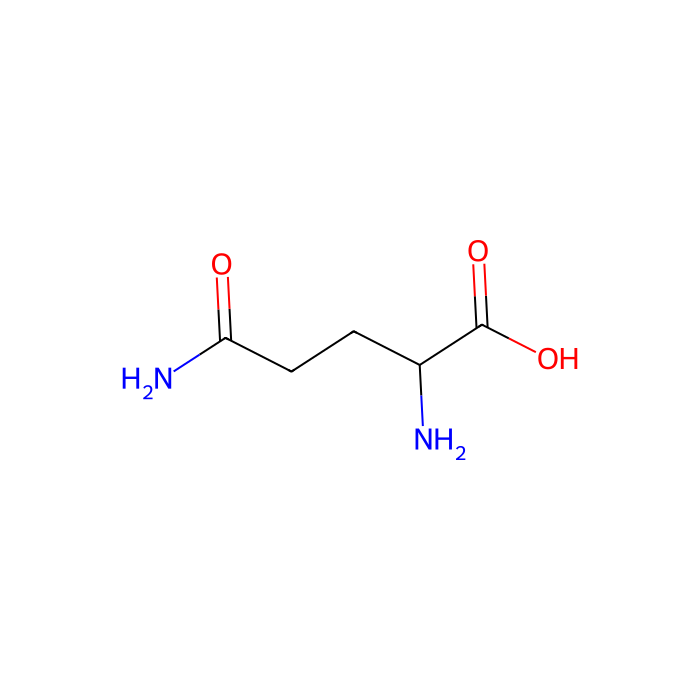
Functional groups: α-amino acid (α-NH2, α-CO2H) with a γ-amide side chain (–CH2–CH2–CONH2); one stereogenic center at Cα (D-configuration).
2D structural description: a five-carbon backbone; from the α-carbon, one branch bears a protonated amino group (–NH2/–NH3+ depending on pH) and a carboxylate/carboxylic acid; the side chain extends –CH2–CH2– to a terminal amide (–CONH2). The α-carbon absolute configuration corresponds to the D series.
Notes
D-Glutamine is the enantiomer of the biosynthetic L-Glutamine. Enantiomers have identical composition but opposite optical rotation and may display different interactions with chiral catalysts, enzymes, or chiral stationary phases.
Synthetic Utility
Functional-group reactivity and strategic value of D-Glutamine in synthesis (literature-based guidance).
Functional groups and selectivity
α-Carboxyl (–CO2H): amenable to activation (e.g., mixed anhydrides, active esters) for amide formation; sensitive to racemization under strong base.
α-Amino (–NH2): typically protected as Boc or Fmoc for iterative couplings; forms salts with mineral acids for crystallization/handling.
γ-Amide side chain: generally inert under standard peptide coupling; can be hydrolyzed to the corresponding D-glutamate (acid) under forcing conditions or enzymatically.
Strategic applications
Chiral pool approach to D-peptides and peptidomimetics; incorporation enhances proteolytic stability and alters conformational preferences.
Precursor to D-glutamic acid derivatives via selective side-chain hydrolysis; useful for accessing D-Glu-based organocatalysts or ligands.
Formation of lactams/pyroglutamyl derivatives under dehydrative or thermal conditions provides cyclic scaffolds for further derivatization.
Tactics to maintain stereochemical integrity
Use mild bases (DIPEA) and rapid couplings (HATU/HBTU/DMTMM) at low temperature to limit epimerization.
Monitor for side reactions (e.g., Gln → pyroglutamyl) during prolonged activations; consider side-chain protection if necessary.
Analysis and QC
Confirm structure and ee using chiral HPLC, Marfey’s derivatization, or NMR with chiral shift reagents; verify low levels of residual coupling reagents and solvents.
Target Specificity
Not applicable to this product.
This item is a small-molecule amino acid, not a biological targeting reagent (e.g., antibody, ligand with defined receptor selectivity provided by the manufacturer). No target/epitope specificity is supplied in the Product Data.
Häufig gestellte Fragen
How should this product be stored?
Store at room temperature.
How is this product shipped?
This product ships under standard ambient conditions. No temperature-controlled packaging is required.
What are the CAS number, molecular formula and molecular weight?
The CAS Number is 5959-95-5, the molecular formula is C5H10N2O3, and the molecular weight is 146.14 g/mol. InChIKey ZDXPYRJPNDTMRX-GSVOUGTGSA-N.
What is the purity of this product?
This product is supplied at ≥98% purity (chemical assay). Lot-specific values are stated on the Certificate of Analysis.
What documentation is provided?
Available product documentation, including Certificates of Analysis (COA), Safety Data Sheets (SDS), and specification sheets, is shown in the product document area. Document availability and access follow the current site policy.
Wir verwenden Cookies, um die ordnungsgemäße Funktion der Website sicherzustellen und, soweit zulässig, Ihr Nutzererlebnis zu verbessern. Sie können Ihre Einstellungen jederzeit unter „Einstellungen“ verwalten. Weitere Informationen finden Sie in unserer Cookie-Richtlinie.
Dürfen wir Sie über Rabattaktionen informieren?
Später erinnern
Vielen Dank! Bitte überprüfen Sie Ihren E-Mail-Posteingang, um zu bestätigen.
Products are supplied to verified businesses, institutions, and qualified professionals for research and development use only. Not for use in humans, animals, diagnosis, or therapy.

 I2109223