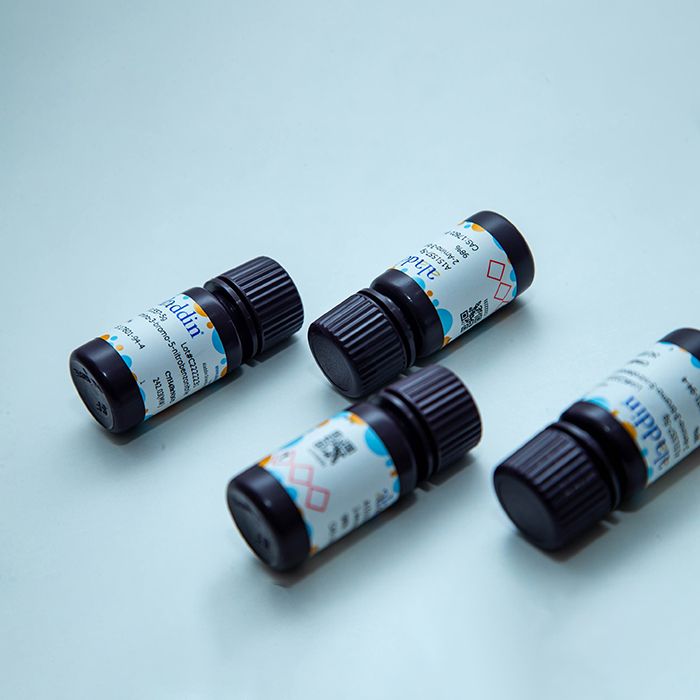
Dehydrocorydaline (13-Methylpalmatine) hydroxyl is an alkaloid that regulates protein expression of Bax , Bcl-2 ; activates caspase-7 , caspase-8 , and inactivates PARP. Dehydrocorydaline hydroxyl elevates p38 MAPK activation. Anti-inflammatory and a
Appearance:Solid
In Vitro:Dehydrocorydaline hydroxyl (0-200 μM) treatment significantly inhibits the growth of MCF-7 cells in a dose-dependent manner. The cell viability is decreased by approximate 40% after 24 h of 200 μM Dehydrocorydaline hydroxyl. Dehydrocorydaline hydroxy
In Vivo:Dehydrocorydaline hydroxyl manifests a low acute toxicity with an LD 50 of about 277.5±19.0mg/kg body weight in mice following oral administration and 21.1±1.4mg/kg for intraperitoneal injection. MCE has not independently confirmed the accuracy of
Biological Activity:Dehydrocorydaline (13-Methylpalmatine) hydroxyl is an alkaloid that regulates protein expression of Bax , Bcl-2 ; activates caspase-7, caspase-8 , and inactivates PARP . Dehydrocorydaline hydroxyl elevates p38 MAPK activation. Anti-inflammatory and anti-c
Spezifikationen
Spezifikationen & Reinheit
≥99%
Storage
Store at -20°C
Verschickt in
Ice chest + Ice pads
Dieses Produkt erfordert Kühlkettenversand. Grundversand und andere Economy-Optionen sind nicht verfügbar.
Aktionsart
INHIBITOR
Reinheit
≥99%
Namen und Kennungen
Molekulargewicht
383.44
Erweiterte Daten
Zertifikate (CoA, COO, BSE/TSE und Analyse-Diagramm)
C of A & Other Certificates(BSE/TSE, COO):
Analytical Chart:
Lösungsrechner
Molarity Calculator
Determine the necessary mass, volume, or concentration for preparing a solution.
Dilution Calculator
Determine the dilution needed to prepare a stock solution.
Reconstitution Calculator
Bewertungen
Kundenbewertungen
Application Protocols
No item-specific, tested application protocols are provided for this product. For general use:
Analytical reference: prepare accurately weighed standards in DMSO/MeOH, dilute with acidified water–organic for LC/PDA/MS. Validate linearity, precision, and stability in your matrix.
Screening: prepare sterile-filtered stocks in DMSO; dilute into assay buffer immediately before use, maintaining low final DMSO content (≤0.1–0.5%). Include appropriate positive/negative controls and solubility checks.
Refer to your internal SOPs and method validation guidelines. This product is for research use only.
Biological Roles
General literature context (no medical/clinical claims; for research background only):
Dehydrocorydaline belongs to the broader class of protoberberine/benzylisoquinoline alkaloids reported from Corydalis and related plants. Members of this class are often cationic, planar, and conjugated, features associated with interactions with nucleic acids, membranes, and diverse enzymes in vitro.
Hydroxylation relative to methoxy congeners can modulate hydrogen bonding, polarity, and ionic interactions, potentially shifting target engagement profiles and transport properties (e.g., uptake via transporters vs passive diffusion). Phenolic groups may also influence redox behavior and metal-chelation tendencies in biochemical assays.
In biochemical investigations, protoberberines are frequently profiled against kinases, topoisomerases, and oxidoreductases, as well as in cell-free systems monitoring intercalation or groove-binding to polynucleotides. Such studies often exploit the strong UV absorbance of the chromophore for detection and quantitation.
Metabolic considerations: phenolic alkaloids may undergo phase II conjugation (glucuronidation/sulfation) in biological systems; quaternary cationic centers typically limit passive membrane permeability, which can affect observed cellular activity (literature generalization; verify experimentally for this exact analog).
Note: The above are general roles reported for the structural class. This catalog entry provides no target-specific data for Dehydrocorydaline (hydroxyl). Use this information to design screening cascades and controls rather than to infer activity.
Buffer Applications
This compound is a small-molecule alkaloid standard and is not used as a buffering agent. It does not constitute a conventional buffer system and does not provide defined pH control.
Practical note:
If preparing assay buffers that include this compound, maintain slightly acidic conditions (e.g., with formate/acetate, pH ~4–6) to support solubility of quaternary/phenolic alkaloids. Select buffers and ionic strengths based on the biological assay requirements rather than relying on the compound for pH stabilization.
Green Alternatives
Given this item is a specialty small molecule rather than a process solvent or bulk reagent, “green alternatives” center on solvent choices and workflow design.
Dissolution solvent: prefer ethanol or water (acidified to maintain solubility of the cationic form) over high-toxicity polar aprotics when feasible. DMSO is widely used but consider minimizing final assay %DMSO to ≤0.1–0.5% to reduce environmental and biological burden.
Chromatography: use water/ethanol or water/ACN systems with volatile, low-toxicity additives (formic or acetic acid). Avoid halogenated solvents. Superficially porous columns can reduce solvent consumption by enabling shorter run times.
Sample prep: adopt miniaturized assays (microplate formats) and microscale extractions to reduce solvent volumes. Where cation-exchange SPE is used, choose methanol or ethanol elution instead of more hazardous alternatives.
Trade-offs:
Ethanol and water are greener but may offer lower solubility ceilings than DMSO for highly conjugated salts; precipitation can occur upon dilution—validate solubility at working concentrations.
Acetonitrile provides sharper LC peaks and lower backpressure than methanol but has higher environmental and supply-chain impacts; balance method performance with sustainability goals.
Sustainability tips:
Prepare concentrated stocks once, aliquot, and store at –20°C to minimize repeated solvent use. Use light-protective vials to extend solution life and reduce re-preparation frequency.
Pharmaceutical Uses
No excipient or pharmacopeial status is specified for this catalog item; it is supplied strictly for research use only.
Research/manufacturing context (non-clinical):
Can serve as a reference standard for analytical profiling of botanical raw materials and finished products containing Corydalis-derived alkaloids. Typical uses include method development and system suitability in RP-HPLC/UPLC with photodiode array or MS detection.
Useful for spike-recovery experiments during extraction optimization, cleanup validation (e.g., cation-exchange SPE), and matrix-effect assessments in LC–MS workflows.
When preparing calibration solutions for QC method development, record exact salt form, counterion content, and water content to ensure accurate mass balance. Use Class A glassware, gravimetric dilutions, and properly validated storage conditions for standards.
No therapeutic indications or clinical applications are provided or implied for this item.
Physical Properties
Item-specific properties:
Appearance: Not specified for this item; refer to CoA/Spec Sheet.
Melting point: Not specified for this item; refer to CoA/Spec Sheet.
Boiling point: Not applicable/relevant for ionic polycyclic alkaloids; Not specified for this item; refer to CoA/Spec Sheet.
Density: Not specified for this item; refer to CoA/Spec Sheet.
Solubility: Not specified for this item; refer to CoA/Spec Sheet.
LogP/logD: Not specified for this item; refer to CoA/Spec Sheet.
Refractive index: Not applicable (solid); Not specified for this item; refer to CoA/Spec Sheet.
Literature/general expectations for protoberberine-type, quaternary isoquinolinium alkaloids (for context only):
Physical state: typically yellow to orange crystalline solids due to extended conjugation (exact color for this item not specified).
Solubility profile: readily soluble in polar organic solvents (DMSO, methanol, ethanol) and in water when present as a chloride or similar salt; limited solubility in nonpolar solvents (e.g., hexanes, toluene).
UV/Vis: strong absorption in the near-UV/visible region owing to the conjugated cationic chromophore; analytical detection often set between ~340–430 nm depending on substitution (exact λmax for this item not specified).
Ionization: permanently cationic (quaternary) in many dehydrogenated protoberberines; phenolic –OH groups (if present) can engage in hydrogen bonding and may influence pKa of counterions/phenolate equilibria, but the core cation does not neutralize under physiological pH.
Note: Use the item’s CoA for definitive numeric specifications; values above are general literature expectations and not product specifications.
Quality and Grades
Grade/purity: Not specified for this item; refer to CoA/Spec Sheet.
Interpretation and guidance:
In the absence of a stated grade (e.g., ≥98%, HPLC-grade, reference standard), consult the Certificate of Analysis for assay method (commonly HPLC/UPLC-DAD or LC-MS), purity value, residual solvent content, and water content, if applicable.
Natural-product-like alkaloids often require orthogonal identity confirmation. High-confidence lots typically include: HPLC purity trace with gradient details and detection wavelength(s), HRMS within defined ppm error, and 1H/13C NMR with solvent assignment. When a hydroxylated analog is specified, spectral data should clearly indicate phenolic signals (e.g., exchangeable OH, downfield aromatic carbons) to distinguish from methoxy-only congeners.
For chromatographic applications (as an analytical reference), low baseline absorbance impurities and stable retention are critical. If your use-case is quantitative (e.g., calibration in LC/LC-MS), request or verify: extinction coefficient (if available), salt form and counterion content, and exact water/ash content when preparing gravimetric standards.
If stabilizers are used or if the material is provided as a specific salt (e.g., chloride), this should be declared on the CoA. No stabilizer or salt-form details are provided in this listing; confirm before method development.
Batch-to-batch consistency: given potential polymorphism/solvate formation in alkaloid salts, confirm appearance and HPLC profile on receipt and before critical assays.
Reaction and Applications
This product is positioned in a small-molecule/compound library context and is primarily used as a chemical standard, screening hit, or reference alkaloid rather than as a general-purpose reagent.
Applications (research use only):
Chemical biology and phenotypic screening: quaternary isoquinolinium alkaloids are frequently evaluated in target-agnostic panels. Dehydrocorydaline-type hydroxylated analogs enable SAR exploration versus methoxy congeners, with the phenolic group affecting charge distribution, solubility, and potential H-bonding patterns (literature/general).
Analytical reference: useful as a marker compound in phytochemical profiling of Corydalis and related botanicals. Employed to optimize extraction, cleanup, and RP-HPLC/UPLC separations using acidified aqueous–organic mobile phases.
Photophysics and binding studies: conjugated cationic chromophore provides strong UV/Vis absorbance; fluorescence is typically weak to moderate but environment-sensitive, enabling qualitative binding readouts in some systems (literature/general; confirm experimentally).
Experimental tips:
Prepare concentrated stocks in DMSO or MeOH; filter (0.2 µm PTFE) for chromatography. For LC–MS method development, start with water/MeOH or water/ACN with 0.05–0.1% formic acid; monitor [M]+ or [M+H]+ in positive ESI.
If derivatization is desired for analytical tagging, prioritize phenolic O-acylation or O-alkylation under mild conditions; avoid conditions that could disrupt the quaternary nitrogen.
For solid-phase extraction (SPE), cation-exchange cartridges can deliver selective retention and cleanup; elute with basic MeOH (e.g., MeOH + 2% NH4OH), then re-acidify for LC compatibility.
Reaction Conditions
Because Dehydrocorydaline (hydroxyl) is not generally used as a reagent but as an analyte/screening compound, the most relevant “conditions” are analytical and mild derivatizations (literature/general guidance):
Stock preparation: dissolve at 1–50 mM in DMSO or methanol. For aqueous systems, adjust to mildly acidic pH (e.g., 0.05–0.1% formic acid) to maintain solubility. Filter through 0.2 µm PTFE/NYLON prior to LC.
LC/UPLC methods: reversed-phase C18/C8 columns; mobile phase A: water + 0.05–0.1% formic or acetic acid; mobile phase B: ACN or MeOH. Typical gradients 5–60% B over 5–20 min at 25–40°C. Detect by PDA at a visible/near-UV wavelength appropriate for protoberberines; confirm by positive ESI-MS.
SPE cleanup (if in complex matrices): strong cation-exchange cartridges; load in acidified aqueous MeOH, wash with weak acidified solvent, elute with MeOH + 1–2% NH4OH, then neutralize/acidify before LC.
Mild O-derivatizations: for acylation, employ acyl chloride/anhydride (1.1–1.5 eq) in dry DCM/MeCN or pyridine at 0–25°C; for alkylation, use alkyl halides in MeCN/DMF with weak base or phase-transfer conditions. Monitor by LC–MS; quench and purify promptly to avoid overreaction or decomposition.
All values above are literature-style generalizations for this structural class and are not product specifications. Optimize empirically for your lab’s equipment and the exact lot.
Safety and Handling
Item-specific hazard data:
Signal word: Not specified for this item; refer to SDS.
H-statements: Not specified for this item; refer to SDS.
GHS classification/pictograms: Not specified for this item; refer to SDS.
General safety guidance for alkaloid research chemicals (literature/practice-based; defer to SDS):
Handle in a chemical fume hood. Avoid inhalation of dust or aerosols and prevent skin/eye contact. Wear appropriate PPE: lab coat, safety glasses/goggles, and chemically resistant gloves (e.g., nitrile). Consider double-gloving for extended handling.
Many isoquinolinium alkaloids can be bioactive; minimize exposure and avoid ingestion. Do not pipette by mouth. Wash thoroughly after handling.
Incompatibilities: strong oxidizers and strong bases may cause degradation; avoid prolonged exposure to high pH, which can promote O-dealkylation of methoxy groups in some analogs. Avoid reducing agents that could alter the quaternary center.
Stability considerations: protect from light to prevent potential photodegradation of conjugated chromophores. Keep tightly closed and dry; moisture may affect hygroscopic salts.
First aid (overview; follow SDS): if inhaled—move to fresh air; if on skin—wash with soap and water; if in eyes—rinse cautiously with water for several minutes and remove contact lenses; if swallowed—rinse mouth and seek medical attention.
Spill/cleanup: avoid dust generation; absorb small spills with inert material and dispose of as hazardous chemical waste consistent with institutional and regulatory requirements.
Solvent Selection
Context for handling and formulation (literature/general for protoberberine-type alkaloids):
Polarity/ionicity: materials of this class are often quaternary ammonium salts, favoring dissolution in polar protic solvents and DMSO. Aqueous solubility is typically good to excellent when the salt form is present (e.g., chloride). Neutral or highly nonpolar solvents generally provide poor solubility.
Recommended solvents for stock solutions and analytics:
Primary: DMSO (analytical and biological screening stocks), methanol, ethanol.
Aqueous: water or buffer (pH ~3–6) may improve solubility and stability for phenolic analogs; mildly acidic modifiers (e.g., 0.1% formic acid) help maintain the cationic form and robust peak shape in LC.
Avoid: strong bases (risk of structural changes) and nonpolar solvents (hexanes, heptane) due to low solubility.
Comparison and practical tips:
DMSO vs ethanol: DMSO allows high-concentration stocks with broad compatibility in in vitro assays, but can complicate MS sensitivity at high injection loads; ethanol is greener and volatile, helpful for film-casting or quick evaporation.
MeOH vs acetonitrile (ACN): both are LC-friendly; MeOH often enhances UV response for protoberberines, whereas ACN can sharpen peaks and reduce backpressure in reversed-phase LC.
For preparative handling, pre-wet reversed-phase media with acidified water/MeOH to retain cationic alkaloids efficiently. If material is highly hygroscopic, weigh rapidly and prepare solutions immediately to ensure accuracy.
Storage and Reconstitution
Item-specific instructions:
Storage conditions: Store at -20°C (per product data). Protect from light and moisture. Keep container tightly closed.
Shipping: Shipped in an ice chest with ice pads (per product data). Inspect upon receipt; if warm, allow to equilibrate to room temperature in a desiccator before opening to minimize condensation.
General guidance (literature/practice-based):
Solid stability: many conjugated alkaloid salts are stable when kept cold, dry, and protected from light. Avoid repeated warming/cooling cycles.
Reconstitution: dissolve in DMSO, methanol, or ethanol to prepare concentrated stocks. For aqueous work, dilute into mildly acidic buffer or water containing 0.05–0.1% formic or acetic acid to promote solubility. Record exact solvent, concentration, and counterion.
Aliquoting: prepare single-use aliquots to avoid repeated freeze–thaw. Store aliquots at -20°C or below. Thaw at room temperature; vortex to ensure homogeneity before use.
Solution stability: not specified for this item; refer to CoA/Spec Sheet. As a precaution, prepare fresh working solutions daily and discard if discoloration, precipitation, or baseline drift in LC is observed.
Container recommendations: use amber glass vials for light protection. For LC-MS standards, pre-rinse vials with solvent and use low-adsorption caps/inserts to minimize surface binding.
Research use only. Not for human or veterinary use.
Structure and Identity
SKU: D658915
Product name: Dehydrocorydaline (hydroxyl)
CAS: D658915 (catalog placeholder; not a registry number)
Molecular formula: Not specified for this item; refer to CoA/Spec Sheet.
Molecular weight: Not specified for this item; refer to CoA/Spec Sheet.
SMILES: Not specified for this item; refer to CoA/Spec Sheet.
InChIKey: Not specified for this item; refer to CoA/Spec Sheet.
General structural notes (literature/general knowledge):
Dehydrocorydaline is commonly classified among protoberberine/benzylisoquinoline alkaloids found in Corydalis and related genera. Many members of this class are quaternary ammonium salts with a tetracyclic isoquinolinium core bearing multiple methoxy and/or hydroxy substituents.
The “(hydroxyl)” designation suggests a hydroxylated analog or salt form bearing at least one phenolic –OH in place of a methoxy group; exact regiochemistry is not specified for this catalog item.
Typical structural features for this family include: an isoquinolinium cation (planar, conjugated), two or more aryl–O substituents (–OMe/–OH), and, in quaternary forms, a permanently charged nitrogen increasing aqueous affinity and UV absorbance.
2D description (literature-typical for protoberberines): a fused polycyclic cationic ring system (four rings) with anisole/phenolic substituents around the periphery; no stereogenic centers when in the fully aromatic quaternary form. Exact positions for this item are not provided here.
Identity verification guidance:
Confirm by combined techniques: HRMS (m/z of molecular ion or [M]+/[M+H]+ consistent with quaternary/phenolic form), 1H/13C NMR (diagnostic downfield aromatic signals, methoxy singlets if present, phenolic OH), and HPLC/UPLC retention vs reference when available.
Synthetic Utility
While primarily a screening/reference small molecule, limited synthetic manipulations can be informative for probe development and analytical tagging (literature/general):
Phenolic functionalization: the “(hydroxyl)” handle enables O-acylation (e.g., with acyl chlorides/anhydrides under mild base) or O-alkylation (e.g., SN2 with alkyl halides under phase-transfer or in polar aprotic media). Protecting-group strategies (e.g., silyl ethers, carbonate formation) can facilitate multi-step work.
Salt/metathesis: if supplied as a particular counterion (e.g., chloride), ion exchange can provide alternative salts (e.g., PF6−, BF4−) to tune solubility and crystallinity for structural studies. Conduct exchanges under controlled conditions to avoid degrading the quaternary center.
Conjugation chemistry: phenolic groups can be converted to activated carbonates/carbamates for tethering to labels or resins. Avoid strongly basic or reductive conditions that might compromise the isoquinolinium core.
Analytical derivatives: formation of UV-rich or fluorogenic esters can assist in trace-level detection, though the native chromophore already offers strong UV response.
Retrosynthetic note:
The rigid protoberberine scaffold limits late-stage diversification primarily to O-functional group manipulations and counterion exchange. N-centered reactions are typically constrained by the quaternary nature of the nitrogen.
Caution: The exact reactivity and optimal conditions depend on the specific substitution pattern and salt form of this item; verify by small-scale trials and spectroscopic monitoring.
Target Specificity
Not applicable. This product is a small-molecule alkaloid standard and is not an antibody or affinity reagent. No antigen/epitope, species reactivity, clone, or isotype information applies.
Wir verwenden Cookies, um die ordnungsgemäße Funktion der Website sicherzustellen und, soweit zulässig, Ihr Nutzererlebnis zu verbessern. Sie können Ihre Einstellungen jederzeit unter „Einstellungen“ verwalten. Weitere Informationen finden Sie in unserer Cookie-Richtlinie.
Dürfen wir Sie über Rabattaktionen informieren?
Später erinnern
Vielen Dank! Bitte überprüfen Sie Ihren E-Mail-Posteingang, um zu bestätigen.
Products are supplied to verified businesses, institutions, and qualified professionals for research and development use only. Not for use in humans, animals, diagnosis, or therapy.