10mM in DMSO for sensitive chromatographic and analytical workflows requiring minimal baseline interference.
🌡
Storage & shipping
Protected from light,Desiccated,Store at -80°C Ships Dry ice packs + Cold packs Check lot-specific COA for exact specifications.
📋
Quality documents
SDS, COA, datasheet, and spec sheet available for download. Lot-specific COA accessible via lot number lookup.
📚
Literature proof
Cited in 0 peer-reviewed publications across chromatography, organic synthesis, and cross-coupling reactions.
Übersicht
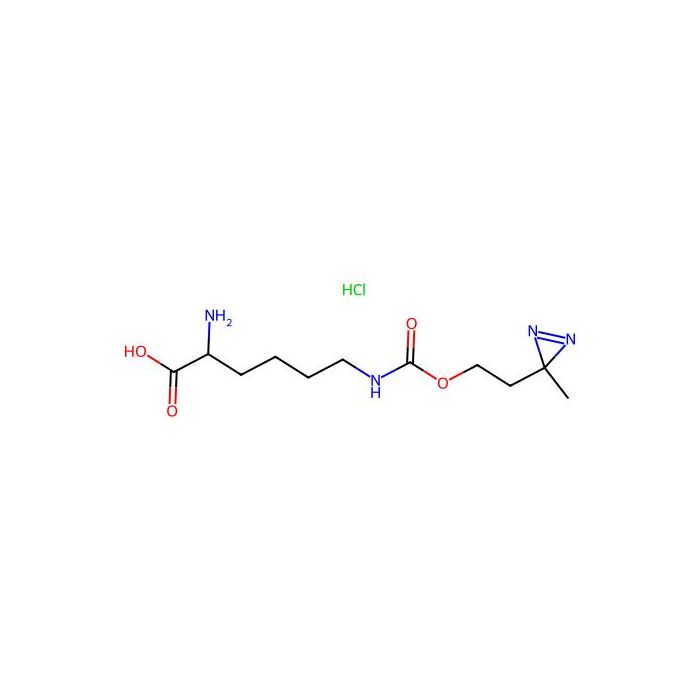
DiAzKs (H-L-Photo-lysine) hydrochloride is a diazirine-containing lysine amino acid and is a photo-cross-linker. DiAzKs hydrochloride can site-selective incorporated into proteins and is used to crosslink protein-protein interactions in vitro and in living cells. DiAzKs hydrochloride acts as a UV light-activated photo-crosslinking probe .
In Vitro
Photo-lysine, which is readily incorporated into proteins by native mammalian translation machinery, can be used to capture and identify proteins that recognize lysine post-translational modifications (PTMs), including 'readers' and 'erasers' of histone modifications. MCE has not independently confirmed the accuracy of these methods. They are for reference only.
Specifications
Spezifikationen & Reinheit
10mM in DMSO
Biochemische und physiologische Mechanismen
DiAzKs (H-L-Photo-lysine) hydrochloride is a diazirine-containing lysine amino acid and is a photo-cross-linker. DiAzKs hydrochloride can site-selective incorporated into proteins and is used to crosslink protein-protein interactions in vitro and in livin
Storage
Protected from light,Desiccated,Store at -80°C
Verschickt in
Dry ice packs + Cold packs
Dieses Produkt erfordert Kühlkettenversand. Grundversand und andere Economy-Optionen sind nicht verfügbar.
Namen und Kennungen
Alternative CAS-Nummer
1253643-88-7
PubChem CID
146026280
Molekulargewicht
308.76
Documentation
📋 Safety Data Sheet (SDS)
Comprehensive hazard, handling, storage, and regulatory compliance document.
Determine the necessary mass, volume, or concentration for preparing a solution.
Dilution Calculator
Determine the dilution needed to prepare a stock solution.
Reconstitution Calculator
Bewertungen
Kundenbewertungen
Application Protocols
Item-specific tested applications and dilutions are not provided. The following is a general, literature-based workflow for diazirine photoaffinity studies; adapt to your system.
Example workflow: Solution-phase photo-crosslinking
Stock preparation: Dissolve DiAzKs hydrochloride in sterile water (slightly acidified if needed) or DMSO to 10–50 mM. Aliquot in amber vials; store at −80 °C.
Sample setup: Add to target protein or cell lysate at the desired final concentration (e.g., 10–500 μM, literature-dependent). Incubate to allow binding/association.
Controls: Include dark control and competition control (with unlabeled ligand or mutated binding site) to assess specificity.
Irradiation: Expose to 350–365 nm light for 0.5–10 min on ice or at room temperature, controlling lamp–sample distance. Minimize heating; gently mix.
Quench/cleanup: Remove unreacted probe (spin columns, precipitation) as appropriate.
Analysis: SDS–PAGE/Western blot, in-gel digestion and LC–MS/MS, or intact MS to identify crosslinked partners.
Notes
For peptide/protein synthesis applications, follow standard Fmoc-SPPS protocols using protected derivatives; conduct all steps under low light.
If live-cell experiments are planned, validate cytocompatible concentrations and irradiation parameters. Observe institutional biosafety practices.
Refer to the product SDS and your method SOPs for definitive operational details.
Biological Roles
Item-specific biological data
None specified for this catalog item; refer to CoA/Spec Sheet for any additional notes.
General/literature perspective on diazirine-containing lysine analogues
Functional concept: These are typically noncanonical amino acids designed to mimic lysine while introducing a photoactivatable diazirine side chain. They do not have endogenous biological roles but are valuable tools for studying biomolecular interactions.
Mechanism in studies: Upon UV activation, the diazirine generates a carbene that can insert into proximal bonds, producing a covalent adduct between the modified residue and interacting partners—capturing transient complexes for downstream analysis (e.g., MS-based proteomics).
Incorporation strategies: Genetic code expansion (amber suppression) to site-specifically install the analogue into proteins in cells or in vitro; solid-phase peptide synthesis to build defined peptides containing the motif; or chemical modification of proteins/ligands when functional handles are present (literature).
Selectivity considerations: Carbene insertion is proximity-driven rather than sequence- or receptor-specific. Therefore, spatial control (site of incorporation, irradiation timing, and duration) is key to achieving meaningful biological readouts.
No clinical or therapeutic claims are made. For research use only.
Buffer Applications
This product is not supplied as a buffering reagent and is not typically used to set or maintain pH.
Practical notes (general)
Dissolution: HCl salts of amino acid derivatives often dissolve readily in slightly acidic aqueous buffers (e.g., acetate, citrate). For neutral pH applications, prepare a concentrated stock in water or DMSO and dilute into the working buffer immediately before use.
Light control: Use amber vials and minimize ambient light to prevent diazirine photoactivation during buffer preparation.
Compatibility: If photo-crosslinking is planned, consider buffer components carefully; primary amines (e.g., Tris) and alcohols can, in principle, quench reactive intermediates during irradiation. Validate empirically with appropriate controls.
For detailed buffer recipes or pH specifications, consult your method requirements; no item-specific buffer data are provided.
Green Alternatives
Applicability
This product is a specialized, photoactive small molecule (likely an amino acid HCl salt). “Greener alternative” considerations pertain more to solvent choices and process conditions than to replacement of the active motif.
Greener practice suggestions (general)
Solvent selection: Prefer water or aqueous buffers where feasible. If organic cosolvents are required, consider ethanol or isopropanol in place of chlorinated solvents, mindful that alcohols can quench carbenes during photolysis.
DMSO vs DMF: For stock solutions, DMSO is often preferred over DMF for greener profiles; both are effective polar aprotics. Minimize volumes.
SPPS process (if applicable): Explore greener coupling protocols (e.g., Oxyma/EDC-HCl in EtOAc or Me-THF) and reduce reliance on DCM/DMF by adopting alternate swelling solvents (literature). Validate photostability under new conditions.
Energy efficiency: Use LED sources at the required wavelength instead of broad-spectrum mercury lamps to reduce energy and heat load, and to improve selectivity.
Waste minimization: Prepare concentrated stocks and aliquot to reduce repeated thaw/irradiation cycles leading to decomposition and waste.
Trade-offs
Water-rich systems are green but may impact membrane permeability in live-cell assays and can increase nonspecific background; optimize to balance performance and sustainability.
No item-specific environmental metrics are specified; consult your EHS group for process-level assessments.
Pharmaceutical Uses
No pharmacopeial status, excipient role, or formulation use is specified for this item. It is offered strictly for research use only.
General context (literature/general knowledge)
Diazirine-containing amino acid analogues are primarily research tools for mechanism elucidation, target identification, and structure–function studies. They are not typical pharmaceutical excipients or APIs.
If used in pre-formulation studies or screening assays, treat as an investigational research chemical. Establish stability-indicating methods under ICH-like stress conditions internally if required for your program.
Regulatory note
For any work intersecting regulated development, ensure internal qualification of the material (identity, purity, impurities, residual solvents) and document storage/handling per GLP/GMP as applicable. Aladdin Scientific supplies this product for laboratory research only.
Physical Properties
Item-specific (from Product Data)
Appearance: Not specified for this item; refer to CoA/Spec Sheet.
Molecular weight: Not specified for this item; refer to CoA/Spec Sheet.
Molecular formula: Not specified for this item; refer to CoA/Spec Sheet.
Other specifications (mp, bp, density, pKa, UV cutoff, water content, metal limits): Not specified for this item; refer to CoA/Spec Sheet.
General/literature guidance for diazirine-containing amino acid hydrochloride salts (not item-specific)
Physical state: typically solid powders at ambient temperature.
Solubility: HCl salts of amino acids often display good solubility in water, aqueous buffers (particularly slightly acidic), and polar aprotic solvents such as DMSO; limited solubility is expected in nonpolar solvents.
Photochemistry: Diazirines are photosensitive; they generally undergo photolysis with UV-A/near-UV light (commonly ~350–365 nm, literature) to generate carbenes.
Stability: Diazirines are regarded as among the more thermally and chemically robust photophores relative to azides, yet should be protected from light and excessive heat to prevent unintended activation (literature).
Acid/base behavior: As an HCl salt, at neutral pH one or more amines may remain protonated; deprotonation and ion-pairing will depend on buffer conditions (general amino acid behavior).
Note: For authoritative, item-specific constants and test methods, consult the product CoA/Spec Sheet and SDS.
Quality and Grades
Item-specific (from Product Data)
Grade/Purity: Not specified for this item; refer to CoA/Spec Sheet.
Guidance on grades and implications (general)
When a purity or grade is specified (e.g., ≥95% by HPLC, peptide synthesis grade), it indicates suitability for demanding applications such as SPPS, photoaffinity proteomics, or probe synthesis. In absence of a stated grade, consult the CoA for actual assay, residual solvents, and chromatographic purity.
Hydrochloride salt: Frequently chosen to enhance handling (reduced hygroscopicity vs. free base in some cases), defined stoichiometry, and improved aqueous solubility. For reactions that require free amine, a base neutralization step may be needed.
Light sensitivity control: For photoactive reagents, quality is closely linked to controlled exposure. Expect packaging in light-protective containers; verify lot-specific photostability notes on the CoA.
Analytical verification: Identity and purity for such compounds are commonly supported by 1H/13C NMR, LC–MS/HRMS, and HPLC. For this catalog item, refer to its CoA/Spec Sheet for the exact test suite and acceptance criteria.
Recommendation
If your application is proteomics/photo-crosslinking, request low-UV-impurity and low-fluorescent-contaminant lots when available. For synthesis workflows, verify compatibility with your protecting group and coupling strategy.
Reaction and Applications
Item-specific applications (from Product Data)
Manufacturer Applications: Not specified for this item.
General/literature applications for diazirine-bearing lysine analogues (not item-specific)
Photoaffinity labeling: Upon UV irradiation (commonly ~350–365 nm), diazirines generate carbenes that insert into nearby C–H, N–H, O–H, and other bonds, enabling covalent capture of transient interactions in proteins, membranes, and complexes.
Chemical biology probes: Incorporated into proteins via genetic code expansion, metabolic labeling, or peptide synthesis to map binding partners and interaction surfaces.
Proteomics workflows: Post-crosslinking enrichment (e.g., via affinity tags on the probe or subsequent chemistries) and MS-based identification of targets.
Materials science: Photopatterning and surface functionalization where carbene insertion affords robust C–C/C–X bonds.
Practical tips (literature)
Minimize light exposure prior to irradiation. Confirm concentration and environment (pH, ionic strength) to balance solubility and native-state interactions.
Degassing is usually not necessary, but oxygen can, in some cases, influence radical pathways; assess impact empirically.
For peptide/protein work, ensure compatibility with buffers and cofactors; some nucleophiles can quench reactive intermediates.
Irradiation: Calibrate lamp output and distance; include dark controls and wavelength controls to validate specificity.
Note: The exact scope for this catalog item depends on its detailed structure; consult CoA/Spec Sheet for structural confirmation.
Reaction Conditions
Item-specific conditions are not provided; the following are literature/general guidelines for related chemistries.
Wavelength: near-UV, commonly ~350–365 nm using LEDs or filtered lamps.
Temperature: 0–25 °C to maintain biomolecular integrity; avoid heating from the light source.
Atmosphere: Ambient is typically acceptable; degassing is usually unnecessary.
Time: Seconds to minutes depending on light intensity, distance, and sample absorbance. Include dark controls.
Matrix: Aqueous buffers or live-cell media; limit components that can quench carbenes (optimize empirically).
Amide coupling (for derivatization or SPPS; literature)
Solvents: DMF, NMP, DCM alternatives (or greener options such as EtOAc/Me-THF when compatible).
Reagents: HATU/HBTU/EDC•HCl with Oxyma; bases such as DIPEA or collidine as required.
Temperature/time: 0–25 °C, 15–120 min typical for solution-phase couplings; monitor by LC–MS.
Work-up and analysis
Protect from light throughout. Use amber glassware and minimize exposure during chromatography.
Verify completion by LC–MS/HPLC; confirm no photolysis by monitoring for N2-loss signatures.
Note: Optimize conditions to your substrate and scale; consult the CoA/Spec Sheet for any stability cautions specific to this item.
Safety and Handling
Item-specific hazard information (from Product Data)
GHS Classification: Not specified for this item; refer to SDS.
Signal Word: Not specified for this item; refer to SDS.
H-Statements: Not specified for this item; refer to SDS.
Pictograms: Not specified for this item; refer to SDS.
General safety guidance (literature/general knowledge)
Photosensitivity: Diazirine groups can be photoactivated; avoid exposure to UV/strong light during handling and storage. Work under low-light or amber conditions.
PPE: Wear lab coat, safety glasses, and appropriate chemical-resistant gloves (e.g., nitrile). Use in a fume hood to minimize exposure to dust or aerosols.
Thermal/chemical stability: Avoid elevated temperatures and strong UV sources to prevent unintended carbene generation. Keep away from strong bases or nucleophiles during long-term storage only as a matter of good practice; diazirines are typically stable under routine laboratory conditions until photolyzed.
Incompatibilities: Avoid strong oxidizers and strong reducing agents unless process-validated. Prevent contact with reactive metals if moisture and chloride could promote corrosion.
First aid (overview; consult SDS): If inhaled—move to fresh air; if on skin/eyes—rinse with water for at least 15 minutes; if ingested—rinse mouth, seek medical advice. Provide SDS to healthcare professionals.
Spill/accidental release: Collect solids with minimal dust generation; for solutions, absorb with inert material. Dispose in accordance with institutional and regulatory requirements.
Always consult the product SDS for definitive hazard classification and response procedures. For research use only.
Solvent Selection
Item-specific (from Product Data)
No solvent recommendations are specified for this item; refer to CoA/Spec Sheet for any lot-specific notes.
General considerations for diazirine-containing amino acid HCl salts (literature/general knowledge)
Polarity & miscibility: HCl salts typically dissolve well in water, dilute acids (e.g., HCl, AcOH), and polar aprotic solvents like DMSO. Solubility in methanol or ethanol may be moderate; poor in nonpolar/hydrocarbon solvents.
Working stocks: For biochemical applications, prepare concentrated stocks in water (acidified if needed) or DMSO, then dilute into buffer immediately before use to limit hydrolysis or background reactivity. Filter-sterilize (0.22 μm) if sterility is required.
Light control: Use amber vials and minimize exposure during dissolution to prevent premature photoactivation.
Compatibility: Choose buffers lacking strong nucleophiles or radical initiators when planning photo-crosslinking to limit non-specific quenching of carbenes (literature). Phosphate, HEPES, or Tris buffers are commonly used; note that free amines (e.g., Tris) can, in principle, intercept carbenes—optimize empirically.
Comparison (general):
Water (acidified): maximizes solubility and protonation; ideal for short-term stocks.
DMSO: excellent for concentrated stocks; mix into aqueous media last.
Alcohols: may be acceptable but can act as carbene traps upon irradiation.
Always verify solvent suitability for your specific assay or synthesis.
Storage and Reconstitution
Item-specific (from Product Data)
Storage Conditions: Store at −80 °C, desiccated, protected from light.
Shipped In: Dry ice packs + Cold packs.
Research Use Note: For research use only.
General handling and reconstitution guidance (literature/general knowledge)
Upon receipt: Keep sealed and cold. Allow container to equilibrate to room temperature in the dark before opening to avoid moisture condensation.
Aliquoting: Prepare small, single-use aliquots in amber vials to minimize freeze–thaw cycles and light exposure. Maintain a desiccant in secondary containment when feasible.
Solubilization: Dissolve in water (slightly acidified, if required), aqueous buffer, or DMSO to prepare concentrated stocks. Filter-sterilize if needed (0.22 μm, low-protein-binding membranes). Record concentration by UV or gravimetry as appropriate.
Working solutions: Prepare immediately before use and keep shielded from light (foil-wrapped tubes). Avoid prolonged storage at ambient temperature.
Stability: Diazirine motifs are generally stable when kept cold, dry, and dark. Avoid repeated thawing and exposure to UV/strong light to prevent premature activation.
Disposal: Treat unused material and solutions as chemical waste in accordance with institutional and local regulations.
For any item-specific stability limits, maximum shelf life, or reconstitution solvents/concentrations, consult the CoA/Spec Sheet.
Structure and Identity
Item-specific (from Product Data)
SKU: D656555
Product Name: DiAzKs hydrochloride
CAS: 2421187-79-1
PubChem CID: 146026280
Molecular formula: Not specified for this item; refer to CoA/Spec Sheet.
Molecular weight: Not specified for this item; refer to CoA/Spec Sheet.
InChIKey: Not specified for this item; refer to CoA/Spec Sheet.
SMILES: Not specified for this item; refer to CoA/Spec Sheet.
General structural notes (literature/general knowledge)
Nomenclature suggests an HCl salt of a diazirine-bearing amino acid/lysine analogue (“DiAzK/DiAzKs” are commonly used shorthand for diazirine-containing lysine variants used as photoaffinity probes in chemical biology).
Hydrochloride form indicates protonated amine(s), enhancing aqueous solubility and handling stability.
Diazirine functional group: a compact three-membered ring with two nitrogens (–C(N2)–) that, upon UV irradiation, extrudes N2 to generate a reactive carbene (literature), enabling covalent capture of proximal molecules.
If this is a lysine analogue as the name implies, typical features include: an α-amino acid backbone (α-amino and α-carboxyl functions), a side chain bearing the diazirine photophore, and potential chiral center at the α-carbon (literature). Exact substitution pattern for this catalog item is not specified here.
2D structure description (general)
Core amino acid scaffold (if applicable): an α-CH bearing an amino group and a carboxylate/carboxylic acid, with a side chain terminating in or containing a diazirine ring. The HCl counterion is associated with protonated amine group(s). Precise atom connectivity for this item is not provided in the Product Data.
Synthetic Utility
General synthetic roles for diazirine-bearing amino acid hydrochlorides (literature/general knowledge)
Building block for peptide synthesis: Can be converted to protected derivatives (e.g., Fmoc-protected forms) for SPPS to embed a photo-crosslinkable residue at defined positions.
Probe construction: Serves as a core scaffold for assembling bifunctional probes by derivatizing the side chain/carboxylate/amine, attaching affinity tags, fluorophores, or cleavable linkers.
Conjugation chemistry: The free amine (after neutralization) and carboxylate can be used for amide coupling (HATU/HBTU/EDC•HCl/Oxyma systems). If multiple amines exist, orthogonal protection strategies are recommended.
Post-irradiation ligation: The carbene insertion product can be further elaborated depending on the insertion site, enabling stabilization and readout in complex mixtures.
Practical considerations
Protecting group strategy: If the material is supplied as the HCl salt of the free amino acid, upstream protection (e.g., Fmoc on α-amine; side-chain protection as needed) may be performed prior to SPPS. Maintain subdued light throughout.
Chemoselectivity: Diazirines usually tolerate a range of coupling conditions, but avoid prolonged exposure to strong bases and high temperatures. Validate that no premature photolysis occurs under your work-up/evaporation conditions.
Purification: Use reversed-phase HPLC with low-light conditions; monitor by MS. Diazirines show characteristic UV absorbance in the near-UV; handle accordingly.
Target Specificity
Not applicable for this product type.
Explanation
This catalog item is a small-molecule/amino acid analogue, not an antibody or biological ligand with an inherent, defined target specificity. Diazirine-based photoaffinity labeling captures proximal interactors upon activation; specificity is determined by probe placement and experimental design rather than intrinsic antigen binding.
Wir verwenden Cookies, um die ordnungsgemäße Funktion der Website sicherzustellen und, soweit zulässig, Ihr Nutzererlebnis zu verbessern. Sie können Ihre Einstellungen jederzeit unter „Einstellungen“ verwalten. Weitere Informationen finden Sie in unserer Cookie-Richtlinie.
Shall we send you a message when we have discounts available?
Remind me later
Thank you! Please check your email inbox to confirm.
Products are supplied to verified businesses, institutions, and qualified professionals for research and development use only. Not for use in humans, animals, diagnosis, or therapy.