GRADE & PURITYMoligand™?Moligand™ — Aladdin's line of ligands and bioactive small molecules. Use for receptor, pathway, and binding studies needing defined small-molecule tools.10 mM in DMSO
Determine the necessary mass, volume, or concentration for preparing a solution.
Dilution Calculator
Determine the dilution needed to prepare a stock solution.
Reconstitution Calculator
Bewertungen
Kundenbewertungen
Application Protocols
No antibody or assay-specific application protocols apply to this small-molecule reagent. For synthetic and materials uses, consider the following general lab protocols (literature/general):
Stock solution preparation
Dissolve in dry toluene, DCM, THF, DMF, or DMSO to desired concentration (e.g., 0.1–1.0 M). Sonication at 30–40 °C can aid dissolution.
TLC/LC monitoring
UV 254 nm detection is effective due to aromatic rings. Use hexanes/EtOAc or toluene gradients for TLC/flash chromatography.
Workup tips
To suppress thiol odors from reductive cleavage, wash organic layers with dilute oxidant (e.g., 0.1–0.5% NaOCl) followed by sodium thiosulfate, then brine. Verify product stability toward oxidants prior to use.
Item-specific tested applications, recommended dilutions, and positive controls: Not applicable to this product.
Biological Roles
No inherent biological function is assigned to dibenzyl disulfide in living systems; it is a synthetic aralkyl disulfide used in chemical research. The following points provide biochemical context relevant to its use in laboratories.
General redox context (literature/general)
Disulfides are central to protein folding and redox homeostasis (e.g., cystine/cysteine couples). DBDS can serve as a model substrate for studying disulfide exchange kinetics, redox potentials, or thiol–disulfide interchange mechanisms under controlled, non-aqueous or biphasic conditions.
Reactivity toward biomolecules (general)
Under reducing conditions (e.g., DTT, TCEP), DBDS is converted to benzyl thiol/thiolate, which can alkylate soft electrophiles. Such reactions are typically studied in vitro; DBDS itself is not a biological metabolite.
Analytical use
May be used as a hydrophobic disulfide standard for chromatographic method development or as a probe for radical-mediated thio-additions in biochemical model systems.
Important limitations
Not water soluble; not suited for direct aqueous biochemical assays without co-solvent or encapsulation.
No clinical or therapeutic roles are implied; For research use only (per Product Data).
If biological compatibility is required, consider water-soluble disulfide analogs (e.g., cystine, 2,2′-dithiodiethanol) for aqueous systems.
Buffer Applications
Dibenzyl disulfide is a hydrophobic organic solid and is not used to formulate aqueous buffer systems. It lacks acid/base functionality for pH control.
Practical note
If studying thiol–disulfide exchange in aqueous media, use a suitable buffer (e.g., phosphate, HEPES) and dissolve DBDS in a water-miscible co-solvent such as DMSO or acetonitrile at low percentage, ensuring compatibility with the biological system.
For purely organic-phase reactions, see the Solvent Selection and Reaction Conditions sections for guidance.
Green Alternatives
Selecting greener sulfurating agents or conditions can reduce odor, toxicity, and waste while maintaining performance.
Why consider alternatives?
DBDS is low-volatility versus small dialkyl disulfides, but it remains hydrophobic and poorly biodegradable; thiol byproducts can be odorous.
Greener strategies (literature/general)
Air/O2-mediated thiol coupling: Use catalytic iodine/TEMPO or base under oxygen to couple thiols directly, avoiding disulfide feedstocks.
Elemental sulfur (S8) as sulfur source: In situ generation of disulfides or thioethers with photocatalysis or base; reduces reliance on preformed disulfides.
Dimethyl carbonate, EtOAc, or 2-MeTHF as solvents in place of chlorinated solvents where feasible; choose toluene/ethyl acetate mixtures for chromatography.
DBDS vs DMDS (dimethyl disulfide): DBDS has far lower vapor pressure (less odor/emissions) but is less volatile/recoverable and less water-compatible.
DBDS vs thiols (e.g., benzyl mercaptan): Disulfide avoids handling free thiols (odor/toxicity) but can generate thiols in situ; choose based on process containment and downstream quench capability.
DBDS vs S8 routes: S8 is atom-economical and benign, but may require specialized activation (photoredox/base) and can broaden reaction optimization.
Practical tip
Implement closed systems and thiol scavenging (oxidative aqueous washes, polymer-bound scavengers) to mitigate EHS impacts when using DBDS.
Pharmaceutical Uses
Dibenzyl disulfide is not an excipient and has no recognized pharmacopeial monograph as an additive. However, in process and discovery chemistry it can have supporting roles (no therapeutic claims implied):
Process/research roles (literature/general)
Protecting-group chemistry: as a precursor to benzylthio groups that can mask nucleophilic sites transiently in API intermediates.
Sulfur introduction: source of benzylthio functionality via metal-catalyzed C–S coupling or radical thiolation for SAR exploration.
Redox control: model disulfide for evaluating reducing/oxidizing conditions, facilitating robustness studies.
Formulation context
Not typically present in final dosage forms; its hydrophobicity and lack of ionizable groups limit formulation utility.
Quality and compliance
Any use in GMP settings would require internal qualification, impurity assessments, and vendor CoA review. Item-specific excipient grade, endotoxin/bioburden, residual solvent, and elemental impurity limits: Not specified for this item; refer to CoA/Spec Sheet.
Physical Properties
The following are literature values intended for planning and comparison; they are not item-specific specifications.
Appearance: Not specified for this item; refer to CoA/Spec Sheet.
Melting point: ~70–73 °C (literature; solid at ambient temperature)
Boiling point: ~360 °C at 1013 mbar; may decompose on prolonged heating (literature)
Density: ~1.26 g/cm³ at 20–25 °C (literature)
Vapor pressure: very low at room temperature (literature qualitative)
Solubility: insoluble in water; soluble in common organic solvents (e.g., toluene, dichloromethane, chloroform, THF, acetone, ethanol) (literature)
LogP (octanol/water): estimated >3 (literature/estimation for aralkyl disulfides)
Refractive index: not typically reported for a solid; nD not applicable (general note)
UV-Vis: weak π–π* absorption from aryl rings in the UV; no strong chromophore above ~280 nm (general/literature)
pKa: not applicable (no ionizable protic functionality); disulfide reduction potentials depend on medium (general note)
Practical implications (general):
Low volatility and solid state reduce odor and handling losses compared with low–MW dialkyl disulfides.
Hydrophobic; partitions into nonpolar phases. Use polar aprotic solvents (DMF/DMSO) if higher polarity is required for coupling chemistry.
Thermal stability is good below the melting point; avoid extended heating near its high bp to limit decomposition to thiols/sulfides.
Quality and Grades
Item-specific grade
Grade/Purity: Moligand™ (from Product Data). This denotes inclusion in Aladdin’s molecular ligand/ligand-like screening collection intended for research, discovery chemistry, and library use. It indicates curation for structural relevance rather than a specific analytical grade like ACS or HPLC.
What Moligand™ typically implies (general explanation)
Focus on scaffold suitability for coordination chemistry, catalytic screening, and reaction discovery (e.g., sulfur-containing donors or redox-active motifs).
Batch documentation: purity, identity, and basic QC are typically supported by a Certificate of Analysis (CoA). Any stabilizers, metals, or residual solvents—if present—would be listed on the CoA.
Non-negotiable notes
Specific purity threshold, stabilizers, metal content, water content, UV cutoffs: Not specified for this item; refer to CoA/Spec Sheet.
Appearance: Not specified for this item; refer to CoA/Spec Sheet.
Practical guidance
For catalysis or materials screening, consider performing a quick incoming QC (e.g., 1H NMR, HPLC/GC) to align with your project’s requirements.
If trace-metal sensitivity is critical (e.g., for cross-coupling studies), pre-wash with chelating agents or repurify as needed, and confirm by ICP-MS as appropriate.
Reaction and Applications
Dibenzyl disulfide is a versatile redox-active sulfur source. It participates in disulfide exchange, acts as a thiolation reagent under radical or ionic activation, and serves as a substrate in C–S bond-forming cross-couplings.
Disulfide exchange and redox (literature)
Oxidant for thiols: catalytic iodine or air can promote RSH → RSSR; DBDS can scramble to form mixed disulfides with target thiols.
Reductive cleavage: hydrides (LiAlH4, NaBH4 with activators), phosphines (PPh3), or electrochemical reduction give benzyl thiolate/benzyl mercaptan, enabling benzylthio protection or S-alkylation.
Radical thiolation (literature)
Thermal or photoinitiated homolysis of S–S (AIBN, peroxides, UV) generates benzylthiyl radicals; these add to alkenes/alkynes to afford benzylthio-functionalized products.
Useful for anti-Markovnikov thiofunctionalization under tin-free conditions.
Cross-coupling and C–S formation (literature)
Copper- or nickel-catalyzed coupling of aryl/vinyl halides or boronic acids with disulfides provides aryl benzyl sulfides (Ar–S–CH2Ph), a common motif and protecting group.
Typical systems: CuI/ligand or Ni(0)/phosphine in DMF/DMSO at 60–120 °C, base-assisted.
Materials and dynamic covalent chemistry (general)
Disulfide linkages impart self-healing and exchange behavior; DBDS is a convenient, less volatile disulfide for model studies in polymer networks.
Practical notes
Control odor by minimizing formation of benzyl thiol (benzenemethanethiol) during workup; oxidants or scavengers (e.g., Oxone, bleach rinse) can re-oxidize liberated thiols.
Monitor reactions by GC or HPLC; aryl-containing DBDS gives strong 254 nm response.
Reaction Conditions
The following are representative literature conditions intended as general guidance; adjust to your substrate and scale. They are not specifications for this item.
Radical thiolation of alkenes (literature example)
Solvent: DMF; temperature: 90–120 °C; time: 8–20 h.
Outcome: Ar–S–CH2Ph formation; 55–90% yields reported for electron-neutral to electron-rich aryl iodides.
Ni-catalyzed cross-coupling (literature example)
Aryl bromide (1.0 equiv), DBDS (0.6–0.7 equiv), Ni(cod)2 (5–10 mol%), phosphine ligand (e.g., PPh3 or dppp), base (Cs2CO3), DMF or dioxane.
60–100 °C, 6–16 h; typical yields 50–80%.
Disulfide exchange (general)
DBDS (1.0 equiv), thiol partner (1.0–2.0 equiv), catalytic I2 (1–5 mol%) or base (Et3N), solvent: MeCN/EtOAc; rt to 50 °C; 0.5–6 h.
Notes: Exclude air/moisture if radical or low-valent metal catalysts are employed. Monitor by TLC/GC; quench carefully to minimize free thiol odor (oxidative aqueous washes can be effective).
Safety and Handling
Safety details specific to this catalog item (GHS classification, pictograms, H-statements) are not provided here. Always consult the product SDS for authoritative guidance.
Product Data
GHS classification: Not specified for this item; refer to SDS.
Signal word / pictograms / H-statements: Not specified for this item; refer to SDS.
General hazards for aralkyl disulfides (literature/practice)
May cause skin/eye irritation; avoid inhalation of dust and contact with skin/eyes.
Combustible solid; combustion can generate SOx.
Disulfides can undergo redox reactions; reducing agents may form corresponding thiols (odor). Manage ventilation accordingly.
PPE and engineering controls (good laboratory practice)
Wear lab coat, safety glasses, and suitable chemical-resistant gloves (e.g., nitrile). Handle in a fume hood to control odors and dust.
Avoid generating dust; use weigh boats and antistatic measures.
Incompatibilities (general)
Strong reducing agents (e.g., LiAlH4, metal hydrides) reduce disulfides to thiols/sulfides; control additions and venting.
Strong oxidizers can over-oxidize sulfur to sulfoxides/sulfones/sulfuric species.
Acids/bases: stable to mild conditions; strong nucleophiles or bases may promote S–S cleavage under heating.
First-aid overview (general)
Skin/eye contact: rinse with water for 15 min; remove contaminated clothing; seek medical attention if irritation persists.
Inhalation: move to fresh air; seek medical attention if symptoms occur.
Ingestion: rinse mouth; do not induce vomiting; seek medical attention.
Always dispose according to local regulations; avoid release to the environment.
Solvent Selection
Dibenzyl disulfide (DBDS) is a hydrophobic, aralkyl disulfide; solvent choices center on dissolving a nonpolar solid and supporting S–S reactivity.
Polarity and miscibility (literature/general)
Polarity class: nonpolar to weakly polar; aromatic content increases solubility in aromatic solvents.
Water: insoluble; miscible with many organic solvents.
Good solvents: toluene, xylene, chlorinated solvents (DCM/CHCl3), ethers (THF, MTBE), ketones (acetone/MEK), esters (EtOAc), and polar aprotics (DMF/DMSO) when higher polarity is needed.
Selection by use case (general guidance)
Radical or thermal S–S cleavage and substitutions: toluene or xylene enable higher temperatures without high pressure.
Cross-coupling to form C–S bonds: polar aprotic media (DMF, DMAc, DMSO, NMP) aid Cu/Ni catalysis and base solvation.
Disulfide exchange with thiols: neutral organic media (EtOAc, MeCN) or alcoholic solvents; base-catalyzed exchange benefits from polar aprotics.
Purification: silica gel chromatography using hexanes/EtOAc or toluene gradients leverages aromatic interactions.
Brief comparison (general)
Toluene vs THF: toluene tolerates higher temperatures and suppresses peroxide concerns; THF beneficial for low-temperature nucleophilic chemistry but can compete for coordination sites.
DCM vs EtOAc: DCM dissolves DBDS efficiently at low temperature; EtOAc preferred for greener profiles and easier waste handling.
Drying/degassing: For metal-catalyzed couplings, dry, oxygen-free solvents improve reproducibility; DBDS itself is not air-sensitive but oxygen can influence radical processes.
Storage and Reconstitution
Item-specific storage and shipping (from Product Data)
Storage: Store at -80 °C.
Shipped in: Dry ice packs + Cold packs.
Stability considerations (general)
Disulfides are generally air-stable solids; low-temperature storage minimizes any slow redox or radical side processes and preserves library integrity.
Protect from prolonged heat and direct sunlight. Keep container tightly closed to avoid moisture ingress and odor release from incidental thiol formation.
Reconstitution and handling (general)
Allow vial to warm to ambient temperature in a desiccator before opening to prevent condensation.
Prepare stock solutions in anhydrous organic solvents (e.g., toluene, DCM, THF, DMF, DMSO). Filter if particulates are present.
For long-term solution storage, keep under inert gas at ≤–20 °C in amber vials; verify stability by periodic NMR or LC.
Freeze–thaw guidance
As a solid, repeated freeze–thaw is generally benign if the container remains sealed and dry. Minimize cycles for solutions; aliquot to avoid repeated warming.
Appearance, stabilizers, and specific shelf-life: Not specified for this item; refer to CoA/Spec Sheet.
For research use only (per Product Data).
Structure and Identity
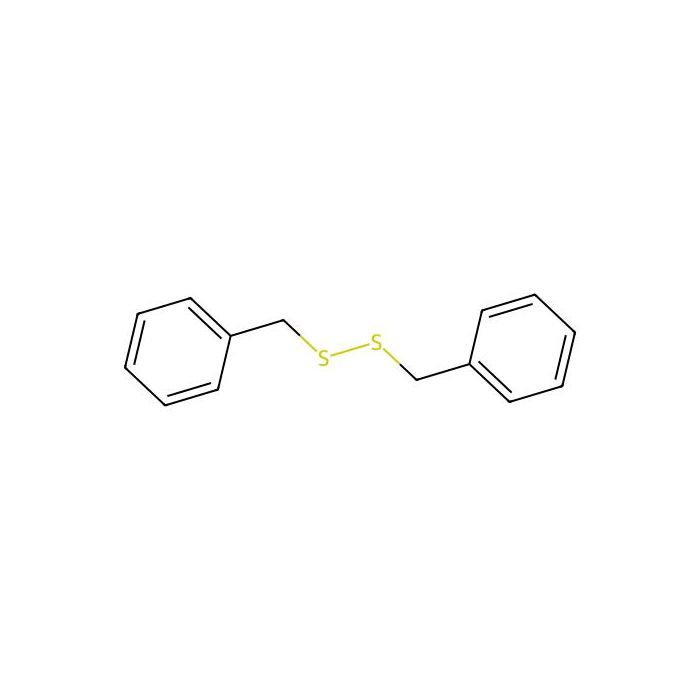
Dibenzyl disulfide is an aromatic disulfide featuring two benzyl groups joined by an S–S bond; a symmetric, achiral molecule useful as a sulfur-transfer and redox-active reagent.
Item-specific identifiers (from Product Data)
SKU: D1500315
Product name: Dibenzyl disulfide
CAS: 150-60-7
PubChem CID: 9012
InChIKey: Not specified for this item; refer to CoA/Spec Sheet.
SMILES: Not specified for this item; refer to CoA/Spec Sheet.
Literature/computed identity (non-spec; for reference)
Functional groups: one disulfide (–S–S–) linking two benzyl methylenes; two phenyl rings.
Connectivity: Ph–CH2–S–S–CH2–Ph; S–S bond length typically ~2.02 Å (literature, typical of dialkyl/aralkyl disulfides).
Electronic aspects: conjugated aryl rings separated from the disulfide by methylene spacers; the S–S bond is the primary redox/cleavage locus; benzylic positions enable radical stabilization in homolytic processes.
2D description: two phenyl rings connected via –CH2–S–S–CH2– forming a linear S–S core with rotatable C–S and S–S bonds; overall nonpolar, hydrophobic character.
Synthetic Utility
Key functional motif: a central disulfide (–S–S–) flanked by benzylic methylenes connected to phenyl rings. This combination supports diverse transformations:
As a sulfur-transfer reagent (literature)
Generation of benzylthiyl radicals under AIBN/UV/peroxide initiation for anti-Markovnikov alkene thiolation.
Thio-Michael additions after radical initiation to electron-poor alkenes.
As a disulfide partner in coupling (literature)
Cu/Ni-catalyzed cross-coupling with aryl/vinyl halides, diazonium salts, or boronic acids to form benzyl aryl sulfides (Ar–S–CH2Ph). Benzylic stabilization aids oxidative addition/reductive elimination sequences.
As a redox shuttle (general)
Disulfide exchange with thiols provides mixed disulfides useful as protecting groups or intermediates. Phosphine- or base-catalyzed S–S metathesis is typically fast at room temperature in polar aprotics.
As a precursor to benzyl thiolate/benzyl mercaptan (literature)
Reductive cleavage (LiAlH4, NaBH4/I2, PPh3/imidazole, electroreduction) affords BnS– reagents for nucleophilic substitution at activated centers (allylic, benzylic, or sulfonate leaving groups).
Retrosynthetic value
DBDS offers a bench-stable, less odorous alternative to benzyl mercaptan in routes that tolerate in situ cleavage or catalytic activation, simplifying storage and handling while maintaining sulfur incorporation flexibility.
Target Specificity
This product is a small organic molecule, not a biological targeting reagent. No antigen/epitope specificity, clone, or isotype applies.
Targeting attributes: Not applicable.
Any item-specific immunological data: Not specified for this item; refer to CoA/Spec Sheet.
Wir verwenden Cookies, um die ordnungsgemäße Funktion der Website sicherzustellen und, soweit zulässig, Ihr Nutzererlebnis zu verbessern. Sie können Ihre Einstellungen jederzeit unter „Einstellungen“ verwalten. Weitere Informationen finden Sie in unserer Cookie-Richtlinie.
Shall we send you a message when we have discounts available?
Remind me later
Thank you! Please check your email inbox to confirm.
Products are supplied to verified businesses, institutions, and qualified professionals for research and development use only. Not for use in humans, animals, diagnosis, or therapy.