≥99.9%, acid <10 ppm, H2O <10 ppm für empfindliche chromatographische und analytische Workflows, die minimale Basislinieninterferenzen erfordern.
🌡
Lagerung & Versand
Versand FedEx DG Service. Genaue Spezifikationen finden Sie im chargenspezifischen COA.
📋
Qualitätsdokumente
SDS, COA, Datenblatt und Spezifikationsblatt stehen zum Download bereit. Chargenspezifische COA über Chargennummernsuche abrufbar.
📚
Literaturbeleg
In 309 peer-reviewten Publikationen zu Chromatographie, organischer Synthese und Kreuzkupplungsreaktionen zitiert.
Übersicht
application Alkyl carbonates find applications as solvents for lithium ion battery electrolytes and the use of high quality battery grade electrolytes having extremely low water (<10 ppm) and acid (<10 ppm) contents are critical for achieving high electrochemical performance.
This compound belongs to the class of organic compounds known as carbonic acid diesters. These are compounds comprising the carbonic acid diester functional group.
External Descriptors
carbonate ester
1. Djoumbou Feunang Y, Eisner R, Knox C, Chepelev L, Hastings J, Owen G, Fahy E, Steinbeck C, Subramanian S, Bolton E, Greiner R, and Wishart DS. ClassyFire: Automated Chemical Classification With A Comprehensive, Computable Taxonomy. Journal of Cheminformatics, 2016, 8:61.
Determine the necessary mass, volume, or concentration for preparing a solution.
Dilution Calculator
Determine the dilution needed to prepare a stock solution.
Reconstitution Calculator
Bewertungen
Kundenbewertungen
Application Protocols
Not applicable to this chemical reagent.
No immunoassay or bioanalytical protocol validations (e.g., WB, IHC, IF, FC) are associated with this product. For experimental use, refer to the Reaction & Applications and Reaction Conditions sections for chemistry-focused guidance.
Biological Roles
Scope
Dimethyl carbonate (DMC) is a synthetic organic carbonate; it is not an endogenous metabolite and has no known native biochemical role in living systems.
Literature/experimental context
Toxicological profile: DMC exhibits relatively low acute toxicity compared with traditional alkylating agents such as dimethyl sulfate. It is often investigated as a low-toxicity solvent/reagent in biochemical extraction or sample preparation workflows, but it is not a buffer component or metabolite.
Biotransformation: Hydrolysis under enzymatic or physiological conditions can yield methanol and carbon dioxide; rates are generally slow in neutral aqueous media and may be catalyzed by esterases.
Protein/nucleic acid interactions: As a polar aprotic solvent, DMC can denature proteins at sufficient concentrations and is not suitable for maintaining native biomolecular structure. It may extract lipophilic molecules from biological matrices.
Environmental fate: Readily biodegradable in many screening tests and exhibits low bioaccumulation potential (logP near zero; literature). Hydrolysis generates relatively benign products, though methanol formation is a consideration for toxicity in aquatic systems.
Practical guidance
Use in biochemical research should be limited to roles as an extraction solvent or reagent under controlled conditions.
Avoid claims of biological efficacy or therapeutic relevance; for any exposure or toxicity assessments, consult the product SDS and current regulatory literature.
Buffer Applications
Not typically applicable
Dimethyl carbonate is not a buffering agent and does not form defined conjugate acid/base pairs suitable for pH control.
Practical note
If used in workflows involving aqueous buffers (e.g., extractions), ensure phase compatibility and account for DMC’s limited water miscibility. Select a true buffer system (e.g., phosphate, HEPES, Tris; not provided with this item) for pH control and refer to those reagents’ specific protocols.
Green Alternatives
Positioning of dimethyl carbonate (DMC) in green chemistry (literature/general)
DMC is widely cited as a greener C1 reagent and solvent due to comparatively low toxicity, biodegradability, and production from CO/CO2 derivatives and methanol via oxidative carbonylation (process-dependent). It is non-halogenated and has favorable EHS characteristics relative to many incumbents.
Greener substitution examples
Replaces phosgene or triphosgene in certain carbonylation steps to access carbonates/carbamates without generating HCl or halogenated byproducts.
Replaces dimethyl sulfate or methyl iodide for O-/N-methylation in base-catalyzed conditions, avoiding highly toxic/alkylating agents.
Serves as a non-chlorinated solvent alternative to dichloromethane or chloroform for extractions/reactions where its polarity suffices.
Trade-offs and limitations
Flammability: Low flash point (~18 °C) increases fire risk relative to some higher-boiling esters or carbonates.
Polarity: Lower dielectric constant limits use with inorganic salts compared to acetonitrile, DMSO, or DMF.
Reactivity: As a reactive solvent, it can participate in side reactions with strong nucleophiles/bases; reaction design should account for this.
Compact comparison (literature; qualitative)
vs Dimethyl sulfate/MeI: Much safer and greener; may require higher temperature/stronger base; selectivity differs (methylation vs methoxycarbonylation balance).
vs DCM/CHCl3: Non-halogenated and biodegradable; more flammable and higher boiling; different extraction partitions.
vs Propylene carbonate: Lower boiling, lower viscosity, but less polar; easier removal post-reaction.
Note: Selection should align with process metrics (E-factor, PMI), energy profile (distillation), and safety objectives.
Pharmaceutical Uses
Scope and limitations
No therapeutic claims. Dimethyl carbonate (DMC) is not a drug substance or recognized pharmaceutical excipient in routine formulations; however, it may be used as a processing solvent or reagent in the synthesis of intermediates under GMP-like controls.
Literature/industry context (general)
Processing solvent: Investigated as a greener, non-halogenated solvent for certain reactions, extractions, and crystallizations in process development. Removal is facilitated by its moderate boiling point (~90 °C).
Reagent function: Employed for methoxycarbonylation or methylation steps as a safer alternative to phosgene, dimethyl sulfate, or methyl iodide.
Regulatory note: If used in GMP manufacturing, control of residual DMC would fall under ICH Q3C (residual solvents) and process-specific acceptance criteria. Validation of purge via drying/distillation is required.
Practical considerations
Materials compatibility and flammability controls are crucial in plant settings (inerting, grounding, explosion-proof equipment).
Quality attributes to monitor: Residual water, residual methanol, nonvolatile residue, and potential formation of mixed carbonates; confirm by CoA/Spec Sheet for the supplied lot.
This catalog item is for research/laboratory use only; suitability for pharmaceutical manufacturing requires additional qualification beyond the scope of this listing.
Physical Properties
Item-specific specifications
Not specified for this item; refer to CoA/Spec Sheet.
Literature/typical values (for planning and method development; not item specifications)
Appearance: Colorless liquid (literature)
Boiling point: ~90–91 °C at 1 atm (literature)
Melting point (freezing point): ~−43 °C (literature)
Density: ~1.07 g/mL at 20–25 °C (literature)
Refractive index: nD20 ~1.368 (literature)
Vapor pressure: on the order of tens of mmHg at 25 °C (literature; moderately volatile)
Flash point: ~18 °C (closed cup) (literature)
Solubility: Limited miscibility with water; miscible with many organic solvents (ethers, esters, aromatics, chlorinated solvents) (literature)
Dielectric constant (ε): ~3.1 at 25 °C (literature) — polar aprotic but significantly less polar than acetone or acetonitrile
LogP (octanol/water): near 0 (literature; low hydrophobicity)
pKa: Not applicable (no acidic protons; carbonate center is not Brønsted acidic)
Practical notes (general)
Hygroscopicity is low; however, moisture can influence base-catalyzed reactions and transesterifications.
Forms azeotropes with certain solvents; distillation planning should account for volatility and flammability.
Compatible with typical polymeric seals; prolonged exposure can swell some elastomers — check material compatibility.
Quality and Grades
Item-specific quality information
Grade/purity: Not specified for this item; refer to CoA/Spec Sheet.
Appearance: Not specified for this item; refer to CoA/Spec Sheet.
General guidance on grades for dimethyl carbonate (DMC)
HPLC/GC grade: Emphasizes low nonvolatile residue and low UV absorbance for chromatographic compatibility. Often filtered and packaged under inert conditions.
Water and alcohol impurity control: For base-catalyzed methylation or carbonylation chemistry, trace alcohols/water can divert reactivity; Karl Fischer and GC headspace specs are frequently used in CoAs. If such values are critical to your work, request the current CoA.
Stabilizers: DMC is typically sold without added stabilizers; however, packaging under dry, air-free conditions reduces hydrolysis. If inhibitors or additives are present, they should be declared in the specification — none are stated for this item.
Trace metals/ionic content: Relevant for electrochemical or organometallic applications; if your use is water/metal-sensitive, verify limits on Na/K/Cl/transition metals with the CoA.
Practical tips
For moisture-critical reactions, consider drying DMC over 3 Å molecular sieves and verify water by KF titration.
For spectroscopic or analytical applications, select grades with documented low UV cutoffs and low residue; confirm via Spec Sheet.
Reaction and Applications
Expanded from catalog context (general chemistry uses; no medical/clinical claims)
Green methylating agent: Under basic conditions, DMC acts as an O-methylating agent for phenoxides and carboxylates and, with appropriate catalysts or elevated temperatures, can N-methylate certain amines. The methylation typically proceeds via a BAc2/SN2 mechanism at the methyl carbon.
Methoxycarbonylation (carboxymethylation): The carbonyl carbon of DMC is electrophilic; in the presence of nucleophiles and bases/catalysts, DMC transfers the –OCOCH3 (methyl carbonate) group, enabling synthesis of carbonates, carbamates, and methyl esters.
Transesterification partner: Exchanges alkoxy groups with alcohols to form mixed carbonates using base or metal catalysts (e.g., alkoxides, DBU, TBD, or heterogeneous catalysts).
Carbonate protecting group chemistry: DMC can introduce carbonate protecting groups onto diols/phenols; these can be later cleaved under mild conditions.
Solvent-reactant dual role: Using DMC in large excess allows it to serve as both solvent and reagent, simplifying workups and improving atom economy.
Cross-coupling compatibility: As a greener solvent, DMC can support certain Pd-catalyzed C–C or C–N couplings, provided bases/catalysts are selected for its polarity/boiling point.
Practical tips
Base choice: K2CO3, Cs2CO3, NaOMe, or organic superbases (DBU, TBD) are common. Stronger bases favor methylation at the methyl carbon; milder/basic catalysts and higher temperatures favor methoxycarbonylation.
Temperature: 80–160 °C depending on transformation; pressure-rated apparatus may be required to minimize loss.
Drying: For moisture-sensitive sequences, dry DMC over 3 Å sieves.
Workup: DMC’s moderate volatility allows removal by rotary evaporation at reduced pressure; residues are typically benign.
Reaction Conditions
General conditions from literature (guidance only; optimize per substrate)
O-Methylation of phenols/carboxylates:
Reagents/bases: K2CO3, Cs2CO3, NaOMe, DBU, TBD (0.1–1.0 equiv base depending on nucleophile strength).
Solvent: Neat DMC (serving as both solvent and reagent) or mixed with a co-solvent (e.g., DMF, toluene) if solubility requires.
Temperature: 80–120 °C; sealed tube or reflux with efficient condenser. Reaction times 2–24 h. Higher base strength and temperature shorten times.
Methoxycarbonylation to carbonates/carbamates:
Catalysts: Alkoxide bases, organocatalysts (TBD, DBU), or metal catalysts (e.g., Sn, Zn salts) have been reported.
Conditions: 100–160 °C, often with DMC in excess; pressure apparatus may be used to limit evaporation. Times 4–24 h. Removal of byproduct methanol can drive equilibrium.
Transesterification with alcohols/diols:
Conditions: Base or acid catalysis; 80–140 °C; azeotropic removal of methanol under reduced pressure or with a sweep gas to shift equilibrium.
Amination (carbamate formation):
Typically requires catalysts and elevated temperatures (≥120 °C) due to reduced nucleophilicity of amines toward carbonate carbonyl; CO2/methanol release may be observed.
Operational guidance
Drying: 3 Å molecular sieves or distillation from CaH2 (exercise caution) prior to moisture-sensitive steps.
Workup: Quench bases with aqueous buffer; partition into organic phase; remove DMC by rotary evaporation; polish by short-path distillation if needed.
Analytics: Monitor by GC or HPLC; DMC gives a distinct GC peak and is UV-transparent down to near-220 nm, but verify UV cutoff for your grade (spec-dependent).
Safety and Handling
Item-specific safety data
GHS elements, signal word, and H-statements: Not specified for this item; refer to SDS.
Shipping: Shipped via FedEx DG Service (Dangerous Goods) per Product Data.
General safety information (literature; defer to the product SDS for authoritative guidance)
Likely GHS classification: Flammable liquid (commonly categorized as Flam. Liq. 2; H225: Highly flammable liquid and vapor). Exact classification varies by supplier/SDS.
Primary hazards: Fire/explosion risk from low flash point and moderate vapor pressure; vapors can form ignitable mixtures with air.
PPE: Safety glasses or splash goggles, lab coat, nitrile gloves; use flame-resistant lab coat when handling bulk quantities or heated material.
Engineering controls: Work in fume hood to manage vapors; use bonding/grounding during transfer to avoid static ignition; keep away from ignition sources and hot surfaces.
First aid (overview):
Inhalation: Move to fresh air; seek medical attention if symptoms persist.
Skin/eye contact: Rinse with water for at least 15 minutes; remove contaminated clothing; obtain medical advice for persistent irritation.
Ingestion: Rinse mouth; do not induce vomiting; seek medical attention.
Fire-fighting: Alcohol-resistant foam, dry chemical, or CO2; water spray for cooling containers. Vapors are heavier than air; consider remote ignition risks.
Peroxide formation: Not an ether prone to peroxidation like THF/diethyl ether; routine peroxide testing is generally unnecessary.
Waste: Collect as flammable organic waste; avoid drains; follow local regulations.
Solvent Selection
Applicability
Dimethyl carbonate (DMC) functions both as a solvent and a benign C1 reagent. As a solvent, it is a polar aprotic liquid of modest polarity with good solvating power for many organics while being relatively low in toxicity.
Polarity and miscibility (literature)
Polarity class: Polar aprotic, relatively low dielectric (ε ~3.1 at 25 °C), between hydrocarbons and acetates in polarity.
Miscibility: Miscible with many organic solvents (ethers, esters, aromatics, chlorinated solvents); limited miscibility with water.
When to choose DMC
Prefer over more hazardous methylating/carbonylating agents (MeI, DMS, phosgene derivatives) when transesterification or methoxycarbonylation under basic/thermal conditions is acceptable.
As a greener replacement for acetone, ethyl acetate, or dichlorinated solvents in extractions or recrystallizations where its intermediate polarity and volatility (bp ~90 °C) are advantageous.
As co-solvent to adjust viscosity and volatility in reactions or extractions.
When to consider alternatives
For highly polar/ionic chemistry (e.g., SN2 with salts, strong ion pairing), acetonitrile, DMSO, or DMF provide higher dielectric environments.
For very low boiling needs, methyl tert-butyl ether (MTBE) or diethyl ether may be preferred; for higher boiling/thermal stability, propylene carbonate or dimethyl sulfoxide may be superior.
Small comparison (literature tendencies)
DMC vs EtOAc: DMC is slightly more polar and more volatile than EtOAc in some systems; both have similar safety profiles but DMC offers unique reagent functionality.
DMC vs MeCN: DMC is less polar and less toxic, but cannot solvate salts as effectively.
DMC vs DCM: DMC avoids chlorinated waste but is more flammable and higher boiling than DCM.
Storage and Reconstitution
Item-specific storage
Storage conditions: Not specified for this item; refer to CoA/Spec Sheet.
Shipped in: FedEx DG Service (per Product Data).
General guidance (literature/practice; not item specifications)
Store tightly closed in original container in a cool, well-ventilated flammables cabinet away from ignition sources.
Keep away from strong bases, acids, and oxidizers to prevent undesired reactions (transesterification/hydrolysis/oxidation).
Moisture considerations: While DMC is only moderately hygroscopic, moisture can impact base-catalyzed reactions; for moisture-sensitive applications, store over 3 Å molecular sieves and backfill headspace with dry inert gas after each use.
Temperature: Ambient storage is typical; avoid heat and direct sunlight. Do not refrigerate below its pour point if frequent handling is required; ensure containers are equilibrated to room temperature before opening to minimize condensation.
Container materials: Compatible with amber glass or metal cans with appropriate liners; avoid prolonged contact with elastomers that may swell; verify compatibility for pumps/seals.
Reconstitution: Not applicable (liquid reagent). If solidification occurs due to low temperature, gently warm to room temperature to fully liquefy before use, ensuring container is vented to avoid pressure build-up.
Shelf life: Check the CoA/label for retest date. Periodically confirm water content (KF) and assay (GC) for critical applications.
Structure and Identity
Item-specific (from Product Data)
SKU: D294884
Product name: Dimethyl carbonate
CAS: 616-38-6
CID: 12021
InChIKey (as provided): 138700
Research use: For research use only
Literature/general identity (for reference; verify against CoA/SDS)
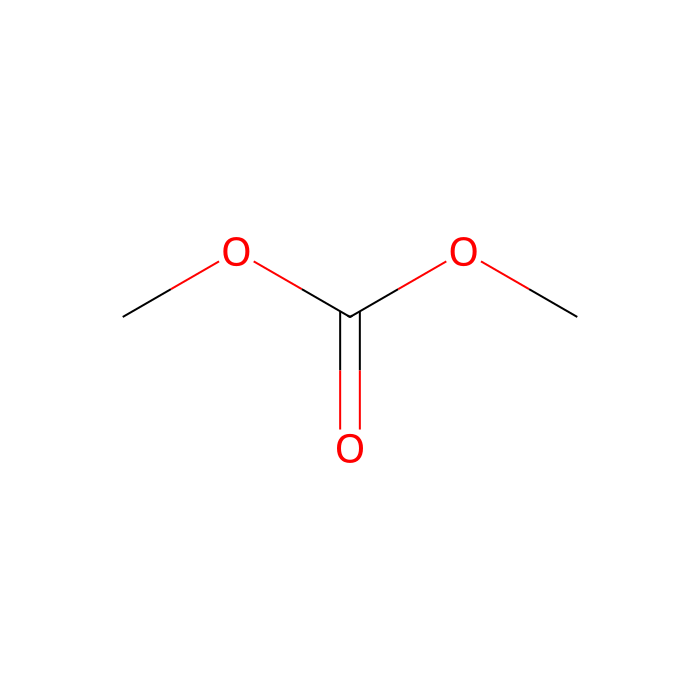
Functional groups: A central carbonyl flanked by two methoxy groups (dialkyl carbonate, specifically a symmetric carbonate diester).
2D description: One carbonyl carbon double-bonded to oxygen and single-bonded to two oxygen atoms, each leading to a methyl group (–O–CH3). No rings, no stereocenters, and no halogens or heterocycles.
Polarity/coordination: Polar aprotic molecule with two ether-like oxygens and one carbonyl oxygen capable of coordinating to Lewis acids and metal cations in solution; lacks hydrogen-bond donors but has multiple acceptor sites.
Isomerism: No stereogenic centers; constitutional isomerism to other C3 carbonate esters is not typical because of symmetry; can form mixed carbonates upon transesterification under basic or catalytic conditions.
Synthetic Utility
Functional reactivity (general)
Electrophilic centers:
Carbonyl carbon of the carbonate (acyl center) enables methoxycarbonylation to form carbonates/carbamates/esters.
Methyl carbons (–O–CH3) enable O-/N-methylation via SN2 displacement under basic conditions, releasing methoxide or methyl carbonate as leaving species.
Chemoselectivity control: Strong bases and lower temperatures favor alkylation at methyl; higher temperatures or catalysts (e.g., alkoxides, organocatalysts) favor acyl transfer (carbonate formation).
Named/representative transformations (literature)
O-Methylation of phenols or carboxylates using K2CO3/Cs2CO3, DBU, TBD, or NaOMe in DMC (solvent/reagent).
Synthesis of dialkyl carbonates from diols and DMC under transesterification catalysis (e.g., TBD, metal alkoxides, heterogeneous base catalysts).
Carbamate formation from amines and DMC with catalysts (e.g., organocatalytic or metal-catalyzed systems) as a phosgene-free route.
Methoxycarbonylative protection of polyols, enabling downstream selective deprotection.
Strategic roles in synthesis
Green C1 synthon to introduce methyl carbonate handles that can be diversified (e.g., to ureas, carbamates) or removed.
Solvent/reagent unification reduces solvent-switching operations and can improve atom economy.
Use sealed reactors or reflux condensers due to volatility and low flash point.
Water control improves yields in base-catalyzed methylations; dry the system (sieves) and use inert atmosphere when moisture-sensitive substrates are present.
Target Specificity
Not applicable to this chemical reagent.
This product is a small-molecule solvent/reagent (dimethyl carbonate), not a biologic or affinity reagent. No antigen/epitope specificity, species reactivity, clone, or isotype data apply.
Wir verwenden Cookies, um die ordnungsgemäße Funktion der Website sicherzustellen und, soweit zulässig, Ihr Nutzererlebnis zu verbessern. Sie können Ihre Einstellungen jederzeit unter „Einstellungen“ verwalten. Weitere Informationen finden Sie in unserer Cookie-Richtlinie.
Dürfen wir Sie über Rabattaktionen informieren?
Später erinnern
Vielen Dank! Bitte überprüfen Sie Ihren E-Mail-Posteingang, um zu bestätigen.
Products are supplied to verified businesses, institutions, and qualified professionals for research and development use only. Not for use in humans, animals, diagnosis, or therapy.

 A2310280