This compound belongs to the class of organic compounds known as sulfenyl compounds. These are organosulfur compounds a sulfenyl group with the general formula RS (R = organyl).
External Descriptors
Not available
1. Djoumbou Feunang Y, Eisner R, Knox C, Chepelev L, Hastings J, Owen G, Fahy E, Steinbeck C, Subramanian S, Bolton E, Greiner R, and Wishart DS. ClassyFire: Automated Chemical Classification With A Comprehensive, Computable Taxonomy. Journal of Cheminformatics, 2016, 8:61.
Determine the necessary mass, volume, or concentration for preparing a solution.
Dilution Calculator
Determine the dilution needed to prepare a stock solution.
Reconstitution Calculator
Bewertungen
Kundenbewertungen
Application Protocols
No tested bioassay protocols (e.g., WB, IHC, IF, FC) are applicable to this small-molecule reagent. It is supplied for general synthetic use.
General lab protocols (literature-style guidance):
Drying/purification prior to sensitive work: Pass through a short plug of basic alumina under N2 or perform a quick vacuum distillation (e.g., 10–20 mmHg) collecting a narrow middle cut to remove low- and high-boiling impurities. Avoid prolonged heating.
Nucleophilic substitution to prepare asymmetric trithiocarbonate:
To a dry, N2-flushed flask charge DMTTC (1.0 equiv) in acetonitrile. Cool to 0–5 °C if exotherm expected.
Add RS– nucleophile (1.1–1.5 equiv) generated in situ from RSH and base (e.g., NaH, K2CO3, or DBU).
Stir 1–4 h at 25–50 °C; monitor by TLC/LC–MS. Quench with water, extract with DCM, wash brine, dry, and concentrate.
Preparing a simple RAFT CTA from DMTTC:
React DMTTC with a chosen R–X (activated, capable of homolytic initiation) in the presence of base or via two-step sequence forming Z–C(=S)–S–R. Consult RAFT literature for selection of R/Z for your monomer.
Always optimize on small scale and consult primary literature for substrate-specific conditions.
Biological Roles
This product is intended strictly for research and laboratory use. No clinical or therapeutic claims are made.
General biochemistry context (literature):
Dimethyl trithiocarbonate is a synthetic organosulfur compound without known endogenous biological role in primary metabolism.
Organotrithiocarbonates can interact with soft biological nucleophiles (e.g., cysteine thiols) in vitro, potentially undergoing exchange reactions at sulfur. Such reactivity underlies their use as chemical tools in materials and polymer–bioconjugation research rather than as biological metabolites.
Hydrolytic/oxidative degradation may yield methanethiol and dimethyl disulfide, compounds that are malodorous and can affect microbial systems at sufficient concentrations. These considerations warrant appropriate containment in bio-facing labs.
Use in bio-related research (non-clinical, literature):
As precursors to RAFT chain transfer agents, trithiocarbonate-derived polymers are frequently explored for protein/peptide conjugation and controlled delivery studies. In such cases, dimethyl trithiocarbonate functions upstream in reagent synthesis rather than as a direct biological modulator.
Safety and compatibility:
Due to potential thiol exchange and sulfur off-gassing under harsh conditions, avoid unsupervised use in cell culture or enzymatic assays unless fully validated; matrix effects can be significant.
Conclusion: No specific biological function is attributed to dimethyl trithiocarbonate; treat it as a reactive chemical intermediate with soft-sulfur reactivity.
Buffer Applications
Dimethyl trithiocarbonate is not a buffering agent and is not typically used to prepare pH buffer systems. It lacks acid–base conjugate pairs in the physiological pH range and does not provide reliable buffering capacity.
Practical guidance:
If your workflow involves this reagent in aqueous media, use standard buffers (e.g., phosphate, HEPES, Tris) validated for your system, and introduce dimethyl trithiocarbonate via a miscible organic cosolvent under controlled conditions.
Be aware that organosulfur reagents may react with buffer components containing nucleophilic amines or thiols; pre-screen for compatibility.
For buffer preparation details, refer to established buffer systems rather than this reagent.
Green Alternatives
Assessment context: Dimethyl trithiocarbonate (DMTTC) is used primarily as a sulfur-rich functional reagent or RAFT precursor. Greener selection hinges on the transformation sought, balancing hazard, volatility, and waste.
Comparative considerations (literature/general):
Against CS2:
Pros (DMTTC): Lower volatility and flammability risk; easier containment; less acute inhalation hazard.
Cons: Still malodorous, sulfur-rich; can hydrolyze to thiols; not benign to aquatic environments.
Cons: Less reactive; may require catalysts/bases and longer times.
Against Lawesson’s reagent/P4S10:
Pros (DMTTC): Liquid handling; often milder conditions; reduced phosphorus-containing waste.
Cons: Lower atom economy toward full carbonyl-to-thiocarbonyl conversion; sulfur waste remains.
For RAFT CTAs: Consider bio-based solvents (2-MeTHF, anisole) as media rather than changing the CTA core; DMTTC-derived CTAs can be prepared and used in greener solvents.
CS2; High (soft electrophile); High; Very high; Sulfur VOCs
Thiophosgene; Very high; Very high/toxic; Moderate; Chlorinated/sulfur waste
Lawesson’s reagent; High (thionation); Moderate–high; Solid; Phosphorus/sulfur residues
Greener practices:
Use minimal excess; closed systems to limit VOCs; select higher-boiling, biorenewable solvents (e.g., 2-MeTHF) where compatible; implement sulfur-specific off-gas scrubbing (e.g., activated carbon/permanganate traps).
Pharmaceutical Uses
No pharmacopoeial monographs or excipient roles are specified for this item. This product is for research use only and is not intended for human or veterinary use.
General formulation/manufacturing context (literature/general):
Dimethyl trithiocarbonate is occasionally encountered as a synthetic intermediate or as a precursor to trithiocarbonate-based chain transfer agents used to prepare polymers that may be evaluated in formulation science (e.g., polymer excipients). In such cases, the reagent is used upstream and is not present in final dosage forms.
Its strong sulfur odor and potential for thiol release make it unsuitable for direct use in pharmaceutical formulations.
Regulatory and quality notes:
GMP status, residual solvent limits, and impurity profiles for pharmaceutical applications are not applicable to this catalog entry unless otherwise noted on a CoA.
Any exploration of pharmaceutical manufacturing relevance should involve conversion to downstream materials with appropriate quality systems in place.
Conclusion: Treat dimethyl trithiocarbonate solely as a laboratory reagent/intermediate in pharmaceutical R&D synthesis, not as a formulation component.
Physical Properties
Item-specific specifications (grade-point values such as density, UV cutoff, water, metals) are not provided in the Product Data for SKU D349451.
Literature/typical properties for dimethyl trithiocarbonate (for general reference only; not item specifications):
Appearance: Colorless to pale yellow liquid with sulfurous odor (literature reports).
Boiling behavior: Reported to distill under reduced pressure; typical literature values ~65–70 °C at 15–20 mmHg; at 1 atm may decompose before a sharp bp. Always distill under vacuum to minimize decomposition (literature).
Melting point: Not commonly reported; expected to remain liquid at ambient (literature).
Density: Often reported near 1.27–1.33 g/mL at 20–25 °C (literature ranges).
Refractive index nD20: Frequently cited around 1.58–1.60 (literature).
Vapor pressure: Elevated under ambient relative to higher-MW trithiocarbonates; handle in a hood (literature inference).
Solubility: Low in water; miscible with many organic solvents (e.g., dichloromethane, toluene, THF, ethers, esters). Good solvating power for soft polar organosulfur systems (literature observations).
Values vary with source and purity. Do not treat literature numbers as specifications for this item. For exact specifications applicable to this lot, see the CoA/Spec Sheet.
Quality and Grades
Grade/Purity: Not specified for this item; refer to CoA/Spec Sheet.
Context for common grades (general guidance):
Research grade: Suitable for most synthetic applications; may have broader impurity profile than high-purity grades.
Purified/reagent grade: Typically controls for common impurities; acceptable for general synthesis and method development.
HPLC/spectrophotometric grade: Tight UV-absorptivity limits and particulate control for chromatographic detection; not commonly specified for specialty organosulfur reagents unless needed for photochemical work.
Stabilizers/inhibitors:
Not specified for this item; refer to CoA/Spec Sheet. In general, many trithiocarbonates are supplied neat without stabilizers. If a stabilizer is present, it should be disclosed on the CoA; stabilizers can influence radical chemistry (e.g., RAFT) and should be removed or accounted for if they interfere.
Quality considerations specific to trithiocarbonates (general):
Peroxide content is usually irrelevant for sulfur-rich media, but oxidative impurities (sulfoxides/sulfones) and hydrolysis byproducts (methanethiol, dimethyl disulfide) can develop on storage.
If high purity is critical (e.g., controlled radical polymerization), consider quick vacuum distillation under inert gas immediately prior to use, and verify by GC/GC–MS and 1H/13C NMR (look for thiocarbonyl carbon around ~220–230 ppm, literature).
Documentation:
For lot-specific assay, water content, and impurity profile: consult the CoA/Spec Sheet provided with the shipment.
Reaction and Applications
Dimethyl trithiocarbonate is a versatile organosulfur reagent that participates in nucleophilic, electrophilic, and radical transformations.
Key application families (literature/general):
RAFT/Controlled radical polymerization precursor: Serves as a convenient trithiocarbonate core for preparing chain transfer agents (CTAs) via transesterification or substitution to introduce the R and Z groups tailored to target monomers. It can also be used directly in certain radical chain-transfer studies.
Sulfur transfer/thionation under mild conditions: The C(=S)–S–R framework can be engaged to introduce C(=S) functionality into carbonyl derivatives (forming dithiocarbonates/xanthates) using alcoholate or thiolate promoters.
Radical trapping and functionalization: Under AIBN/thermal initiation, it can intercept carbon-centered radicals to form thioether-linked adducts or serve in Barton–MacCombie-type deoxygenation manifolds when converted to appropriate thionocarbonyl derivatives.
Nucleophilic substitution at sulfur: Soft nucleophiles (thiolates, phosphines) can cleave the S–Me bonds, generating mixed trithiocarbonates and liberating MeS–, which may further react (literature).
Building block for dithioesters: Conversion with acid chlorides or activated carboxylic derivatives in the presence of base can afford dithiocarbonyl-containing intermediates useful in ligation and polymer end-group installation.
Practical notes:
Maintain anhydrous, oxygen-poor conditions to preserve the thiocarbonyl integrity.
Trace oxidation products can alter radical-transfer kinetics; consider purification (short-path distillation under reduced pressure) prior to kinetics-sensitive work.
Monitor by UV–vis (thiocarbonyl n→π* band in the visible region) or by 13C NMR (C=S ~220–230 ppm; literature).
Reaction Conditions
General guidance from literature for common uses; adapt to your substrate/scale. These are not item-specific specifications.
Note: Remove oxygen/moisture to maintain thiocarbonyl integrity; use amber glass to minimize photolysis.
Safety and Handling
Safety information specific to this catalog item is not fully specified in the Product Data. Always consult the SDS for authoritative guidance.
General GHS considerations for dialkyl trithiocarbonates (literature/general):
GHS classification/pictograms: Not specified for this item; refer to SDS. Many organosulfur liquids are classified as harmful/irritant and hazardous to aquatic life.
Signal word/H-statements: Not specified for this item; refer to SDS.
Handling and PPE (good laboratory practice):
Use in a well-ventilated fume hood; vapors and accidental hydrolysis can release foul-smelling thiols.
Wear appropriate PPE: lab coat, nitrile gloves (change regularly), safety goggles or face shield.
Avoid inhalation and skin contact; minimize vapor formation and aerosolization.
Incompatibilities and reactivity:
Avoid strong oxidizers (risk of exothermic oxidation to sulfoxide/sulfone and sulfur oxides).
Avoid strong bases/acids and nucleophiles that can cleave C–S bonds or cause transesterification.
Thermal decomposition may release toxic sulfur-containing gases (e.g., H2S, SOx, CS2-like species; literature caution).
First aid (overview; follow institutional protocol):
Inhalation: Move to fresh air; seek medical attention if symptoms persist.
Skin/eye contact: Immediate decontamination with water for ≥15 min; remove contaminated clothing; seek medical advice.
Ingestion: Rinse mouth; do not induce vomiting; obtain medical attention.
Spill/fire response:
Spill: Absorb with inert material, control vapors, dispose as hazardous waste.
Fire: Use dry chemical, CO2, or foam. Combustion may produce toxic sulfur fumes.
Storage per Product Data:
Store at 2–8 °C. Keep container tightly closed in a dry, well-ventilated place. Protect from light and oxidants.
Solvent Selection
As a small, moderately polarizable organosulfur liquid, dimethyl trithiocarbonate behaves as a soft, weakly polar aprotic medium/additive rather than a primary polar solvent.
Polarity and miscibility (literature/general):
Weakly polar aprotic; high polarizability due to three sulfur atoms.
Miscible with many organic solvents (e.g., DCM, chloroform, toluene, THF, diethyl ether, acetonitrile, esters). Very low solubility in water.
Dielectric behavior: Not commonly tabulated; expect lower dielectric than nitriles/DMF but higher polarizability than ethers/hydrocarbons (literature expectations).
When to use:
As a reagent co-solvent to enhance solubility of soft-organophiles or to moderate radical chemistry environments.
As a sulfur-transfer reagent present in solution with an inert carrier solvent (e.g., toluene, DCM) to control viscosity and volatility.
Comparisons (general):
Versus CS2: Less volatile and easier to handle; higher boiling under vacuum; safer handling profile but still malodorous and sulfur-rich.
Versus thiophosgene or Lawesson’s reagent: Less electrophilic/less aggressive sulfurizing power; better suited when mild thionation or radical chain-transfer behavior is desired.
Practical tips:
Use dry, oxygen-free solvents when selectivity against oxidation/hydrolysis is important.
For polymer-related radical processes, common carriers are toluene, anisole, dioxane, or acetonitrile depending on monomer solubility (literature practice).
Note: If your process is solvent-critical, validate with small-scale screening; no item-specific solvent impurities or UV specifications are provided here.
Storage and Reconstitution
Storage conditions (item-specific): Store at 2–8 °C (per Product Data). Shipments are on wet ice. Keep container tightly closed in a dry, well-ventilated place. Protect from light and air/oxidants.
Appearance: Not specified for this item; refer to CoA/Spec Sheet.
Reconstitution: Not applicable; typically supplied neat as a liquid. If solidification occurs at low temperature, warm gently to ambient and homogenize before use.
Handling after opening (general best practice):
Blank headspace with inert gas (N2/Ar) after each use to minimize oxidation/hydrolysis.
Store in amber glass with PTFE-lined cap to limit light exposure and permeation.
Avoid repeated freeze–thaw; maintain at 2–8 °C when not in use. For long-term storage, consider aliquoting under inert atmosphere.
Stability notes (literature/general):
Sensitive to oxidation (formation of sulfoxide/sulfone) and to hydrolysis yielding thiols/disulfides; these impurities can impact radical transfer performance.
Short-path distillation under reduced pressure can refresh material prior to kinetics-sensitive reactions.
Disposal: Treat as hazardous sulfur-containing organic waste according to institutional and local regulations.
For lot-specific stability and any inhibitor/stabilizer content: consult the CoA/Spec Sheet and the SDS.
Structure and Identity
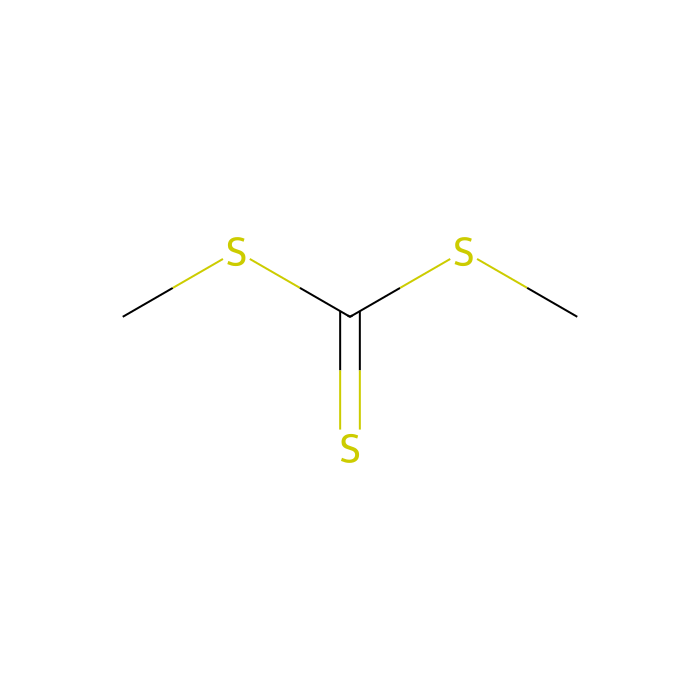
Dimethyl trithiocarbonate is a dialkyl trithiocarbonate featuring two methyl thio substituents bound to a central C(=S) group.
Molecular formula: Not specified for this item; refer to CoA/Spec Sheet. (Literature: C3H6S3)
Molecular weight: Not specified for this item; refer to CoA/Spec Sheet. (Literature: ~138.27 g/mol)
Structure (descriptive): A central thiocarbonyl carbon (C= S) flanked by two thioether sulfurs (–S–CH3). The connectivity is CH3–S–C(=S)–S–CH3; no rings or stereocenters. Functional groups: thiocarbonyl (C=S) and two thioethers.
Functional group profile driving reactivity (literature/general):
Thiocarbonyl (C=S): Soft electrophile enabling nucleophilic addition, radical capture, and UV–visible activity (n→π* band) useful for monitoring.
Thioether sulfurs: Sites for substitution by soft nucleophiles (thiolates, phosphines); susceptible to oxidation.
Representative transformations:
RAFT agent construction: Alcohols/thiols and appropriate R-group sources can exchange with the methyl groups to furnish tailored trithiocarbonates (Z–C(=S)–S–R) serving as CTAs. Subsequent polymerizations of styrenics, (meth)acrylates, acrylamides, and vinyl esters are well-documented.
Mixed trithiocarbonate synthesis: Nucleophilic attack by RS– on DMTTC yields asymmetric trithiocarbonates with liberation of MeS– (which can be trapped or oxidized to MeSSMe), enabling stepwise installation of functionality.
Dithioester/dithiocarbonate access: Activation of carboxylic derivatives in the presence of DMTTC can furnish thionocarbonyl-containing intermediates valuable in ligation chemistry and as handles for post-polymerization modification.
Radical chemistry: Under thermal or photochemical initiation (e.g., AIBN, peroxides, visible-light photocatalysis), DMTTC can mediate chain-transfer events or capture radicals to form C–S bonds.
Strategic value:
Compact, inexpensive sulfur donor with tunable reactivity.
Symmetry simplifies characterization and facilitates selective installation of one tailored substituent at a time.
Limitations:
Hydrolysis/oxidation sensitivity requires careful handling.
Odor and sulfurous byproducts necessitate scrubbing and containment.
Target Specificity
Not applicable. This product is a small-molecule organosulfur reagent, not a biological targeting agent (e.g., antibody, ligand, or probe with defined antigen/epitope specificity).
Antigen/epitope, clone, isotype, and species reactivity: Not relevant.
For applications involving polymer–biomolecule conjugation, any “specificity” arises from downstream functional groups engineered onto polymers derived from trithiocarbonate chemistry, not from dimethyl trithiocarbonate itself.
Häufig gestellte Fragen
How should this product be stored?
Store at 2–8 °C. Refrigerated storage is required to maintain the specified shelf life.
How is this product shipped?
This product ships chilled on wet ice. Unpack on arrival and transfer it to the storage condition stated above.
What are the CAS number, molecular formula and molecular weight?
The CAS Number is 2314-48-9, the molecular formula is C3H6S3, and the molecular weight is 138.27 g/mol. InChIKey IQWMXKTYXNMSLC-UHFFFAOYSA-N.
What documentation is provided?
Available product documentation, including Certificates of Analysis (COA), Safety Data Sheets (SDS), and specification sheets, is shown in the product document area. Document availability and access follow the current site policy.
Wir verwenden Cookies, um die ordnungsgemäße Funktion der Website sicherzustellen und, soweit zulässig, Ihr Nutzererlebnis zu verbessern. Sie können Ihre Einstellungen jederzeit unter „Einstellungen“ verwalten. Weitere Informationen finden Sie in unserer Cookie-Richtlinie.
Dürfen wir Sie über Rabattaktionen informieren?
Später erinnern
Vielen Dank! Bitte überprüfen Sie Ihren E-Mail-Posteingang, um zu bestätigen.
Products are supplied to verified businesses, institutions, and qualified professionals for research and development use only. Not for use in humans, animals, diagnosis, or therapy.

 F2301816