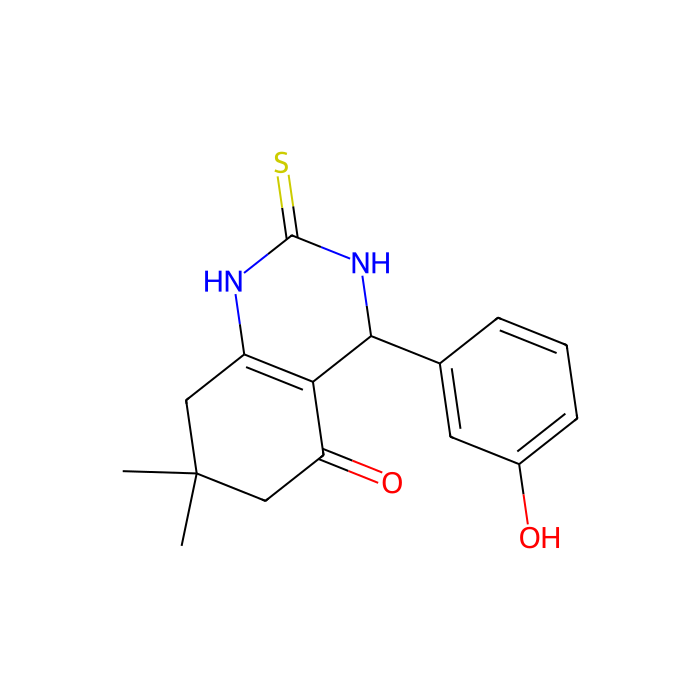
Inhibitor of mitotic motor kinesin Eg5 (IC50= 200 nM). Arrests mitosis, triggers apoptosis and up-regulates Hsp-70 expression in multiple human myeloma cell lines. Also inhibits the growth of several types of cancer cell lines (EC50values are 330, 603, 74
Storage
Store at -20°C,Argon charged
Verschickt in
Ice chest + Ice pads
Dieses Produkt erfordert Kühlkettenversand. Grundversand und andere Economy-Optionen sind nicht verfügbar.
This compound belongs to the class of organic compounds known as quinazolines. These are compounds containing a quinazoline moiety, which is made up of two fused six-member aromatic rings, a benzene ring and a pyrimidine ring.
External Descriptors
Not available
1. Djoumbou Feunang Y, Eisner R, Knox C, Chepelev L, Hastings J, Owen G, Fahy E, Steinbeck C, Subramanian S, Bolton E, Greiner R, and Wishart DS. ClassyFire: Automated Chemical Classification With A Comprehensive, Computable Taxonomy. Journal of Cheminformatics, 2016, 8:61.
Solvent:DMSO, Max Conc. mg/mL: 30.24, Max Conc. mM: 100; Solvent:ethanol, Max Conc. mg/mL: 15.12, Max Conc. mM: 50
Empfindlichkeit
Air Sensitive
Schmelzpunkt (°C)
262 °C(dec.)
Molekulargewicht
302.400 g/mol
XLogP3
2.000
Hydrogen Bond Donor Count
3
Hydrogen Bond Acceptor Count
3
Rotatable Bond Count
1
Exact Mass
302.109 Da
Monoisotopic Mass
302.109 Da
Topological Polar Surface Area
93.500 Ų
Heavy Atom Count
21
Formal Charge
0
Complexity
512.000
Isotope Atom Count
0
Defined Atom Stereocenter Count
0
Undefined Atom Stereocenter Count
1
Defined Bond Stereocenter Count
0
Undefined Bond Stereocenter Count
0
The total count of all stereochemical bonds
0
Covalently-Bonded Unit Count
1
Lösungsrechner
Molarity Calculator
Determine the necessary mass, volume, or concentration for preparing a solution.
Dilution Calculator
Determine the dilution needed to prepare a stock solution.
Reconstitution Calculator
Bewertungen
Kundenbewertungen
Application Protocols
No tested applications or protocols are provided in the Product Data for SKU D287363.
General starting points (non-spec, for research planning only):
Biochemical enzyme assay: prepare serial dilutions in DMSO, dilute into assay buffer to ≤1% DMSO final, measure activity with appropriate readout (e.g., ATPase, fluorescence) and fit dose–response to obtain IC50.
Cell-based assay: prepare DMSO stocks, add to cultured cells maintaining constant final DMSO, incubate per experimental design, and assess phenotypes by imaging, viability, or target-pathway biomarkers. Include vehicle-only and positive/negative controls.
These are generic examples; develop and validate your own SOPs. Always defer to your institution’s best practices.
Biological Roles
Item-specific biological targets and activities are not provided in the Product Data.
General literature context (non-spec, research only):
Dimethylenastron is described in the scientific literature as a small-molecule tool compound employed to interrogate mitotic processes by chemical inhibition of motor-protein function in cells and cell-free systems. It is used to modulate spindle dynamics in synchronized cell populations and to probe enzymatic mechanisms in vitro.
Typical experimental modalities include cell-cycle analysis by flow cytometry, immunofluorescence imaging of spindle architecture, and enzyme kinetics assays. The compound may serve as a benchmark inhibitor in screening cascades or as a positive control in phenotypic assays.
Off-targets and selectivity must be evaluated empirically for each experimental system. Concentration-dependent effects, compound aggregation, and vehicle (DMSO) artifacts should be controlled for.
Important caveats:
For research use only. No medical, diagnostic, or therapeutic use is intended or permitted.
Actual potency, selectivity, and cellular permeability for this SKU/lot should be verified under your conditions using appropriate controls and orthogonal assays. Refer to the primary literature and validate with your own data.
Buffer Applications
This product is not a buffering agent and is not used to prepare pH buffer systems. If preparing assay media containing this probe, select a biologically appropriate buffer (e.g., PBS, HEPES, or assay-specific buffers) and control the final organic solvent percentage (e.g., DMSO) to maintain cell and enzyme compatibility.
Green Alternatives
Green chemistry considerations are generally applied to solvents and reagents that participate in reactions. Dimethylenastron is a specialized research probe rather than a commodity solvent or reagent, so direct “green alternatives” are not typically applicable.
Practical greener practices when working with small-molecule probes:
Solvent minimization: Use the minimum DMSO volume to prepare high-concentration stocks, then dilute into aqueous buffers. Plan experiments to avoid unnecessary solvent waste.
Work-up/disposal: Segregate halogenated and non-halogenated solvent streams; dispose of DMSO-containing aqueous waste per institutional policy.
Safer carriers: If compatible with your assay, consider aqueous cyclodextrin formulations or lipid carriers to reduce organic solvent percentage (literature strategy, non-spec). Validate that carriers do not perturb your biological readout.
Energy efficiency: Store only the needed aliquots at −20°C and avoid unnecessary freeze–thaw; this reduces cold-chain energy burden and preserves material integrity.
If your objective is to replace a reaction solvent or reagent in your workflow, evaluate greener alternatives for those process steps (e.g., 2-MeTHF vs THF, CPME vs ether). This selection is upstream of Dimethylenastron use and will have a greater sustainability impact.
Pharmaceutical Uses
Formulation/excipient status: Not applicable. This product is provided strictly for research use only.
Pharmacopeial status: No pharmacopoeial monograph is indicated in the Product Data.
Context (general, non-spec):
Small-molecule research probes like Dimethylenastron may be used in preclinical discovery laboratories for target validation and mechanism studies, but they are not manufactured, tested, or warranted for human or veterinary administration.
If you require GMP-grade materials, validated impurity profiles, or documentation suitable for regulated development, contact your QA department and request appropriate sourcing channels separate from this research-use SKU.
Physical Properties
Item-specific physico-chemical specifications are not provided in the Product Data.
Appearance: Not specified for this item; refer to CoA/Spec Sheet.
Melting point: Not specified for this item; refer to CoA/Spec Sheet.
Boiling point: Not applicable/unknown for this solid probe; Not specified for this item; refer to CoA/Spec Sheet.
Density: Not specified for this item; refer to CoA/Spec Sheet.
Solubility (item-specific): Not specified for this item; refer to CoA/Spec Sheet.
LogP, pKa, refractive index: Not specified for this item; refer to CoA/Spec Sheet.
General guidance (literature, non-spec):
Many small-molecule kinesin inhibitors are sparingly soluble in water and are commonly prepared as concentrated DMSO stock solutions (e.g., 10–50 mM) and subsequently diluted into assay buffers. Actual solubility limits and stability of Dimethylenastron must be verified experimentally for your system.
Hygroscopicity/peroxide formation: not expected to be peroxide-forming; moisture sensitivity is unknown for this item; handle under dry conditions as good practice.
Measurement notes:
If your application requires precise melting point, residual solvent, water content, or UV cutoff, request the current CoA/Spec Sheet for this lot. Validate working concentrations by UV/Vis or HPLC where applicable.
Quality and Grades
Grade/Purity: Not specified for this item; refer to CoA/Spec Sheet.
Interpretation and guidance:
When a purity grade is not stated, request the current Certificate of Analysis (CoA) to verify assay (%), analytical method (e.g., HPLC/UPLC), and identity confirmation (NMR/HRMS). For screening and chemical-biology work, ≥95% HPLC is typically desired; for mechanistic enzymology or structure–activity studies, ≥98% may be preferred. These are general guidelines; they are not specifications for this item.
Residual solvents, water content (KF), and inorganic impurities are critical for some assays; if these parameters matter to your work, confirm them on the lot-specific CoA.
Stabilizers/inhibitors: None are indicated in the Product Data. If stabilizers are present in a given lot, they will be declared on the CoA/SDS because they may affect certain bioassays.
Chromatographic suitability: If using for HPLC reference or spike-recovery, request UV transparency and impurity profile. Low-UV-absorbing impurities can confound quantitation.
Documentation:
For regulated or QC environments, retain CoA and SDS with lot numbers. If required, inquire about additional documentation (method of analysis, impurity characterization, or elemental analysis) for this SKU.
Reaction and Applications
This product is not typically used as a synthetic reagent or catalyst. It is primarily employed as a small-molecule research probe.
Research applications (literature, non-spec):
Chemical biology: Used to study cell-division machinery by chemical perturbation of motor proteins in vitro or in cell-based systems. Serves as a reference control in high-content imaging and mechanistic assays.
Biochemistry/biophysics: Tool compound for enzyme kinetics, binding studies (e.g., fluorescence polarization, thermal shift), and structure–activity analysis in motor-protein research.
Practical notes:
Prepare fresh, accurately quantified stock solutions (by weight and volumetric addition to dry solvent). Record exact concentration, solvent, and lot.
For light- or air-sensitive compounds, minimize exposure; purge vials with inert gas as appropriate. The Product Data recommends storage under argon.
For cellular assays, maintain consistent vehicle concentration across treatments and controls; include vehicle-only controls.
If you require a synthetic building block or reagent functionality, this compound is unlikely to be the optimal choice; consider dedicated coupling partners, catalysts, or electrophiles/nucleophiles suited to your transformation.
Reaction Conditions
Not typically applicable. Dimethylenastron is not used as a reagent or catalyst in synthetic reactions.
If using the compound in biochemical or cellular assays (general guidance, non-spec):
Stock preparation: commonly dissolved in anhydrous DMSO (e.g., 10–50 mM). Filter if sterility is required.
Working concentrations: determine empirically via dose–response; include vehicle controls at the same final DMSO percentage.
Incubation: pre-equilibrate assay buffers and maintain consistent temperature; adsorption to plastics can occur with hydrophobic probes—use low-binding labware.
Stability: minimize prolonged exposure to ambient light/air if the scaffold is sensitive; aliquot to avoid multiple freeze–thaw cycles.
For any precise kinetic or stability parameters, consult primary literature and validate under your assay conditions.
Safety and Handling
Hazard classification (item-specific):
Signal word: Not specified for this item; refer to SDS.
H-statements: Not specified for this item; refer to SDS.
GHS classification/pictograms: Not specified for this item; refer to SDS.
Best-practice laboratory handling (general):
Use in a certified chemical fume hood; avoid inhalation of dust or aerosols.
PPE: lab coat, safety glasses, appropriate chemically resistant gloves (e.g., nitrile); consider double-gloving for prolonged handling of DMSO solutions.
Avoid contact with skin and eyes; prevent environmental release.
Storage incompatibilities: keep away from strong oxidizers and acids/bases until compatibility is known. Segregate from foodstuffs and pharmaceuticals.
Preparation: dissolve in anhydrous solvent (commonly DMSO for screening stocks). Filter sterilize solutions if aseptic work is required. Avoid repeated freeze–thaw of stock vials.
First-aid overview (consult SDS for authoritative guidance):
Inhalation: move to fresh air, seek medical attention if symptoms persist.
Skin/eye contact: rinse with water for at least 15 minutes; remove contaminated clothing; obtain medical advice.
Ingestion: rinse mouth, do not induce vomiting unless directed by medical personnel; seek immediate attention.
Spill/fire response:
Small spills: absorb with inert material, collect for disposal as hazardous waste.
Fire: use CO2, dry chemical, or foam. Combustion may produce toxic fumes; firefighters should wear SCBA.
Always defer to the product SDS and institutional EHS policies.
Solvent Selection
Item-specific solubility and solvent recommendations are not provided in the Product Data; confirm empirically and consult the CoA.
General guidance for small hydrophobic research probes (literature, non-spec):
Primary stock solvent: DMSO is commonly used due to high solvating power for aromatic/heteroaromatic inhibitors and compatibility with biological assays at low final percentages (≤0.5–1% v/v).
Alternative solvents for preparative work: DMF, NMP, acetonitrile, ethyl acetate, methanol, or isopropanol, depending on polarity and crystallinity of the specific scaffold. Water solubility is often limited; co-solvent systems or cosolubilizers (e.g., 10–20% DMSO in buffer) may be required for assays.
Dilution practice: Prepare concentrated DMSO stocks (e.g., 10–50 mM), then dilute into pre-warmed assay buffer with vigorous mixing to minimize precipitation. Maintain consistent final DMSO across controls and treated samples.
Filtration: If clarity is required, use 0.22 µm PTFE or PVDF filters compatible with organic solvents.
Comparison notes (literature):
DMSO vs DMF: DMSO is generally preferred for bioassays due to lower cytotoxicity at low percentages and better water miscibility; DMF/NMP are more aggressive and often reserved for synthesis or when DMSO solubility is inadequate.
Always verify actual solubility and compatibility for Dimethylenastron in your system.
Storage and Reconstitution
Storage conditions (Product Data): Store at −20°C, argon charged.
Shipping (Product Data): Shipped in ice chest with ice pads (cold chain).
Storage guidance:
Keep container tightly closed under inert gas as provided. Protect from moisture and excessive light. Store in a dedicated, labeled, desiccated cabinet or freezer box to prevent cross-contamination.
Upon receipt, allow the sealed container to equilibrate to room temperature before opening to avoid condensation. Reseal promptly; if feasible, backfill headspace with argon or nitrogen.
Reconstitution and aliquoting (general, non-spec):
Prepare concentrated stock solutions in anhydrous DMSO. Example workflow: weigh the required amount quickly, add pre-measured dry DMSO to achieve the target molarity, vortex until fully dissolved, and, if needed, pass through a 0.22 µm PTFE filter.
Aliquot stocks into small, single-use vials or PCR tubes to avoid repeated freeze–thaw. Label with compound name, lot, solvent, concentration, and date.
Working solutions: dilute into pre-warmed assay buffer with vigorous mixing to minimize precipitation. Use freshly prepared dilutions; discard unused working solutions at end of day.
Stability notes:
Long-term stability and solution shelf life are not specified for this item; refer to CoA/Spec Sheet and confirm empirically by analytical methods (e.g., HPLC).
Structure and Identity
Product name: Dimethylenastron (research-use chemical probe)
CAS: 863774-58-7 (Product Data)
PubChem CID: 11609157 (Product Data)
InChIKey: Not specified for this item; refer to CoA/Spec Sheet. (Product Data)
SMILES: Not specified for this item; refer to CoA/Spec Sheet. (Product Data)
Molecular formula: Not specified for this item; refer to CoA/Spec Sheet. (Product Data)
Molecular weight: Not specified for this item; refer to CoA/Spec Sheet. (Product Data)
Structural features (general literature context, not item-specific):
Dimethylenastron is reported in the literature as a small-molecule inhibitor used as a chemical probe in cell-cycle studies. The scaffold is generally described as a heteroaromatic, polycyclic inhibitor optimized for kinesin motor binding; exact atom connectivity and stereochemistry should be confirmed from primary literature or the CoA/SDS for this specific lot.
2D description (general): planar to quasi-planar aromatic core with heteroatoms capable of H-bond acceptor interactions; typically contains lipophilic substituents that favor DMSO solubility. Please consult the product’s CoA for definitive identifiers and structure depiction for this SKU.
Synthetic Utility
Dimethylenastron is a finished small-molecule probe and is not typically deployed as a synthetic reagent or building block.
General comments (non-spec):
If derivatization is desired for SAR or probe development, common medicinal-chemistry tactics include modification of peripheral substituents, bioisosteric replacements, and linker installation for bioconjugation. However, specific functional handles and reactivity depend on the exact scaffold, which is not provided in the Product Data for this SKU.
For custom analog synthesis, consult the primary literature for reported routes and identify strategic disconnections enabling late-stage diversification (e.g., amide couplings, heteroaryl cross-couplings). Verify that starting materials and intermediates align with your safety and regulatory requirements.
Conclusion: For routine synthetic transformations, choose purpose-built reagents. Treat Dimethylenastron as a terminal compound intended for bioassay use.
Target Specificity
Not specified for this item; refer to CoA/Spec Sheet and SDS. No antigen/epitope or biological target details are provided in the Product Data for SKU D287363.
Wir verwenden Cookies, um die ordnungsgemäße Funktion der Website sicherzustellen und, soweit zulässig, Ihr Nutzererlebnis zu verbessern. Sie können Ihre Einstellungen jederzeit unter „Einstellungen“ verwalten. Weitere Informationen finden Sie in unserer Cookie-Richtlinie.
Shall we send you a message when we have discounts available?
Remind me later
Thank you! Please check your email inbox to confirm.
Products are supplied to verified businesses, institutions, and qualified professionals for research and development use only. Not for use in humans, animals, diagnosis, or therapy.

 B23091003