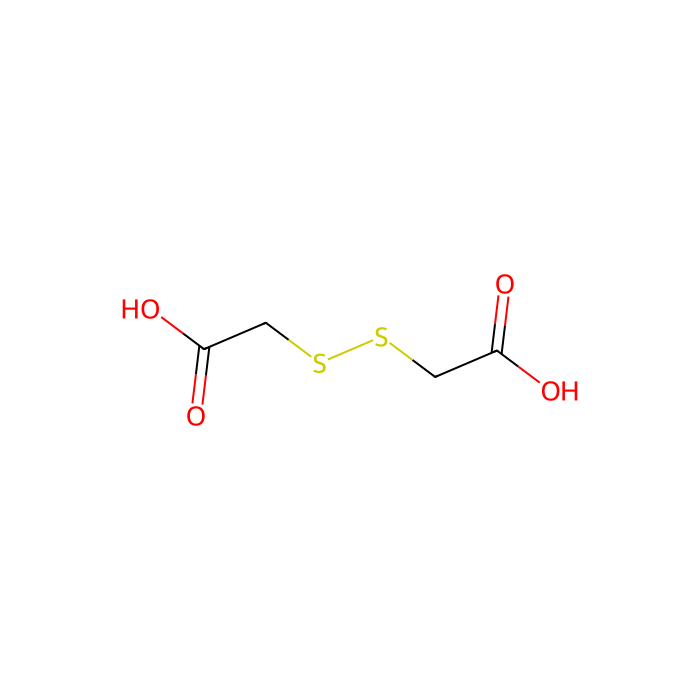
Dithiodiglycolic acid - ≥96% , CAS No.505-73-7

CAS: 505-73-7 Cat. No.: D113563 Summenformel: C4H6O4S2 Molekulargewicht: 182.22 EG-Nummer: 208-019-8
Zu bestellen verfügbar
QUALITÄT & REINHEIT ≥96%
Synonyms
Dithiodiacetic acid|I+/-,I+/-'-DithiodiessigsA currencyure|2,2'-Dithiobisacetic acid|2,2'-Dithiodi(acetic) acid|2,2'-Dithiodiacetic acid|Acetic acid, 2,2'-dithiobis-|DithiodiglycolicAcid|2,2'-disulfanediyldiacetic acid|2,2-dithioglycolic acid|Bis(carboxymethyl) disulfide|Dithiodiglycolic acid|2,2'-DITHIODIETHANOIC ACID|2,2 inverted exclamation mark -Disulfanediyldiacetic Acid|Acetic acid, dithiodi-|Acetic acid,2'-dithiobis-|2,2'-Dithiodiglycolic acid|Dithiodiglycollic acid|DITHIODIGLYCOLIC ACID [INCI]|2-(carboxymethyldisulfanyl)acetic acid|BIS(MERCAPTOACETIC ACID)|Dithioglycolic acid|2,2′-Dithiodiacetic acid
Storage
Store at -20°C
Shipped In
Ice chest + Ice pads
★
Größe
Deutschland (EU)
USA*
Preis
Menge
5g
D113563-5g
—
2 Auf Lager

19,00€

28,55€
Speichern 9,55 € (33.43%)
25g
D113563-25g
Auf Bestellung · 8–12 Wochen

50,24€

75,41€
Speichern 25,16 € (33.37%)
100g
D113563-100g
—
1 Auf Lager

200,36€

301,02€
Speichern 100,66 € (33.44%)
Enter a quantity for the sizes you want to add.

Spezifikationen

Synonyme
Dithiodiacetic acid | I+/-,I+/-'-DithiodiessigsA currencyure | 2,2'-Dithiobisacetic acid | 2,2'-Dithiodi(acetic) acid | 2,2'-Dithiodiacetic acid | Acetic acid, 2,2'-dithiobis- | DithiodiglycolicAcid | 2,2'-disulfanediyldiacetic acid | 2,2-dithioglycolic acid | Bis(carboxymethyl) disulfide | Dithiodiglycolic acid | 2,2'-DITHIODIETHANOIC AC Show more
Spezifikationen & Reinheit
≥96%
Storage
Store at -20°C
Verschickt in
Ice chest + Ice pads
Dieses Produkt erfordert Kühlkettenversand. Grundversand und andere Economy-Optionen sind nicht verfügbar.
Reinheit
≥96%
Namen und Kennungen
Pubchem Sid
Pubchem Sid Url
https://pubchem.ncbi.nlm.nih.gov/substance/504754264
SMILES
C(C(=O)O)SSCC(=O)O
IUPAC Name
2-(carboxymethyldisulfanyl)acetic acid
InChIKey
DLLMHEDYJQACRM-UHFFFAOYSA-N
InChI
1S/C4H6O4S2/c5-3(6)1-9-10-2-4(7)8/h1-2H2,(H,5,6)(H,7,8)
Isomere SMILES
C(C(=O)O)SSCC(=O)O
WGK Deutschland
3
Molekulargewicht
182.22
Reaxy-Rn
1771018
Reaxys-RN_link_address
https://www.reaxys.com/reaxys/secured/hopinto.do?context=S&query=IDE.XRN=1771018&ln=

Erweiterte Daten

Taxonomic Classification

Taxonomy Tree

KingdomOrganic compounds
SuperclassOrganic acids and derivatives
KlasseCarboxylic acids and derivatives
SubclassDicarboxylic acids and derivatives
Intermediate Tree Nodes Not available
Direct ParentDicarboxylic acids and derivatives
Alternative Parents Dialkyldisulfides  Sulfenyl compounds  Carboxylic acids  Organic oxides  Hydrocarbon derivatives  Carbonyl compounds  
Molecular FrameworkAliphatic acyclic compounds
Substituents Dicarboxylic acid or derivatives - Dialkyldisulfide - Organic disulfide - Sulfenyl compound - Carboxylic acid - Organic oxygen compound - Organic oxide - Hydrocarbon derivative - Organosulfur compound - Organooxygen compound - Carbonyl group - Aliphatic acyclic compound
BeschreibungThis compound belongs to the class of organic compounds known as dicarboxylic acids and derivatives. These are organic compounds containing exactly two carboxylic acid groups.
External Descriptors Not available
3D-Struktur
Interaktives chemisches Strukturmodell


Zugehörige Ziele (menschlich)
CYP2D6 Tclin Cytochrome P450 2D6 (33882 Activities)
Activity TypeRelationActivity valueUnitsAction TypeJournalPubMed IddoiAssay Aladdin ID
CYP1A2 Tchem Cytochrome P450 1A2 (26471 Activities)
Activity TypeRelationActivity valueUnitsAction TypeJournalPubMed IddoiAssay Aladdin ID
CYP2C9 Tchem Cytochrome P450 2C9 (32119 Activities)
Activity TypeRelationActivity valueUnitsAction TypeJournalPubMed IddoiAssay Aladdin ID
CYP2C19 Tchem Cytochrome P450 2C19 (29246 Activities)
Activity TypeRelationActivity valueUnitsAction TypeJournalPubMed IddoiAssay Aladdin ID
CYP3A4 Tclin Cytochrome P450 3A4 (53859 Activities)
Activity TypeRelationActivity valueUnitsAction TypeJournalPubMed IddoiAssay Aladdin ID
A498 (42825 Activities)
Activity TypeRelationActivity valueUnitsAction TypeJournalPubMed IddoiAssay Aladdin ID
ACHN (49357 Activities)
Activity TypeRelationActivity valueUnitsAction TypeJournalPubMed IddoiAssay Aladdin ID
CAKI-1 (44928 Activities)
Activity TypeRelationActivity valueUnitsAction TypeJournalPubMed IddoiAssay Aladdin ID
CCRF-CEM (65223 Activities)
Activity TypeRelationActivity valueUnitsAction TypeJournalPubMed IddoiAssay Aladdin ID
COLO 205 (50209 Activities)
Activity TypeRelationActivity valueUnitsAction TypeJournalPubMed IddoiAssay Aladdin ID
DU-145 (51482 Activities)
Activity TypeRelationActivity valueUnitsAction TypeJournalPubMed IddoiAssay Aladdin ID
HL-60 (67320 Activities)
Activity TypeRelationActivity valueUnitsAction TypeJournalPubMed IddoiAssay Aladdin ID
HT-29 (80576 Activities)
Activity TypeRelationActivity valueUnitsAction TypeJournalPubMed IddoiAssay Aladdin ID
K562 (73714 Activities)
Activity TypeRelationActivity valueUnitsAction TypeJournalPubMed IddoiAssay Aladdin ID
KM12 (47707 Activities)
Activity TypeRelationActivity valueUnitsAction TypeJournalPubMed IddoiAssay Aladdin ID
M14 (47487 Activities)
Activity TypeRelationActivity valueUnitsAction TypeJournalPubMed IddoiAssay Aladdin ID
MCF7 (126967 Activities)
Activity TypeRelationActivity valueUnitsAction TypeJournalPubMed IddoiAssay Aladdin ID
MOLT-4 (49676 Activities)
Activity TypeRelationActivity valueUnitsAction TypeJournalPubMed IddoiAssay Aladdin ID
OVCAR-3 (48710 Activities)
Activity TypeRelationActivity valueUnitsAction TypeJournalPubMed IddoiAssay Aladdin ID
OVCAR-4 (44535 Activities)
Activity TypeRelationActivity valueUnitsAction TypeJournalPubMed IddoiAssay Aladdin ID
OVCAR-5 (45555 Activities)
Activity TypeRelationActivity valueUnitsAction TypeJournalPubMed IddoiAssay Aladdin ID
OVCAR-8 (47708 Activities)
Activity TypeRelationActivity valueUnitsAction TypeJournalPubMed IddoiAssay Aladdin ID
PC-3 (62116 Activities)
Activity TypeRelationActivity valueUnitsAction TypeJournalPubMed IddoiAssay Aladdin ID
RPMI-8226 (44974 Activities)
Activity TypeRelationActivity valueUnitsAction TypeJournalPubMed IddoiAssay Aladdin ID
RXF 393 (41971 Activities)
Activity TypeRelationActivity valueUnitsAction TypeJournalPubMed IddoiAssay Aladdin ID
SF-295 (48000 Activities)
Activity TypeRelationActivity valueUnitsAction TypeJournalPubMed IddoiAssay Aladdin ID
SK-MEL-2 (46422 Activities)
Activity TypeRelationActivity valueUnitsAction TypeJournalPubMed IddoiAssay Aladdin ID
SK-MEL-28 (48833 Activities)
Activity TypeRelationActivity valueUnitsAction TypeJournalPubMed IddoiAssay Aladdin ID
SK-MEL-5 (47095 Activities)
Activity TypeRelationActivity valueUnitsAction TypeJournalPubMed IddoiAssay Aladdin ID
SK-OV-3 (52876 Activities)
Activity TypeRelationActivity valueUnitsAction TypeJournalPubMed IddoiAssay Aladdin ID
SN12C (47755 Activities)
Activity TypeRelationActivity valueUnitsAction TypeJournalPubMed IddoiAssay Aladdin ID
SNB-19 (46794 Activities)
Activity TypeRelationActivity valueUnitsAction TypeJournalPubMed IddoiAssay Aladdin ID
TK-10 (45540 Activities)
Activity TypeRelationActivity valueUnitsAction TypeJournalPubMed IddoiAssay Aladdin ID
U-251 (51189 Activities)
Activity TypeRelationActivity valueUnitsAction TypeJournalPubMed IddoiAssay Aladdin ID
UACC-257 (46019 Activities)
Activity TypeRelationActivity valueUnitsAction TypeJournalPubMed IddoiAssay Aladdin ID
UACC-62 (47335 Activities)
Activity TypeRelationActivity valueUnitsAction TypeJournalPubMed IddoiAssay Aladdin ID
UO-31 (46270 Activities)
Activity TypeRelationActivity valueUnitsAction TypeJournalPubMed IddoiAssay Aladdin ID
786-0 (47912 Activities)
Activity TypeRelationActivity valueUnitsAction TypeJournalPubMed IddoiAssay Aladdin ID
A549 (127892 Activities)
Activity TypeRelationActivity valueUnitsAction TypeJournalPubMed IddoiAssay Aladdin ID
NCI/ADR-RES (33767 Activities)
Activity TypeRelationActivity valueUnitsAction TypeJournalPubMed IddoiAssay Aladdin ID
T47D (39041 Activities)
Activity TypeRelationActivity valueUnitsAction TypeJournalPubMed IddoiAssay Aladdin ID
EKVX (44102 Activities)
Activity TypeRelationActivity valueUnitsAction TypeJournalPubMed IddoiAssay Aladdin ID
NCI-H322M (45589 Activities)
Activity TypeRelationActivity valueUnitsAction TypeJournalPubMed IddoiAssay Aladdin ID
HCC 2998 (41480 Activities)
Activity TypeRelationActivity valueUnitsAction TypeJournalPubMed IddoiAssay Aladdin ID
HCT-116 (91556 Activities)
Activity TypeRelationActivity valueUnitsAction TypeJournalPubMed IddoiAssay Aladdin ID
HOP-92 (41141 Activities)
Activity TypeRelationActivity valueUnitsAction TypeJournalPubMed IddoiAssay Aladdin ID
Hs-578T (29457 Activities)
Activity TypeRelationActivity valueUnitsAction TypeJournalPubMed IddoiAssay Aladdin ID
NCI-H460 (60772 Activities)
Activity TypeRelationActivity valueUnitsAction TypeJournalPubMed IddoiAssay Aladdin ID
SF-268 (49410 Activities)
Activity TypeRelationActivity valueUnitsAction TypeJournalPubMed IddoiAssay Aladdin ID
IGROV-1 (47897 Activities)
Activity TypeRelationActivity valueUnitsAction TypeJournalPubMed IddoiAssay Aladdin ID
Wirkungsmechanismen
Zertifikate (CoA, COO, BSE/TSE und Analyse-Diagramm)
C of A & Other Certificates(BSE/TSE, COO):
Analytical Chart:

Find and download the COA for your product by matching the lot number on the packaging.

27 results found

Lot NumberCertificate TypeDatumArtikel
E2625374E2625374Certificate of AnalysisMay 28, 2026 D113563
E2625339E2625339Certificate of AnalysisMay 28, 2026 D113563
E2625338E2625338Certificate of AnalysisMay 28, 2026 D113563
A2609039A2609039Certificate of AnalysisJul 28, 2025 D113563
G2524336G2524336Certificate of AnalysisJul 28, 2025 D113563
G2524320G2524320Certificate of AnalysisJul 28, 2025 D113563
G2524319G2524319Certificate of AnalysisJul 28, 2025 D113563
C2504212C2504212Certificate of AnalysisMar 07, 2025 D113563
C2504232C2504232Certificate of AnalysisMar 07, 2025 D113563
C2504331C2504331Certificate of AnalysisMar 07, 2025 D113563
C2408056C2408056Certificate of AnalysisMar 12, 2024 D113563
J2421270J2421270Certificate of AnalysisMar 12, 2024 D113563
C2408051C2408051Certificate of AnalysisMar 12, 2024 D113563
C2408052C2408052Certificate of AnalysisMar 12, 2024 D113563
C2408053C2408053Certificate of AnalysisMar 12, 2024 D113563
C2408054C2408054Certificate of AnalysisMar 12, 2024 D113563
C2408055C2408055Certificate of AnalysisMar 12, 2024 D113563
A2412080A2412080Certificate of AnalysisAug 22, 2023 D113563
H2318381H2318381Certificate of AnalysisAug 22, 2023 D113563
H2318382H2318382Certificate of AnalysisAug 22, 2023 D113563
H2318394H2318394Certificate of AnalysisAug 22, 2023 D113563
H2318395H2318395Certificate of AnalysisAug 22, 2023 D113563
H2318396H2318396Certificate of AnalysisAug 22, 2023 D113563
J2323069J2323069Certificate of AnalysisAug 22, 2023 D113563
D2328040D2328040Certificate of AnalysisFeb 09, 2023 D113563
B2306923B2306923Certificate of AnalysisFeb 09, 2023 D113563
J2214293J2214293Certificate of AnalysisDec 22, 2021 D113563
Chemische und physikalische Eigenschaften
LöslichkeitSoluble in water; Soluble in Methanol,Ethanol,Ether
Schmelzpunkt (°C)107°C
Molekulargewicht182.200 g/mol
XLogP30.100
Hydrogen Bond Donor Count2
Hydrogen Bond Acceptor Count6
Rotatable Bond Count5
Exact Mass181.971 Da
Monoisotopic Mass181.971 Da
Topological Polar Surface Area125.000 Ų
Heavy Atom Count10
Formal Charge0
Complexity119.000
Isotope Atom Count0
Defined Atom Stereocenter Count0
Undefined Atom Stereocenter Count0
Defined Bond Stereocenter Count0
Undefined Bond Stereocenter Count0
The total count of all stereochemical bonds0
Covalently-Bonded Unit Count1
Citations of This Product
Lösungsrechner
Bewertungen

Kundenbewertungen

Application Protocols

Not applicable (no vendor-tested bioassay protocols provided)

  • No specific tested applications (e.g., WB, IHC, IF, FC) or recommended dilutions are provided for this small-molecule reagent.

General laboratory usage notes (literature-based)

  • For conjugation: generate NHS esters in situ (EDC/NHS) and couple to amines at pH 7.2–7.6; quench residual actives with Tris or ethanolamine; purify by dialysis or chromatography.
  • For reduction studies: prepare solutions freshly in degassed buffer; initiate reduction with TCEP or DTT; quantify thiols by Ellman’s reagent (DTNB) at 412 nm.
  • For polymer crosslinking: pre-activate carboxylates (e.g., with DIC/DMAP) and blend with diols/diamines; cure under inert atmosphere to protect the disulfide.

Always adapt conditions to your system and consult the primary literature.

Biological Roles

Applicability

  • Dithiodiglycolic acid is a synthetic, symmetric disulfide diacid and is not a known endogenous metabolite.

General biochemical context (literature)

  • Disulfide motifs: disulfide bonds are pivotal in protein folding and redox signaling. While this compound is not a biological disulfide, it can serve as a model substrate for studying disulfide reduction, thiol–disulfide exchange kinetics, and reductive environments (e.g., glutathione-mediated processes).
  • Reductant sensitivity: intracellular milieus rich in glutathione (1–10 mM) can cleave disulfide linkers; thus, dithiodiglycolic acid-derived conjugates are often explored as reduction-responsive materials in vitro.
  • Metal interaction: upon reduction to thioglycolate, strong affinity for metal surfaces (e.g., Au, Ag) can be exploited in biointerfaces and biosensors to test immobilization and release under reductive triggers.

Use limitations

  • Any biological discussions are strictly for research context. This product is labeled For research use only and is not intended for diagnostic, therapeutic, or in vivo use.

Recommendations

  • When using as a model disulfide in biochemical assays, buffer at pH 7.0–7.5 to mimic physiological conditions, control ionic strength, and quantify reduction using Ellman’s reagent (DTNB) post-reduction (literature method).
Buffer Applications

Not typically applicable

  • Dithiodiglycolic acid is a diprotic aliphatic dicarboxylic acid, but it is not commonly used as a defined buffering agent in standard biological or analytical buffer systems.

General guidance (if used experimentally)

  • pH range: as a dicarboxylic acid, any buffering capacity would be confined to acidic ranges near its pKa values (typical aliphatic dicarboxylic acids buffer roughly in the pH ~2–4 and ~4–6 regions). Exact pKa values for this specific compound should be determined experimentally before buffer use.
  • Considerations: the central disulfide can undergo exchange or reduction in the presence of thiols or reductants commonly present in biological samples; this can change solution composition over time.

Recommendation

  • For robust buffering, select established systems (e.g., citrate, acetate, MES, phosphate). Use dithiodiglycolic acid primarily as a functional linker or redox-responsive building block rather than as a buffer component.
Green Alternatives

Assessment context

  • Dithiodiglycolic acid is not a volatile organic solvent; its green profile depends on synthesis route, solvent choices, and downstream handling of sulfur-containing wastes.

Greener choices and tradeoffs (literature-based)

  • Alternative linkers: 3,3′-dithiodipropionic acid (DTDPA) and cystine provide disulfide functionality with different biodegradability profiles. Cystine (biogenic amino acid disulfide) is renewable but introduces amines and stereocenters, which may be undesirable.
  • Solvent selection: prefer water, ethanol, or 2-MeTHF for transformations when feasible instead of chlorinated solvents or DMF/NMP. Carbodiimide couplings can be adapted to aqueous ethanol or water with EDC and NHS.
  • Reductants/oxidants: use TCEP (aqueous, odorless, phosphate salts) instead of thiol-based reductants that generate malodorous waste; for oxidation, air/O2 with TEMPO or catalytic systems can replace stoichiometric halogens (I2), reducing halogenated waste.

Comparison snapshot (general)

  • Water/EtOH vs DMF/DCM: lower toxicity and easier waste management; may require surfactants or phase-transfer catalysts to achieve comparable rates/yields.
  • Cystine vs disulfide diacids: renewable source and benign degradation products but more complex protection/deprotection and solubility behavior.

Practical recommendations

  • Design aqueous or aqueous-alcoholic couplings (EDC/NHS) at controlled pH to minimize organic solvent usage.
  • Implement closed systems and scrubbers when generating thiols to control odors; segregate sulfur-containing waste for proper treatment.
Pharmaceutical Uses

Scope

  • No pharmacopeial monograph or excipient grade is specified for this item. This product is supplied For research use only and is not intended for human or veterinary use.

Formulation-relevant notes (general, non-clinical)

  • Functional linker: the diacid can be derivatized to form amide/ester linkages, embedding a reducible disulfide in drug–polymer conjugates or carrier systems for in vitro research on reduction-triggered release.
  • Salt forms: disodium or dipotassium salts may improve aqueous solubility for process or formulation screening (research scale). Validate stability with respect to disulfide integrity and pH.
  • Analytical controls: monitor for formation of thioglycolic acid upon exposure to reductants; LC-MS and HPLC with UV or CAD detection are suitable.

Manufacturing considerations (research context)

  • Avoid contact with strong reducing agents during handling to maintain disulfide content; process under inert atmosphere if necessary.
  • Control residual solvents and moisture to meet internal specifications for investigational materials.

Regulatory note

  • In absence of a stated pharmaceutical grade, do not use in GMP drug product. For any preclinical formulation work, establish in-house specifications and conduct appropriate characterization.
Physical Properties

Item-specific specifications

  • Boiling point, melting point, density, refractive index, water/peroxide/metal limits, UV cutoff: Not specified for this item; refer to CoA/Spec Sheet.

Literature/general properties (for context; not item-specific specs)

  • Physical state/appearance (typical): crystalline solid (dicarboxylic acids commonly isolate as solids).
  • Acid–base: diprotic acid; each –COOH typically exhibits pKa in the ~2–4 range (literature class behavior for aliphatic dicarboxylic acids). Exact pKa values for this compound should be confirmed experimentally.
  • Solubility profile (qualitative, literature): expected to be highly soluble in water under basic conditions (forming di-/mono-carboxylate salts); limited to moderate solubility in neutral water; soluble in polar protic/amide solvents (MeOH, EtOH, DMSO, DMF). Verify for your application.
  • Partitioning: the presence of two carboxyl groups leads to low logP at neutral/alkaline pH (exists as anions); unionized form more hydrophilic than typical disulfides.
  • Redox: disulfide bond is reducible to two thiols (2 × HS–CH2–CO2H) and can undergo disulfide exchange; resistant to typical oxygen but sensitive to strong reductants.

Practical notes (general)

  • Hygroscopicity: dicarboxylic acids can absorb moisture; handle quickly in ambient air.
  • Thermal behavior: avoid prolonged heating; decomposition may occur before boiling.
  • pH-dependent solubility: dissolve by partial neutralization with NaOH/KOH to prepare mono- or disodium salts for aqueous work.
Quality and Grades

Item-specific quality information

  • Grade/purity: Not specified for this item; refer to CoA/Spec Sheet.
  • Stabilizers/inhibitors: Not specified for this item; refer to CoA/Spec Sheet.

General guidance on quality and implications

  • Research grade vs analytical grade: analytical reagent (AR) grade emphasizes low inorganic/organic impurities and is suitable for quantitative work; research grade is acceptable for most synthetic transformations. If HPLC/LC-MS use is intended (e.g., as a standard or linker), request low non-volatile residue and low metal content documentation.
  • Disulfide integrity: for disulfide-containing materials, the main quality consideration is the oxidation state. Monitor by HPLC/LC-MS for the parent disulfide and absence of reduced thiol (thioglycolic acid) or over-oxidized sulfinic/sulfonic acids.
  • Acidity profile: titration purity (acid number) is a practical check for dicarboxylic acids; Karl Fischer moisture can influence mass-based stoichiometry in coupling reactions. If moisture matters in your application, request the KF value for your lot.
  • Metals: if you plan metal-catalyzed coupling or trace analysis, low metal content may be important; request ICP data where relevant.

Documentation

  • Certificate of Analysis (CoA) and Specification Sheet will provide lot-specific assay, identity (NMR/IR/LC-MS), residual solvents, moisture, and any stabilizer use. Use these to set acceptance criteria for your workflow.
Reaction and Applications

Context (expanding on typical uses for this disulfide diacid)

  • Redox chemistry: serves as a symmetric disulfide that can be reduced to thioglycolic acid (TGA). This reversible redox pair is useful for studying disulfide exchange and for redox-responsive linkers in materials and conjugates.
  • Linker chemistry: the two terminal carboxylates can be activated (e.g., EDC/NHS) to form amide or ester linkages to biomolecules or polymers. The central –S–S– enables cleavability under reducing intracellular or chemical conditions.
  • Surface/metal interactions: carboxylates can chelate/coordinate to metal ions or surfaces; after reduction, the resulting thiols bind strongly to noble metals (Au, Ag), enabling monolayer or ligand exchange studies.
  • Polymer and hydrogel networks: incorporation as a disulfide-bearing crosslinker grants stimuli-responsiveness (degradable under reductive environments); spacer length and hydrophilicity can tune swelling and degradation.

Synthetic transformations (literature)

  • Reduction to thiols: TCEP or DTT in aqueous buffer (pH 7–8) or NaBH4 in alcohol/water yields HS–CH2–CO2H (2 equiv.).
  • Oxidative coupling: thioglycolic acid can be re-oxidized with I2, air/O2 (with catalyst), or H2O2 to regenerate the disulfide.
  • Coupling to amines/alcohols: EDC/NHS or DIC/DMAP enables formation of amide/ester derivatives. Conversion to acid chlorides (SOCl2, oxalyl chloride) affords higher reactivity in nonpolar media.
  • Disulfide exchange: in presence of thiols and base, undergoes exchange to mixed disulfides—useful for dynamic combinatorial chemistry.

Notes

  • Control pH and avoid excess nucleophilic thiol to limit undesired exchange during coupling.
  • Monitor integrity by LC-MS (M+H+ 183, literature) and by thiol assays after reduction.
Reaction Conditions

General literature guidance (illustrative; adjust to your system)

  • Amide coupling (EDC/NHS, aqueous): dissolve compound (5–20 mM) in MES buffer pH 5.5–6.0; add NHS (1.1–1.5 eq per COOH) and EDC·HCl (1.1–1.5 eq per COOH); activate 10–30 min at RT; add amine (1.0–2.0 eq per activated site) and adjust to pH 7.2–7.6; react 1–4 h or overnight at RT. Monitor by HPLC.
  • Steglich esterification (DCM/DMF): acid (1.0 eq per COOH), alcohol (1.5–3.0 eq), DIC (1.1–1.5 eq), catalytic DMAP (0.05–0.1 eq); 0–25°C, 2–18 h. Keep nucleophilic thiols absent to maintain disulfide.
  • Acid chloride formation: reflux with SOCl2 (4–10 eq) with a catalytic DMF drop; 0.5–2 h under inert atmosphere; remove volatiles, use immediately to minimize side reactions.
  • Reduction to thiols: TCEP·HCl (1.1–1.5 eq per disulfide) in phosphate buffer pH 7.2–7.8, 0.5–2 h at RT; alternatively DTT (1.5–2.5 eq) pH 7.5–8.5. For nonaqueous, NaBH4 (2–4 eq) in MeOH/H2O at 0–25°C. Quench carefully and control odor.
  • Disulfide exchange: substrate and thiol (1–2 eq) with base (e.g., TEA, pH 8–9 in water or organic base in DMF) at RT to 40°C; hours to overnight; monitor by LC-MS.

Expected outcomes (typical, literature)

  • Couplings often proceed in 60–90% isolated yield for mono-derivatives with careful stoichiometry; di-derivatization can reach >80% combined yields.

Notes

  • Maintain neutral to mildly basic pH to prevent premature disulfide cleavage; exclude reductants and avoid prolonged exposure to strong base.
Safety and Handling

Item-specific hazard data

  • Signal word, H-statements, GHS classification, pictograms: Not specified for this item; refer to SDS.

General safety guidance (literature/analog-based; not a substitute for SDS)

  • Likely hazards: irritant to skin/eyes/respiratory tract (organic acids). Disulfides are not peroxidizable like ethers but can be reduced to volatile thiols (odor/toxicity concerns) during reactions or spills.
  • PPE: lab coat, safety glasses or face shield, appropriate chemical-resistant gloves (nitrile or equivalent), and use in a fume hood to avoid inhalation of dust/aerosols.
  • First aid (overview):
    • Inhalation: move to fresh air; seek medical attention if symptoms persist.
    • Skin/eye contact: rinse immediately with plenty of water for ≥15 minutes; remove contaminated clothing; seek medical advice.
    • Ingestion: rinse mouth; do not induce vomiting; seek medical attention.
  • Incompatibilities: strong reducing agents (e.g., DTT, TCEP, NaBH4) will cleave the disulfide to thiols; strong oxidizers can over-oxidize sulfur; store away from bases/acids that can cause uncontrolled reactions; avoid reactive metals that form carboxylates.
  • Spill/cleanup: avoid dust formation; collect solids by gentle sweeping; for solutions, absorb with inert material; ventilate area.
  • Fire: use CO2, dry chemical, or foam; decomposition can emit sulfur oxides.

Always consult the product’s SDS for authoritative and regulatory hazard information.

Solvent Selection

Applicability

  • As a polar, redox-active dicarboxylic acid, solvent choice depends on whether you need the unionized acid, the carboxylate salt, or to preserve/transform the disulfide.

General solvent behavior (literature)

  • Water: limited to moderate solubility as free acid; high solubility upon partial/complete neutralization (Na+/K+ carboxylates). Ideal for bioconjugation-style EDC/NHS chemistries near neutral pH if converted in situ to active esters.
  • Alcohols (MeOH, EtOH, iPrOH): good for Fischer esterification (acid-catalyzed) when moisture is controlled.
  • Polar aprotic (DMF, DMSO, NMP): dissolve the neutral diacid for amide couplings (DIC/EDC/HATU) or for preparing NHS esters; protect from reductants.
  • Chlorinated solvents (DCM, CHCl3): may require base (TEA) or conversion to acid chloride to enhance solubility/reactivity; monitor for disulfide stability.

Selection tips

  • Preserve disulfide: avoid reducing agents (DTT, TCEP) and strongly basic aqueous media that generate thiolates.
  • Promote coupling: use DMF/DMSO with carbodiimides and catalytic DMAP or NHS; include base (DIPEA) as needed.
  • Aqueous work: adjust to pH 6–7.5 to balance solubility and minimize disulfide exchange; buffer with non-nucleophilic systems (e.g., MES, phosphate) to avoid side reactions.

Comparison (general)

  • Dithiodiglycolic acid vs 3,3′-dithiodipropionic acid: the former is slightly more acidic (alpha to carbonyl) and typically more water-soluble; the latter offers longer spacer length and may be less polar—choose based on spacer length and solubility needs.
Storage and Reconstitution

Item-specific storage/shipping

  • Storage conditions: Store at -20°C (per Product Data).
  • Shipped in: Ice chest + ice pads (per Product Data).

General handling and stability guidance

  • Protection: keep tightly sealed under dry, inert atmosphere if possible. Limit exposure to ambient moisture and air to minimize hydrolysis/acid uptake and unintended redox changes.
  • Light/temperature: store in the dark; avoid repeated warming/cooling cycles. Aliquot upon first opening to reduce freeze–thaw and headspace oxygen exposure.
  • Incompatibilities: avoid contact with strong reducing agents (e.g., DTT, TCEP, NaBH4) or strong oxidizers during storage.

Reconstitution (general suggestions; verify solubility experimentally)

  • Aqueous: dissolve by partial neutralization with equimolar NaOH/KOH to form mono- or disodium salt; typical working concentrations 10–100 mM for coupling chemistry. Adjust pH to application need (commonly 6.0–7.5 to preserve disulfide).
  • Organic: DMF or DMSO often provide convenient stock solutions (0.1–0.5 M). Filter (0.2 µm) if needed.
  • Stability of solutions: prepare fresh when possible; store chilled (2–8°C) for short periods. For long-term storage of solutions, freeze at -20°C and avoid reducers.

Labeling

  • Research Use Only (per Product Data). Always refer to the product CoA/SDS for lot-specific stability and handling instructions.
Structure and Identity

Item-specific (from Product Data)

  • SKU: D113563
  • Product name: Dithiodiglycolic acid
  • CAS: 505-73-7
  • PubChem CID: 68164
  • InChIKey: 66516 (as provided)
  • Storage: Store at -20°C
  • Shipping: Ice chest + ice pads

Literature/computed identity (general reference values; verify against CoA/SDS for this lot)

  • Preferred IUPAC name: 2,2′-disulfanediyldiacetic acid (also: dithiodiglycolic acid)
  • Molecular formula (literature): C4H6O4S2
  • Molecular weight (literature): ~182.21 g/mol
  • SMILES (literature): O=C(O)CSSC(=O)O
  • InChI (literature): InChI=1S/C4H6O4S2/c5-3(6)1-7-8-2-4(9)10/h1-2H2,(H,5,6),(H,9,10)

Structural features (general chemistry description)

  • Functional groups: two terminal carboxylic acids (dicarboxylic acid) linked by a central disulfide (–S–S–) bridge via methylene spacers (–CH2–).
  • Core motif: symmetric disulfide connecting two glycolic-acid–derived fragments (thioglycolic acid dimer).
  • 2D description: HOOC–CH2–S–S–CH2–COOH; no stereocenters; achiral, symmetric molecule.
  • Implications: acidic, hydrogen-bond donor/acceptor at the termini; redox-active disulfide susceptible to reduction to thiols (thioglycolic acid) and to exchange reactions under basic/thiolate conditions.
Synthetic Utility

Functional handles and reactivity (literature)

  • Carboxylic acids (×2): enable amide coupling (EDC/HOBt, DIC/DMAP, HATU/DIPEA), esterification (Fischer, Steglich), and conversion to acyl chlorides (SOCl2, (COCl)2). Orthogonal activation (mono- vs di-activation) enables asymmetric derivatization.
  • Disulfide core: redox-responsive motif—reduction to thiols (thioglycolic acid) allows subsequent thiol–ene, thiol–Michael, or Au–S surface attachment. Disulfide exchange under basic/thiolate conditions provides dynamic covalent chemistry.

Applications

  • Cleavable crosslinker: embed in polymer networks, hydrogels, or bioconjugates to enable reductive cleavage and controlled release.
  • Spacer engineering: tune hydrophilicity and distance between conjugated entities; compared with longer-chain analogs, dithiodiglycolic acid provides a shorter, more polar spacer.
  • Protecting-group strategy: use the disulfide as a latent dithiol protecting group for thioglycolic acid—introduce, derivatize carboxylates, then reduce to unveil thiols.

Practical tips

  • For selective mono-activation, limit equivalents of coupling reagent and use sterics/bases to favor half-ester/amide formation; chromatographic separation may be required.
  • Preserve disulfide during coupling by avoiding nucleophilic thiols and strong bases; neutral to slightly basic conditions (pH 6.5–8) are typically safe.
  • Verify product integrity by LC-MS (disulfide intact) and by reducing a small aliquot to confirm formation of the corresponding dithiol (QA check).
Target Specificity

Not applicable

  • This product is a small-molecule chemical reagent, not a biological targeting reagent (e.g., antibody, ligand, or inhibitor with defined biological targets). No antigen/epitope, clone, species reactivity, or isotype information applies.

Häufig gestellte Fragen

What is the purity of this product?
This product is supplied at ≥96% purity (chemical assay). Lot-specific values are stated on the Certificate of Analysis.
How should this product be stored?
Store at ?20 °C. Freezer storage is required to maintain the specified shelf life.
How is this product shipped?
This product ships in an insulated container with ice pads. Unpack on arrival and transfer it to the storage condition stated above.
What are the CAS number, molecular formula and molecular weight?
The CAS Number is 505-73-7, the molecular formula is C4H6O4S2, and the molecular weight is 182.22 g/mol. InChIKey DLLMHEDYJQACRM-UHFFFAOYSA-N.
What documentation is provided?
Available product documentation, including Certificates of Analysis (COA), Safety Data Sheets (SDS), and specification sheets, is shown in the product document area. Document availability and access follow the current site policy.

Dürfen wir Sie über Rabattaktionen informieren?

Später erinnern

Vielen Dank! Bitte überprüfen Sie Ihren E-Mail-Posteingang, um zu bestätigen.

Hoppla! Benachrichtigungen sind deaktiviert.