QUALITÄT & REINHEITMoligand™?Moligand™ — Aladdin's line of ligands and bioactive small molecules. Use for receptor, pathway, and binding studies needing defined small-molecule tools.≥99%
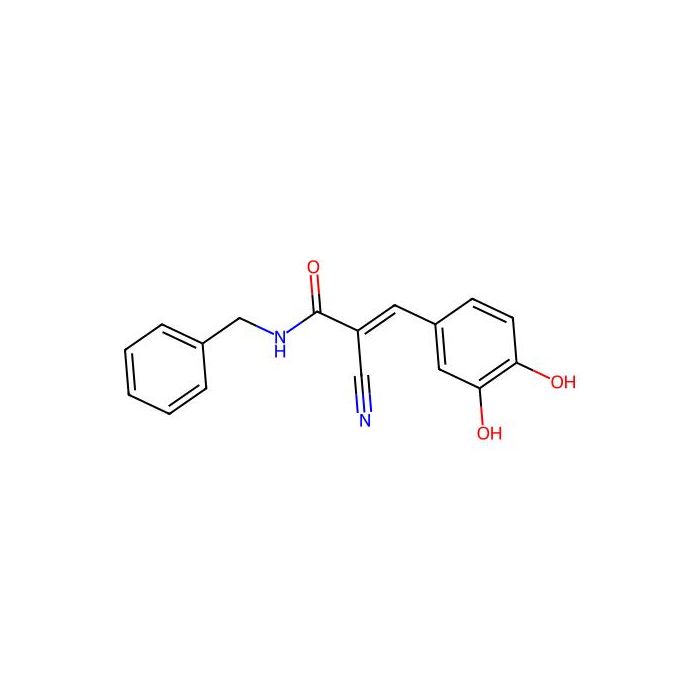
(E/Z)-AG490 ((E/Z)-Tyrphostin AG490 ) is a racemic compound of (E)-AG490 and (Z)-AG490 isomers. (E)-AG490 is a tyrosine kinase inhibitor that inhibits EGFR , Stat-3 and JAK2/3.
This compound belongs to the class of organic compounds known as hydroxycinnamic acids and derivatives. These are compounds containing an cinnamic acid (or a derivative thereof) where the benzene ring is hydroxylated.
External Descriptors
Not available
1. Djoumbou Feunang Y, Eisner R, Knox C, Chepelev L, Hastings J, Owen G, Fahy E, Steinbeck C, Subramanian S, Bolton E, Greiner R, and Wishart DS. ClassyFire: Automated Chemical Classification With A Comprehensive, Computable Taxonomy. Journal of Cheminformatics, 2016, 8:61.
P264:Wash hands [and …] thoroughly after handling.
P270:Do not eat, drink or smoke when using this product.
P273:Avoid release to the environment.
P321:Specific treatment (see ... on this label).
P330:Rinse mouth.
P391:Collect spillage.
P405:Store locked up.
P501:Dispose of contents/container to an approved waste disposal plant.
P301+P316:IF SWALLOWED: Get emergency medical help immediately.
Lösungsrechner
Molarity Calculator
Determine the necessary mass, volume, or concentration for preparing a solution.
Dilution Calculator
Determine the dilution needed to prepare a stock solution.
Reconstitution Calculator
Bewertungen
Kundenbewertungen
Application Protocols
No tested applications or protocols are provided for this item.
Item-specific recommendations such as assay type, working concentrations, or positive controls are Not specified for this item; refer to CoA/Spec Sheet.
General reminder: When developing protocols with small-molecule probes, pre-validate solvent tolerance, run vehicle controls, and document lot/isomer composition. However, Aladdin provides no protocol guarantees for this SKU.
Biological Roles
Note: The following is literature-based background intended to assist experimental design. It does not constitute medical/clinical guidance.
Chemical biology context (literature)
AG490 is widely cited as a tyrphostin-class tool compound used to interrogate kinase-driven signaling cascades. In numerous reports, it has been used to modulate the JAK/STAT axis (e.g., JAK2-dependent STAT phosphorylation) and related pathways. Potency, selectivity, and cellular outcomes can vary by system, concentration, and exposure time, and off-target effects have been reported.
Use cases in discovery workflows (literature)
Short-term pathway inhibition to study signal transduction dynamics (e.g., phospho-protein time courses by immunoblotting or phospho-specific ELISA).
Phenotypic screens where modulation of kinase signaling is hypothesized to influence observed endpoints.
Caveats
E/Z isomer mixtures may differ in potency and selectivity; document lot and isomer composition where available.
Confirm on-target effects with orthogonal probes or genetic controls, and include vehicle controls to account for solvent effects.
Item-specific note
No specific bioactivity, potency, or selectivity data are provided with this listing. Consult primary literature and verify experimentally under your conditions.
Buffer Applications
This product is not a buffering agent and is not typically used to prepare buffer systems.
Practical notes relevant to this compound type:
When diluting DMSO stock solutions into aqueous assay buffers (e.g., PBS, HEPES), add slowly with vigorous mixing to reduce precipitation.
Maintain consistent final DMSO percentage across control and treated samples.
If precipitation occurs, consider modest temperature elevation (room temperature to 37 °C), co-solvent adjustments, or cyclodextrin inclusion—validate that such changes do not affect your readout.
No buffer capacity, pKa specifications, or recommended buffer recipes are provided for this item.
Green Alternatives
For small-molecule probe handling, “green alternatives” typically concern solvent choices rather than alternative actives.
Solvent considerations (general guidance)
Prefer minimal volumes of DMSO and evaluate greener co-solvents where feasible.
Ethanol (bio-derived) can be considered for low-concentration working solutions if solubility permits, but precipitation risk must be assessed.
Aqueous solubilization aids such as cyclodextrins (e.g., HP-β-CD) or small amounts of biocompatible surfactants can reduce reliance on high-boiling polar aprotics; validate assay compatibility.
Comparison (general)
DMSO: Excellent solvency, widely accepted; not “green,” but low use levels mitigate impact.
DMF/NMP: Powerful solvents but less desirable from an EHS standpoint; restrict use and ensure proper waste handling.
Ethanol/IPA: Greener profiles but often inadequate for high-concentration stocks of hydrophobic probes.
Active substitution
No direct “green substitute” for (E/Z)-AG490 as a defined research probe. If an alternative chemical probe is desired for a given pathway, consult the literature for functionally similar but potentially more soluble or stable scaffolds; ensure comparability and validate activity in your system.
Pharmaceutical Uses
No pharmacopeial or formulation-excipient role is provided for this item. This product is supplied as a research-grade small molecule (Moligand™) and is intended strictly for laboratory research use.
Not specified for this item:
Any compendial monograph status (USP/EP/JP)
Excipient designation, dosage form compatibility, or manufacturing specifications
If formulation studies are undertaken for research purposes (e.g., delivery in model systems), ensure materials are handled under appropriate non-GMP conditions and that any solvents/excipients are compatible with your experimental model. No clinical or therapeutic applications are implied or supported by this listing.
Physical Properties
Item-specific physicochemical specifications were not supplied.
Product Data (item-specific)
Appearance: Not specified for this item; refer to CoA/Spec Sheet.
Molecular Weight: Not specified for this item; refer to CoA/Spec Sheet.
Literature/computed (for reference only; verify against primary sources before use)
Aqueous solubility: Typically very low for tyrphostin-class probes; commonly prepared as concentrated DMSO stocks (e.g., 10–50 mM) and diluted into assay media with final DMSO ≤0.1–0.5% v/v (literature practice).
Solubility profile: Good solubility in polar aprotic solvents (DMSO, DMF); limited in alcohols and minimal in water or nonpolar hydrocarbons (literature trends for similar scaffolds).
Partitioning: Moderate-to-high lipophilicity is common for kinase-probe scaffolds; exact logP/logD should be obtained from PubChem (CID: 5328779) or cheminformatics tools (literature/computed).
Melting point, boiling point, density, refractive index, pKa, UV–vis properties: Not specified for this item; consult SDS/CoA or trusted databases for literature values.
Note: Do not treat literature/computed values as specifications. For regulated or quantitative work, use the Certificate of Analysis specific to this lot.
Quality and Grades
Supplied Grade (item-specific): Moligand™
Moligand™ indicates a small-molecule ligand/probe grade intended for screening, target engagement, and exploratory mechanistic studies in research settings. It is not a GMP or clinical grade.
What this typically entails (general description of the grade)
Emphasis on structural identity confirmation (e.g., LC–MS, NMR) and assay-appropriate purity suitable for discovery workflows.
Focus on batch-to-batch consistency and stability packaging (light-protective, inert atmosphere) to maintain integrity of potentially sensitive scaffolds.
May be provided as an isomeric mixture when relevant to the chemical identity (here: E/Z mixture), unless otherwise specified on the CoA. If isomer ratio is critical, verify on the lot-specific documentation.
Not provided for this item—verify on CoA/Spec Sheet
Exact purity %, isomeric ratio, residual solvent levels, trace metal limits, water content, and UV-cutoff are Not specified for this item; refer to CoA/Spec Sheet.
Practical guidance
If using for quantitative SAR or biophysical measurements, document the lot number and retain chromatograms/specs. Where necessary, further purify or pre-dry under mild vacuum in the dark and under inert gas to maintain defined composition.
Reaction and Applications
This product is supplied as a research ligand/probe rather than a general synthetic reagent.
Primary use (research)
Employed in discovery biology and chemical biology as a small-molecule tool compound in pathway interrogation and target engagement experiments (literature). See Biological Roles for more context.
As a synthetic reagent
Not typically used as a reagent, catalyst, or building block in routine organic synthesis. No manufacturer reaction applications are provided for this item.
Good practices for solution handling (applicable to assay prep)
Dry, deoxygenated solvents (e.g., anhydrous DMSO) and inert-atmosphere handling are recommended given the supplier’s argon-charged packaging and light sensitivity note.
Minimize freeze–thaw cycles by preparing single-use aliquots.
Not specified for this item
Any named reaction roles, catalytic uses, or stoichiometric transformations are Not specified for this item; refer to primary literature if considering derivatization.
Reaction Conditions
Not typically applicable. (E/Z)-AG490 is supplied for use as a research ligand/probe rather than as a reagent under defined synthetic reaction conditions.
If conducting any chemical modification for research purposes, conditions must be developed empirically based on the verified structure from CoA/PubChem and standard organic chemistry practice.
No item-specific data are provided for:
Solvent/catalyst systems
Temperature or time profiles
Expected yields or kinetics
Refer to the literature for tyrphostin analog syntheses if planning structure–activity relation (SAR) work, and validate all conditions on small scale.
Safety and Handling
Research use: For research use only.
GHS/SDS (item-specific)
Signal Word: Not specified for this item; refer to SDS.
Hazard Statements (H-codes): Not specified for this item; refer to SDS.
GHS Classification/Pictograms: Not specified for this item; refer to SDS.
Manufacturer storage guidance (item-specific)
Store at −20 °C, protected from light, under inert gas (argon charged).
General laboratory precautions (best practice)
Wear appropriate PPE: lab coat, safety glasses, and chemical-resistant gloves (e.g., nitrile). Handle in a fume hood to avoid inhalation of dust/aerosols.
Light/air sensitivity: The supplier’s guidance (argon, light protection) indicates potential susceptibility to oxidation or photodegradation. Minimize air exposure (rapidly recap, use septum vials), and shield from ambient light.
Incompatibilities: Avoid strong oxidizers; limit prolonged exposure to bases/acids that might induce isomerization or decomposition of conjugated systems (general guidance for similar scaffolds).
Spill/first aid (summary—defer to SDS): Absorb small spills with inert material; avoid dust generation. In case of contact, rinse with water for ≥15 min; seek medical attention as needed. If inhaled, move to fresh air. If ingested, rinse mouth—do not induce vomiting; get medical attention.
Always consult the official SDS for authoritative hazard, toxicological, and first-aid information prior to use.
Solvent Selection
AG490-class probes are typically hydrophobic to moderately lipophilic, favoring polar aprotic solvents for stock preparation.
Recommended stock solvents (literature/practice)
DMSO: Primary choice for 10–50 mM stocks; excellent solvency and miscibility with assay buffers at low final % DMSO.
DMF or NMP: Alternatives when DMSO is unsuitable; similar solvation strength but consider toxicity/handling.
Ethanol: Sometimes workable at lower concentrations; solubility can be limited and precipitation on dilution more likely.
Dilution into assay media (general guidance)
Prepare concentrated, light-protected stocks in DMSO under inert gas when possible.
Add to aqueous buffers (e.g., PBS, HEPES) with vigorous mixing to minimize precipitation; keep final DMSO at or below assay tolerance (commonly ≤0.1–0.5% v/v).
For poorly soluble scenarios, consider co-solvent systems (DMSO + PEG400 or DMSO + minimal Tween-80) or inclusion complexes (e.g., HP-β-CD), validating that additives do not perturb the assay.
Not specified for this item
Exact solubility values and partition coefficients are Not specified for this item; refer to CoA/Spec Sheet or PubChem (CID: 5328779).
When to choose alternatives
If optical readouts are sensitive to DMSO background or viscosity, screen DMF/NMP/EtOH at minimal use levels, balancing solubility vs. assay compatibility.
Storage and Reconstitution
Item-specific storage
Store at −20 °C.
Protect from light.
Keep under inert atmosphere (argon charged).
Shipped in an ice chest with ice pads to limit thermal excursions.
Reconstitution (general best practice for small-molecule probes)
Allow vial to equilibrate to room temperature in the dark before opening to prevent moisture condensation.
Open under inert gas if possible. Prepare a concentrated stock in anhydrous DMSO (commonly 10–50 mM, as solubility permits; verify empirically). Mix until fully dissolved; gentle warming (≤37 °C) and sonication can help.
Sterile-filter (0.22 μm PTFE) if particulate is observed and application demands sterility.
Aliquot into amber, airtight microtubes or crimp vials under inert gas to create single-use portions.
Stability management
Minimize freeze–thaw cycles; thaw only the required aliquot.
Store aliquots at −20 °C in the dark. For working solutions, keep on ice and use promptly; discard if precipitation or discoloration is observed.
Not specified for this item
Exact shelf life, solution stability, and isomerization kinetics are Not specified for this item; consult the CoA/Spec Sheet and perform small-scale stability checks in your matrix.
Research Use Note: For research use only.
Structure and Identity
Overview: (E/Z)-AG490 is a small-molecule research ligand supplied as a mixture of geometric isomers (E and Z). It is widely recognized in the literature as a tyrphostin-class probe compound.
Product Data (item-specific)
Product Name: (E/Z)-AG490
SKU: E1428924
CAS: 134036-52-5
PubChem CID: 5328779
InChIKey: 350042 (as provided; appears non-standard/truncated—verify against CoA or external databases)
SMILES: Not specified for this item; refer to CoA/Spec Sheet.
Molecular Formula: Not specified for this item; refer to CoA/Spec Sheet.
Molecular Weight: Not specified for this item; refer to CoA/Spec Sheet.
Structural features (general/literature)
Isomerism: Provided as an E/Z mixture, indicating a central C=C unit able to adopt geometric isomerism (literature/generic description of AG490-class compounds).
Chemical class: Tyrphostin-type small molecule inhibitor scaffold (literature), typically featuring aryl–vinyl linkages and conjugation. Specific ring/functional substituents should be confirmed from an authoritative database for this CAS/CID.
2D structure description (general)
Planar, conjugated aromatic system(s) connected by an alkene unit capable of E/Z geometry; polarizable π-system with potential H-bond donor/acceptor sites depending on substituents (literature). Exact atom connectivity should be verified in PubChem (CID: 5328779) or the CoA.
Synthetic Utility
This product is provided as a defined research probe rather than a general synthetic intermediate.
Typical use in synthesis: Not commonly used as a reagent, catalyst, or coupling partner in standard organic synthesis workflows.
If derivatization is desired (general considerations for conjugated/aromatic probes):
Functional handles present in tyrphostin-like scaffolds (e.g., phenolic OH or amide/unsaturated linkages in some analogs) can, in principle, be chemoselectively modified (etherification/esterification, amidation, or Suzuki/Sonogashira on suitably halogenated analogs). The exact feasibility depends on the verified substitution pattern of this CAS.
E/Z geometry control may be relevant if isomerically pure derivatives are targeted; photochemical or base-catalyzed isomerization pathways should be assessed experimentally.
Item-specific note: No manufacturer information is provided regarding protective groups, reactive handles, or derivatization routes for this SKU. Consult the CoA or literature for the precise structure before planning any synthetic manipulation.
Target Specificity
No target specificity, antigen, or binding data are provided for this item.
Item-specific: Not specified for this item; refer to CoA/Spec Sheet.
Literature note (for context only): AG490 has been widely used as a tool compound in studies of kinase signaling (e.g., JAK/STAT axis). However, reported selectivity profiles can vary across systems and assay formats; confirm specificity under your experimental conditions using orthogonal controls.
For definitive target information, consult primary literature and perform in-house profiling.
Häufig gestellte Fragen
What is the purity of this product?
This product is supplied at ≥99% purity (chemical assay). Lot-specific values are stated on the Certificate of Analysis.
Benötigen Sie Hilfe bei der Auswahl der Qualität?
Unser Leitfaden zur Qualitätsauswahl behandelt Reinheit, Stabilisatorstatus und Anwendungseignung für alle Varianten in unserem Katalog.
Wir verwenden Cookies, um die ordnungsgemäße Funktion der Website sicherzustellen und, soweit zulässig, Ihr Nutzererlebnis zu verbessern. Sie können Ihre Einstellungen jederzeit unter „Einstellungen“ verwalten. Weitere Informationen finden Sie in unserer Cookie-Richtlinie.
Dürfen wir Sie über Rabattaktionen informieren?
Später erinnern
Vielen Dank! Bitte überprüfen Sie Ihren E-Mail-Posteingang, um zu bestätigen.
Products are supplied to verified businesses, institutions, and qualified professionals for research and development use only. Not for use in humans, animals, diagnosis, or therapy.

 I2608725