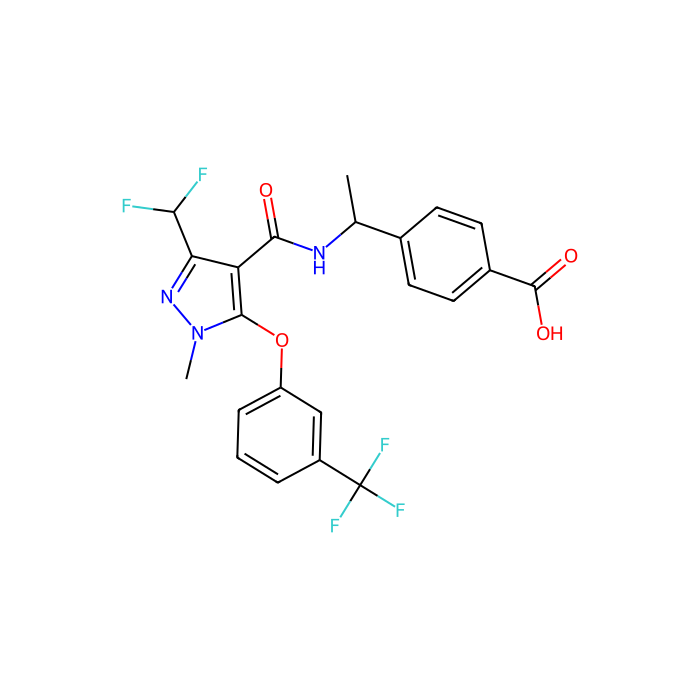
E7046 (ER-886406) - ≥99% , CAS No.1369489-71-3

CAS: 1369489-71-3 Cat. No.: E413568 Summenformel: C22H18F5N3O4 Molekulargewicht: 483.39
Zu bestellen verfügbar
GRADE & PURITY ≥99%
Synonyms
PALUPIPRANT | s6649 | HY-103088 | BDBM119448 | Hordenine, >=97.0% (HPLC) | 4-[(1S)-1-[[[3-(difluoromethyl)-1-methyl-5-[3-(trifluoromethyl)phenoxy]-1H-pyrazol-4-yl]carbonyl]amino]ethyl]-benzoic acid | YWY620GU8I | Benzoic acid, 4-((1S)-1-(((3-(difluorometh
Storage
Store at -20°C
Shipped In
Ice chest + Ice pads
★
Size
Deutschland (EU)
USA*
Price
Qty
5mg
E413568-5mg
—
3 Auf Lager

26,81€

40,70€
Speichern 13,88 € (34.12%)
25mg
E413568-25mg
—
3 Auf Lager

86,69€

130,07€
Speichern 43,39 € (33.36%)
50mg
E413568-50mg
—
2 Auf Lager

144,83€

217,72€
Speichern 72,89 € (33.48%)
100mg
E413568-100mg
—
2 Auf Lager

244,62€

366,97€
Speichern 122,35 € (33.34%)
Enter a quantity for the sizes you want to add.
🧪
Why this grade

≥99% for sensitive chromatographic and analytical workflows requiring minimal baseline interference.

🌡

Storage & shipping

Store at -20°C Ships Ice chest + Ice pads Check lot-specific COA for exact specifications.

📋

Quality documents

SDS, COA, datasheet, and spec sheet available for download. Lot-specific COA accessible via lot number lookup.

📚

Literature proof

Cited in 0 peer-reviewed publications across chromatography, organic synthesis, and cross-coupling reactions.

Übersicht

Information

E7046 (ER-886406) E7046 (ER-886406) is a selective inhibitor of the prostaglandin E 2 (PGE 2 ) receptor EP4 with IC50 of 13.5 nM and Ki of 23.14 nM.


Targets

EP4 (Cell-free assay); EP4 (Cell-free assay) 13.5nM; 23.14 nM(Ki)


In vitro

E7046 has specific and potent inhibitory activity on PGE2-mediated pro-tumor myeloid cell differentiation and activation.


In vivo

E7046 treatment reduces the growth or even rejected established tumors in vivo in a manner dependent on both myeloid and CD8+ T cells.


Cell Research(from reference)

Cell lines:Monocytes 

Concentrations:10,100,300,1000,or 3000 nM 

Incubation Time:7d 

Specifications

Synonyme
PALUPIPRANT | s6649 | HY-103088 | BDBM119448 | Hordenine, >=97.0% (HPLC) | 4-[(1S)-1-[[[3-(difluoromethyl)-1-methyl-5-[3-(trifluoromethyl)phenoxy]-1H-pyrazol-4-yl]carbonyl]amino]ethyl]-benzoic acid | YWY620GU8I | Benzoic acid, 4-((1S)-1-(((3-(difluorometh
Spezifikationen & Reinheit
≥99%
Biochemische und physiologische Mechanismen
E7046 (ER-886406) is a selective inhibitor of the prostaglandin E2 (PGE2) receptor EP4 with IC50 of 13.5 nM and Ki of 23.14 nM.
Storage
Store at -20°C
Verschickt in
Ice chest + Ice pads
Dieses Produkt erfordert Kühlkettenversand. Grundversand und andere Economy-Optionen sind nicht verfügbar.
Reinheit
≥99%
Namen und Kennungen
Pubchem Sid
Pubchem Sid Url
https://pubchem.ncbi.nlm.nih.gov/substance/504771496
Kanonisches Lächeln
CC(C1=CC=C(C=C1)C(=O)O)NC(=O)C2=C(N(N=C2C(F)F)C)OC3=CC=CC(=C3)C(F)(F)F
IUPAC Name
4-[(1S)-1-[[3-(difluoromethyl)-1-methyl-5-[3-(trifluoromethyl)phenoxy]pyrazole-4-carbonyl]amino]ethyl]benzoic acid
InChIKey
MKLKAQMPKHNQPR-NSHDSACASA-N
INCHI
1S/C22H18F5N3O4/c1-11(12-6-8-13(9-7-12)21(32)33)28-19(31)16-17(18(23)24)29-30(2)20(16)34-15-5-3-4-14(10-15)22(25,26)27/h3-11,18H,1-2H3,(H,28,31)(H,32,33)/t11-/m0/s1
Isomere SMILES
C[C@@H](C1=CC=C(C=C1)C(=O)O)NC(=O)C2=C(N(N=C2C(F)F)C)OC3=CC=CC(=C3)C(F)(F)F
Molekulargewicht
483.39
Reaxy-Rn
54734638
Reaxys-RN_link_address
https://www.reaxys.com/reaxys/secured/hopinto.do?context=S&query=IDE.XRN=54734638&ln=

Documentation

📋 Safety Data Sheet (SDS)

Comprehensive hazard, handling, storage, and regulatory compliance document.

Download SDS →

✅ Certificate of Analysis (COA)

Lot-specific quality data. Enter your lot number to retrieve the exact COA.

Look up COA →

📊 Datasheet

Quick-reference summary of product specifications and applications.

View datasheet →

🔬 Specification Sheet

Full quality attributes and acceptance criteria for this grade.

View spec sheet →

Advanced Data

Taxonomic Classification

Taxonomy Tree

KingdomOrganic compounds
SuperclassOrganic oxygen compounds
KlasseOrganooxygen compounds
SubclassEthers
Intermediate Tree Nodes Not available
Direct ParentDiarylethers
Alternative Parents Trifluoromethylbenzenes  Benzoic acids  Pyrazole-4-carboxamides  Phenoxy compounds  Phenol ethers  Benzoyl derivatives  Vinylogous amides  Heteroaromatic compounds  Secondary carboxylic acid amides  Azacyclic compounds  Carboxylic acids  Alkyl fluorides  Organofluorides  Organonitrogen compounds  Organic oxides  Hydrocarbon derivatives  
Molecular FrameworkAromatic heteromonocyclic compounds
Substituents Diaryl ether - Trifluoromethylbenzene - Benzoic acid or derivatives - Benzoic acid - Phenoxy compound - Pyrazole-4-carboxamide - Benzoyl - Phenol ether - Monocyclic benzene moiety - Benzenoid - Azole - Heteroaromatic compound - Vinylogous amide - Pyrazole - Secondary carboxylic acid amide - Carboxamide group - Azacycle - Organoheterocyclic compound - Carboxylic acid derivative - Carboxylic acid - Organonitrogen compound - Alkyl halide - Alkyl fluoride - Hydrocarbon derivative - Organic oxide - Organic nitrogen compound - Organofluoride - Organohalogen compound - Aromatic heteromonocyclic compound
BeschreibungThis compound belongs to the class of organic compounds known as diarylethers. These are organic compounds containing the dialkyl ether functional group, with the formula ROR', where R and R' are aryl groups.
External Descriptors Not available
3D-Struktur
Interaktives chemisches Strukturmodell


Zugehörige Ziele (menschlich)
PTGER4 Tclin Prostaglandin E2 receptor EP4 subtype (2 Activities)
Activity TypeActivity Value -log(M)Mechanism of ActionActivity ReferencePublications (PubMed IDs)
ABL1 Tclin Tyrosine-protein kinase ABL (18331 Activities)
Activity TypeRelationActivity valueUnitsAction TypeJournalPubMed IddoiAssay Aladdin ID
ADRB2 Tclin Beta-2 adrenergic receptor (11824 Activities)
Activity TypeRelationActivity valueUnitsAction TypeJournalPubMed IddoiAssay Aladdin ID
ADRA2A Tclin Alpha-2a adrenergic receptor (9450 Activities)
Activity TypeRelationActivity valueUnitsAction TypeJournalPubMed IddoiAssay Aladdin ID
AGTR1 Tclin Type-1 angiotensin II receptor (5176 Activities)
Activity TypeRelationActivity valueUnitsAction TypeJournalPubMed IddoiAssay Aladdin ID
PTGER2 Tclin Prostanoid EP2 receptor (1730 Activities)
Activity TypeRelationActivity valueUnitsAction TypeJournalPubMed IddoiAssay Aladdin ID
PTGER1 Tclin Prostanoid EP1 receptor (1696 Activities)
Activity TypeRelationActivity valueUnitsAction TypeJournalPubMed IddoiAssay Aladdin ID
PTGER4 Tclin Prostanoid EP4 receptor (2181 Activities)
Activity TypeRelationActivity valueUnitsAction TypeJournalPubMed IddoiAssay Aladdin ID
GSK3B Tclin Glycogen synthase kinase-3 beta (11785 Activities)
Activity TypeRelationActivity valueUnitsAction TypeJournalPubMed IddoiAssay Aladdin ID
PTGER3 Tclin Prostanoid EP3 receptor (1985 Activities)
Activity TypeRelationActivity valueUnitsAction TypeJournalPubMed IddoiAssay Aladdin ID
CSNK1D Tchem Casein kinase I delta (4546 Activities)
Activity TypeRelationActivity valueUnitsAction TypeJournalPubMed IddoiAssay Aladdin ID
CYP2D6 Tclin Cytochrome P450 2D6 (33882 Activities)
Activity TypeRelationActivity valueUnitsAction TypeJournalPubMed IddoiAssay Aladdin ID
S1PR1 Tclin Sphingosine 1-phosphate receptor Edg-1 (5806 Activities)
Activity TypeRelationActivity valueUnitsAction TypeJournalPubMed IddoiAssay Aladdin ID
CDK2 Tchem Cyclin-dependent kinase 2 (9050 Activities)
Activity TypeRelationActivity valueUnitsAction TypeJournalPubMed IddoiAssay Aladdin ID
GLP1R Tclin Glucagon-like peptide 1 receptor (111429 Activities)
Activity TypeRelationActivity valueUnitsAction TypeJournalPubMed IddoiAssay Aladdin ID
CYP1A2 Tchem Cytochrome P450 1A2 (26471 Activities)
Activity TypeRelationActivity valueUnitsAction TypeJournalPubMed IddoiAssay Aladdin ID
C5AR1 Tclin C5a anaphylatoxin chemotactic receptor (2677 Activities)
Activity TypeRelationActivity valueUnitsAction TypeJournalPubMed IddoiAssay Aladdin ID
CYP2C9 Tchem Cytochrome P450 2C9 (32119 Activities)
Activity TypeRelationActivity valueUnitsAction TypeJournalPubMed IddoiAssay Aladdin ID
CYP3A4 Tclin Cytochrome P450 3A4 (53859 Activities)
Activity TypeRelationActivity valueUnitsAction TypeJournalPubMed IddoiAssay Aladdin ID
AURKA Tchem Serine/threonine-protein kinase Aurora-A (10240 Activities)
Activity TypeRelationActivity valueUnitsAction TypeJournalPubMed IddoiAssay Aladdin ID
CYP2E1 Tchem Cytochrome P450 2E1 (2174 Activities)
Activity TypeRelationActivity valueUnitsAction TypeJournalPubMed IddoiAssay Aladdin ID
CYP2B6 Tchem Cytochrome P450 2B6 (1338 Activities)
Activity TypeRelationActivity valueUnitsAction TypeJournalPubMed IddoiAssay Aladdin ID
U2OS (164939 Activities)
Activity TypeRelationActivity valueUnitsAction TypeJournalPubMed IddoiAssay Aladdin ID
HEK293 (82097 Activities)
Activity TypeRelationActivity valueUnitsAction TypeJournalPubMed IddoiAssay Aladdin ID
CX3CR1 Tchem C-X3-C chemokine receptor 1 (1686 Activities)
Activity TypeRelationActivity valueUnitsAction TypeJournalPubMed IddoiAssay Aladdin ID
FPR2 Tchem Lipoxin A4 receptor (3472 Activities)
Activity TypeRelationActivity valueUnitsAction TypeJournalPubMed IddoiAssay Aladdin ID
FFAR4 Tchem G-protein coupled receptor 120 (2999 Activities)
Activity TypeRelationActivity valueUnitsAction TypeJournalPubMed IddoiAssay Aladdin ID
BRD4 Tchem Bromodomain-containing protein 4 (13122 Activities)
Activity TypeRelationActivity valueUnitsAction TypeJournalPubMed IddoiAssay Aladdin ID
GPR35 Tchem G-protein coupled receptor 35 (2643 Activities)
Activity TypeRelationActivity valueUnitsAction TypeJournalPubMed IddoiAssay Aladdin ID
TRIM24 Tchem Transcription intermediary factor 1-alpha (2087 Activities)
Activity TypeRelationActivity valueUnitsAction TypeJournalPubMed IddoiAssay Aladdin ID
BRPF1 Tchem Peregrin (2217 Activities)
Activity TypeRelationActivity valueUnitsAction TypeJournalPubMed IddoiAssay Aladdin ID
HEK-293T (167025 Activities)
Activity TypeRelationActivity valueUnitsAction TypeJournalPubMed IddoiAssay Aladdin ID
Zugehörige Ziele (nicht menschlich)
Aplnr Apelin receptor (201 Activities)
Activity TypeRelationActivity valueUnitsAction TypeJournalPubMed IddoiAssay Aladdin ID
Mapk1 MAP kinase ERK2 (650 Activities)
Activity TypeRelationActivity valueUnitsAction TypeJournalPubMed IddoiAssay Aladdin ID
Fgfr3 Fibroblast growth factor receptor 3 (21 Activities)
Activity TypeRelationActivity valueUnitsAction TypeJournalPubMed IddoiAssay Aladdin ID
EMT6 (738 Activities)
Activity TypeRelationActivity valueUnitsAction TypeJournalPubMed IddoiAssay Aladdin ID
3LL cell line (138 Activities)
Activity TypeRelationActivity valueUnitsAction TypeJournalPubMed IddoiAssay Aladdin ID
CT26 (928 Activities)
Activity TypeRelationActivity valueUnitsAction TypeJournalPubMed IddoiAssay Aladdin ID
Gpr119 Glucose-dependent insulinotropic receptor (270 Activities)
Activity TypeRelationActivity valueUnitsAction TypeJournalPubMed IddoiAssay Aladdin ID
Panc02 (118 Activities)
Activity TypeRelationActivity valueUnitsAction TypeJournalPubMed IddoiAssay Aladdin ID
Wirkungsmechanismen
Zertifikate (CoA, COO, BSE/TSE und Analyse-Diagramm)
C of A & Other Certificates(BSE/TSE, COO):
Analytical Chart:

Find and download the COA for your product by matching the lot number on the packaging.

4 results found

Lot NumberCertificate TypeDatumArtikel
K2218471Certificate of AnalysisSep 04, 2025 E413568
K2218563Certificate of AnalysisSep 04, 2025 E413568
K2218564Certificate of AnalysisSep 04, 2025 E413568
K2218565Certificate of AnalysisSep 04, 2025 E413568
Chemische und physikalische Eigenschaften
LöslichkeitSolubility (25°C) In vitro DMSO: 100 mg/mL (206.87 mM);    
Molekulargewicht483.400 g/mol
XLogP34.300
Hydrogen Bond Donor Count2
Hydrogen Bond Acceptor Count10
Rotatable Bond Count7
Exact Mass483.122 Da
Monoisotopic Mass483.122 Da
Topological Polar Surface Area93.500 Ų
Heavy Atom Count34
Formal Charge0
Complexity717.000
Isotope Atom Count0
Defined Atom Stereocenter Count1
Undefined Atom Stereocenter Count0
Defined Bond Stereocenter Count0
Undefined Bond Stereocenter Count0
The total count of all stereochemical bonds0
Covalently-Bonded Unit Count1
Lösungsrechner
Bewertungen

Kundenbewertungen

Application Protocols

No vendor-validated application protocols are provided for this item.

General guidance for small-molecule screening (not item-specific):

  • Stock preparation: Dissolve in dry DMSO to a defined concentration (e.g., 10–50 mM). Vortex and, if needed, brief sonication to aid dissolution.
  • Plating: Use low-retention tips/plates. Backfill with assay buffer to the desired final DMSO percentage (commonly ≤0.1–1% v/v).
  • Controls: Include vehicle controls matched to final DMSO content and appropriate positive/negative controls relevant to your assay biology.
  • Stability checks: Periodically re-test by LC–MS or HPLC after multiple freeze–thaw cycles or prolonged storage.

For detailed, assay-specific protocols (biochemical vs. cellular), follow your laboratory SOPs. This product is supplied for research use only.

Biological Roles

Item-specific biological target, pathway, or mechanism of action are not provided in the Product Data.

General considerations for small-molecule library compounds (not item-specific, literature/practice):

  • Such compounds are used as chemical tools in discovery research to probe pathways, modulate protein function, or serve as starting points for SAR campaigns after initial screening hits.
  • Typical applications include high-throughput screening (HTS), high-content imaging assays, biochemical enzyme assays, target deconvolution studies, and chemoproteomic enrichment if suitably functionalized.
  • Stock solution management (accurate concentration, stability tracking, and plate mapping) is crucial for reproducible biological readouts.

Important: No medical or clinical claims are made for this item. For any biological conclusions, verify identity, purity, and integrity via your own QC and consult the lot-specific documentation.

Buffer Applications

This item is a small-molecule library compound and is not a buffering agent. Buffer formulation guidance is therefore not directly applicable.

Practical notes for assay buffers (general):

  • When diluting DMSO stocks into aqueous buffers (e.g., PBS, HEPES, Tris), keep final DMSO at levels compatible with your biology (commonly ≤0.1–1% v/v).
  • To mitigate precipitation upon dilution, add compound stock slowly with mixing and consider using a small amount of non-ionic surfactant (e.g., 0.01% Tween-20) if compatible, or include a co-solvent fraction.
  • Maintain consistent pH and ionic strength to minimize compound aggregation artifacts.

For buffer recipes and pH ranges, use standard buffer references; this product itself does not serve as a buffer component.

Green Alternatives

This listing represents a specific small-molecule library member rather than a process reagent or solvent. As such, selection of a “green alternative” compound is not typically applicable.

  • If your objective is to optimize environmental footprint in screening workflows, consider process-level adjustments:

    • Use minimal DMSO volumes and adopt plate formats that reduce solvent waste.
    • Implement solvent recovery for washing steps and prefer water-based buffers when feasible.
    • Consolidate assay runs to minimize cold-chain shipments and dry ice usage.
  • If you are seeking a mechanistically similar tool compound with improved EHS characteristics, consult medicinal chemistry literature for alternative chemotypes; however, target or MoA details are not provided here and must be defined by your project needs.

Pharmaceutical Uses

No pharmacopeial status, excipient role, or formulation use is provided in the Product Data.

  • This product is supplied strictly for research use only. It is not approved for use as a drug substance, excipient, or in manufacturing of products intended for human or veterinary use.
  • If used as a research tool in pre-formulation or ADME studies, ensure in-house qualification and compliance with institutional policies. Any extrapolation to development contexts requires independent verification and is outside the scope of this listing.
Physical Properties

Item-specific physicochemical constants are not supplied in the Product Data. Do not treat the following placeholders as specifications.

  • Appearance: Not specified for this item; refer to CoA/Spec Sheet.
  • Melting point: Not specified for this item; refer to CoA/Spec Sheet.
  • Boiling point: Not applicable/rarely used for library solids; Not specified for this item; refer to CoA/Spec Sheet.
  • Density: Not specified for this item; refer to CoA/Spec Sheet.
  • Solubility: Not specified for this item; refer to CoA/Spec Sheet.
  • LogP / cLogP: Not specified for this item; refer to CoA/Spec Sheet.
  • pKa: Not specified for this item; refer to CoA/Spec Sheet.
  • Refractive index: Not applicable (typically a solid); Not specified for this item; refer to CoA/Spec Sheet.

General guidance (literature/practice, not item-specific):

  • Small-molecule screening compounds are commonly supplied as crystalline solids or powders with good solubility in DMSO and varying solubility in aqueous buffers depending on ionization state.
  • When first handling a new library compound whose solubility is unknown, assess solubility by preparing a concentrated DMSO stock (e.g., 10–50 mM) and diluting into assay buffer with attention to final DMSO percentage.
  • Verify actual properties from the item’s CoA for experimental planning.
Quality and Grades

The Product Data do not list a specific grade or purity for this item.

  • Grade/Purity: Not specified for this item; refer to CoA/Spec Sheet.
  • Research Use: For research use only (as provided); not for human or veterinary use.

Context for professional users:

  • Small-molecule library compounds are typically supplied with HPLC/LC–MS identity confirmation and a purity threshold (commonly ≥95% by HPLC), but the exact acceptance criteria may vary by lot and supplier. Always consult the lot-specific CoA for: assay purity method and result, identity confirmation (MS/HRMS, NMR), and residual solvent levels.
  • If your application is analytical (e.g., as a reference), request or verify orthogonal characterization (NMR, HRMS). If your application is biological screening, ensure that trace impurities and residual solvents are compatible with the assay.
  • Stabilizers/additives: Not specified for this item; refer to CoA/Spec Sheet.

Recommendation:

  • Incorporate incoming QC (e.g., quick LC–MS check) when screening hits have program-critical impact.
Reaction and Applications

This product is sold as a discrete, ready-to-use small molecule for screening and research. It is not typically employed as a synthetic reagent or solvent.

  • Synthetic reaction applications (e.g., as a catalyst, reagent, or monomer) are not applicable based on the Product Data available.
  • Primary use case: inclusion in small-molecule libraries for biochemical, cellular, or phenotypic screening, target validation, or SAR follow-up once activity is observed.

Practical notes for research workflows:

  • Prepare accurately quantified stock solutions (gravimetric or volumetric) and record lot number for reproducibility.
  • Filter sterilization is generally unnecessary unless required by your assay format; if done, confirm no adsorption losses to filter materials.
  • Track compound stability under assay and storage conditions (freeze–thaw, light exposure), and re-verify by LC–MS after extended storage.

For any intended chemical transformations on this scaffold (e.g., derivatization for probe development), obtain the full structural information (SMILES/NMR) from the CoA or trusted databases to plan reaction feasibility.

Reaction Conditions

Not applicable. This product is not provided as a general reagent or catalyst, and no synthetic transformations are prescribed in the Product Data.

General laboratory handling conditions for solution preparation (not item-specific):

  • Prepare stock solutions under dry, clean conditions. If the compound is moisture sensitive (unknown here), handle swiftly and consider inert atmosphere.
  • For DMSO stocks, typical concentrations range 10–50 mM; verify solubility and stability by visual inspection and LC–MS as needed.
  • Store working aliquots at recommended temperatures and minimize freeze–thaw cycles to preserve integrity.
Safety and Handling

Safety information specific to this item is not provided in the Product Data; consult the SDS for authoritative guidance.

  • GHS Classification / Signal Word / H-Statements / Pictograms: Not specified for this item; refer to SDS.
  • General laboratory precautions:
    • Handle in a fume hood, wear appropriate PPE: lab coat, safety glasses, and suitable gloves (e.g., nitrile).
    • Avoid inhalation of dust or aerosols; prevent skin/eye contact.
  • Handling notes for screening compounds:
    • If preparing DMSO stocks, avoid moisture ingress; keep vials tightly closed to minimize hygroscopic uptake and concentration drift.
    • Use amber vials if the compound is light sensitive (check CoA/SDS); default to protecting from light until confirmed.
  • Incompatibilities: Unknown for this item; as a precaution, avoid strong oxidizers/reducers and extreme pH until compatibility is verified.
  • First aid (overview): In case of contact, rinse with plenty of water; if inhaled, move to fresh air; if ingested or upon exposure symptoms, seek medical attention. Defer to SDS for specifics.
  • Waste disposal: Collect as organic chemical waste in accordance with institutional and local regulations.
Solvent Selection

No item-specific solubility data are provided. The guidance below reflects common practices for small-molecule library compounds.

  • Primary solvent for stocks: Anhydrous DMSO is typically preferred for preparing concentrated stocks (e.g., 10–50 mM), due to broad solvency and biological assay compatibility at low percentages.
  • Secondary solvents (if needed): DMF or ethanol can be used when DMSO is unsuitable; verify assay compatibility. Cosolvent systems (DMSO + aqueous buffer, or ethanol + buffer) may aid dissolution upon dilution.
  • Aqueous media: Solubility depends on ionizable groups; if unknown, assume limited aqueous solubility and pre-dissolve in an organic solvent before buffer dilution.
  • pH adjustment: For ionizable compounds, modest pH adjustment of buffer can enhance solubility, but confirm compound stability versus pH prior to use.

Quick comparison (general, not item-specific):

  • DMSO: highest solvency; broadly assay-compatible up to 0.1–1% v/v.
  • DMF: strong solvent; more hygroscopic and less favored biologically.
  • Ethanol: good for some hydrophobic compounds; higher assay percentages may be required versus DMSO.

Always verify solubility and stability empirically for this specific item using the lot CoA.

Storage and Reconstitution
  • Storage Conditions (as provided): Store at −20°C.
  • Shipping Condition: Ice chest + ice pads (cold-chain).

Reconstitution (general guidance for small molecules; not item-specific):

  • Allow vial to equilibrate to room temperature in a desiccated environment before opening to avoid condensation.
  • Prepare concentrated stock solutions in anhydrous DMSO (typical: 10–50 mM), unless the CoA specifies an alternative solvent. Record exact solvent and concentration on the vial.
  • If aqueous working solutions are required, dilute the DMSO stock into buffer with mixing; maintain a consistent final DMSO percentage across samples.

Aliquoting and stability:

  • Prepare single-use aliquots to minimize freeze–thaw cycles. Store aliquots at −20°C (or per CoA). Protect from light if sensitivity is unknown.
  • Inspect for precipitation or discoloration before use. If stability is critical, confirm integrity by LC–MS/HPLC at defined intervals.

Specifications:

  • Appearance, purity, stabilizers: Not specified for this item; refer to CoA/Spec Sheet.
Structure and Identity

Concise research compound entry for a small-molecule library member.

  • Product Name: E7046 (ER-886406)
  • SKU: E413568
  • CAS: 1369489-71-3
  • PubChem CID: 56944705
  • InChIKey: 221440 (as provided in Product Data)
  • SMILES: Not specified for this item; refer to CoA/Spec Sheet.
  • Molecular Formula: Not specified for this item; refer to CoA/Spec Sheet.
  • Molecular Weight: Not specified for this item; refer to CoA/Spec Sheet.

Structural description (general guidance):

  • Item-specific structural features are not provided in the Product Data. For exact functional groups, ring systems, and stereochemistry, please refer to the CoA/SDS or authoritative databases using the CAS or CID above.
  • As a member of a small-molecule screening collection, this compound is typically a discrete organic molecule suitable for preparation as DMSO stock solutions for biochemical or cell-based assays.

Notes:

  • If structural identifiers (SMILES/InChI) are required for cheminformatics, extract directly from the CoA or trusted databases keyed by the provided CAS/CID to avoid transcription errors.
Synthetic Utility

Based on the Product Data, this material is offered as a discrete small-molecule research compound rather than a synthetic building block.

  • Without a disclosed structure, no reliable guidance can be given on reactive handles (e.g., halogens, heteroaryl positions, amide linkages) or derivatization strategies.
  • If derivatization or probe development is desired, obtain the exact structure (SMILES/NMR) from the CoA or authoritative sources and evaluate feasibility for: late-stage functionalization, biotin/fluorophore tagging, or photoaffinity handle installation.
  • For library expansion or SAR, standard medicinal chemistry playbooks apply once the scaffold and substitution vectors are known (e.g., polarity tuning, heteroatom scans, conformational locking).
Target Specificity

Target, pathway, and binding profile are not provided in the Product Data for this item.

  • No antigen/epitope, enzyme, receptor, or channel specificity is claimed here.
  • For internal records, if your program associates this compound with a specific target, document lot numbers, assay conditions, and reference standards to maintain traceability.

Item-specific note: Only include target claims that are supported by supplier documentation or peer-reviewed sources; otherwise, treat as an unannotated library member.

Shall we send you a message when we have discounts available?

Remind me later

Thank you! Please check your email inbox to confirm.

Oops! Notifications are disabled.