Ethyl 2-acetoxy-2-methylacetoacetate was used to prepare 2-acetolactate via hydrolysis with NaOH. It was also used in isolation and characterization of a novel thermophilic bacterium Geobacillus sp. for the production of acetoin and 2,3-butanediol.
This compound belongs to the class of organic compounds known as beta-keto acids and derivatives. These are organic compounds containing an aldehyde substituted with a keto group on the C3 carbon atom.
External Descriptors
Not available
1. Djoumbou Feunang Y, Eisner R, Knox C, Chepelev L, Hastings J, Owen G, Fahy E, Steinbeck C, Subramanian S, Bolton E, Greiner R, and Wishart DS. ClassyFire: Automated Chemical Classification With A Comprehensive, Computable Taxonomy. Journal of Cheminformatics, 2016, 8:61.
Determine the necessary mass, volume, or concentration for preparing a solution.
Dilution Calculator
Determine the dilution needed to prepare a stock solution.
Reconstitution Calculator
Bewertungen
Kundenbewertungen
Application Protocols
No antibody/assay application protocols apply to this small-molecule reagent. For practical laboratory use, refer to:
Reaction & Applications for conceptual use-cases.
Reaction Conditions for starting conditions and catalysts.
Solvent Selection for media and workup choices.
Validate and document your own operating procedures based on your reaction system and scale.
Biological Roles
This product is a synthetic organic building block with no typical biological role or function assigned. It is not a metabolite or cofactor commonly discussed in biochemistry literature. Any biological interactions would be incidental and context-dependent in a chemical biology experiment.
Research-use context: For research use only (per Product Data). If used in chemical biology, it would serve as a chemical precursor/intermediate, not as a buffer, ligand, or enzyme substrate of recognized physiological relevance.
For biological safety or exposure considerations, consult the SDS; no clinical or therapeutic uses are implied.
Buffer Applications
Not typically applicable. Ethyl 2-acetoxy-2-methylacetoacetate is a neutral organic building block and is not used as a buffering agent. For experimental planning, focus on the Reaction & Applications, Synthetic Utility, and Solvent Selection sections.
Green Alternatives
As a reactive building block, the major green-leverage points are solvent and workup choices rather than the reagent itself.
Replace dichloromethane (CH2Cl2) with: Ethyl acetate (EtOAc) or cyclopentyl methyl ether (CPME) — lower halogenated solvent footprint; may need higher temperatures for comparable rates.
Replace tetrahydrofuran (THF) with: 2-Methyltetrahydrofuran (2-MeTHF) — bio-based origin, better peroxide stability profile than THF; note different polarity (can affect Lewis acid solubility) and water content specs.
Replace toluene with: CPME or dimethyl carbonate (DMC) where feasible — CPME offers broad compatibility and easy phase splits; DMC is benign but less polar and less coordinating.
Process-intensification options:
Use catalytic Brønsted acids (e.g., p-toluenesulfonic acid at low loadings) or mild Lewis acids instead of stoichiometric promoters to reduce waste.
Implement continuous flow for acid-promoted substitutions to improve heat/mass transfer and limit overreaction.
Choose greener workup: salt-assisted phase separation, minimal chlorinated solvent rinses, and recovery/reuse of esters (EtOAc) where possible.
Waste minimization:
Monitor reactions by inline/atline analytics (IR/UPLC) to avoid overactivation and byproduct formation, reducing purification burden.
All substitutions should be verified for rate, selectivity, and impurity profile before scale-up.
Pharmaceutical Uses
No excipient or pharmacopeial role is specified for this item. It may serve as a synthetic intermediate in medicinal chemistry or process development, but it is not formulated as a drug substance or excipient according to the provided Product Data.
Research-use note: For research use only (as stated). Any application in pharmaceutical R&D would be as a reagent/intermediate within synthetic routes, not in clinical formulations.
Physical Properties
Item-specific specifications: Not specified for this item; refer to CoA/Spec Sheet.
Literature/general reference values (not item specifications; verify with primary sources before use):
Physical state: Typically encountered as a colorless to pale liquid for closely related acyloxylated acetoacetates; exact appearance for this SKU is not specified.
Volatility/boiling behavior: β-Ketoesters of comparable molecular weight often show moderate boiling points in the 190–240 °C range at atmospheric pressure; reduced-pressure distillation is commonly used (literature, class behavior).
Density and refractive index: Frequently in the 1.05–1.15 g/mL and nD20 ~1.42–1.47 ranges for acetoacetate esters and tertiary acetates, respectively (literature ranges for class; not specific to this item).
Solubility: Expected to be miscible with many organic solvents (Et2O, CH2Cl2, THF, toluene, MeCN) and poorly soluble in water due to the hydrophobic ester/acetate groups (general behavior of β-ketoesters).
Acid–base behavior: The α carbon here is quaternary; classical enolization at the α-position is suppressed. Any observable “enolic” tautomerism pertains to the 1,3-dicarbonyl fragment but is greatly reduced when the α site is fully substituted (literature rationale).
Partitioning: Tertiary acetates bearing β-dicarbonyls typically show moderate lipophilicity; exact logP for this structure is not readily available in common handbooks (consult primary data).
Note: Use the product’s CoA/SDS for definitive specifications and handling set-points.
Quality and Grades
Grade/Purity for this SKU: Not specified for this item; refer to CoA/Spec Sheet.
How to interpret common grades (general guidance):
Reagent/AR grade: Suitable for general synthesis; impurities typically controlled for routine laboratory use.
High-purity or “>98%” organics: Suitable for fine synthesis where side reactions from minor impurities must be minimized (e.g., Lewis-acid-mediated substitutions or catalytic work).
Stabilized materials: Some acylated β-dicarbonyl compounds are shipped without stabilizers; others may include micro-amounts of acid scavengers. The presence/absence of stabilizers can affect reactivity in acid-catalyzed steps.
Practical quality guidance for this compound class:
Water and alcohol content can promote partial hydrolysis/transesterification. If your application is acid- or base-catalyzed solvolysis, trace alcohols can influence selectivity. Drying solvents and using anhydrous techniques can improve reproducibility.
For chromatography-sensitive work, low-UV-absorbance solvents and pre-inhibited glassware (acid-free) help minimize undesired acetate cleavage.
Always verify exact assay, residual solvents, and any stabilizer notes on the item’s CoA before scale-up.
Reaction and Applications
Ethyl 2-acetoxy-2-methylacetoacetate combines a β-ketoester with a tertiary acetate leaving group at the α-position (quaternary center). This setup enables electrophilic activation chemistry distinct from classical enolate-based β-ketoester reactions.
Acid- or Lewis acid–promoted substitution at the tertiary acetate: The acetate can depart to generate a stabilized tertiary cationic or acyloxonium-like intermediate that is trapped by nucleophiles (ROH, halides, allylsilanes, silyl enol ethers), installing diverse α-heteroatom or carbon substituents while retaining the β-ketoester.
Solvolysis to tertiary alcohols: In protic media under acidic catalysis, acetate displacement affords 2-hydroxy-2-methylacetoacetate derivatives; subsequent manipulations (O-alkylation, carbonate formation) are possible.
Annulation/acyloin-type variants: The activated α-center adjacent to a 1,3-dicarbonyl can participate in cascade reactions under strong Lewis acids (e.g., TiCl4, BF3·OEt2) with suitable partners to build substituted cyclic frameworks (method-dependent; literature precedents for tertiary acetate electrophiles).
Decarboxylative routes: Downstream, the β-ketoester can undergo thermal or base-mediated decarboxylation after appropriate derivatization (e.g., Krapcho-like conditions on appropriately functionalized derivatives), enabling access to ketone frameworks.
Practical tips:
Keep conditions dry and neutral unless promoting substitution; trace acids can induce slow acetate cleavage.
Avoid strong bases aimed at enolate chemistry at the α-position: the center is quaternized and non-enolizable; base may instead drive undesired transesterification or cleavage.
Lewis acids should be titrated; overactivation can lead to fragmentation or acyl transfer.
These are literature-style use cases; confirm compatibility and optimize for your substrates.
Reaction Conditions
The following are literature-style, general guidelines for transformations of tertiary acetates on β-ketoester frameworks; they are not specifications for this SKU:
Acid-promoted solvolysis/substitution:
Typical solvents: CH2Cl2, toluene, EtOAc, or the nucleophile alcohol (MeOH/EtOH/i-PrOH) as solvent.
Catalysts: p-TsOH·H2O (1–10 mol%), H2SO4 (cat.), or Lewis acids such as BF3·OEt2 (0.5–1.5 equiv), TiCl4 (0.2–1.0 equiv), SnCl4 (cat.–stoich.).
Temperatures: 0 °C to reflux depending on solvent and acid strength; begin at 0–25 °C to assess stability.
Times/yields: Minutes to several hours; isolated yields vary widely (40–90%) based on nucleophile and conditions (literature ranges).
Soft C-nucleophiles (allylsilanes, silyl enol ethers) under strong Lewis acids → C–C coupling at the tertiary center.
Downstream manipulations of the β-ketoester:
Hydrolysis/decarboxylation to ketones under aqueous acid/heat after appropriate protection of sensitive groups.
Selective reductions (e.g., NaBH4/CeCl3 for 1,2-reduction of the ketone in derivatives) with caution due to the tertiary center.
Always pilot at small scale; moisture, acid strength, and temperature critically influence selectivity and stability.
Safety and Handling
Regulatory and GHS information for this specific item: Not specified; refer to the product SDS for authoritative hazard classification, pictograms, and H-statements.
General chemical safety (class-based guidance for β-ketoesters and tertiary acetates):
Potential hazards: Combustible organic liquid; may cause irritation to skin/eyes/respiratory tract. Avoid inhalation of vapors/mists and contact with skin/eyes. Tertiary acetates can undergo acid-promoted solvolysis—avoid strong acids unless intended.
Recommended PPE: Lab coat, safety goggles, and appropriate chemical-resistant gloves (e.g., nitrile). Use in a fume hood to minimize vapor/mist exposure.
Storage incompatibilities: Keep away from strong acids/bases, strong oxidizers, and moisture if hydrolysis is a concern in your application. Segregate from peroxides and powerful reducing agents.
First aid overview: If on skin/eyes, rinse with water for at least 15 minutes; remove contaminated clothing. If inhaled, move to fresh air. If ingested, rinse mouth; do not induce vomiting; seek medical advice. Follow SDS instructions.
Spill/accident response: Contain with inert absorbent, collect in a chemical waste container. Ventilate area; avoid ignition sources.
Fire-fighting: Use CO2, dry chemical, or foam. Combustion may produce CO, CO2, and acrid fumes; firefighters should wear self-contained breathing apparatus.
Always defer to the SDS supplied with this product for definitive, manufacturer-specific safety data and regulatory classifications.
Solvent Selection
This product is a reactive organic building block rather than a solvent. Solvent choice should be driven by the intended transformation at the tertiary acetate/β-ketoester motif.
Polarity/solubility profile (general expectations for this class):
Good solubility in moderately polar aprotic solvents (CH2Cl2, THF, EtOAc, MeCN) and in less polar aromatics (toluene). Limited solubility in water.
Typical solvent choices by operation:
Nucleophilic substitutions or solvolysis at the tertiary acetate: CH2Cl2 or toluene with a Lewis or Brønsted acid catalyst; alcohols (MeOH, EtOH, i-PrOH) as both solvent and nucleophile for acetoxy displacement under acidic conditions.
Chelation- or Lewis-acid-promoted transformations involving the β-dicarbonyl: CH2Cl2, toluene, or nitromethane under dry, inert conditions.
Workup/extraction: Et2O/MTBE or EtOAc/hexanes partitions commonly give clean phase separation; adjust based on density and emulsions.
When to choose alternatives:
If acid-labile behavior is problematic, use neutral, non-protic solvents (toluene, CH2Cl2, CPME, 2-MeTHF) and ensure neutrality of glassware.
For greener profiles, consider 2-MeTHF or CPME in place of THF/CH2Cl2, or EtOAc in place of CH2Cl2 when reaction compatibility allows.
Always validate solvent effects on rate/selectivity at small scale before optimization.
Storage and Reconstitution
Storage conditions (from Product Data): Room temperature. Store tightly closed in a dry, well-ventilated place away from direct heat and incompatible reagents (strong acids/bases, oxidizers).
Shipping (from Product Data): Shipped at ambient temperature (Normal).
Form supplied: Not specified for this item; refer to CoA/Spec Sheet.
Reconstitution: Not applicable; supplied as a neat organic reagent. If dilution is needed for dosing or stock solutions, prepare under dry, inert conditions using compatible anhydrous solvents (e.g., CH2Cl2, toluene, THF, EtOAc) appropriate to your intended reaction.
Handling notes:
Minimize exposure to moisture and strong acids to avoid unintended acetate cleavage.
If long-term storage is anticipated, consider storing under inert gas and using septum-sealed containers to limit hydrolysis and oxidation.
Warm to ambient temperature before opening to prevent condensation from humid air.
Always consult the product’s CoA and SDS for the most accurate, item-specific instructions.
Structure and Identity
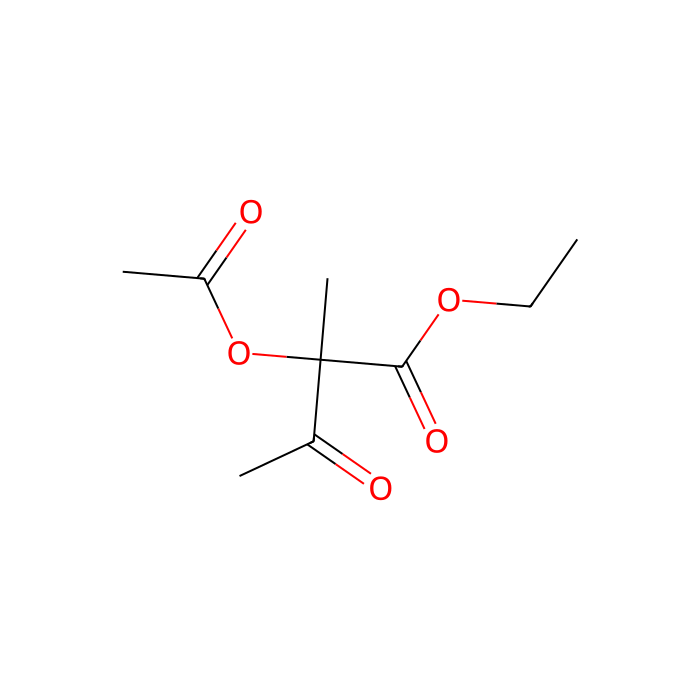
Ethyl 2-acetoxy-2-methylacetoacetate is a β-ketoester bearing a tertiary α-carbon substituted with an acetoxy and a methyl group, making it an acyloxylated, fully substituted acetoacetate derivative.
Item-specific identifiers (from Product Data):
CAS: 25409-39-6
CID: 117229
InChIKey: 316324 (as provided)
SMILES: Not specified for this item; refer to CoA/Spec Sheet.
Molecular formula: Not specified for this item; refer to CoA/Spec Sheet.
Molecular weight: Not specified for this item; refer to CoA/Spec Sheet.
Literature/computed structural information (for reference only; not item-specific specifications):
Common structural description: CH3–CO–C(Me)(OAc)–COOEt (i.e., the methylene of ethyl acetoacetate is replaced by a quaternary center bearing Me and OAc).
2D structure in words: An acetoacetate framework with the central (α) carbon bonded to: (i) a methyl group, (ii) an acetoxy substituent (–O–C(=O)CH3), (iii) a carbonyl carbon of an acetyl group (–CO–CH3), and (iv) a carbonyl carbon of an ethyl ester (–COOCH2CH3). The α carbon is quaternary and non-enolizable.
Stereochemistry: None (achiral quaternary center with two different heteroatom substituents; no defined stereogenic center).
Synthetic Utility
Functional group ensemble:
β-Ketoester (1,3-dicarbonyl) motif enables downstream transformations: reduction to diols, acylations on the enolizable ketone of derivatives, and decarboxylation after appropriate manipulations.
Tertiary acetate at the α-position provides a leaving group that can be activated under acidic/Lewis acidic conditions to forge C–O, C–N, C–S, and C–C bonds via substitution pathways.
Retrosynthetic value:
Acts as an electrophilic synthon for quaternary carbon construction adjacent to carbonyls. By choosing nucleophiles (alcohols, azide, halides, soft carbon nucleophiles), one can diversify the α-substitution while maintaining the β-ketoester handle for later stage edits.
The β-ketoester can be transformed to ketones (decarboxylation), tertiary alcohols (acetate solvolysis), or elaborated heterocycles (Knorr/Paal–Knorr-type strategies after appropriate derivatization of the diketone equivalent).
Named/related strategies (literature):
Lewis acid–mediated substitution of tertiary acetates (e.g., BF3·OEt2, TiCl4).
Krapcho-like demethoxycarbonylation and hydrolysis/decarboxylation sequences on β-ketoesters (after suitable conversions).
Practical considerations:
Avoid strong basic enolate chemistry at the α-position: the center is quaternized.
Control acidity; trace acid catalysis can slowly cleave the acetate. For storage and handling, maintain neutral, dry conditions.
Target Specificity
Not applicable. This product is a small-molecule chemical reagent and does not have antigen/epitope specificity, clone, or isotype attributes. See the Reaction & Applications and Synthetic Utility sections for relevant technical information.
Häufig gestellte Fragen
How should this product be stored?
Store at room temperature.
What is the purity of this product?
This product is supplied at ≥96% purity (chemical assay). Lot-specific values are stated on the Certificate of Analysis.
How is this product shipped?
This product ships under standard ambient conditions. No temperature-controlled packaging is required.
What are the CAS number, molecular formula and molecular weight?
The CAS Number is 25409-39-6, the molecular formula is C9H14O5, and the molecular weight is 202.2 g/mol. InChIKey RHFWCEYBHLGCKH-UHFFFAOYSA-N.
What documentation is provided?
Available product documentation, including Certificates of Analysis (COA), Safety Data Sheets (SDS), and specification sheets, is shown in the product document area. Document availability and access follow the current site policy.
Wir verwenden Cookies, um die ordnungsgemäße Funktion der Website sicherzustellen und, soweit zulässig, Ihr Nutzererlebnis zu verbessern. Sie können Ihre Einstellungen jederzeit unter „Einstellungen“ verwalten. Weitere Informationen finden Sie in unserer Cookie-Richtlinie.
Dürfen wir Sie über Rabattaktionen informieren?
Später erinnern
Vielen Dank! Bitte überprüfen Sie Ihren E-Mail-Posteingang, um zu bestätigen.
Products are supplied to verified businesses, institutions, and qualified professionals for research and development use only. Not for use in humans, animals, diagnosis, or therapy.

 D2603291