Ethyl 2-Chloracetoacetate is used in the preparation of oxazoles and thiazoles as agonists for peroxisome proliferator-activated receptor δ. It is also used to synthesize dimethylimidazothiadiazolecarbohydrazides with anticancer activities.
This compound belongs to the class of organic compounds known as beta-keto acids and derivatives. These are organic compounds containing an aldehyde substituted with a keto group on the C3 carbon atom.
External Descriptors
Not available
1. Djoumbou Feunang Y, Eisner R, Knox C, Chepelev L, Hastings J, Owen G, Fahy E, Steinbeck C, Subramanian S, Bolton E, Greiner R, and Wishart DS. ClassyFire: Automated Chemical Classification With A Comprehensive, Computable Taxonomy. Journal of Cheminformatics, 2016, 8:61.
Determine the necessary mass, volume, or concentration for preparing a solution.
Dilution Calculator
Determine the dilution needed to prepare a stock solution.
Reconstitution Calculator
Bewertungen
Kundenbewertungen
Application Protocols
No biological assay protocols (WB, IHC, IF, FC) are applicable to this small-molecule reagent. For synthetic operations, see Reaction Conditions and Synthetic Utility sections for generalized procedures. Users should adapt solvent/base/temperature to their specific nucleophile/electrophile pairing and scale, and validate by TLC/GC/HPLC.
Biological Roles
This product is a small-molecule synthetic building block and does not have a primary biological role in vivo. No biochemical function is assigned to this substance as a natural metabolite.
Research context (general):
Used to prepare β-keto esters/amides and heterocyclic scaffolds that may be evaluated in biochemical assays. Any biological activity arises from derived compounds rather than the reagent itself.
The α-halo carbonyl motif can alkylate nucleophiles; while this underpins its synthetic utility, it also suggests nonspecific reactivity toward biomolecules. Accordingly, it is handled strictly as a laboratory chemical, not for biological administration.
Esters can be hydrolyzed by esterases under biological conditions; however, the parent compound is not intended for biological exposure. No validated metabolic pathway data are provided for this item.
Safety note: Any discussion of biological effects is outside the scope of this research-grade listing. Use strictly for research and laboratory synthesis as indicated (Research Use Only).
Buffer Applications
Not typically applicable. Ethyl 2-chloroacetoacetate is an organic synthetic reagent, not a buffering agent. It is moisture-sensitive and prone to hydrolysis in aqueous media, making it unsuitable for preparing or stabilizing aqueous buffer systems. For aqueous work, consider completing synthetic steps in organic media, isolate the product, and then formulate into buffers separately if required for downstream assays.
Green Alternatives
Greener choices focus on solvent and reagent selection while retaining the unique electrophilicity of an α-chloro β-keto ester (literature/practice; not product-specific):
Solvent substitutions:
Replace chlorinated solvents (DCM, CHCl3) with 2-MeTHF, CPME, or EtOAc when polarity permits. These offer better EHS profiles and easier recycling.
For SN2 reactions, MeCN can often be substituted with propylene carbonate or EtOAc (if nucleophile is sufficiently reactive); acetone is a greener polar aprotic alternative to DMF/DMSO.
Base and additives:
Use inorganic carbonates (K2CO3, Cs2CO3) or organic bases (DIPEA) in lieu of stronger bases where possible to minimize side reactions and waste.
Employ solid-supported bases or phase-transfer catalysts to reduce solvent volumes and improve workup.
Reagent-level considerations:
Brominated analogs (e.g., ethyl 2-bromoacetoacetate) are sometimes used for higher reactivity but increase halogenated waste. The chloro variant may be preferable from a halogen E-factor standpoint when reactivity suffices.
Non-halogen leaving groups (mesylates/tosylates derived in situ from hydroxy precursors) can, in some cases, reduce corrosive HCl byproducts, though synthesis and stability trade-offs apply.
Energy and waste minimization:
Conduct at ambient temperature where feasible; use flow chemistry to improve heat/mass transfer and reduce solvent use.
Trade-offs: Greener solvents may slow SN2 rates; modest temperature elevation or catalyst use (e.g., PTC) can compensate.
Pharmaceutical Uses
No excipient or pharmacopeial role is specified for this item; refer to CoA/Spec Sheet.
General process-chemistry context (non-clinical; no therapeutic claims):
Commonly employed as a versatile intermediate to construct β-keto esters/amides and heterocycles used in medicinal chemistry lead generation and API intermediate synthesis.
The α-chloro handle enables convergent SN2 assembly of side chains, while the β-keto ester can participate in decarboxylation to access methyl ketones, or in annulations (e.g., with ureas/thioureas) to furnish barbiturate-like or pyrimidinone cores.
From a manufacturing standpoint, considerations include control of residual chloride (HCl) and halo-organics, selection of greener solvents (EtOAc/2-MeTHF), and robust hydrolysis control to prevent formation of the corresponding acid impurity.
Regulatory note: This is provided for research use only. It is not intended for use in humans or for clinical applications. Any use in GMP or scale-up should be supported by full specifications, impurity profiles, and validated analytical methods obtained via the product’s CoA and method files.
Physical Properties
Item-specific specifications (this lot):
Molecular formula: Not specified for this item; refer to CoA/Spec Sheet.
Molecular weight: Not specified for this item; refer to CoA/Spec Sheet.
Appearance: Not specified for this item; refer to CoA/Spec Sheet.
General/literature properties (for reference only; confirm on CoA/SDS before use):
Physical state: typically a clear, colorless to pale yellow liquid with a characteristic odor.
Volatility: moderate; handle in a fume hood to minimize inhalation exposure.
Solubility: miscible with common polar aprotic organic solvents (e.g., acetonitrile, DMF, DMSO, acetone) and chlorinated solvents; low solubility in water due to ester/ketone hydrophobicity, but subject to hydrolysis in aqueous base.
Acidity/enolization: exhibits pronounced 1,3-dicarbonyl tautomerism; the methylene between carbonyls is acidic (pKa of analogous β-keto esters in the 10–13 range in DMSO, literature). This underpins facile enolate formation under mild base.
Partitioning: expected moderate lipophilicity typical of β-keto ethyl esters (logP positive, literature qualitative).
Refractive index, density, boiling/melting points, UV cutoff: Not specified for this item; refer to CoA/Spec Sheet. (Consult SDS or primary literature for typical numeric values if needed for process design.)
Note: Because α-halo carbonyls can undergo decomposition (e.g., HCl release, hydrolysis), measured properties (e.g., color, acid number) may drift with storage if not protected from moisture and bases.
Quality and Grades
Grade/Purity for this catalog item: Not specified for this item; refer to CoA/Spec Sheet.
How to interpret grades (general guidance):
Synthetic/intermediate grade: suitable for routine synthesis where trace impurities are tolerable.
Purified or ≥98%: preferred for multistep synthesis and structure–activity studies where impurity carryover matters.
HPLC grade solvents vs reagents: for reagents like ethyl 2-chloroacetoacetate, low UV background is less critical than purity and hydrolytic stability; however, low-UV solvent grades may still be relevant for chromatographic analysis.
Stabilizers/inhibitors:
None are listed for this item. If stabilizers or acid inhibitors are used to suppress hydrolysis or self-condensation, they will be declared on the CoA. Absent that disclosure, assume none are present.
Quality notes specific to α-halo β-keto esters (general):
Moisture content and acid number can increase upon storage via hydrolysis to the corresponding acid and ethanol. Karl Fischer water, GC purity, and chloride (as HCl) are typical CoA controls.
Color (APHA) may darken with time if not stored under inert gas; slight yellowing alone is not necessarily indicative of performance loss but should be monitored.
Verification:
For regulated or scale-up work, request a current CoA with GC/HPLC, residual solvents, and any inhibitor/stabilizer declarations.
Reaction and Applications
This α-chloro β-keto ester is a versatile electrophile and synthon for constructing C–C, C–N, C–O, and C–S bonds (literature/practice; expand from common catalog use cases):
SN2 Displacement at the α-chloromethyl unit:
Amines → β-keto amides/esters; thiols → thioethers; alkoxides/phenoxides → β-keto ethers. Typically done in MeCN/acetone/DMF with mild base (K2CO3, DIPEA) at 0–25 °C.
Enolate-based C–C bond formation (β-keto ester chemistry):
The methylene between carbonyls forms enolates under NaH, LDA, or K2CO3, enabling alkylation, Michael additions, and Claisen-type condensations. Dual reactivity (electrophile at ClCH2– and nucleophile at enolate) supports cascade sequences.
Heterocycle synthesis:
Pyrazoles/isoxazoles: condensation with hydrazines or hydroxylamine followed by cyclization.
Pyridazinones/uracils/barbiturate-like scaffolds: annulations with ureas, thioureas, guanidines, or amidines.
Coumarins/chromones via Knoevenagel-type condensations using the activated methylene.
Acylation equivalents:
The chloroacetyl fragment serves as an acyl donor in nucleophile capture, generating β-keto functionalities that can be further elaborated (e.g., decarboxylation to ketones or reduction to diols).
Orthogonal reactivity strategies:
Sequence control: perform nucleophilic substitution first under neutral/mildly basic conditions, then form enolates for subsequent C-alkylation; or invert order to install substituents selectively.
Practical tips:
Control base strength to steer SN2 vs enolate formation. Monitor for HCl formation; include base scavengers.
Use anhydrous conditions; moisture promotes hydrolysis and reduces yield. In-process controls by TLC/GC help avoid over-alkylation or self-condensation.
Reaction Conditions
The following conditions are general literature guidance for α-chloro β-keto esters; optimize for your substrate set and scale. They are not product specifications.
SN2 substitution (amines/thiols/alcohols):
Solvent: MeCN or acetone (anhydrous); DMF/DMSO for less reactive nucleophiles.
Base: K2CO3 (1.2–2.0 equiv) or DIPEA/Et3N (1.5–3.0 equiv) to neutralize HCl.
Temperature/time: 0–25 °C, 1–16 h. Monitor by TLC/GC.
Typical outcome: formation of β-keto amides/ethers/thioethers; avoid excess strong base to limit enolate side reactions.
Enolate alkylation at β-keto site:
Solvent: THF or toluene, dry; -78 to 0 °C for LDA/KHMDS, or rt with NaH/K2CO3 for softer conditions.
Electrophiles: benzyl/allyl halides, activated alkyl halides, Michael acceptors (for conjugate additions in two-step sequences).
Quench: NH4Cl or HOAc solutions at low temperature to control exotherm.
Reagents: hydrazines or hydroxylamine (1.0–1.5 equiv).
Solvent: EtOH/i-PrOH or MeOH with catalytic acid/base as needed.
Temperature: reflux 1–6 h; remove HCl with base scavenger.
Decarboxylation to ketones:
Hydrolysis to the β-keto acid followed by thermal decarboxylation (80–150 °C) affords substituted methyl ketones (workup under acidic conditions to prevent retro reactions).
Workup/purification:
Partition between aqueous bicarbonate and EtOAc to remove HCl and inorganic salts; dry and purify by column chromatography (hexanes/EtOAc) or distillation if stable.
Always run small-scale trials to assess competing hydrolysis and self-condensation.
Safety and Handling
Item-specific hazard information:
Signal word: Not specified for this item; refer to SDS.
H-statements: Not specified for this item; refer to SDS.
GHS classification/pictograms: Not specified for this item; refer to SDS.
General safety guidance for α-halo β-keto esters (literature/practice; not product-specific):
Hazards: typically harmful if swallowed, inhaled, or in contact with skin; may be irritating to eyes/respiratory tract. α-Halo carbonyls are electrophilic and may be lachrymatory and sensitizing in some individuals. Hydrolysis or decomposition can generate HCl.
PPE: wear chemical-resistant gloves (e.g., nitrile), lab coat, and splash goggles. Use in a certified chemical fume hood. Avoid skin contact and inhalation of vapors.
Handling: minimize exposure to moisture and bases; avoid prolonged heating. Keep containers tightly closed and inerted. Use dry syringes/pipettes for transfers.
Incompatibilities: strong bases (promote rapid enolate formation and possible elimination/substitution), strong nucleophiles (uncontrolled SN2), strong oxidizers/reductants, and aqueous acids/bases (hydrolysis). Metals and amines can catalyze decomposition; segregate accordingly.
First aid (overview; consult SDS): move exposed persons to fresh air for inhalation; flush skin/eyes with water for ≥15 min; remove contaminated clothing. Seek medical attention if symptoms persist.
Spill/cleanup: absorb with inert material, avoid neutralization with strong bases; collect for hazardous waste. Ventilate area.
Fire: use CO2, dry chemical, or foam. Combustion may release HCl and carbon oxides; firefighters should wear SCBA.
Always consult the product SDS for authoritative, product-specific safety information.
Solvent Selection
Applicability: This is a moderately polar, electrophilic organic reagent rather than a solvent. The guidance below addresses solvents for using/storing this reagent (literature/practice; not product-specific specs).
Polarity/miscibility profile (literature):
Good solubility in polar aprotic media (MeCN, DMF, DMSO, acetone) and chlorinated solvents (DCM, CHCl3). Limited water solubility; susceptible to hydrolysis in aqueous base.
For SN2 substitutions with amines/thiols/alkoxides, MeCN, acetone, or DMF commonly balance solubility and reactivity.
Selection by transformation:
Nucleophilic substitution at CH2–Cl: MeCN or acetone with K2CO3/Et3N to favor clean SN2 and easy workup; DMF/DMSO for less reactive nucleophiles (beware of difficult removal and side reactions).
Enolate chemistry at the β-keto site: THF, toluene, or MTBE with LDA/NaH/KHMDS under low temperature; avoid protic solvents that quench base.
Heterocycle annulations (e.g., with hydrazines/ureas): EtOH or i-PrOH as benign media when compatible; buffer with base scavengers to manage HCl.
Process considerations:
Use anhydrous solvents; dry over molecular sieves or by distillation. Residual water promotes hydrolysis to the acid and ethanol.
For greener practice, consider EtOAc, 2-MeTHF, or CPME as replacements for DCM/DMF where feasible (see Green Alternatives).
Storage/solution prep:
Prepare stock solutions in dry MeCN or EtOAc under inert gas; store chilled if long-term, and use within days to limit decomposition.
Storage and Reconstitution
Storage conditions (item-specific): Room temperature, Argon charged. Keep container tightly closed and under inert gas to suppress hydrolysis and decomposition. Shipped: Normal.
Reconstitution: Not applicable; supplied neat. If stock solutions are needed, prepare in dry, oxygen-free solvents (e.g., acetonitrile, ethyl acetate, or THF) under argon. Use amberized glassware if light sensitivity is a concern.
General handling and stability (literature/practice):
Moisture sensitivity: α-Halo β-keto esters can hydrolyze to the corresponding acid and ethanol, and can release HCl. Minimize headspace, use dry septa/syringes, and blanket with inert gas after each use.
Temperature: Ambient storage is acceptable per item data; for long-term storage consider cool (2–8 °C) and dry conditions to extend shelf life (do not freeze unless validated).
In-use guidance: Dispense aliquots to avoid repeated air/moisture exposure. If distillation is employed for purification, use reduced pressure and avoid prolonged high temperatures.
Shelf-life monitoring: Track color changes, GC purity, and acid number. If significant acidity or discoloration develops, consider re-purification or fresh material.
Research Use Only: This product is intended for research and laboratory use only.
Structure and Identity
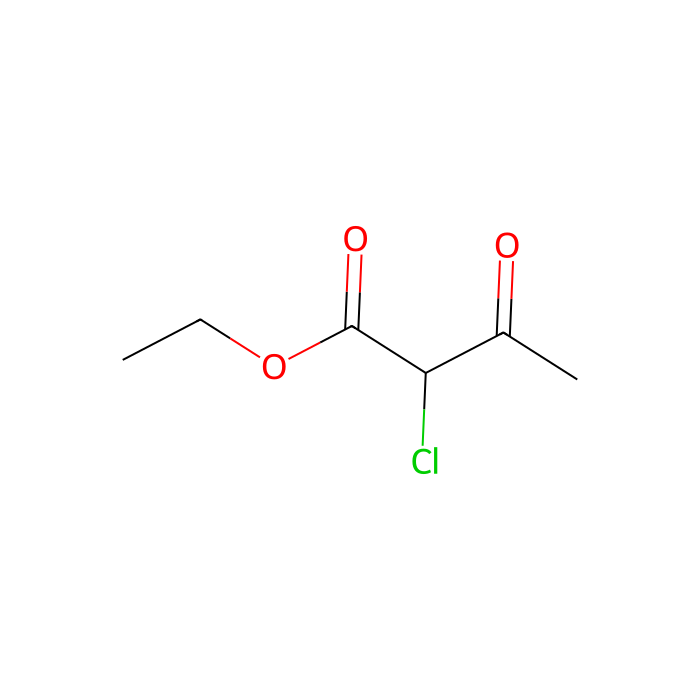
Ethyl 2-chloroacetoacetate is a chlorinated 1,3-dicarbonyl (an α-halo β-keto ester) frequently used as an electrophilic building block in organic synthesis.
Item-specific identifiers (as provided):
CAS: 609-15-4
CID (PubChem): 11858
InChIKey: 313790 (format appears truncated; Not specified for this item; refer to CoA/Spec Sheet.)
SMILES: Not specified for this item; refer to CoA/Spec Sheet.
Structure (general/literature description):
Functional groups: one ketone (β-position), one ethyl ester, and an α-chloromethyl moiety adjacent to a carbonyl. The molecule is an activated α-halo carbonyl coupled to a β-keto ester, enabling both SN2 displacement at the chloromethyl and enolate chemistry at the methylene between the carbonyls.
Ring systems/stereochemistry: acyclic; no stereogenic centers in the parent structure.
2D description in words: a terminal chloromethyl linked to a carbonyl (chloroacetyl fragment) followed by a methylene and a second carbonyl attached to an ethoxy group (ethyl ester), i.e., a chloroacetyl unit conjugated through methylene to an acetoacetate ester.
Empirical formula and molecular weight: Not specified for this item; refer to CoA/Spec Sheet. (Literature identifies this substance as an α-chloro β-keto ethyl ester; verify exact identifiers on the product CoA.)
Synonym context (literature): often referred to as ethyl chloroacetoacetate or ECAA in synthetic protocols.
Synthetic Utility
Key reactivity elements and how to exploit them (literature/practice):
Bifunctional synthon:
Electrophile: α-chloromethyl group enables SN2 displacement by N/O/S/C nucleophiles to install functionality adjacent to a carbonyl (chloroacetyl-derived).
Nucleophile: the β-keto ester methylene enolizes readily (under NaH/LDA/K2CO3), enabling alkylations, Michael additions, and aldol/Claisen condensations.
Named/related transformations:
Knoevenagel and Hantzsch-type condensations to assemble heterocycles.
Gabriel and Bucherer–Bergs-like approaches when combined with nitrogen nucleophiles/ureas to forge cyclic ureides and pyrimidinones.
Decarboxylative protocols: thermal or base-promoted decarboxylation after elaboration affords substituted acetyl derivatives (methyl ketones).
Retrosynthetic value:
Serves as a masked 1,3-dicarbonyl that can be unmasked or diversified through either site. Orthogonal protection/reactivity strategies allow stepwise installation of substituents.
Downstream diversification:
Reduction (NaBH4/Luche) of the ketone to β-hydroxy esters; chemoselective reductions require careful conditions to avoid dehalogenation.
Halogen exchange (Finkelstein-type) to bromo/iodo analogs for increased reactivity when needed.
O→N acyl transfer and amidation strategies to create β-keto amides.
Practical cautions:
Competing enolate formation can divert SN2 pathways under strong base; use mild bases for substitutions. Manage HCl byproduct with scavengers to prevent corrosion and side reactions.
Maintain anhydrous, inert conditions to suppress hydrolysis and self-condensation.
Target Specificity
Not applicable. This product is a small-molecule chemical reagent and does not have biological target specificity parameters (e.g., antigen, epitope, clone, isotype). For biochemical targets relevant to compounds synthesized from this reagent, consult the literature pertinent to those specific analogs.
Wir verwenden Cookies, um die ordnungsgemäße Funktion der Website sicherzustellen und, soweit zulässig, Ihr Nutzererlebnis zu verbessern. Sie können Ihre Einstellungen jederzeit unter „Einstellungen“ verwalten. Weitere Informationen finden Sie in unserer Cookie-Richtlinie.
Dürfen wir Sie über Rabattaktionen informieren?
Später erinnern
Vielen Dank! Bitte überprüfen Sie Ihren E-Mail-Posteingang, um zu bestätigen.
Products are supplied to verified businesses, institutions, and qualified professionals for research and development use only. Not for use in humans, animals, diagnosis, or therapy.

 L2103079