This compound belongs to the class of organic compounds known as perfluoroalkyl carboxylic acid and derivatives. These are organic compounds containing an alkyl chain attached to the C-alpha of a carboxylic acid group (or a derivative thereof), where all hydrogens of the alkyl chain are replaced by fluorine atoms.
External Descriptors
Not available
1. Djoumbou Feunang Y, Eisner R, Knox C, Chepelev L, Hastings J, Owen G, Fahy E, Steinbeck C, Subramanian S, Bolton E, Greiner R, and Wishart DS. ClassyFire: Automated Chemical Classification With A Comprehensive, Computable Taxonomy. Journal of Cheminformatics, 2016, 8:61.
Determine the necessary mass, volume, or concentration for preparing a solution.
Dilution Calculator
Determine the dilution needed to prepare a stock solution.
Reconstitution Calculator
Bewertungen
Kundenbewertungen
Application Protocols
No assay-validated application protocols are provided for this item. For synthetic transformations, see the Reaction Conditions and Synthetic Utility sections for literature-style starting points. For materials/surface applications, establish process-specific protocols (solution concentration, substrate pretreatment, curing profile) with appropriate controls and analytical verification (contact angle, XPS, 19F NMR).
Biological Roles
This product is a synthetic organic reagent with no intended biological function in living systems. The following points provide general background on long-chain perfluoroalkyl substances (PFAS) and their derivatives; they are not medical or clinical claims and do not pertain to therapeutic use.
Biochemical fate (general literature): Perfluoroalkyl chains resist metabolic oxidation/reduction and enzymatic degradation due to strong C–F bonds and the electron-withdrawing perfluoroalkyl group.
Transport/partitioning: PFAS compounds display unusual partitioning behavior; many acids bind serum proteins rather than accumulating in lipids. Neutral esters like ethyl perfluorooctanoate may undergo hydrolysis (abiotic or enzymatic) to the corresponding acid over time in environmental or biological contexts, but rates depend strongly on conditions.
Environmental persistence: Long-chain PFAS are recognized for persistence and potential bioaccumulation. Laboratory use should minimize environmental release.
For experimental biology workflows:
This ester is not a buffer, nutrient, or enzyme substrate. If used in exposure studies or as a chemical probe, validate stability and conversion to perfluorooctanoate under the specific assay conditions.
Quantitation often requires LC/MS or GC/MS with careful sample preparation to avoid background PFAS contamination.
Note: Aladdin supplies this material strictly for research use only.
Buffer Applications
Not typically applicable. Ethyl perfluorooctanoate is a neutral, highly hydrophobic/fluorophilic ester and is not used as a buffering component. If working in biphasic aqueous systems (e.g., hydrolysis or extraction), select an appropriate aqueous buffer to control pH while using an organic/fluorinated co-solvent for solubility.
Green Alternatives
Context: Long-chain perfluoroalkyl substances (PFAS) are persistent and bioaccumulative. When function allows, consider non-PFAS or shorter-chain substitutes to reduce environmental footprint. Selection must balance performance, regulatory, and safety constraints.
Comparison overview (general literature guidance; not item-specific specs)
Pros: Lower bioaccumulation potential and often improved regulatory acceptance compared to C8.
Cons: Still persistent; may require higher dosage; performance gap vs. C8.
Option: Hyperbranched or polymeric nonionic surfactants (e.g., polyether-modified silicones)
Pros: Effective wetting/leveling; lower environmental concern relative to PFAS.
Cons: Thermal/chemical stability below that of perfluorinated systems.
Option: Process redesign (surface roughening, plasma treatment)
Pros: Achieves repellency without persistent chemistries.
Cons: Capital and process complexity.
Guidance:
Conduct performance benchmarking at equal surface fluorine content or equal repellency metrics (contact angle, oil rating).
Implement closed-loop handling and dedicated PFAS waste segregation when use of this C8 ester is technically required.
Pharmaceutical Uses
Not a typical pharmaceutical excipient. Long-chain perfluoroalkyl esters are generally not used in human/animal formulations. In pharmaceutical process chemistry or materials R&D, related fluorinated esters may be explored for surface modification of tooling or as intermediates in synthesizing specialty monomers/polymers for device coatings.
If considered for manufacturing support studies (non-clinical):
Verify extractables/leachables and residual PFAS controls.
Document fate and purge of PFAS materials and establish dedicated waste handling in compliance with local regulations.
No pharmacopeial monograph is associated with this item. Use is restricted to research and development applications.
Physical Properties
Item-specific specs for this catalog lot are not provided. Do not use the following literature values as specifications; consult the CoA/Spec Sheet for purchase-specific data.
Appearance (item-specific): Not specified for this item; refer to CoA/Spec Sheet.
Density: Not specified for this item; refer to CoA/Spec Sheet.
Refractive index: Not specified for this item; refer to CoA/Spec Sheet.
Water/peroxide/UV cut-off/trace metals: Not specified for this item; refer to CoA/Spec Sheet.
Literature/typical properties (non-binding):
Physical state: typically a colorless, high-density liquid (literature).
Boiling point: high for a C10 ester due to extensive fluorination; often reported above 150–200 °C at ambient pressure (literature, ranges vary by purity and measurement method).
Melting point: generally below room temperature (literature).
Solubility: very low in water; miscible with many halogenated solvents (e.g., perfluorinated and chlorinated media); limited solubility in hydrocarbons; mixes with specialty fluorinated solvents (literature).
LogP/logD: effective hydrophobicity is high, but conventional logP may be atypical due to fluorophilicity (literature trend).
Vapor pressure: low to moderate for a fluorinated C10 ester (literature).
Notes for use:
Expect strong surface activity at interfaces and unusual wetting behavior on low-energy surfaces.
For precise constants relevant to your protocol (bp, density at T, refractive index), verify with the lot-specific CoA.
Quality and Grades
Grade/Purity (item-specific): Not specified for this item; refer to CoA/Spec Sheet.
Stabilizers/inhibitors: Not specified for this item; refer to CoA/Spec Sheet.
Guidance for interpreting grade terminology (general):
Research-grade fluorinated esters are typically assessed for identity (NMR, IR, MS), purity by GC/LC, water content (Karl Fischer) when relevant, residual alcohol/acid content, and volatile/nonvolatile residue.
If marketed as “GC” or “analytical standard” grade, expect tighter control of volatile impurities and lower UV background (for LC/UV uses). “HPLC grade” typically refers to solvents rather than reagents, but low-UV-absorbing material may be emphasized for trace analysis workflows.
Stabilizer-free materials are preferred when performing base- or amine-promoted transformations (e.g., amidation). If a stabilizer is present, understand its impact on downstream chemistry and remove by washing or distillation when needed.
What to check on the CoA for this item:
Assay/purity basis (GC area %, NMR qNMR, or weight %).
Residual perfluorooctanoic acid (hydrolysis product) and ethanol content.
Moisture (KF), acid value/saponification value, and color.
Any reported metals/ionic content if the material is intended for surface science or electronics-related work.
Note: Do not treat literature values as specifications; always follow the lot-specific CoA.
Reaction and Applications
Use context: As an ethyl ester of a perfluoroacyl group, ethyl perfluorooctanoate functions as a fluorinated building block, surface-modifier precursor, and a process intermediate.
Representative reactions (literature/general)
Hydrolysis/saponification → perfluorooctanoic acid (PFOA). Base-catalyzed cleavage in alcoholic media proceeds efficiently; aqueous hydrolysis may require heating and co-solvent.
Aminolysis (amidation) → perfluorooctanamides. Primary/secondary amines convert the ester under heating; coupling reagents are not required, but activating to the acid chloride may be faster.
Transesterification → other alkyl perfluorooctanoates using acid or base catalysts; continuous removal of the leaving alcohol drives conversion.
Conversion to acyl chloride using oxalyl chloride, thionyl chloride, or Ghosez reagent, then used for acylation of alcohols/amines.
Fluorinated surface treatments: blending or grafting into polymers to impart oil/water repellency and low surface energy; the ester group allows further derivatization onto resins.
Practical tips
Dry, neutral conditions maintain ester integrity during handling; trace base promotes slow hydrolysis.
Conventional nucleophiles approach the carbonyl center; the perfluoroalkyl chain is inert to most reagents, resisting oxidation/reduction under standard conditions.
For kinetic acceleration in aminolysis, use excess amine or Lewis acid activation, and elevate temperature (80–120 °C) in a polar aprotic medium.
Analytical use
Serves as a reference or surrogate standard in PFAS method development for GC/MS (after careful method validation; volatility is higher than the corresponding acid) and LC/MS after hydrolysis or derivatization.
Reaction Conditions
General, literature-informed guidance (verify on small scale; not item-specific specifications):
Hydrolysis/saponification to PFOA
Typical: 1–2 M NaOH or KOH in MeOH/EtOH, 20–60 °C, 1–6 h. After completion, remove alcohol, acidify aqueous phase to pH ~1–2 to precipitate/extract the acid.
Aqueous conditions: 1–5 M base with a co-solvent (THF/MeOH), 50–80 °C, longer times.
Aminolysis to amides
Solvent: DMF, DMSO, toluene, or neat amine; 60–120 °C.
Conditions: 2–5 equiv amine; optionally add catalytic DMAP or employ microwave heating to enhance rates. Remove generated EtOH to drive equilibrium.
Transesterification
Acid-catalyzed: p-TsOH (1–5 mol%), toluene or xylene, reflux with Dean–Stark to remove EtOH.
Base-catalyzed: Sodium alkoxide (5–10 mol%) in the corresponding alcohol, 25–80 °C.
Conversion to acyl chloride
Reagents: Oxalyl chloride (1.1–1.5 equiv) with catalytic DMF; 0–25 °C then to reflux as needed. Work up under anhydrous conditions; avoid moisture.
Analytical notes
Monitor by GC/FID or GC/MS if volatility permits; LC/MS for polar derivatives. 19F NMR provides rapid conversion tracking (distinct CF3 and CF2 multiplets).
Yields
Hydrolysis/aminolysis typically furnish good to excellent yields (70–95%) under optimized conditions in literature reports, contingent on nucleophile and solvent.
Safety and Handling
Item-specific GHS and hazard communication are not provided here. Always review the product SDS before use.
Item-specific hazard lines
Signal word: Not specified for this item; refer to SDS.
H-statements: Not specified for this item; refer to SDS.
GHS classification/pictograms: Not specified for this item; refer to SDS.
General safety considerations for long-chain perfluoroalkyl esters (literature/guidance):
Potential hazards: May cause eye/skin irritation and respiratory irritation on aerosol/vapor exposure. Persistent, bioaccumulative, and toxic (PBT) behavior is a concern for long-chain PFAS; handle to minimize releases to drain or environment. Combustion can produce toxic hydrogen fluoride (HF) and carbonyl fluorides.
PPE: Use lab coat, safety glasses or face shield, and appropriate chemically resistant gloves (e.g., fluoroelastomer or multi-layer laminate). Avoid skin contact and inhalation of vapors/mist.
Engineering controls: Use in a fume hood. Prevent aerosol formation. Employ secondary containment and PFAS-waste segregation.
Incompatibilities: Avoid strong bases and nucleophiles if ester stability is required (risk of saponification/aminolysis). Avoid strong oxidizers and high-temperature contact with reactive metals.
First aid (overview; consult SDS/medical professional): Move to fresh air after inhalation; rinse skin/eyes with water for at least 15 minutes; seek medical attention if irritation persists. If ingested, rinse mouth; do not induce vomiting unless directed by medical personnel.
Fire: Use CO2, dry chemical, or alcohol-resistant foam. Firefighting may require positive-pressure SCBA due to HF risk.
Solvent Selection
Applicability: Ethyl perfluorooctanoate is a reagent/substrate rather than a general-purpose solvent. However, its handling and use benefit from compatible solvent selection.
Polarity/solubility profile (literature trends)
Strongly lipophobic and oleophobic relative to hydrocarbons; preferentially soluble in fluorinated solvents (e.g., perfluorohexane, HFE-type ethers) and many chlorinated solvents (e.g., dichloromethane, chloroform).
Low solubility in water; moderate in polar aprotics like acetonitrile or DMF can vary; test on small scale.
Dielectric behavior: Fluorinated media often have low dielectric constants; if ionic chemistry is involved (e.g., saponification), add a co-solvent with higher polarity (MeOH, EtOH, THF, DMSO) to aid mixing.
Selection tips by operation
Hydrolysis/saponification: Use alcoholic KOH/NaOH (MeOH/EtOH) or aqueous-organic biphasic systems; add a phase transfer catalyst if needed.
Amidation/alcoholysis: Conduct in polar aprotic solvents (DMF, NMP) or neat with the nucleophile; remove ethanol by azeotrope (Dean–Stark with toluene or molecular sieves) to drive equilibrium.
Purification: Nonpolar fluorinated or chlorinated eluents can be advantageous; conventional silica can retain polar impurities while the ester elutes early.
Comparison (general)
Hydrocarbon solvents: usually poor solvators.
Chlorinated solvents: better solvators; verify material compatibility.
Fluorinated solvents: best solvators and for surface treatments; consider cost and EHS implications.
Storage and Reconstitution
Storage conditions (item-specific): Room temperature (per Product Data). Protect from moisture and strong bases to prevent hydrolysis. Store in tightly sealed fluoropolymer-lined or compatible glass containers to minimize sorption.
Shipping: Shipped at ambient temperature (Normal).
Stability (general): Fluorinated esters are typically shelf-stable under dry, neutral conditions. Prolonged exposure to alkaline media or high humidity can lead to slow hydrolysis.
Handling tips:
Purge headspace with dry nitrogen/argon for long-term storage.
If precise water content is critical, consider storing over desiccant in a desiccator cabinet.
Reconstitution: Not applicable; supplied neat unless otherwise stated. If solidification occurs at low temperature, warm gently to ambient and homogenize before use.
Freeze–thaw: Not required. Avoid repeated heating–cooling cycles; aliquot if frequent access is anticipated.
Always refer to the lot-specific CoA/SDS for definitive guidance.
Research Use Note: For research use only.
Structure and Identity
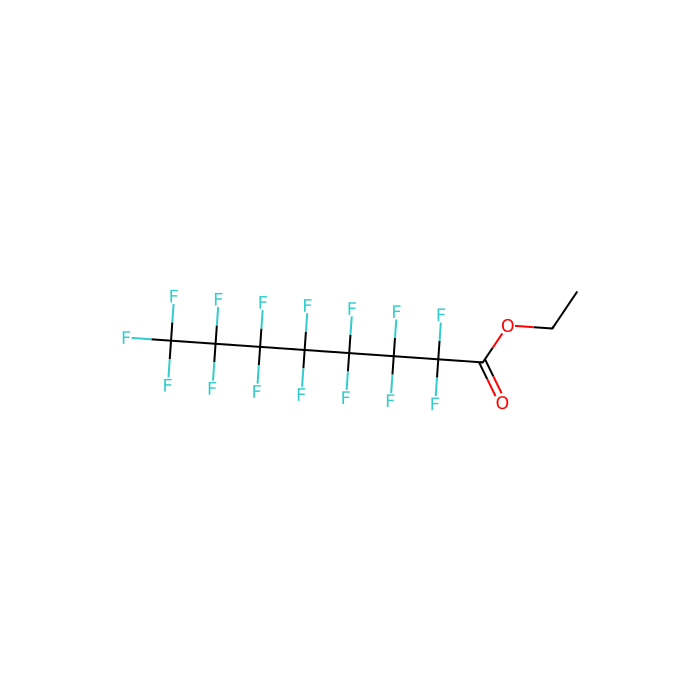
Brief description: Ethyl perfluorooctanoate is the ethyl ester of perfluorooctanoic acid (PFOA), comprising a highly fluorinated C7F15– chain attached to a perfluoroacyl ester (–C(=O)OEt). It is a neutral, highly lipophobic and hydrophobic fluorinated ester.
Item-specific (from Product Data)
CAS: 3108-24-5
SKU: E169473
Product Name: ETHYL PERFLUOROOCTANOATE
CID: 76555
InChIKey: 169707 (as provided)
SMILES: Not specified for this item; refer to CoA/Spec Sheet.
Molecular Formula: Not specified for this item; refer to CoA/Spec Sheet.
Molecular Weight: Not specified for this item; refer to CoA/Spec Sheet.
Literature/typical identifiers (informational, not item-specific)
Common name: PFOA ethyl ester; perfluorooctanoyl ethyl ester
Typical molecular formula (literature): C10H5F15O2
Left terminus: CF3 headgroup followed by six CF2 units then a terminal CF2 attached to a carbonyl carbon.
Functional group: an anhydrous carboxylate as an ethyl ester (–C(=O)OEt).
Right terminus: ethoxy group –O–CH2–CH3.
Note: Exact structural identifiers for this catalog item should be confirmed against the CoA/Spec Sheet.
Synthetic Utility
Functional logic: The molecule combines an activated carboxylic acid derivative (ethyl ester) with an inert, strongly electron-withdrawing perfluoroalkyl chain. This enables selective transformations at the carbonyl while preserving the C–F-rich segment.
Transformations (literature/general)
Hydrolysis → perfluorooctanoic acid (PFOA) for further coupling or salt formation.
Aminolysis → perfluorooctanamides, enabling introduction of functional handles (e.g., diamines, PEG-amines) that improve compatibility with polymers or surfaces.
Transesterification → installation of tailored alcohols (allyl, benzyl, hydroxyethyl) to modulate reactivity (e.g., photolabile or cleavable esters).
Activation → acyl chloride or mixed anhydrides for rapid acylation of alcohols/amines and access to perfluoroacylated products.
Radical grafting (indirect): Blending followed by peroxide-initiated grafting onto polymer backbones can physically entrap or covalently attach the perfluoroalkyl moiety via amide/ester intermediates prepared from this ester.
Retrosynthetic value
Serves as a convergent entry to perfluorooctanoyl derivatives where direct handling of the corrosive acid chloride is undesirable.
The ethyl group provides a manageable leaving group (ethanol) under both acidic and basic catalysis.
Practical considerations
Perfluoroalkyl chains depress nucleophilicity at the carbonyl carbon; elevate temperature or use catalysts to achieve reasonable rates.
Avoid strong base when preserving the ester; exploit it deliberately for saponification when targeting acids.
Target Specificity
Not applicable. This product is a small-molecule fluorinated ester, not a biological targeting reagent, antibody, or probe with defined target specificity.
Wir verwenden Cookies, um die ordnungsgemäße Funktion der Website sicherzustellen und, soweit zulässig, Ihr Nutzererlebnis zu verbessern. Sie können Ihre Einstellungen jederzeit unter „Einstellungen“ verwalten. Weitere Informationen finden Sie in unserer Cookie-Richtlinie.
Shall we send you a message when we have discounts available?
Remind me later
Thank you! Please check your email inbox to confirm.
Products are supplied to verified businesses, institutions, and qualified professionals for research and development use only. Not for use in humans, animals, diagnosis, or therapy.

 I2109237