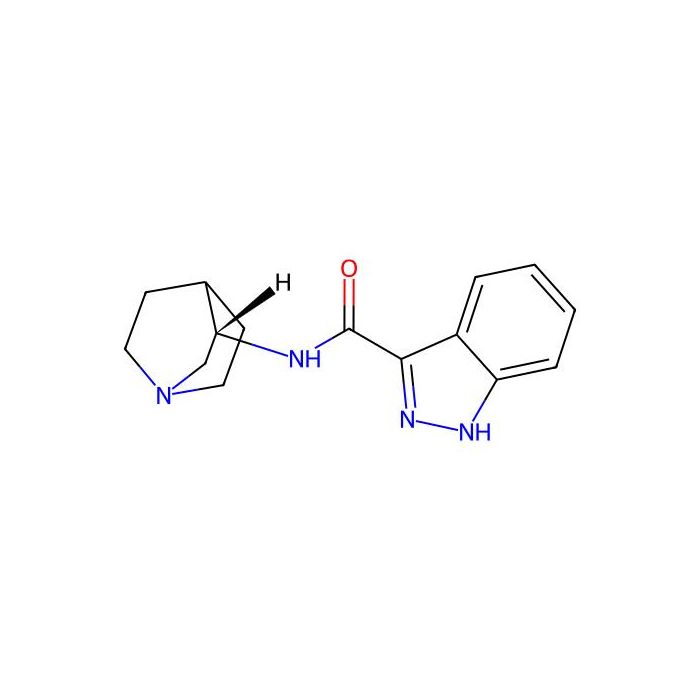
This compound belongs to the class of organic compounds known as indazole-3-carboxamides. These are aromatic compounds containing an indazole ring system that is substituted at the 3-position with a carboxamide group.
External Descriptors
Not available
1. Djoumbou Feunang Y, Eisner R, Knox C, Chepelev L, Hastings J, Owen G, Fahy E, Steinbeck C, Subramanian S, Bolton E, Greiner R, and Wishart DS. ClassyFire: Automated Chemical Classification With A Comprehensive, Computable Taxonomy. Journal of Cheminformatics, 2016, 8:61.
Zertifikate (CoA, COO, BSE/TSE und Analyse-Diagramm)
C of A & Other Certificates(BSE/TSE, COO):
Analytical Chart:
Chemische und physikalische Eigenschaften
Molekulargewicht
270.330 g/mol
XLogP3
1.800
Hydrogen Bond Donor Count
2
Hydrogen Bond Acceptor Count
3
Rotatable Bond Count
2
Exact Mass
270.148 Da
Monoisotopic Mass
270.148 Da
Topological Polar Surface Area
61.000 Ų
Heavy Atom Count
20
Formal Charge
0
Complexity
380.000
Isotope Atom Count
0
Defined Atom Stereocenter Count
1
Undefined Atom Stereocenter Count
0
Defined Bond Stereocenter Count
0
Undefined Bond Stereocenter Count
0
The total count of all stereochemical bonds
0
Covalently-Bonded Unit Count
1
Lösungsrechner
Molarity Calculator
Determine the necessary mass, volume, or concentration for preparing a solution.
Dilution Calculator
Determine the dilution needed to prepare a stock solution.
Reconstitution Calculator
Bewertungen
Kundenbewertungen
Application Protocols
No tested application protocols are provided for this item. The following is general guidance for handling small molecules in research assays.
Stock preparation: Dissolve in an appropriate solvent (commonly DMSO) to 10–50 mM. Vortex and, if necessary, sonicate briefly. Filter through 0.2 µm PTFE for analytical work.
Working solutions: Dilute stocks into assay buffer or cell culture media to desired concentrations, keeping final DMSO ≤0.1–1% v/v.
Controls: Include vehicle controls at matched solvent percentages. Incorporate positive/negative control compounds if available for the assay class.
Storage of solutions: Aliquot stocks to minimize freeze–thaw; protect from light if chromophores are suspected (unknown here). Reassess concentration by UV or LC–MS over time to monitor stability.
Note: These steps are general and must be adapted once the compound’s solubility and stability are known.
Biological Roles
No mechanism-of-action, target, or pathway information is provided for this product. The following guidance is general to small-molecule screening compounds and is not specific to Facinicline.
Potential roles in research: chemical probes or leads for interrogating biochemical pathways once a target association is established via screening or literature.
Off-target assessment: In the absence of defined specificity, comprehensive profiling (broad panel binding/functional assays) is recommended to understand selectivity and potential assay interference.
ADME considerations (general): Evaluate stability in assay media, plasma protein binding, and microsomal stability if moving beyond primary screening. Measure basic physicochemical parameters (logD, pKa, aqueous solubility) to aid interpretation of biological data.
Important note
No biological function, receptor binding, or pathway attribution should be inferred from this listing. All uses are for research purposes only, and any biological claims must be supported by independent experimental data.
Buffer Applications
This product is not a buffering agent and has no specified role in buffer preparation.
Practical note (general)
When dosing small molecules into biological buffers, maintain final DMSO (or other cosolvent) at ≤0.1–1% v/v to minimize solvent effects on pH and biomolecule stability.
Verify compound stability across the intended buffer pH (e.g., 6.5–8.0 for many biochemical assays) and ionic strengths to avoid precipitation or hydrolysis.
Green Alternatives
Green chemistry considerations are more pertinent to solvent and process choices than to the identity of a discrete screening compound.
For solution preparation, consider lower-toxicity, lower environmental-impact solvents where compatible with your assays (e.g., ethanol over DMF). However, DMSO often remains necessary for solubility; minimize its use by preparing concentrated stocks and diluting into aqueous buffers.
For analytical workflows, prefer acetonitrile/water or methanol/water mobile phases with volatile modifiers (formic acid, ammonium acetate) to facilitate waste treatment.
Illustrative comparison (general; not item-specific)
DMSO vs ethanol: DMSO offers broader solubility but is harder to remove and more hygroscopic; ethanol is greener but less capable with highly lipophilic compounds.
DMF/DMAc vs acetonitrile/methanol: ACN/MeOH are generally greener and more volatile, reducing worker exposure and easing waste handling.
Operational tips
Scale down assay volumes to reduce solvent and consumable use.
Consolidate solvent rinses and use microflow LC–MS when feasible to cut solvent consumption.
Pharmaceutical Uses
No pharmacopeial status, excipient role, or formulation use is provided for this item. This product is supplied strictly for research use only.
General guidance (non-clinical, non-therapeutic)
If used in pre-formulation research, determine solubility across biorelevant media, conduct forced-degradation studies (oxidative, thermal, photolytic, pH) to map stability-indicating methods.
For in vitro dosing solutions, prepare DMSO concentrates and dilute into media immediately before use to limit precipitation and degradation.
Compliance note
Not for human or veterinary use. No clinical or therapeutic claims are made or implied.
Physical Properties
Item-specific physicochemical data have not been provided in the Product Data. Do not treat literature values as product specifications.
Item-specific values (specifications)
Appearance: Not specified for this item; refer to CoA/Spec Sheet.
Molecular formula: Not specified for this item; refer to CoA/Spec Sheet.
Molecular weight: Not specified for this item; refer to CoA/Spec Sheet.
Melting point: Not specified for this item; refer to CoA/Spec Sheet.
Boiling point: Not specified for this item; refer to CoA/Spec Sheet.
Density: Not specified for this item; refer to CoA/Spec Sheet.
Solubility (water/organic): Not specified for this item; refer to CoA/Spec Sheet.
LogP, pKa, refractive index, UV cutoff: Not specified for this item; refer to CoA/Spec Sheet.
General guidance (literature/practice; not item specifications)
Small-molecule screening compounds are commonly supplied as crystalline solids or powders; initial dissolution typically in DMSO (10–50 mM stocks) with subsequent dilution into assay buffers containing cosolvent (e.g., ≤1% v/v DMSO).
If the compound contains basic/acidic functionality (unknown here), solubility can often be enhanced with minimal acid/base modifiers (e.g., 0.1% formic acid or ammonium hydroxide) for LC–MS analyses.
For method development, determine intrinsic solubility and stability across pH 2–10 and in common solvents (DMSO, MeOH, ACN, PBS) experimentally.
Quality and Grades
Item-specific grade/purity data are not provided for this listing.
Grade/Purity (as sold): Not specified for this item; refer to CoA/Spec Sheet.
Stabilizers/Inhibitors: Not specified for this item; refer to CoA/Spec Sheet.
Guidance on interpreting grade (general)
Screening-library compounds are typically supplied at high chemical purity (often ≥95% by HPLC/LC–MS) to support SAR and bioassay fidelity; verify by reviewing the CoA, which commonly includes chromatographic purity, exact mass, and in some cases NMR data.
If “HPLC grade” or “LC–MS qualified” is stated for solvents or solutions, it refers to low UV background and low nonvolatile residue—this is not specified here for the neat compound.
Residual solvents, water content (Karl Fischer), and counterion form (for salts) can influence apparent purity and potency; confirm on the CoA.
Recommended quality control on receipt (best practice)
Verify identity by LC–MS (exact mass match to calculated), and spot-check by 1H NMR if material amount permits.
Assess chromatographic purity using the same method as intended assays (gradient, detection wavelength) to ensure fit-for-purpose quality.
Reaction and Applications
This product is listed as part of a small-molecule/compound library and is primarily intended for screening, target discovery, and chemical biology research rather than use as a general synthetic reagent.
Applicable research applications (general)
Assay development and high-throughput/medium-throughput screening (HTS/MTS) as a test article.
Structure–activity relationship (SAR) studies where analogs are compared across biochemical or cell-based assays.
Analytical reference standard for method development and quantitation (after independent characterization).
Not typically applicable
The compound is not generally used to promote or catalyze named organic reactions, nor is it a common building block reagent. For synthetic methodology content, see the “Synthetic Utility” section for limited guidance.
Practical tips
Prepare accurately quantified DMSO stocks (gravimetric preferred for hygroscopic solvents) and document lot number and exact concentration.
Track stability under assay conditions (temperature, light, and pH). Reassess potency after multiple freeze–thaw cycles to detect degradation or adsorption losses.
Reaction Conditions
Not applicable. This product is not supplied as a reagent for promoting chemical reactions, and no item-specific reaction conditions are provided.
General note
If the compound is to be derivatized for probe development (e.g., biotinylation, fluorophore tagging), appropriate reaction conditions will depend entirely on the functional groups present, which are not specified here. Determine the structure first, then select mild, chemoselective conditions compatible with the scaffold.
Safety and Handling
Authoritative safety information must be taken from the product SDS. Hazard classification is not provided in the Product Data for this item.
GHS and hazard data (item-specific)
Signal word: Not specified for this item; refer to SDS.
H-statements: Not specified for this item; refer to SDS.
GHS classification/pictograms: Not specified for this item; refer to SDS.
General laboratory precautions (good practice)
PPE: lab coat, safety glasses, and appropriate chemically resistant gloves (e.g., nitrile). Handle powders in a fume hood to minimize inhalation exposure.
Avoid contact with skin, eyes, and clothing. Prevent dust/aerosol formation.
Storage incompatibilities: Until specific data are available, segregate from strong oxidizers and acids/bases. Keep container tightly closed and protected from moisture and light as a precaution.
First aid overview: In case of contact, rinse affected area with water for ≥15 minutes; remove contaminated clothing. If inhaled, move to fresh air. If ingested, rinse mouth. Seek medical attention and provide SDS.
Spill response: Avoid dust; collect with inert absorbent, place in chemical waste. Decontaminate area per institutional SOPs.
Waste: Dispose of in accordance with local regulations for organic laboratory chemicals.
Notes
No evidence of peroxide formation risk (information insufficient). If using organic solvents, follow their specific SDS requirements.
Solvent Selection
No item-specific solubility profile is provided. The following guidance is general for small-molecule screening compounds and should be validated experimentally.
Primary stock solvent (common practice): DMSO due to broad solvating power and compatibility with most biochemical assays.
Secondary solvents: methanol, acetonitrile, or ethanol for analytical preparation; DMF for challenging solubility (ensure assay compatibility and cytotoxicity controls if used in biological contexts).
Aqueous handling: Prepare concentrated DMSO stocks, then dilute into buffered aqueous media to final DMSO ≤0.1–1% v/v to limit solvent effects.
pH-assisted solubility: If the compound is basic/acidic (unknown here), consider slight acidification (e.g., 0.1% formic acid) or basification (e.g., 0.1% NH4OH) for LC–MS sample prep.
Small comparison (general, literature)
DMSO: highest solvency; hygroscopic; high boiling point facilitates stability but complicates drying.
MeOH/ACN: volatile, LC–MS friendly; lower solvency breadth than DMSO.
2-MeTHF/EtOAc: greener options for synthetic workups but less relevant for assay stock solutions.
Tips
Perform a mini solubility screen (DMSO, MeOH, ACN, PBS) at target concentration. Inspect for haze/precipitation after dilution into buffer and after freeze–thaw.
Filter 0.2 µm before LC–MS to protect instrumentation.
Storage and Reconstitution
Storage conditions (item-specific)
Storage: Room temperature (as provided in Product Data). Protect from moisture and excessive heat. Until more data are available, store in a desiccator and away from direct light as a precaution.
Shipped in: Not specified for this item; refer to CoA/Spec Sheet.
Reconstitution (general guidance; not item-specific specs)
Solvent choice: Start with anhydrous DMSO for concentrated stocks. If successful, consider secondary solvents (MeOH, ACN, EtOH) as needed for your application.
Target stock concentration: Commonly 10–50 mM for screening; confirm solubility experimentally.
Procedure: Allow container to equilibrate to room temperature before opening to prevent moisture condensation. Weigh quickly, cap promptly. Add solvent incrementally with mixing; gentle warming (≤40 °C) or brief sonication can aid dissolution.
Aliquoting: Dispense single-use aliquots to avoid repeated freeze–thaw and headspace moisture ingress.
Stability considerations
Solution stability, hygroscopicity, and light sensitivity: Not specified for this item; refer to CoA/Spec Sheet. If unknown, store solutions at −20 °C in the dark and use within 1–2 weeks pending stability verification.
Research use note
For research use only. Not for human or veterinary use.
Structure and Identity
Overview of basic identifiers for this screening compound.
Product name: Facinicline (SKU: F669054)
CAS: 677306-35-3
PubChem CID: 9970357
InChIKey: 352268 (as provided; verify on CoA/SDS for complete key)
Synonyms: Not specified for this item; refer to CoA/Spec Sheet.
Molecular formula: Not specified for this item; refer to CoA/Spec Sheet.
Molecular weight: Not specified for this item; refer to CoA/Spec Sheet.
SMILES: Not specified for this item; refer to CoA/Spec Sheet.
Structural features
Item-specific structural description (rings, heteroatoms, stereochemistry): Not specified for this item; refer to CoA/Spec Sheet.
Notes
This product is listed in a small-molecule/compound library category and is intended for research screening and chemical biology workflows.
Where exact structural strings (SMILES/InChI) are required for informatics, obtain them from the Certificate of Analysis (CoA) or authoritative databases corresponding to the CAS/CID above.
Synthetic Utility
Item-specific functional groups and reactivity are not provided, so detailed synthetic guidance is not possible without structural information.
General comments
Without a known scaffold or functional group inventory, this compound is not positioned as a building block or reagent. It is intended primarily as a screening compound/chemical probe candidate.
If structural information is obtained (SMILES/InChI from CoA), retrosynthetic analysis can identify potential diversification points for analog synthesis (e.g., amide coupling handles, heteroaryl halides for cross-coupling, basic amines for salt formation). Until such data are available, no specific transformations can be recommended.
Recommendation
Use this material as a reference standard or test article. For synthetic campaigns, obtain or elucidate the structure, then design analogs leveraging standard medicinal chemistry transformations appropriate to the functional groups present.
Target Specificity
Target, selectivity, and binding data are not provided for this item.
Antigen/target name: Not specified for this item; refer to CoA/Spec Sheet.
Species reactivity/clone/isotype: Not applicable; this is a small molecule, not an antibody product.
Guidance
Establish target specificity experimentally via binding assays, phenotypic profiling, and counterscreens to exclude assay interference. Public database annotations (linked to the CAS/CID) may offer hypotheses but must be independently validated.
Wir verwenden Cookies, um die ordnungsgemäße Funktion der Website sicherzustellen und, soweit zulässig, Ihr Nutzererlebnis zu verbessern. Sie können Ihre Einstellungen jederzeit unter „Einstellungen“ verwalten. Weitere Informationen finden Sie in unserer Cookie-Richtlinie.
Dürfen wir Sie über Rabattaktionen informieren?
Später erinnern
Vielen Dank! Bitte überprüfen Sie Ihren E-Mail-Posteingang, um zu bestätigen.
Products are supplied to verified businesses, institutions, and qualified professionals for research and development use only. Not for use in humans, animals, diagnosis, or therapy.