
Regioselectivity of Pyridine-Diimine (PDI)–Cobalt-Catalyzed Simmons–Smith-Type Cyclopropanation: Alkene Substitution Patterns and the Methylene-Transfer Mechanism
Regioselectivity of Pyridine-Diimine (PDI)–Cobalt-Catalyzed Simmons–Smith-Type Cyclopropanation: Alkene Substitution Patterns and the Methylene-Transfer Mechanism
Introduction
The Simmons–Smith reaction constructs cyclopropanes by transferring a methylene group to an alkene carbon–carbon double bond. In the classical reaction, diiodomethane (CH₂I₂) and a zinc–copper couple generate a zinc carbenoid reagent that transfers a CH₂ unit to the alkene, generally with retention of the geometric relationship present in the starting alkene.[3]
For substrates containing multiple carbon–carbon double bonds, the reaction also involves the issue of site selectivity. Traditional zinc carbenoids exhibit pronounced electrophilic character, and more electron-rich double bonds are generally more reactive; functional groups such as hydroxyl and ether groups that can interact with Zn may also exert directing effects. When multiple double bonds have similar electronic properties and no effective directing effect is present, the differences in reaction rates among the sites may be small, readily leading to mixtures of regioisomers.[1]
In 2018, Werth and Uyeda reported a reductive Simmons–Smith-type cyclopropanation catalyzed by a pyridine-diimine (PDI) cobalt complex. This system uses dibromomethane (CH₂Br₂) as the methylene source and Zn as the reductant, with the isopropyl-substituted PDI cobalt complex [i-PrPDI]CoBr₂ as the catalyst. It exhibits markedly different reactivities toward alkenes with similar electronic properties but different substitution patterns.[1]
This reaction system therefore raises a clear question: once cobalt participates in methylene transfer, why is regioselectivity no longer governed primarily by electronically driven reactivity trends, but instead exhibits a reactivity order that is highly sensitive to double-bond substitution patterns and spatial arrangement?
1. A Model Substrate Reveals Reversal of Regioselectivity
1.1 Direct competition between two double bonds with similar electronic properties
4-Vinylcyclohex-1-ene contains both:
· a terminal monosubstituted double bond;
· an endocyclic disubstituted double bond.
The two double bonds differ only slightly in their electronic properties, making this substrate well suited for comparing the site-selectivity patterns of traditional zinc carbenoids and the cobalt-catalyzed system.[1]
Under CH₂I₂/Et₂Zn conditions, the reaction favors the more electron-rich endocyclic disubstituted double bond. With 1.0 equiv of CH₂I₂ and 0.5 equiv of Et₂Zn, the total yield of monocyclopropanation products is 28%, with a regioisomer ratio (rr) of 1:6.7, favoring the product resulting from cyclopropanation of the endocyclic double bond. Increasing the reagent loading raises the monocyclopropanation yield while also increasing the amount of dicyclopropanation byproduct, without changing the predominant direction of regioselectivity.[1]
When the system is changed to [i-PrPDI]CoBr₂/CH₂Br₂/Zn, the preferred reaction site is reversed. With 6 mol% [i-PrPDI]CoBr₂, the product resulting from cyclopropanation of the terminal double bond is formed in 81% yield with rr >50:1, while the dicyclopropanation product is formed in less than 1%. CH₂Br₂/Zn in the absence of a cobalt catalyst gives less than 1% cyclopropanation product.[1]
Reaction System | Major Reaction Site | Monocyclopropanation Product(s) | rr | Dicyclopropanation Product |
CH₂I₂/Et₂Zn | Endocyclic disubstituted double bond | 28% | 1:6.7 | 3% |
CH₂Br₂/Zn, no Co catalyst | — | <1% | — | <1% |
[i-PrPDI]CoBr₂/CH₂Br₂/Zn | Terminal monosubstituted double bond | 81% | >50:1 | <1% |
The two effective reaction systems use different methylene sources and different Zn reagents. Therefore, the rr values of 1:6.7 and >50:1 reflect differences in selectivity between the two complete methylene-transfer systems and cannot be attributed solely to a change in any single reagent.
Catalyst screening further showed that CoBr₂ or the iPrPDI ligand alone produced essentially no effective reaction; changing the aryl substitution pattern of the PDI ligand, or replacing Co with Fe or Ni, also markedly altered the reaction efficiency.[1] These results indicate that the high regioselectivity is closely associated with the methylene-transfer pathway generated by the specific PDI–Co catalytic system.
2. Alkene Competition Experiments Establish the Relationship between Substitution Pattern and Reactivity
2.1 Three competition experiments directly compare the relative reaction rates of different double bonds
The authors subsequently performed intermolecular competition experiments using two alkenes and CH₂Br₂ in a 1:1:1 molar ratio, comparing the ability of alkenes with different substitution patterns to consume CH₂Br₂ under identical catalytic conditions.[1]
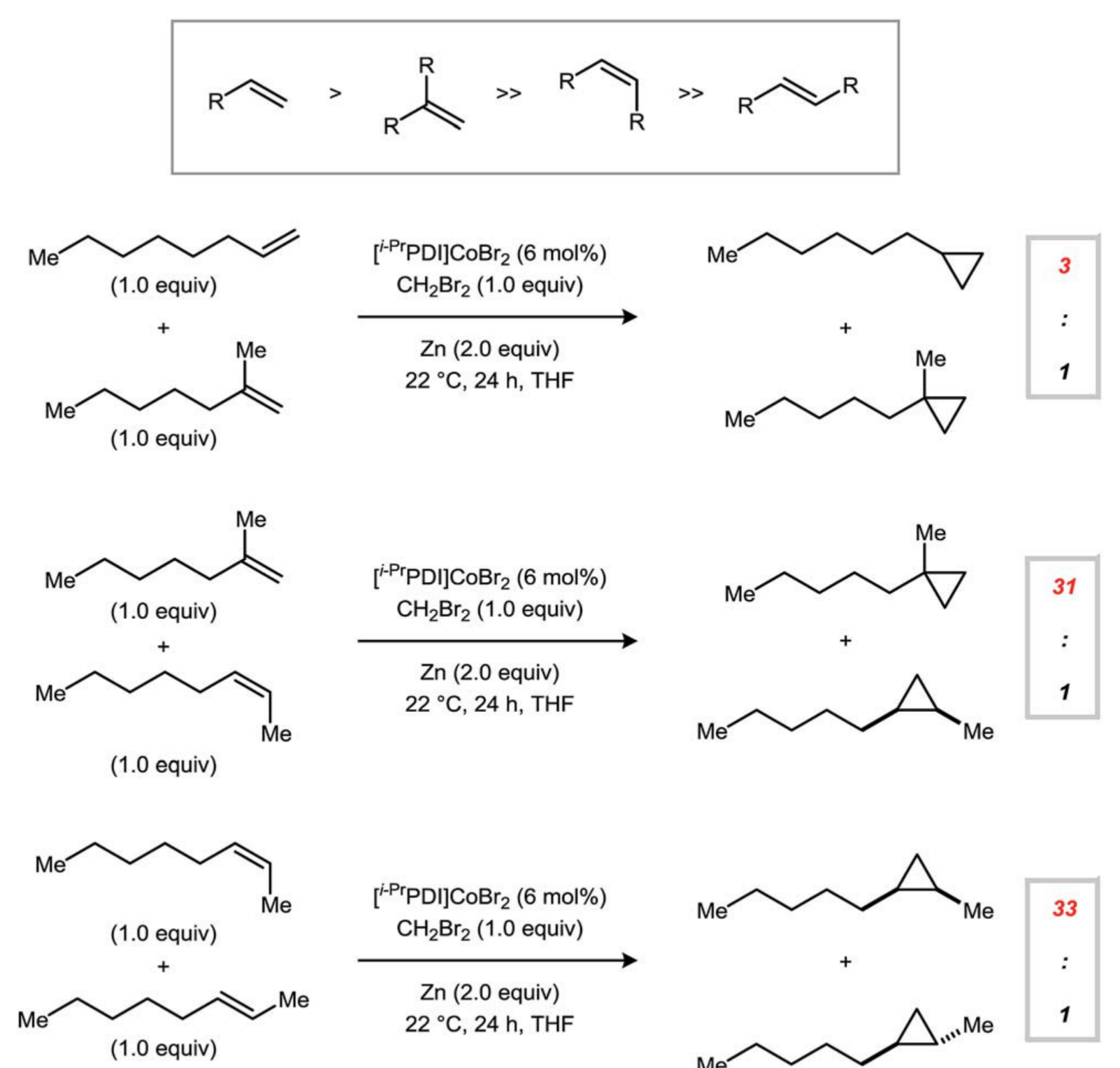
Figure 1. Intermolecular competition experiments with alkenes of different substitution patterns. Two alkenes and CH₂Br₂ were subjected to competitive reaction in a 1:1:1 molar ratio to compare the relative reactivities of alkenes with different substitution patterns and geometries. Image source: Werth J.; Uyeda C. Chem. Sci. 2018, 9, 1604–1609, original paper Fig. 2, CC BY 3.0.[1]
The three competition experiments showed distinctly different levels of selectivity.
The selectivity between a monosubstituted alkene and a 1,1-disubstituted alkene was approximately 3:1. The monosubstituted alkene reacted faster, although the degree of discrimination between the two types of terminal alkene was limited.
The selectivity between terminal and internal alkenes reached at least 31:1. Reactivity decreased markedly when the double bond changed from terminal to internal.
The selectivity of a Z-1,2-disubstituted alkene over the corresponding E-1,2-disubstituted alkene reached 33:1. The two alkenes have the same degree of substitution, with the principal difference arising from the spatial arrangement of substituents on the two sides of the double bond. This result directly demonstrates that alkene geometry can substantially alter the rate of methylene transfer.[1]
On the basis of the competition experiments, the authors established the following overall reactivity order:
monosubstituted alkenes > 1,1-disubstituted alkenes > Z-1,2-disubstituted alkenes > E-1,2-disubstituted alkenes > trisubstituted alkenes
No conversion of tetrasubstituted alkenes was observed under the tested conditions.[1]
2.2 Degree of substitution alone cannot explain this reactivity order
The selectivity between monosubstituted and 1,1-disubstituted alkenes is approximately 3:1, whereas the selectivity between terminal and internal alkenes can reach at least 31:1. This shows that reactivity does not decrease uniformly as the number of substituents increases.
The Z/E comparison further demonstrates this point. Z- and E-1,2-disubstituted alkenes have the same degree of substitution, yet exhibit a 33:1 difference in reactivity. The reaction rate is influenced by the actual three-dimensional arrangement of substituents around the double bond and by how that arrangement affects the approach of the alkene to the methylene-transfer center.[1]
The “substitution-pattern selectivity” established experimentally in 2018 therefore comprises two levels:
1. When a double bond changes from terminal to internal, the spatial environment encountered during approach to the methylene-transfer species changes substantially;
2. Among internal double bonds with the same degree of substitution, Z/E geometry further alters the spatial relationship between the substituents and the catalyst.
These observations provided the experimental basis for subsequent mechanistic studies aimed at explaining the origin of regioselectivity.
3. Complex Polyalkenes Validate the Substitution-Pattern Selectivity
3.1 Coordinating functional groups do not change the major reaction site
In the classical Simmons–Smith reaction, alcohol and ether groups can produce pronounced directing effects through interactions with Zn, causing preferential cyclopropanation of a nearby double bond.
Some of the terpene substrates examined by Werth and Uyeda contain ether groups or free hydroxyl groups. In these substrates, the [i-PrPDI]CoBr₂ catalytic system still predominantly cyclopropanates the less sterically substituted double bond, and the directing effects commonly observed in classical Zn-carbenoid systems do not become the dominant factor controlling regioselectivity.[1]
3.2 α,β-Unsaturated carbonyl groups do not alter the major substitution-pattern trend
The authors also examined substrates containing α,β-unsaturated carbonyl double bonds. The presence of an electron-deficient double bond did not alter the major regioselectivity trend predicted from the double-bond substitution pattern.[1]
These results show that, within the substrate scope examined in this study, the PDI–Co catalytic system can be more sensitive to the spatial substitution pattern of an alkene than to certain conventional electronic effects and coordination-directed effects.
Note: This trend applies to the [i-PrPDI]CoBr₂/CH₂Br₂/Zn system and to the substrate scope validated in the paper. It should not be directly generalized as a universal reactivity order for other metal-catalyzed cyclopropanation reactions.
3.3 Conjugated 1,3-dienes also show preferential reaction at the terminal double bond
The authors further examined different types of conjugated 1,3-dienes. All substrates investigated showed high selectivity for cyclopropanation of the terminal double bond over the internal double bond, while substantial secondary cyclopropanation was avoided, thereby affording vinylcyclopropane products.[1]
The mutually consistent results obtained with polyalkenes, terpenes, and 1,3-dienes show that the relationship between substitution pattern and relative reactivity is not limited to simple alkene competition experiments, but can also be applied to structurally more complex substrates.
4. Mechanistic Studies in 2018: Co(I), ZnBr₂, and Methylene-Transfer Species
4.1 [i-PrPDI]CoBr (formal Co(I)) is the major resting state observed during catalysis
During the standard catalytic reaction, the solution is deep purple. Ultraviolet–visible absorption spectroscopy (UV–vis) matched that of independently prepared [i-PrPDI]CoBr, supporting a Co(I) species as the catalyst resting state.[1]
The authors also found that reaction of [i-PrPDI]CoBr₂ with excess metallic Zn generates [i-PrPDI]CoBr. Here, Zn acts as the reductant, supplying electrons to the cobalt complex and reducing the cobalt center from formal Co(II) to Co(I):
[i-PrPDI]CoBr₂ —Zn→ [i-PrPDI]CoBr
In terms of formal oxidation states, this can be represented in simplified form as:
Co(II) + e⁻ → Co(I)
The electron is supplied by metallic Zn, which is itself oxidized during this process.[1]
Cyclic voltammetry further showed that the Co(II)/Co(I) redox potential is approximately −1.00 V, whereas further reduction through the Co(I)/Co(0) couple requires approximately −1.93 V. The latter reduction lies beyond the range achievable by Zn in this system; the experimental results are therefore consistent with the accumulation of Co(I) during catalysis.[1]
A Co(I) resting state refers to a cobalt species that is present at relatively high concentration during the catalytic reaction and can therefore be observed spectroscopically.
4.2 ZnBr₂ plays a key role in achieving high efficiency and high regioselectivity
The authors performed a stoichiometric reaction using isolated [i-PrPDI]CoBr with 4-vinylcyclohex-1-ene and CH₂Br₂. In the absence of Zn, [i-PrPDI]CoBr₂ was formed after 24 h, and the total yield of cyclopropanation products was only 26%, with an rr of approximately 3:1.
Upon addition of ZnBr₂, the reaction again displayed high efficiency and high regioselectivity similar to those observed under catalytic conditions.[1]

Figure 2. Mechanistic studies of cobalt-catalyzed Simmons–Smith-type cyclopropanation. The figure includes identification of the Co(I) resting state, cyclic-voltammetry experiments, the effect of ZnBr₂ on stoichiometric cyclopropanation, the Co/Zn carbenoid species proposed in the 2018 study, a bimetallic model for Lewis-acid-promoted Simmons–Smith reactions, and the solid-state structure of a Co/Zn complex. Image source: Werth J.; Uyeda C. Chem. Sci. 2018, 9, 1604–1609, original paper Fig. 6, CC BY 3.0.[1]
Figure 2c provides a key experiment for understanding the role of ZnBr₂: when an isolated Co(I) species participates in the stoichiometric reaction, both the yield and regioselectivity are substantially lower than those of the complete catalytic system; upon addition of ZnBr₂, both are restored. ZnBr₂ is therefore not merely an irrelevant byproduct formed upon oxidation of Zn, but an important component that influences the catalytically relevant methylene-transfer process.[1]
The stoichiometric experiments also generated a green Co/Zn complex 31. X-ray crystallography showed that the ZnBr₂-type Lewis acid interacts with the PDI–Co unit through a Br ligand and substantially elongates the corresponding Co—Br bond. Based on these observations, together with spectroscopic, electrochemical, and stoichiometric experiments, the 2018 study proposed a catalytically relevant carbenoid species containing both Co and Zn.[1]
The 2018 experiments established a relationship among Co(I), ZnBr₂, Co/Zn interactions, and efficient methylene transfer; however, the specific bonding mode of the transient CH₂-transfer species had not yet been established at that time.
5. Mechanistic Studies in 2025: Evidence Supports Cationic [(PDI)Co(CH₂Br)]⁺ as a Key Methylene-Transfer Species
In 2025, Werth, Berger, and Uyeda conducted further experimental and computational studies on the same class of PDI–Co/CH₂Br₂/Zn reactions. The results support a cationic [(PDI)Co(CH₂Br)]⁺ species as a key methylene-transfer intermediate and propose this species as a transition-metal analogue of the Simmons–Smith reagent.[2]
5.1 Zn links catalyst reduction and ZnBr₂ generation
The 2025 reductant experiments further distinguished the roles of Zn. Zn can serve as the terminal electron source that maintains the cobalt catalyst in an appropriate low-valent state, while ZnBr₂ generated during the reaction participates in halide-ion equilibria as a Lewis acid.
Although the outer-sphere electron-transfer reductant cobaltocene can itself reduce the cobalt precursor, it does not effectively promote cyclopropanation; cyclopropanation resumes upon addition of ZnBr₂. In contrast, addition of LiBr markedly inhibits the reaction. These experiments support a role for ZnBr₂ in promoting catalysis by binding Br⁻ and lowering the effective concentration of free halide in the reaction mixture.[2]
5.2 CH₂Br₂ activation and formation of a cationic cobalt carbenoid
Subsequent mechanistic studies support activation of CH₂Br₂ by low-valent [i-PrPDI]CoBr through halogen-atom abstraction, generating a bromomethyl radical (·CH₂Br) and [i-PrPDI]CoBr₂. The authors proposed two possible pathways for formation of the neutral Co(II) carbenoid (PDI)Co(CH₂Br)Br: ·CH₂Br may recombine with [i-PrPDI]CoBr₂ to form a Co(III) carbenoid, which is subsequently reduced by Zn; alternatively, after solvent-cage escape, ·CH₂Br may recombine directly with another molecule of [i-PrPDI]CoBr to form the Co(II) carbenoid.[2]
On this basis, the computational model further proposes that ZnBr₂ can assist in the abstraction of Br⁻ from the neutral carbenoid, generating a low-coordinate cation:
[(PDI)Co(CH₂Br)]⁺
The calculated cationic species adopts a square-planar geometry, and its Co—C—Br unit displays electronic characteristics intermediate between the two limiting descriptions Co—CH₂Br and Co=CH₂ with an axial Br ligand.[2]
This model provides a more specific interpretation of the ZnBr₂ effect observed in 2018:
ZnBr₂ binds Br⁻ → favors formation of a low-coordinate cationic Co(CH₂Br) species → lowers the barrier for CH₂ transfer to the alkene.
5.3 The methylene group forms the two C—C bonds through a concerted but asynchronous process
Density functional theory (DFT) calculations compared cyclopropanation pathways involving different Co(CH₂Br) carbenoids.
Calculated Pathway | Activation Free Energy for CH₂ Transfer |
Neutral (PDI)Co(CH₂Br)Br | 30.6 kcal/mol |
Neutral species coordinated to ZnBr₂ | 29.4 kcal/mol |
Cationic [(PDI)Co(CH₂Br)]⁺ | 6.9 kcal/mol |
The CH₂-transfer barrier of the cationic carbenoid is substantially lower, consistent with catalysis at room temperature; the transition state for an alternative carbometalation/ring-closure pathway is 7.7 kcal/mol higher than that for the concerted CH₂-transfer pathway of the cationic species.[2]
The calculated cyclopropanation transition state corresponds to a concerted but highly asynchronous bond-forming process: the two new C—C bonds are formed within the same elementary reaction step, but one C—C bond is substantially more advanced than the other in the transition state.[2]
This result also complements the stereochemical experiments reported in 2018. At that time, a Z-configured alkene gave the cis-cyclopropane in 95% yield and, within the limits of detection, as a single diastereomer; a vinylcyclopropane radical probe likewise showed no ring opening characteristic of a cyclopropylmethyl radical.[1]
The bromomethyl radical (·CH₂Br) proposed in the 2025 study appears during the early stage of CH₂Br₂ activation by the cobalt species, before the alkene participates in bond formation. By contrast, the 2018 stereochemical and radical-probe experiments address the subsequent cyclopropane-forming process and indicate that, once the alkene participates in bond formation, the reaction does not proceed through a sufficiently long-lived radical intermediate capable of conformational rotation or cyclopropylmethyl ring opening.[1,2]
6. Structural Origin of Regioselectivity: Geometric Orientation of Alkene Approach to the Methylene-Transfer Center
The 2025 computational study further examined the transition state for cyclopropanation between the cationic [(PDI)Co(CH₂Br)]⁺ species and an alkene. The results show that the alkene substitution pattern changes the spatial orientation with which the alkene approaches the Co—CH₂Br methylene-transfer unit, thereby affecting the relative reaction barriers of different double bonds.[2]
6.1 Methylene transfer imposes geometric requirements on the direction of alkene approach
Transfer of CH₂ from an M(CH₂Br)-type carbenoid to an alkene involves two complementary orbital interactions:
1. donation from the alkene π orbital into the C—Br σ* antibonding orbital;
2. donation from the metal–carbon (M—C) σ bonding orbital into the alkene π* antibonding orbital.
Here, “*” is the standard molecular-orbital notation indicating an antibonding orbital.
The first orbital interaction is less sensitive to the direction of alkene approach; the second requires appropriate, approximately parallel alignment between the Co—C σ bond and the alkene π* antibonding orbital. Consequently, substituents around the alkene that restrict this approach geometry can alter the energy of the cyclopropanation transition state.[2]
6.2 Terminal and endocyclic double bonds adopt different approach geometries
For 4-vinylcyclohex-1-ene, calculations reveal clear geometric differences between the two double bonds as they enter the methylene-transfer transition state.
The less sterically congested terminal double bond can approach in a direction approximately parallel to the Co—CH₂ bond axis. The authors described this orientation using the Co—C1—C2—C3 dihedral angle, which was calculated to be approximately 137°, with 180° corresponding to complete parallel alignment.
For the endocyclic disubstituted double bond, approach to the Co—CH₂Br unit is sterically restricted by the ortho substituents on the catalyst aryl groups, making it difficult to maintain the same approach direction. The corresponding dihedral angle is approximately 110°, representing a substantial deviation from parallel alignment.[2]
Accordingly, the origin of regioselectivity can be represented as follows:
Different double-bond substitution patterns and spatial arrangements
↓
Different steric constraints as the alkene approaches the Co—CH₂Br unit
↓
Different degrees of geometric matching between the Co—C σ bond and the alkene π* antibonding orbital
↓
Different relative energies of the cyclopropanation transition states
↓
Different regioselectivities
6.3 The calculations reproduce the direction of selectivity but not the magnitude of the experimental difference
In the density functional theory (DFT) calculations, the cyclopropanation pathway involving the terminal double bond of 4-vinylcyclohex-1-ene is approximately 0.16 kcal/mol lower in energy than that involving the endocyclic double bond, reproducing the experimentally observed direction of selectivity.[2]
This energy difference is substantially smaller than the difference implied by the experimental regioselectivity of >50:1. The computational model simplified the actual catalyst by replacing the complete isopropyl-substituted environment of the ligand with a smaller methyl-substituted environment. The authors suggested that this ligand truncation may weaken the steric differentiation in the model and therefore underestimate the selectivity between the two reaction sites.[2]
These calculations primarily reveal the structural origin and direction of regioselectivity: the terminal double bond can adopt a more favorable approach orientation, whereas the endocyclic double bond experiences greater steric restriction. The calculated value of 0.16 kcal/mol does not represent the actual difference in activation free energy between the two reaction pathways in the complete experimental catalytic system.
7. Conclusion
The [i-PrPDI]CoBr₂/CH₂Br₂/Zn system imparts pronounced alkene-substitution-pattern selectivity to Simmons–Smith-type cyclopropanation. For 4-vinylcyclohex-1-ene, traditional CH₂I₂/Et₂Zn conditions favor the endocyclic disubstituted double bond, whereas the PDI–Co catalytic system preferentially cyclopropanates the terminal double bond in 81% yield with a regioisomer ratio of >50:1.[1]
Competition experiments further established the relative reactivity order monosubstituted > 1,1-disubstituted > Z-1,2-disubstituted > E-1,2-disubstituted > trisubstituted, demonstrating that this catalytic system can distinguish electronically similar alkenes on the basis of their substitution patterns and spatial arrangements.[1]
The spectroscopic, electrochemical, stoichiometric-reaction, and crystallographic studies reported in 2018 revealed the relationship among Co(I), ZnBr₂, and the catalytically relevant methylene-transfer process; subsequent work in 2025 further supported cationic [(PDI)Co(CH₂Br)]⁺ as a key methylene-transfer species. Computational studies showed that the spatial orientation adopted by an alkene as it approaches the Co(CH₂Br) unit affects the bond-forming transition state, causing different substitution patterns to produce different reaction barriers.
The regioselectivity of this system can therefore be attributed to the ability of PDI–Co catalysis to alter the methylene-transfer species and its spatial environment, amplifying the influence of alkene substitution patterns and three-dimensional arrangement on the bond-forming process and ultimately producing differences in the regioselective reactivity of distinct double bonds within polyalkenes.
8. Representative Chemicals Related to Cobalt-Catalyzed Simmons–Smith-Type Cyclopropanation Research
Table 1. Chemicals Related to the Core Catalytic System, Mechanistic Studies, and Catalyst Construction
Category | CAS No. | Aladdin Cat. No. | Name | Specification or Purity | Product Features and Applications |
Core Methylene Source | 74-95-3 | Dibromomethane | ≥99% | Methylene source for cobalt-catalyzed reductive Simmons–Smith-type cyclopropanation, used for CH₂ transfer and studies of regioselectivity in polyalkenes | |
Core Reductant | 7440-66-6 | Zinc granules | AR, ≥99% | Stoichiometric reductant for cobalt-catalyzed reductive cyclopropanation, used for the formation of low-valent cobalt species, catalyst turnover, and CH₂Br₂/Zn reaction systems | |
Core Reaction Solvent | 109-99-9 | T1491789 | Tetrahydrofuran (THF) | Anhydrous grade, ≥99.9%, stabilizer-free, H₂O ≤30 ppm | Reaction solvent for cobalt-catalyzed CH₂Br₂/Zn cyclopropanation, used in catalyst screening, regioselectivity experiments, and related mechanistic studies |
Core Cobalt Source | 7789-43-7 | Cobalt(II) bromide | PrimorTrace™, ≥99.99% metals basis, powder | Used with the iPrPDI ligand to construct the cobalt catalytic system for studies of reductive cyclopropanation, regioselectivity, and catalyst structure–activity relationships | |
Core PDI Ligand | 204203-14-5 | 2,6-Bis[1-(2,6-diisopropylphenylimino)ethyl]pyridine | ≥98% | Key ligand for the [i-PrPDI]CoBr₂ catalytic system, used to regulate the coordination environment of the cobalt center and the regioselectivity of alkenes with different substitution patterns | |
Lewis Acid Related to Mechanistic Studies | 7699-45-8 | Zinc bromide | PrimorTrace™, ultra-dry grade, ≥99.99% metals basis | Used to investigate the effects of ZnBr₂ on the yield and regioselectivity of stoichiometric cyclopropanation, as well as Co/Zn interactions and methylene-transfer species | |
Cobalt Precursor for Catalyst Screening | 18346-57-1 | Dibromo(1,2-dimethoxyethane)cobalt(II) | ≥98% | Cobalt-source control used in catalyst structure–activity relationship studies to compare the effects of different cobalt precursors and coordination environments on cyclopropanation activity | |
Coordinating Solvent Related to Cobalt Precursors | 110-71-4 | 1,2-Dimethoxyethane | Anhydrous grade, ≥99.5%, inhibitor-free | Ether coordinating solvent used in studies related to metal etherates, cobalt-complex precursors, and anhydrous coordination chemistry | |
Metal Source for Catalyst Screening | 7789-46-0 | Iron(II) bromide | PrimorTrace™, ≥99.995% metals basis, −10 mesh | First-row transition-metal control in PDI ligand systems, used to compare the effects of Fe and Co centers on reductive cyclopropanation activity | |
Metal Source for Catalyst Screening | 13462-88-9 | Nickel bromide | Anhydrous grade, PrimorTrace™, ≥99.99% metals basis, powder | First-row transition-metal control in PDI ligand systems, used to compare the effects of Ni and Co centers on reductive cyclopropanation activity | |
Nitrogen-Containing Ligand for Catalyst Screening | 1148-79-4 | 2,2′:6′,2′′-Terpyridine | ≥98% | Multidentate nitrogen-containing ligand for cobalt-catalyst ligand screening, used to investigate the effects of ligand structure and coordination environment on catalytic activity | |
Phosphine Ligand for Catalyst Screening | 603-35-0 | Triphenylphosphine | ≥99% (GC) | Phosphine ligand for cobalt-catalyst ligand screening, used to compare the effects of phosphine and nitrogen-containing ligands on catalytic activity | |
Starting Material for PDI Ligand Preparation | 1129-30-2 | 2,6-Diacetylpyridine | ≥99% | Starting material providing the pyridine dicarbonyl framework for pyridine-diimine ligands, used in synthetic studies of PDI-type transition-metal catalyst ligands | |
Starting Material for PDI Ligand Preparation | 24544-04-5 | 2,6-Diisopropylaniline (DIPA) | ≥95% | Arylamine building block for the iPrPDI ligand, used to construct pyridine-diimine ligands bearing ortho-isopropyl substituents |
Table 2. Chemicals Related to the Classical Simmons–Smith System and Regioselectivity Controls
Category | CAS No. | Aladdin Cat. No. | Name | Specification or Purity | Product Features and Applications |
Classical Methylene Source | 75-11-6 | Diiodomethane | ≥98% (GC), contains copper stabilizer | Methylene source for the classical Simmons–Smith reaction; used with Et₂Zn or AlEt₃ to form regioselectivity control systems | |
Classical Organozinc Reagent | 557-20-0 | D684313 | Diethylzinc solution | 2 M in toluene | Forms a Furukawa-type zinc carbenoid system with CH₂I₂, used for classical Simmons–Smith cyclopropanation and regioselectivity controls |
Solvent for Classical Control Reactions | 75-09-2 | D433567 | Dichloromethane | Suitable for analysis, ACS | Reaction solvent for CH₂I₂/Et₂Zn regioselectivity control experiments, used in studies of traditional zinc-carbenoid cyclopropanation |
Brønsted Acid Additive | 455-40-3 | 3,5-Difluorobenzoic acid | ≥98% | Acidic additive in CH₂I₂/Et₂Zn control experiments, used to investigate the effects of acid addition on regioselectivity, conversion, and dicyclopropanation | |
Lewis Acid Additive | 7550-45-0 | T118447 | Titanium tetrachloride | PrimorTrace™, ≥99.99% metals basis | Lewis acid additive in CH₂I₂/Et₂Zn control experiments, used to examine the effects of Lewis acids on the efficiency and regioselectivity of zinc-carbenoid cyclopropanation |
Component of an Aluminum Carbenoid System | 97-93-8 | Triethylaluminum solution | 25 wt. % in toluene | Forms an aluminum-carbenoid control system with CH₂I₂, used to compare the regioselectivity of methylene-transfer systems involving Al, Zn, and Co | |
Classical Acidic Promoter | 76-05-1 | Trifluoroacetic acid (TFA) | Anhydrous grade, ≥99% | Acidic promoter-related reagent in classical Simmons–Smith chemistry, used in studies of zinc-carbenoid activation and acid-addition effects | |
Classical Simmons–Smith Metal Component | 7440-50-8 | Copper | Nanopowder, 25 nm particle size (TEM), wet powder | Related to the metal component of the classical zinc–copper Simmons–Smith system; applicable to chemical studies involving metallic copper and zinc–copper systems | |
Ligand for Coordination Control of Zinc Carbenoids | 366-18-7 | 2,2′-Bipyridine | AR, ≥99% | Related to bipyridine-coordinated, stabilized zinc-carbenoid chemistry, used in studies of organozinc-species stabilization and coordination effects |
Table 3. Representative Alkene Substrates and Compounds for Regioselectivity Studies
Category | CAS No. | Aladdin Cat. No. | Name | Specification or Purity | Product Features and Applications |
Core Polyalkene Model Substrate | 100-40-3 | 4-Vinyl-1-cyclohexene | ≥97%, contains 25–200 ppm BHT stabilizer | Contains both a terminal monosubstituted double bond and an endocyclic disubstituted double bond; used for regioselectivity comparisons between classical and cobalt-catalyzed systems, catalyst screening, and ZnBr₂ mechanistic experiments | |
1,1-Disubstituted Alkene Model | 15870-10-7 | 2-Methyl-1-heptene | ≥98% (GC) | Representative 1,1-disubstituted terminal alkene, used in competition reactions and relative-reactivity studies of different alkene substitution patterns | |
Z-1,2-Disubstituted Alkene Model | 7642-04-8 | cis-2-Octene | ≥95% (GC) | Representative Z-configured internal disubstituted alkene, used to study the relationship between internal-alkene geometry and relative cyclopropanation reactivity | |
E-1,2-Disubstituted Alkene Model | 13389-42-9 | trans-2-Octene | ≥97% (GC) | Representative E-configured internal disubstituted alkene, used in comparison with the Z isomer to investigate the effect of double-bond geometry on relative reactivity | |
Terpene Polyalkene Substrate | 5989-27-5 | (R)-(+)-Limonene | ≥95%, contains 0.03% alpha-tocopherol as stabilizer | Terpene polyalkene containing double bonds with different degrees of substitution, used for regioselective monocyclopropanation and studies of multisite alkene reactivity | |
α,β-Unsaturated Carbonyl Polyalkene Substrate | 6485-40-1 | L-Carvone | ≥99% | Terpene substrate containing alkene sites with different electronic properties, used to investigate the effects of alkene substitution patterns and electronic effects on regioselectivity | |
Hydroxyl-Containing Polyalkene Substrate | 18457-55-1 | (S)-(−)-Perillyl alcohol | ≥96% | Terpene substrate containing a free hydroxyl group and multiple alkene sites, used to investigate the relationship between classical hydroxyl-directed effects and cobalt-catalyzed regioselectivity | |
Conjugated 1,3-Diene Substrate | 16939-57-4 | trans-1-Phenyl-1,3-butadiene | ≥95% | Representative conjugated 1,3-diene substrate, used for regioselective monocyclopropanation of terminal versus internal double bonds and for the construction of vinylcyclopropanes |
Note: The products listed above are representative Aladdin research-related products. Specific applications should be determined with reference to product specifications, batch COAs, and the intended reaction or evaluation system. Additional information on product specifications, grades, and COAs can be obtained by searching the Aladdin website using the “product name/CAS number/catalog number.”
References
[1] Werth, J.; Uyeda, C. Regioselective Simmons–Smith-type Cyclopropanations of Polyalkenes Enabled by Transition Metal Catalysis. Chemical Science, 2018, 9, 1604–1609. DOI: 10.1039/C7SC04861K.
[2] Werth, J.; Berger, K.; Uyeda, C. A Catalytically Generated Transition Metal Analog of the Simmons–Smith Reagent. Tetrahedron, 2025, 185, 134830. DOI: 10.1016/j.tet.2025.134830.
[3] Simmons, H. E.; Smith, R. D. A New Synthesis of Cyclopropanes from Olefins. Journal of the American Chemical Society, 1958, 80(19), 5323–5324. DOI: 10.1021/ja01552a080.
For more related articles, see below:
Copper(I)-catalyzed azide-alkyne cycloaddition (CuAAC)
N-Heterocyclic Carbene (NHC) Ligands
Nicewicz Photoredox Catalysts for Anti-Markovnikov Alkene Hydrofunctionalization