
Technical Articles: Reagent Chemistry, Synthesis & Bioscience Guides
Epoxy Silane Coupling Agents: Structural Features, Classification, Typical Applications, and Precautions for Use
Epoxy Silane Coupling Agents: Structural Features, Classification, Typical Applications, and Precautions for Use
1. What Are Epoxy Silane Coupling Agents
Epoxy silane coupling agents are a class of organosilicon compounds whose molecules contain both an “epoxy-functional organic end” and a “hydrolyzable silane end.” Their typical structure can be expressed as: Epoxy group – organic spacer chain – Si(OR)₃
In this structure, the epoxy group participates in the curing or crosslinking reactions of organic resins. The alkoxy groups in Si(OR)₃ hydrolyze in the presence of water to form silanols, which can condense with hydroxyl groups on siliceous surfaces such as glass and silica, as well as on the surfaces of some metal oxides, thereby forming an interfacial structure dominated by siloxane bonds and surface condensation layers. Through this bifunctional reactive structure, epoxy silanes improve the interfacial bonding strength between inorganic materials and organic resins, as well as wet adhesion, water resistance, resistance to heat and humidity, and filler dispersibility.
Epoxy silanes are commonly used in epoxy resins, polyurethane resins, acrylic resins, phenolic resins, rubber, sealants, coatings, composites, and filler surface treatment. Their core value lies in reducing interfacial defects between organic and inorganic phases, thereby enabling materials to maintain more stable performance under moisture, heat, stress, or corrosive environments.
2. Representative Product: 3-Glycidyloxypropyltrimethoxysilane
3-Glycidyloxypropyltrimethoxysilane has a CAS number of 2530-83-8, a molecular formula of C₉H₂₀O₅Si, and a relative molecular mass of 236.34. This product is typically a colorless to nearly colorless transparent liquid, with a relative density of about 1.07 and a refractive index of about 1.427 to 1.429. It is sensitive to moisture and should be stored in a sealed, moisture-protected container.
Its condensed structural formula can be written as:
CH₂(O)CHCH₂O(CH₂)₃Si(OCH₃)₃
where CH₂(O)CH denotes the epoxide ring structure. The molecular structure is shown in the figure below:
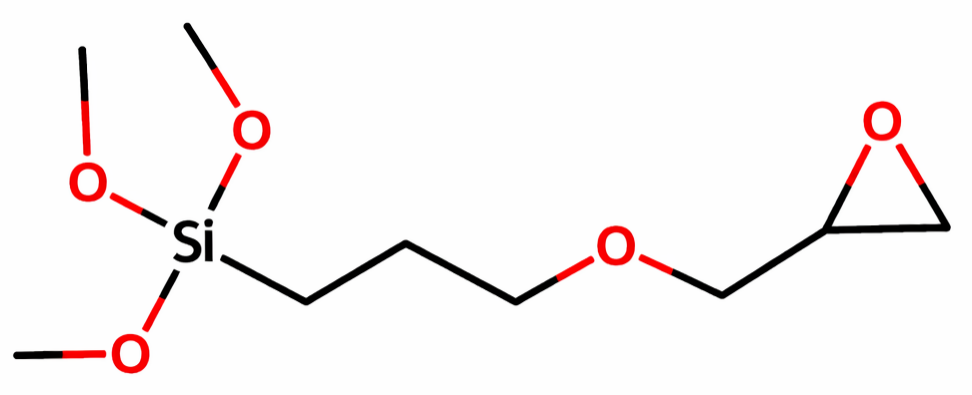
3-Glycidyloxypropyltrimethoxysilane belongs to the class of epoxy-functional trialkoxysilanes. The methoxy silane end hydrolyzes relatively quickly, while the epoxy-functional organic end can undergo ring-opening reactions with reactive groups in certain resin systems under curing conditions, and can also improve compatibility, wetting behavior, or adhesion in a variety of thermoplastic resins, elastomers, and rubber systems.
Structural unit | Structural composition | Reaction characteristics | Contribution to material performance |
Trimethoxysilane end | −Si(OCH₃)₃ | Hydrolyzes in the presence of water to form silanol: R−Si(OCH₃)₃ + 3H₂O → R−Si(OH)₃ + 3CH₃OH | Provides reactive sites for interaction with inorganic surfaces |
Silanol structure | −Si(OH)₃ | Condenses with hydroxyl groups on inorganic surfaces: R−Si(OH)₃ + HO−M → R−Si−O−M + H₂O | Forms a stable interfacial layer on surfaces such as glass, silica, and metal oxides |
Siloxane network | −Si−O−Si− | Silanols self-condense to form a siloxane structure | Improves interfacial water resistance, heat resistance, and wet adhesion |
Propyl spacer chain | −CH₂−CH₂−CH₂− | Provides a flexible linking distance and reduces steric hindrance | Buffers interfacial stress between the resin and the inorganic surface |
Ether linkage | −O− | Increases molecular polarity and wetting ability | Improves compatibility with polar resins, silica, glass fibers, and mineral fillers |
Glycidyl ether-type epoxy end | Three-membered epoxide ring | Can undergo ring-opening reactions under curing conditions with amines, acid anhydrides, carboxyl groups, phenolic hydroxyl groups, alcoholic hydroxyl groups, thiols, etc. | Enters the resin crosslinked network and enhances the chemical bonding strength between the organic and inorganic phases |
3. Basic Production Process of 3-Glycidyloxypropyltrimethoxysilane
The mainstream synthesis route for 3-glycidyloxypropyltrimethoxysilane is the hydrosilylation reaction. The raw materials are allyl glycidyl ether and trimethoxysilane. Under the action of a platinum-based catalyst, the silicon-hydrogen bond in trimethoxysilane adds across the carbon-carbon double bond of allyl glycidyl ether.
Main reaction equation:
CH₂(O)CHCH₂OCH₂CH=CH₂ + HSi(OCH₃)₃ → CH₂(O)CHCH₂O(CH₂)₃Si(OCH₃)₃
Item | Core content |
Reaction type | Hydrosilylation reaction |
Main raw materials | Allyl glycidyl ether, trimethoxysilane |
Catalytic system | Platinum-based catalyst |
Common reaction conditions | Dry system, inert gas protection; dropwise addition processes can be carried out at about 60 to 90°C, while continuous tubular processes may also use higher temperature conditions, depending on catalyst activity, residence time, and by-product control targets. |
Purification method | Recovery of low-boiling components after the reaction, followed by vacuum distillation to obtain the target product |
Key control points | Control moisture, acidic/basic impurities, feed rate, and reaction temperature to reduce isomerization of allyl glycidyl ether, branched isomers, eight-membered-ring by-products, high-boiling components, and epoxy ring-opening side reactions |
The system must be kept dry during production. Moisture can cause premature hydrolysis and condensation of the trimethoxysilane end, while acidic or strongly nucleophilic impurities can increase the risk of epoxy ring opening. Different processes adjust temperature and feeding mode according to catalyst activity, reactor type, raw material ratio, and by-product control targets.
4. Classification of Epoxy Silanes and Characteristics of Aliphatic Epoxy Silanes
Aliphatic epoxy silanes refer to epoxy silanes whose epoxy-functional organic end does not contain an aromatic ring, and they mainly include open-chain glycidyl ether types and alicyclic epoxy types. 3-Glycidyloxypropyltrimethoxysilane belongs to the open-chain aliphatic glycidyl ether-type epoxy silanes.
Aliphatic epoxy silanes usually feature light color, low viscosity, good wetting, and broad resin compatibility. Molecules of the open-chain glycidyl ether type contain a flexible propyl chain and an ether linkage, making them suitable for adhesives, coatings, composites, and filler treatment. Alicyclic epoxy types contain a cyclohexane skeleton and have a more rigid structure, making them suitable for hard coatings, organic-inorganic hybrid materials, and systems requiring higher heat resistance.
Epoxy silanes can also be classified according to their hydrolyzable groups. Methoxy types hydrolyze relatively quickly, and trialkoxy types provide high crosslink density. Ethoxy types hydrolyze more slowly, with ethanol as the hydrolysis by-product. Dialkoxy types show better stability after hydrolysis, and their condensation structures tend to be more linear.
Basis of classification | Category | Representative product | Structural features | Product characteristics |
By epoxy-functional organic end | Open-chain aliphatic glycidyl ether type | 3-Glycidyloxypropyltrimethoxysilane, CAS 2530-83-8 | Glycidyl ether epoxy end, propyl spacer chain, trimethoxysilane end | Fast hydrolysis, high coupling efficiency, suitable for epoxy resins, filler treatment, glass fiber, adhesives, and electronic encapsulation systems |
By epoxy-functional organic end | Open-chain aliphatic glycidyl ether ethoxy type | 3-Glycidyloxypropyltriethoxysilane, CAS 2602-34-8 | Glycidyl ether epoxy end, triethoxysilane end | Slower hydrolysis, wider processing latitude, ethanol as the hydrolysis by-product, suitable for formulations that are more sensitive to reaction rate |
By epoxy-functional organic end | Alicyclic epoxy type | 2-(3,4-Epoxycyclohexyl)ethyltrimethoxysilane, CAS 3388-04-3 | Epoxy group located on a cyclohexane skeleton, trimethoxy silane end | Higher molecular rigidity, suitable for hard coatings, hybrid materials, and heat-resistant systems |
By hydrolyzable group at the silicon end | Trimethoxy type | CAS 2530-83-8, CAS 3388-04-3 | One silicon atom bonded to three methoxy groups | Fast hydrolysis, high reactivity, suitable for rapid surface treatment and high-strength interfacial coupling |
By hydrolyzable group at the silicon end | Triethoxy type | CAS 2602-34-8 | One silicon atom bonded to three ethoxy groups | Slower hydrolysis, better formulation stability, suitable for systems requiring longer processing time |
By hydrolyzable group at the silicon end | Dialkoxy type | Diethoxy(3-glycidyloxypropyl)methylsilane, CAS 2897-60-1 | One methyl group replaces one alkoxy group, leaving only two hydrolyzable alkoxy groups on the silicon end | Lower crosslink density than trialkoxy types, lower tendency to gel, better flexibility and hydrophobicity |
By molecular form | Monomeric type | CAS 2530-83-8, CAS 2602-34-8, CAS 3388-04-3 | Single small-molecule silane | High activity, low addition level, suitable for surface treatment and direct formulation addition |
By molecular form | Oligomeric type | Epoxy silane oligomers | Partially condensed oligomeric structure | Lower release of volatile alcohols, suitable for waterborne systems, primers, and continuous coating processes |
5. Typical Uses of Epoxy Silanes, Problems They Solve, and Their Mechanisms of Action
Application area | Problem addressed | Mechanism of action | Performance improvement |
Glass fiber reinforced composites | Glass fiber surfaces are hydrophilic, resin wetting and interfacial bonding are insufficient, and strength declines after moisture exposure | The silane end condenses with silanol groups on the glass surface, while the epoxy end enters the resin curing network | Improves flexural strength, tensile strength, interlaminar shear strength, and wet strength retention |
Treatment of fillers such as silica, quartz powder, alumina, and aluminum hydroxide | Filler agglomeration, sedimentation, poor resin wetting, and increased viscosity in highly filled systems | The silane forms an organophilic interfacial layer on the filler surface, and the epoxy end reacts with or is compatible with the resin | Improves dispersibility, reduces interfacial defects, and enhances filler loading and mechanical properties |
Epoxy adhesives and sealants | Unstable wet adhesion to substrates such as glass, metals, ceramics, and concrete | Silanols form siloxane bonds with inorganic surfaces, and the epoxy end participates in adhesive-layer curing | Improves dry and wet adhesion and reduces interfacial delamination |
Metal primers and anticorrosion coatings | Blistering, delamination, and underfilm corrosion under moisture, salt spray, and thermal cycling | The silane forms a thin siloxane interfacial layer, enhances coating adhesion to metal oxide surfaces, and reduces water migration along the interface | Improves salt spray resistance, heat and humidity resistance, and edge corrosion protection |
Electronic encapsulants, potting compounds, and chip packaging composites | Weak filler-resin interfaces in highly filled epoxy systems, leading to delamination, cracking, or reduced electrical performance after moisture uptake | Modifies the surfaces of fillers such as silica and quartz powder so that the fillers form a stable interface with the epoxy network | Improves damp-heat reliability, mechanical strength, dimensional stability, and electrical insulation retention |
Scratch-resistant coatings for plastic optical parts | Low surface hardness of plastics and insufficient adhesion of hard coatings | The epoxy end participates in organic curing, while silanol condensation forms a hard siloxane structure | Improves scratch resistance, abrasion resistance, and coating adhesion; in transparent systems, it helps balance hardness and adhesion |
Waterborne coatings and emulsion systems | Insufficient adhesion of waterborne resins to inorganic substrates, pigments/fillers, and metal surfaces | Appropriate epoxy silanes provide coupling and crosslinking points during film formation in waterborne systems | Improves water resistance, wet adhesion, pigment/filler stability, and coating integrity |
Surface modification of nanoparticles and microparticles | High surface energy, easy agglomeration, and poor compatibility with organic systems | The silane end is grafted onto the particle surface, and the epoxy end serves as a site for subsequent reactions | Improves dispersion stability and facilitates further grafting of resins, amines, or other functional molecules |
Cement-based repair materials and epoxy mortars | Poor interfacial durability of epoxy repair layers on damp inorganic substrates | The silane interacts with hydroxyl groups on silicates, metal oxides, or mineral surfaces, while the epoxy end enters the resin network | Improves adhesion to damp substrates, peel resistance, and durability |
6. Comparison of the Characteristics of Epoxy Silanes and Amino Silanes
Both epoxy silanes and amino silanes are organofunctional silanes. Their differences mainly arise from the functional groups at the organic end. Epoxy silanes are often used for filler pretreatment or added to the epoxy resin side, whereas amino silanes can also be used for filler pretreatment and are also commonly added to the curing-agent side of two-component systems.
Comparison item | Epoxy silane | Amino silane |
Organic functional group | Epoxide ring | Primary amine, secondary amine, or polyamine |
Reaction mode | The epoxide ring undergoes ring-opening reactions with amines, acid anhydrides, carboxyl groups, hydroxyl groups, thiols, etc. under curing conditions | The amino group is strongly nucleophilic and can react directly with epoxies, isocyanates, acid anhydrides, etc. |
Reaction rate | Relatively moderate, facilitating control of formulation pot life | Relatively fast, and can easily affect the storage stability of epoxy systems |
Acidity/basicity | Close to neutral, with relatively little effect on system acidity/basicity | Clearly basic, and can promote hydrolysis, condensation, or resin reactions |
Recommended point of addition | Usually added to the resin side, or used first for filler and substrate pretreatment | A common practice is to add it to the curing-agent side, or use it first for filler and substrate pretreatment |
Relationship with epoxy resins | The epoxy end can enter the epoxy curing network, and the interfacial reaction is relatively moderate | The amino group can participate in epoxy curing, with stronger reactivity that requires control of the formulation window |
Color and odor | Usually suitable for light-colored, transparent, and low-odor systems | Amine odor is more pronounced, and color stability should be evaluated in light-colored systems |
Damp-heat durability | Suitable for epoxy, polyurethane, and acrylic systems requiring wet adhesion, water resistance, and resistance to heat and humidity | Initial adhesion is strong, but long-term damp-heat performance depends on amino content, water absorption, and formulation structure |
Typical applications | Electronic encapsulation, filler treatment, anticorrosion coatings, transparent wear-resistant coatings, epoxy adhesives | Curing systems for epoxy adhesives, glass fiber treatment, rubber filler treatment, polyurethane systems, and phenolic systems |
Main limitations | Requires reactive groups or curing conditions in the formulation that can open the epoxide ring | Can easily shorten pot life, and strong basicity and amine reactivity may introduce side reactions |
7. Precautions for Using Epoxy Silanes
7.1 Control Moisture
The alkoxysilane end of epoxy silanes reacts with water and then undergoes condensation. The original liquid should be stored in a sealed container. After opening, contact with air and moisture should be minimized, and dry inert gas protection should be used when necessary. 3-Glycidyloxypropyltrimethoxysilane is moisture-sensitive and should be stored in a cool, light-protected, and tightly sealed condition.
7.2 Hydrolysate Solutions Should Not Be Stored for Long Periods
During pre-hydrolysis treatment, a water-alcohol system is typically used and controlled within a weakly acidic range, for example around pH 4.5 to 5.5. Excessively high acidity increases the risk of epoxy ring opening, while excessively high alkalinity accelerates silanol condensation, leading to turbidity, precipitation, or gelation. Prepared hydrolysate solutions should preferably be used immediately after preparation, or be consumed within a pre-validated usable time limit.
7.3 The Substrate Surface Must Be Clean
Oil, mold-release agents, dust, oxide scale, and weak boundary layers hinder silane contact with surface hydroxyl groups. Surfaces such as glass, silica, quartz, silicates, alumina, and most metal oxides are more suitable for silane coupling. Carbonate-based substrates such as calcium carbonate and marble, as well as some iron oxide surfaces, have relatively weaker ability to form stable siloxane bonds, and therefore surface treatment plans or combined systems usually need to be adjusted according to the substrate properties.
7.4 The Addition Level Needs to Be Determined Experimentally
In coatings, adhesives, and sealants, 0.5% to 1.0% of resin solids can be used as an initial trial dosage. If the dosage is too low, interfacial coverage will be insufficient. If it is too high, a self-condensed layer may form, leading to interface embrittlement, reduced adhesion, or poorer system stability.
7.5 Pay Attention to the Order of Addition
In two-component epoxy systems, epoxy silanes are usually more suitable for addition to the resin side or for filler pretreatment. If they are added directly into components containing strong amines, strong acids, or strongly nucleophilic species, premature epoxy ring opening may occur and shorten pot life.
7.6 Adequate Drying and Curing Are Required
After hydrolysis, silanes require drying, heating, or resin curing to drive the condensation reaction forward. If drying is insufficient, the interface relies mainly on physical adsorption and hydrogen bonding, and water resistance as well as resistance to heat and humidity will decline.
7.7 Pay Attention to Alcohol Release
Trimethoxy types release methanol upon hydrolysis, while triethoxy types release ethanol. Ventilation should be maintained in enclosed spaces, spray application, and the preparation of waterborne systems to avoid accumulation of alcohol vapors.
7.8 Avoid Incompatible Substances
Strong acids, strong bases, strong oxidizing agents, moisture, reactive amines, and highly aqueous systems containing large amounts of hydroxyl groups may all accelerate hydrolysis, condensation, or epoxy ring opening. During formulation development, changes in viscosity, gel time, storage stability, and adhesion retention should be evaluated.
7.9 Follow Proper Safety Protection Measures
3-Glycidyloxypropyltrimethoxysilane can cause skin irritation and serious eye irritation. Protective gloves, goggles, and protective clothing should be worn during operation, and skin contact, eye contact, and inhalation of mists should be avoided.
7.10 Select the Appropriate Type According to the Application Target
When rapid hydrolysis and high coupling efficiency are required, trimethoxy types can be selected. When a longer processing window and a milder hydrolysis rate are needed, triethoxy types can be selected. When reduced gelation tendency and improved flexibility are required, dialkoxy types can be selected. When higher rigidity and harder surface performance are needed, alicyclic epoxy types can be selected.
8. Classification, Features, and Applications of Epoxy Silane Coupling Agents and Related Representative Chemicals
Classification | CAS No. | Aladdin Catalog No. | Name | Specification or Purity | Product features and applications |
Glycidyl ether-type epoxy trialkoxysilane | 2530-83-8 | 3-Glycidyloxypropyltrimethoxysilane | ≥97% | A representative glycidyl ether-type epoxy silane. It can be used for surface treatment of glass, silica, metal oxides, and similar substrates, and is also commonly used for interfacial coupling in epoxy resins, adhesives, coatings, and composites. | |
Glycidyl ether-type epoxy trialkoxysilane | 2602-34-8 | Triethoxy(3-glycidyloxypropyl)silane(GPTES) | ≥96%(GC) | A triethoxy-type glycidyl ether epoxy silane, suitable for surface modification of inorganic fillers, interfacial bonding between resins and inorganic phases, and the construction of organic-inorganic hybrids in sol-gel systems. | |
Glycidyl ether-type epoxy alkoxysilane (methyl-substituted) | 2897-60-1 | Diethoxy(3-glycidyloxypropyl)methylsilane | ≥98% | A methyl-substituted diethoxy epoxy silane, often used to regulate hydrolysis-condensation behavior and interfacial layer structure, and applicable in coatings, sealants, and filler treatment systems. | |
Glycidyl ether-type epoxy alkoxysilane (methyl-substituted) | 65799-47-5 | 3-Glycidyloxypropyl(dimethoxy)methylsilane | ≥96%(GC) | A methyl dimethoxy epoxy silane that can be used for interfacial bonding between organic resins and inorganic substrates, and can also serve as an epoxy-introducing reagent in surface grafting and hybrid material preparation. | |
Glycidyl ether-type epoxy alkoxysilane (low hydrolyzable site density) | 17963-04-1 | 3-Glycidoxypropyldimethylethoxysilane | ≥97% | A monoethoxy epoxy silane suitable for reducing surface condensation density or serving as a structural-adjustment silane in silicone modification, interfacial grafting, and hydrophobic surface construction. | |
Epoxycyclohexyl-type epoxy trialkoxysilane | 3388-04-3 | 2-(3,4-Epoxycyclohexyl)ethyltrimethoxysilane | ≥97%(GC) | An epoxycyclohexyl-type epoxy silane commonly used in cationic curing, weather-resistant coatings, electronic encapsulation, and organic-inorganic hybrid materials, and also for introducing alicyclic epoxy reactive sites onto surfaces. | |
Epoxycyclohexyl-type epoxy trialkoxysilane | 10217-34-2 | 2-(3,4-Epoxycyclohexyl)Ethyl Triethoxysilane(mixture of enantiomers) | ≥97% | A triethoxy-type epoxycyclohexyl silane suitable for heat-resistant coatings, electronic materials, crosslinked network construction, and inorganic surface functionalization. | |
Amino silane control/reference compound | 13822-56-5 | (3-Aminopropyl)trimethoxysilane | Chloride ion ≤13 ppm | Often used as an amino-type coupling agent reference compound for comparing differences between epoxy and amino silanes in resin reaction pathways, interfacial bonding, and surface modification routes. | |
Amino silane control/reference compound | 919-30-2 | (3-Aminopropyl)triethoxysilane(APTS) | ≥99% | Commonly used for amination of surfaces such as glass, silica, metal oxides, and mineral fillers, and also serves as a control or co-reactive silane in epoxy resin systems. | |
Amino silane control/reference compound | 3179-76-8 | 3-Aminopropyl(diethoxy)methylsilane | ≥97% | A methyl-substituted amino silane that can be used to regulate interfacial layer structure and compatibility with organic phases, and can also be combined with epoxy silanes in composite interface design. | |
Polyamine-type amino silane control/reference compound | 5089-72-5 | 3-(2-Aminoethylamino)propyltriethoxysilane | ≥96% | Contains a polyamine structure and is often used to increase the density of active surface sites. It can also serve as a curing-reaction reference compound or synergistic modifier in epoxy silane-related systems. | |
Polyamine-type amino silane control/reference compound | 1760-24-3 | N-[3-(Trimethoxysilyl)propyl]ethylenediamine | ≥95% | Commonly used to prepare highly aminated surfaces, adsorption materials, and functional layers on inorganic fillers, and can also be used to investigate how polyamine structures affect epoxy reactions and interfacial bonding. | |
Polyamine-type amino silane control/reference compound | 35141-30-1 | 3-[2-(2-Aminoethylamino)ethylamino]propyl-trimethoxysilane | ≥90% | Contains a triamine structure and is suitable for highly reactive surface modification, adsorption-layer construction, and multi-point interfacial bonding studies. It can also serve as a high-functionality reference compound in epoxy silane systems. | |
Epoxy reactive diluent / reactive intermediate | 106-92-3 | Allyl glycidyl ether(AGE) | ≥99% | Not a silane coupling agent itself. It is commonly used as an epoxy reactive diluent, graft-modification monomer, or reactive intermediate for constructing organic-phase systems containing epoxy functionality. | |
Basic silane precursor / organosilicon intermediate | 2487-90-3 | T107289 | Trimethoxysilane | ≥95% | It is a basic organosilicon intermediate that can be used in silicon-containing structure synthesis, hydrosilylation derivatization, and studies on functional silane precursors. |
Note: The products listed above are representative products from Aladdin. For more product specifications, search the Aladdin website using the product name / CAS / catalog number.
References
[1] Plueddemann E P. Silane Coupling Agents. 2nd ed. New York: Plenum Press, 1991.
[2] Arkles B, Maddox A, Singh M, Zazyczny J, Matisons J. Silane Coupling Agents: Connecting Across Boundaries. 3rd ed. Morrisville: Gelest, Inc., 2014.
[3] Arkles B, Goff J. Silanes and Silicones for Epoxy Resins. Morrisville: Gelest, Inc., 2017.
[4] Shin-Etsu Chemical Co., Ltd. Silane Coupling Agents: Combination of Organic and Inorganic Materials. Tokyo: Shin-Etsu Chemical Co., Ltd., 2023.
[5] Shin-Etsu Silicones of America, Inc. KBM-403 Product Data Sheet. Akron: Shin-Etsu Silicones of America, Inc.
[6] Momentive Performance Materials Inc. Silquest A-187 Silane: Technical Data Sheet. Momentive Performance Materials Inc., 2025.
[7] Tokyo Chemical Industry Co., Ltd. 3-Glycidyloxypropyltrimethoxysilane Safety Data Sheet. Tokyo: Tokyo Chemical Industry Co., Ltd., 2025.
[8] Bade S, Seliger B, Schladerbeck N, Sauer J. Process for Preparing Glycidyloxyalkyltrialkoxysilanes: US8039646B2. 2011-10-18.
[9] Chernyshev E A, Belyakova Z V, Knyazeva L K, Khromykh N N. Hydrosilylation of Allyl Glycidyl Ether with Triethoxysilane. Russian Journal of General Chemistry, 2007, 77(1): 55-61.
[10] Li J, Zhang L, Ma T L, Yang C H. Pt/C Catalyst for Hydrosilylation of Allyl Glycidyl Ether with Trimethoxysilane. Advanced Materials Research, 2011, 233-235: 1544-1547.
[11] Innocenzi P, Brusatin G, Guglielmi M, Bertani R. New Synthetic Route to (3-Glycidoxypropyl)trimethoxysilane-Based Hybrid Organic-Inorganic Materials. Chemistry of Materials, 1999, 11(7): 1672-1679.
For more related articles, please see below: