
What Is Direct Compression? Process Characteristics, Suitability Criteria, and Excipient Selection
What Is Direct Compression? Process Characteristics, Suitability Criteria, and Excipient Selection
Direct compression is a manufacturing method used in tablet production. Compared with wet granulation tableting and dry granulation tableting, direct compression does not include a separate granulation step. Instead, the active pharmaceutical ingredient and excipients undergo the necessary sieving, deagglomeration, blending, and lubrication operations before being fed directly into a tablet press and compressed into tablets.
Direct compression eliminates operations such as granulation, drying, and sizing, but it also forgoes the improvements in powder flowability, segregation resistance, and compression performance that may be provided by granulation. Therefore, determining whether a formulation is suitable for direct compression requires more than simply considering whether the number of process steps has been reduced. It is also necessary to assess whether the powder blend can consistently fill the die cavities, maintain uniform composition, and form tablets that meet the required quality standards under compression.
The figure below summarizes the process flow, key requirements, and excipient-selection logic for direct compression.
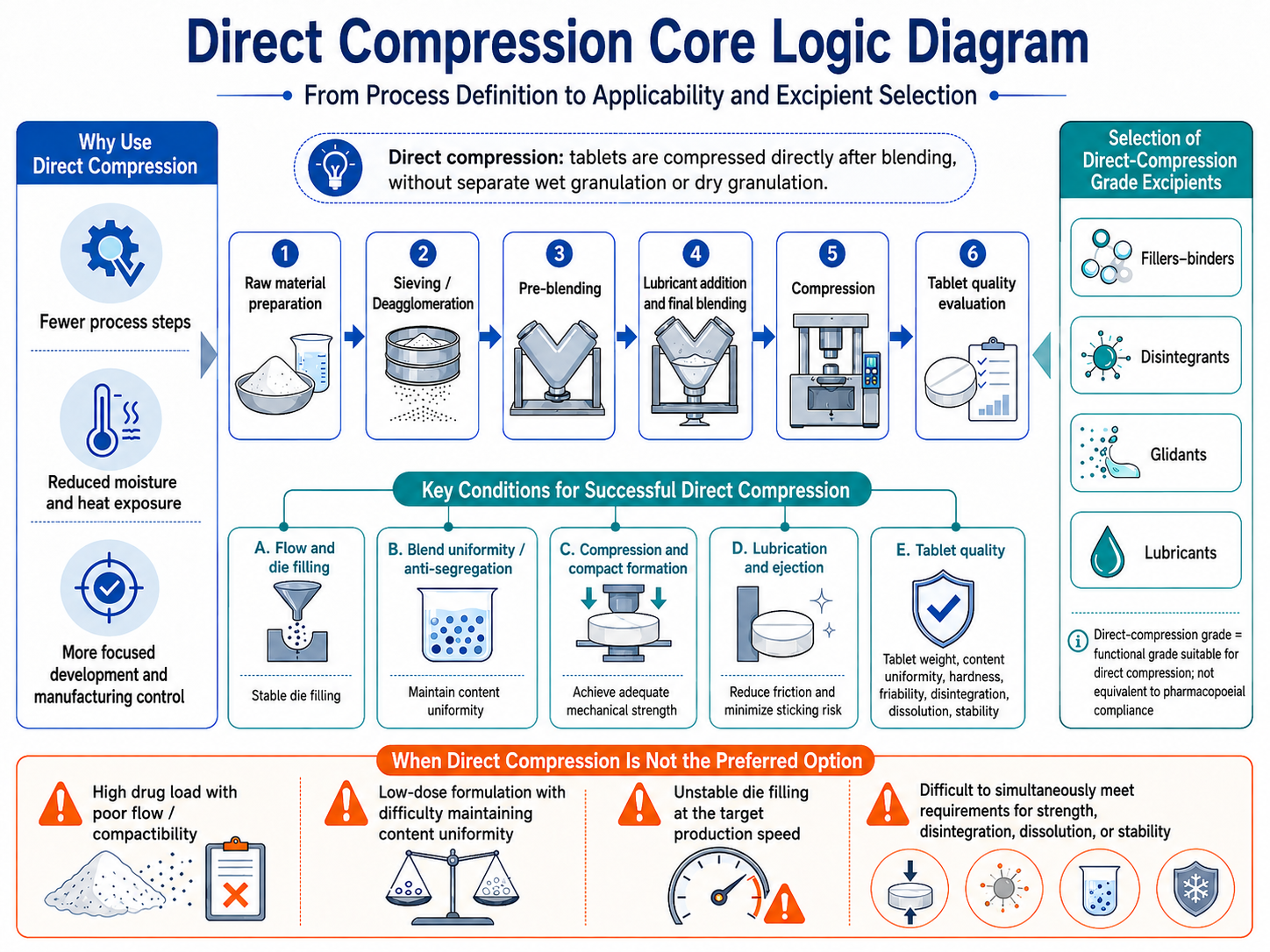
1 What Is Direct Compression?
1.1 Definition of Direct Compression
Direct compression is a process in which the active pharmaceutical ingredient is blended with suitable excipients and compressed directly into tablets without a separate wet granulation or dry granulation step.
The drug substance is commonly referred to as the active pharmaceutical ingredient, abbreviated as API.
A typical direct compression process is as follows:
Preparation of API and excipients → Sieving or deagglomeration as needed → Premixing → Addition of lubricant and final blending → Tableting
The term “direct” is used in contrast to “compression after granulation” and does not mean that the materials receive no treatment before compression. Sieving, deagglomeration, staged addition, and premixing may still be used during production to eliminate agglomerates, improve the state of dispersion, or enhance blend uniformity.
These operations do not convert the entire formulation blend into granules and therefore remain part of a direct compression process. If the formulation blend is first subjected to wet granulation, roller compaction, or slugging, followed by sizing and tableting, the process is classified as granulation followed by compression.
1.2 Differences Between Direct Compression and Compression After Granulation
The primary difference among the three processes is whether granulation is used before tableting to alter the particulate structure of the powder.
Comparison Item | Direct Compression | Wet Granulation Tableting | Dry Granulation Tableting |
Separate granulation step | Not included | A wet granulation step is included | A roller compaction or slugging step is included |
Granulation liquid | Not used | Water or another granulation liquid is usually used | Not used |
Dedicated drying step | Usually not required | Usually required | Usually not required |
Primary determinants of powder performance | API properties, excipient functionality, and formulation composition | Combined effects of material properties and wet granulation | Combined effects of material properties and dry compaction |
Main issues of concern | Flow, segregation, compression, and lubrication | Granulation endpoint, drying, and granule properties | Degree of compaction, granule properties, and recompression performance |
Wet or dry granulation can alter the particle size, density, and surface characteristics of the original powder, thereby improving the flowability, blend stability, or compression performance of certain materials. Direct compression eliminates this conditioning process and is therefore more sensitive to the physical properties of the API and excipients.
2 Why Use Direct Compression?
2.1 Reduction in Production Steps
Direct compression usually eliminates operations such as granulation-liquid preparation, granulation, drying, and sizing, thereby reducing equipment use, material transfers, and in-process control points.
For products with suitable material properties and formulation compositions, direct compression can help:
① shorten the production process;
② reduce certain types of energy consumption;
③ reduce the burden associated with equipment cleaning and material transfer;
④ reduce material losses accumulated across multiple processing steps;
⑤ make the production process easier to control and trace.
However, fewer process steps do not necessarily result in lower overall costs. If a formulation exhibits unstable flow, segregation, sticking, or insufficient tablet strength, formulation optimization and process control may become more difficult.
The process value of direct compression therefore depends on two conditions: first, the process must be capable of stable production; second, the resulting tablets must consistently meet the required quality standards.
2.2 Reduction in Exposure to Moisture and Heat
Wet granulation usually requires the addition of water or another granulation liquid and includes a drying step. For APIs that readily undergo hydrolysis upon contact with water, are sensitive to temperature, or may undergo changes in crystal form under moist and heated conditions, direct compression can reduce the effects of moisture and heating associated with granulation.
This advantage is formulation-dependent. Even when direct compression is used, the following factors may still affect product stability:
① moisture in the excipients;
② humidity in the manufacturing environment;
③ interactions between the API and excipients;
④ changes in crystal form or structure induced by compression;
⑤ the moisture-barrier properties of the packaging materials;
⑥ the temperature and humidity under which the product is stored.
Direct compression can reduce some of the stability risks associated with wet granulation, but it cannot replace API–excipient compatibility studies or stability testing.
2.3 Focusing Process Studies on Key Operations
The principal operations in direct compression are the handling of the API and excipients, blending, lubrication, and tableting. Development personnel can therefore focus more closely on studying how material attributes, blending conditions, and tableting parameters affect product quality.
The International Council for Harmonisation of Technical Requirements for Pharmaceuticals for Human Use is abbreviated as ICH. ICH Q8(R2) states that pharmaceutical development should consider the properties of the API, excipient characteristics, the manufacturing process, and product quality requirements in order to identify material attributes and process parameters that may affect product quality[1].
Although direct compression involves fewer process steps, formulation development is not necessarily simpler. Powder properties that might otherwise be improved through granulation must instead be achieved through control of raw materials, excipient selection, and formulation design.
3 What Requirements Must Be Met for Direct Compression?
Whether direct compression can be performed consistently may be assessed according to the sequence experienced by the powder after it enters the tablet press:
Stable feeding and die filling → Maintenance of uniform composition → Tablet formation under compression → Decompression and ejection → Compliance with tablet quality requirements
3.1 The Powder Blend Has Suitable Flow and Die-Filling Properties
During operation of a rotary tablet press, the powder must enter the die cavities within a limited period of time. If powder flow is discontinuous or the filling rate is insufficient, the amount of material entering the die cavities may vary, resulting in fluctuations in tablet weight and the drug content of individual tablets.
The principal factors affecting powder flow and die filling include:
① particle size and particle-size distribution;
② particle morphology and surface roughness;
③ bulk density, tapped density, and packing state;
④ moisture, electrostatic charge, and interparticle cohesion;
⑤ feeder design, die-cavity dimensions, and fill depth;
⑥ tablet-press speed and the time available for die filling.
Parameters such as angle of repose, compressibility index, and funnel flow rate may be used for preliminary comparisons of materials, but they cannot independently represent the actual die-filling performance of a powder in a tablet press.
Studies have shown that the flow characteristics of a blend, tablet-press speed, feeder speed, and equipment scale can jointly affect tablet-weight variability during direct compression. Stable die filling on experimental equipment does not mean that the same formulation will perform identically on production-scale equipment or at higher tableting speeds[4].
3.2 The Blend Can Maintain Uniform Composition
Achieving uniformity at the end of blending does not mean that the material will remain uniform throughout storage, transfer, hopper discharge, and tableting.
When the API and excipients differ substantially in particle size, density, morphology, or surface properties, segregation may occur during vibration, free fall, or flow. This issue is particularly important in low-dose formulations because the API accounts for only a small proportion of the formulation, and localized changes in the distribution of a small number of particles may affect the drug content of an individual tablet.
The principal factors affecting blend uniformity and segregation tendency include:
1. Whether the API is agglomerated;
2. Whether the particle sizes of the API and excipients are compatible;
3. Whether substantial density differences exist among the components;
4. Whether the blending sequence, duration, and intensity are appropriate;
5. Whether the material-transfer distance and drop height are excessive;
6. Whether the hopper-discharge method is likely to cause stratification.
Studies using low-dose model formulations have shown that excipient particle size, surface structure, blending equipment, and blending time may all affect API distribution and content uniformity[5].
Extending the blending time does not necessarily resolve segregation. If the principal cause is a difference in particle size or density, longer blending may not eliminate the risk of stratification during subsequent material transfer and may also increase the extent to which lubricant coats the particle surfaces.
3.3 The Blend Has Suitable Compression and Tablet-Forming Properties
After entering the die cavity, the powder undergoes particle rearrangement, volume reduction, plastic deformation, brittle fracture, and interparticulate bonding. To describe this process accurately, compression studies generally distinguish among three concepts: compressibility, tabletability, and compactibility[3].
Term | Primary Relationship Characterized | Meaning |
Compressibility | Relationship between solid fraction or porosity and compaction pressure | The ability of a material to become densified under pressure |
Tabletability | Relationship between tablet tensile strength and compaction pressure | The ability to form a tablet of a given mechanical strength at a specified pressure |
Compactibility | Relationship between tablet tensile strength and solid fraction or porosity | The ability to form interparticulate bonds at the same degree of densification |
A powder that can be readily densified will not necessarily form tablets with suitable strength. If interparticulate bonding is insufficient, the tablets may have low tensile strength or high friability. If elastic recovery after decompression is excessive, capping, cracking, or lamination may occur.
Different materials may exhibit different deformation behaviors under pressure:
① plastic deformation helps increase the contact area between particles;
② brittle fracture can generate new particle surfaces and bonding sites;
③ pronounced elastic recovery may increase the risk of structural damage to the tablet after decompression.
Actual formulations contain multiple materials. The performance of an entire formulation should therefore not be judged solely on the tableting results of an individual raw material or excipient.
3.4 Lubrication and Ejection Remain Stable
Lubricants are used to reduce friction between the tablet and the die wall, decrease ejection force, and reduce the risks of sticking, binding, and equipment wear.
Magnesium stearate is a commonly used tablet lubricant. During blending, magnesium stearate particles gradually disperse and coat portions of the surfaces of the API and excipients. An appropriate degree of coating promotes lubrication, but excessive coating may weaken effective bonding between particles.
Studies have shown that the particle size and amount of magnesium stearate, blending time, and particle properties of the lubricated excipients can all affect lubricant dispersion and tablet tensile strength[6].
The following should be evaluated together when establishing lubrication conditions:
① ejection force and ejection behavior;
② tablet tensile strength or crushing strength;
③ friability;
④ disintegration and dissolution;
⑤ the effects of changes in lubricant-blending time on tablet performance.
When the amount of lubricant is increased to reduce ejection force, it is also necessary to determine whether tablet mechanical strength or drug-release performance is adversely affected.
3.5 Tablet Quality Attributes Remain Balanced
The objective of direct compression is not simply to increase tablet hardness, but to ensure that tablet weight, content uniformity, mechanical strength, friability, disintegration, dissolution, stability, and other attributes simultaneously meet product requirements.
For example, increasing compaction pressure can generally increase tablet density and mechanical strength, but it may also reduce porosity and delay the penetration of liquid into the tablet. Increasing the amount of lubricant may reduce ejection force, but it may also weaken interparticulate bonding.
Formulation and process design must therefore balance the following properties:
① the stability of die filling and ejection during production;
② the mechanical integrity of tablets during production, packaging, and transportation;
③ tablet disintegration and drug release when the tablet enters its intended use environment;
④ the physical and chemical stability of the product during storage.
4 What Are Direct-Compression-Grade Excipients?
4.1 Direct-Compression Grade Describes Functionality and Processing Suitability
“Direct-compression grade,” “DC grade,” and “suitable for direct compression” are terms commonly used by suppliers or within the industry to describe the functional and processing suitability of an excipient. They are not standardized pharmacopoeial quality grades.
Category | Primary Issue Addressed |
Pharmaceutical grade or pharmacopoeial compliance | Whether the identity, purity, content, and pharmacopoeial test items of an excipient comply with the relevant standards |
Direct-compression grade | Whether the particle size, morphology, density, flow, compression, or tablet-forming properties of an excipient make it more suitable for direct compression |
Supplier product specification | The control ranges established by the supplier for particle size, moisture, density, and other material attributes |
An excipient may simultaneously comply with pharmacopoeial standards and have a direct-compression-grade specification.
Pharmacopoeial compliance is an important foundation for excipient quality control, but it cannot independently demonstrate that the excipient will provide suitable functional performance in a particular direct compression formulation.
The United States Pharmacopeia–National Formulary is abbreviated as USP–NF. USP–NF General Chapter 〈1059〉 states that the effects of an excipient on pharmaceutical product quality and performance depend on the specific formulation and process and may also depend on material attributes that are not evaluated in a pharmacopoeial monograph. These attributes may vary among suppliers or batches[2].
4.2 Excipients with the Same Name May Have Different Direct Compression Performance
Excipients with the same chemical name may exhibit different direct compression performance because of differences in manufacturing processes and particle structures. Common differences include particle size and particle-size distribution; particle morphology and surface roughness; internal particle pore structure; bulk density and tapped density; moisture content and hygroscopicity; plastic-deformation or brittle-fracture characteristics; and sensitivity to lubricants.
Some direct-compression-grade excipients are produced using spray drying, agglomeration, controlled crystallization, coprocessing, or other methods to modify their particle properties.
For example, a study of a spray-dried, coprocessed rice-starch-based excipient found that a specific coprocessing method produced relatively regular agglomerated particles and improved the material’s flow, tablet-forming, and disintegration performance[8].
Spray drying or agglomeration during excipient manufacture does not affect the classification of the pharmaceutical manufacturing process as direct compression. Whether a process is classified as direct compression is determined primarily by whether a separate granulation step is applied to the formulation blend during tablet manufacture.
4.3 Principal Functions of Excipients in Direct Compression
Excipient Category | Principal Function | Key Considerations During Selection |
Filler–binder | Increases tablet mass and volume and helps the powder form tablets with suitable strength | Flowability, compactibility, dilution capacity, and lubricant sensitivity |
Disintegrant | Promotes liquid penetration into the tablet and helps the compacted structure break apart | Amount added, method of addition, compaction pressure, and properties of the principal excipients |
Glidant | Reduces interparticle cohesion or friction and improves feeding and die filling | Cause of the flow defect, degree of dispersion, and amount used |
Lubricant | Reduces die-wall friction and ejection force and facilitates tablet ejection | Lubrication efficiency, blending time, tablet strength, and drug-release performance |
An excipient may perform multiple functions. For example, certain fillers can increase tablet volume while also improving flow or strengthening interparticulate bonding.
5 How to Select Excipients for Direct Compression
The selection of excipients for direct compression should begin with the properties of the API and the tablet quality requirements. The principal formulation-limiting problem should first be identified, after which the primary excipient system can be established and adjusted in a targeted manner.
The following sequence is recommended:
Define product requirements → Evaluate the API and drug loading → Identify the principal risks → Establish the excipient system → Verify performance on the target equipment
5.1 Identify the Principal Limitations Based on the API and Product Requirements
Before selecting excipients, it is necessary to define the tablet dose, tablet weight, mechanical strength, disintegration, dissolution, and stability requirements and to determine the principal effects of the API on direct compression.
The following three aspects should be considered:
① API proportion: In high-drug-loading formulations, the flow and tablet-forming properties of the API have a greater influence on the blend. In low-dose formulations, API dispersion and content uniformity generally require greater attention.
② Principal powder-related issue: Determine whether the main formulation limitation arises from flow and die filling, blend segregation, tablet-forming ability, or adhesion and ejection.
③ Drug-release and stability requirements: Determine the formulation strategy based on the solubility and wettability of the API and its sensitivity to moisture, temperature, and excipients.
5.2 Establish the Excipient System Based on the Principal Risks
A direct compression formulation usually begins with the selection of the primary filler–binder system. Disintegrants, glidants, lubricants, or wetting agents are then added to address any remaining problems.
Principal Problem | Primary Causes to Be Assessed | Excipient Selection and Adjustment Strategy |
Unstable die filling or tablet weight | Particle cohesion, unsuitable particle size or density, or insufficient dynamic flow | Select a principal filler with suitable flow and packing properties; if the problem is caused by particle cohesion, evaluate the use of a glidant |
Content non-uniformity or susceptibility to segregation in a low-dose formulation | Differences in particle size or density between the API and excipients, API agglomeration, or stratification during transfer | Improve API dispersion and particle matching and select filler or carrier materials that promote uniform distribution |
Insufficient tablet strength, cracking, or capping | Insufficient interparticulate bonding, substantial elastic recovery, or high API loading | Select principal excipients with suitable dry-binding and tablet-forming properties and adjust the excipient combination |
Slow disintegration or dissolution | Low tablet porosity, insufficient wetting, or unsuitable disintegrant or lubrication conditions | Adjust the disintegrant, principal excipients, and compaction conditions and, where necessary, evaluate wetting agents |
High ejection force or sticking | Die-wall friction, material adhesion, moisture, or insufficient lubrication | Optimize the lubrication and anti-sticking system and adjust the lubricant type, amount, and blending conditions |
The primary filler–binder determines the basic flow, die-filling, and tablet-forming properties of the blend. Common materials include various grades of microcrystalline cellulose, lactose, mannitol, and dibasic calcium phosphate.
The following should be compared during selection:
1. Flow and segregation resistance at the target drug loading;
2. Mechanical strength and cracking tendency at different compaction pressures;
3. Whether tablet strength, disintegration, and dissolution change substantially after lubricant addition.
Candidate excipients should be evaluated in blends with an API proportion and final composition close to those of the target formulation. Good performance when an excipient is compressed alone does not mean that it will perform identically in the actual formulation.
5.3 Verify Performance on the Target Equipment and Under Production Conditions
Laboratory testing may be used to screen excipients and formulation proportions, but final confirmation must take into account the target tablet press and intended production speed.
Verification should focus on the following three areas:
① Processing stability: Whether the blend is susceptible to segregation, whether feeding and die filling remain stable, and whether substantial tablet-weight fluctuations occur;
② Compression stability: Whether tablet mechanical strength is appropriate and whether cracking, capping, sticking, or increased ejection force occurs;
③ Finished-product quality: Whether content uniformity, friability, disintegration, dissolution, and stability meet the applicable requirements.
Laboratory single-punch tablet presses and production-scale rotary tablet presses differ in feeding method, compression dwell time, and operating speed. Therefore, excipient-selection results obtained from small-scale testing must also be confirmed using equipment and conditions that approximate actual production.
6 When Should Direct Compression Not Be Prioritized?
6.1 High-Drug-Loading APIs with Poor Flow and Tablet-Forming Properties
High drug loading alone does not preclude direct compression[7].
However, when the API accounts for a high proportion of the formulation and also exhibits poor flowability, substantial cohesion, insufficient tablet-forming ability, or pronounced elastic recovery, the amount of excipient available to improve performance becomes limited.
If increasing the amount of the principal excipients makes it difficult to achieve the target drug loading, or if increasing compaction pressure still results in insufficient strength, cracking, or capping, API particle engineering, dry granulation, or wet granulation may be further compared as alternative approaches.
6.2 Low-Dose Formulations That Cannot Maintain Content Uniformity
When the API is present at a low proportion, readily agglomerates, or differs substantially from the excipients in particle size and density, a direct-blend formulation may exhibit variations in drug content during transfer, hopper discharge, and tableting.
If stable content uniformity still cannot be achieved after optimizing API dispersion, blending sequence, particle matching, and material transfer, methods such as ordered mixing and carrier adsorption may be further evaluated[5], or particle-engineering and granulation approaches may be compared.
6.3 Unstable Die Filling at the Target Production Speed
Some powders can be compressed successfully under low-speed experimental conditions but may exhibit discontinuous feeding, tablet-weight fluctuations, or insufficient die filling at the target production speed.
Under these circumstances, static laboratory flow measurements cannot replace evaluation of dynamic die filling on the tablet press. If stable filling still cannot be achieved after adjusting the principal excipients, glidant, feeder, and tablet-press parameters, the suitability of a granulation process may be further assessed.
6.4 Excessive Formulation Sensitivity to Compression and Lubrication Conditions
If small changes in compaction pressure, tableting speed, or lubricant-blending time result in substantial changes in tablet strength, disintegration, or dissolution, the formulation has a narrow operating range.
If a suitable range of production conditions still cannot be established after adjusting the excipients and process, granulation may help reorganize the particulate structure and reduce the influence of the original powder properties on the manufacturing process.
6.5 Direct Compression Cannot Simultaneously Meet Product Quality Requirements
The suitability of direct compression ultimately depends on whether tablet weight, content uniformity, mechanical strength, friability, disintegration, dissolution, stability, and other attributes can simultaneously meet the product requirements.
If direct compression produces tablets with acceptable appearance and strength but content uniformity, dissolution, or stability does not meet the applicable requirements, the formulation must still be adjusted or alternative manufacturing processes compared.
7 Classification, Product Features, and Applications of Representative Chemicals Related to Direct Compression
Table 1. Fillers, Diluents, and Principal Tablet-Forming Materials
Category | CAS No. | Aladdin Product No. | Name | Specification or Purity | Product Features and Applications |
Plastic-deformation-type filler–binder | 9004-34-6 | Microcrystalline cellulose | JP, European Pharmacopoeia (Ph. Eur.), E 460(i), FCC, NF | Primarily undergoes plastic deformation under compression and provides both filling and dry-binding functions; used in studies of API dilution and loading, the compaction pressure–tensile strength relationship, lubricant sensitivity, and high-drug-load formulations. | |
Anhydrous-lactose-type brittle filler | 63-42-3 | Lactose, anhydrous | PharmPure™, USP, JP, European Pharmacopoeia (Ph. Eur.), NF | A low-moisture lactose material that can undergo brittle fracture under compression; used in studies of moisture-sensitive formulations, tablet porosity, mechanical strength, disintegration, and dissolution. | |
Lactose-monohydrate-type crystalline filler | 5989-81-1 | α-Lactose monohydrate | Ultrapure grade, ≥99.5% (HPLC) | Its hydrated crystal form and purity are well defined; used in studies of lactose hydration state, particle size, blending ratios with microcrystalline cellulose, and compaction and tablet-forming performance. | |
Anhydrous-phosphate-type brittle filler | 7757-93-9 | Dibasic calcium phosphate | Anhydrous grade, PharmPure™, USP, BP, European Pharmacopoeia (Ph. Eur.), fine powder | A high-density inorganic powder that primarily undergoes brittle fracture under compression; used in studies of inorganic filler systems, tablet density, compaction behavior, lubrication, and disintegration. | |
Dihydrate-phosphate-type inorganic filler | 7789-77-7 | Dibasic calcium phosphate dihydrate | Biomedical grade, ≥98%, <70 μm | Contains water of crystallization and has a particle size below 70 μm; used in comparative studies of the anhydrous and dihydrate forms, hydration state, tableting performance, disintegration, and storage stability. | |
Carbonate-type mineral filler | 471-34-1 | Calcium carbonate | BioReagent, ≥99% | A high-purity alkaline inorganic powder; used in studies of filling, tablet formation, disintegration, and dissolution in calcium-containing tablets, mineral tablets, and high-load inorganic formulations. | |
Natural-starch-type filler–conventional disintegrant | 9005-25-8 | S116028 | Corn starch | PharmPure™, ChP | A natural granular starch with filling, water-absorption, and swelling properties; used as a conventional disintegrant comparator and in studies of starch addition levels, tablet porosity, and disintegration performance. |
Low-dextrose-equivalent carbohydrate filler–binder | 9050-36-6 | Maltodextrin | Dextrose equivalent 5.0–8.0 | A water-soluble carbohydrate polymer with a low dextrose equivalent that provides both filling and binding functions; used in studies of powder tablet formation, tablet mechanical strength, disintegration, and dissolution. | |
Mannitol-type palatability filler | 69-65-8 | D-Mannitol | Ultrapure grade, ≥99% (HPLC) | A crystalline polyol with sweetness, a cooling sensation, and water solubility; used in studies of palatability, compression strength, wetting, and disintegration in chewable tablets, lozenges, and orally disintegrating tablets. | |
Xylitol-type cooling sweet filler | 87-99-0 | Xylitol | Pharmaceutical grade | A pharmaceutical-grade polyol with sweetness and a cooling sensation; used in studies of sweet filling, moisture absorption, tablet formation, and physical stability in chewable tablets, lozenges, and orally disintegrating tablets. | |
Isomalt-type sweet filler | 64519-82-0 | Isomalt | ≥99% | A polyol-based composite sweetening material with a relatively low tendency to absorb moisture; used in studies of flow, tablet formation, palatability, and storage stability in chewable tablets, lozenges, and orally disintegrating tablets. | |
Maltitol-type soluble filler | 585-88-6 | Maltitol | ≥98% | A water-soluble polyol sweetening material; used in studies of sweet filling, moisture absorption, mechanical strength, and dissolution behavior in chewable tablets and lozenges. | |
Anhydrous-glucose-type soluble filler | 50-99-7 | D-(+)-Glucose | Anhydrous grade, UltraBio™, ≥99.5% (HPLC), sum of enantiomers | A high-purity anhydrous monosaccharide with high water solubility; used in carbohydrate-filler models, lozenges, and rapidly dissolving tablets, as well as in studies of the relationships among crystal particle size, tablet formation, and dissolution. | |
Sucrose-type crystalline sweet filler | 57-50-1 | GMP1520006 | Sucrose | USP, ChP, JP, European Pharmacopoeia (Ph. Eur.), ultralow endotoxin | A pharmacopoeial-grade crystalline disaccharide with both sweetness and water solubility; used in lozenges, chewable tablets, rapidly dissolving tablets, and studies of the relationship between sugar-crystal particle size and tableting performance. |
Table 2. Binding, Film-Forming, Matrix, and Wetting-Modification Materials
Category | CAS No. | Aladdin Product No. | Name | Specification or Purity | Product Features and Applications |
Low-molecular-weight povidone-type dry binder | 9003-39-8 | Polyvinylpyrrolidone (PVP) | Average molecular weight 8,000, K16–18 | A low-molecular-weight, water-soluble polymer with dry-binding, wetting, and dispersing functions; used in studies of tablet mechanical strength, API dispersion, disintegration, and dissolution of poorly soluble drugs. | |
Povidone–vinyl acetate copolymer-type dry binder | 25086-89-9 | Vinylpyrrolidone–vinyl acetate copolymer (PVP/VA) | Copolymer, 7:3 | Provides dry-binding, film-forming, and drug-dispersing functions; used in studies of high-drug-load direct compression formulations, tablet tensile strength, solid dispersions, and dissolution performance. | |
High-viscosity hydroxypropyl cellulose-type hydrophilic matrix material | 9004-64-2 | Hydroxypropyl cellulose (HPC) | Viscosity 4,000–6,500 mPa·s, 2% aqueous solution at 20°C | A high-viscosity, water-soluble cellulose ether capable of forming a hydrated gel layer; used in studies of directly compressed hydrophilic matrix tablets, tablet mechanical strength, swelling, erosion, and drug release. | |
Low-viscosity hydroxypropyl methylcellulose-type binder–film former | 9004-65-3 | Hydroxypropyl methylcellulose (HPMC) | USP 2910, viscosity of 2% solution: 15 mPa·s; methoxy: 28–30%; hydroxypropyl: 7.0–12% | A low-viscosity, water-soluble cellulose ether with binding, film-forming, and wetting functions; used in studies of tablet strength, drug dispersion, disintegration, dissolution, and film formation. | |
Low-viscosity polyethylene oxide-type hydration-binding material | 25322-68-3 | Polyethylene oxide | Viscosity 65–115 cps | A hydrophilic polyether that absorbs water, hydrates, and forms a viscous polymer layer; used in studies of direct-compression tablet formation, water absorption and swelling, adhesion, and release behavior. | |
Low-molecular-weight block-polyether-type nonionic wetting agent | 9003-11-6 | Poly(ethylene glycol)-block-poly(propylene glycol)-block-poly(ethylene glycol) | Average Mn ~2,900 (EO:PO = 2:3) | A low-molecular-weight polyoxyethylene–polyoxypropylene block polymer with nonionic surface activity; used in studies of poorly soluble drug wetting, solid dispersions, carrier adsorption, and disintegration–dissolution relationships. | |
Alkyl-sulfate-type anionic wetting agent | 151-21-3 | Sodium dodecyl sulfate (SDS) | Anhydrous grade, ACS, ≥99% | An anionic surface-active material with wetting, dispersing, and solubilizing functions; used in studies of wetting and dissolution in directly compressed tablets containing poorly soluble drugs and of surfactant–lubricant interactions. |
Table 3. Disintegration, Liquid Loading, Adsorption, Glidant, and Lubrication Materials
Category | CAS No. | Aladdin Product No. | Name | Specification or Purity | Product Features and Applications |
Crosslinked-cellulose-type superdisintegrant | 74811-65-7 | Croscarmellose sodium | JP, European Pharmacopoeia (Ph. Eur.), NF | Promotes disruption of the tablet structure through capillary water uptake and fiber swelling; used in studies of addition level, compaction pressure, disintegration, and dissolution in immediate-release and orally disintegrating tablets. | |
Crosslinked-povidone-type capillary-wicking disintegrant | 25249-54-1 | Crosslinked polyvinylpyrrolidone (PVP-P) | USP grade, crosslinked, powder | A crosslinked porous polymer that promotes disintegration primarily through capillary water uptake and particle dispersion; used in orally disintegrating tablets, immediate-release tablets, and studies of poorly soluble drug dispersion. | |
Sodium-carboxymethyl-starch-type swelling disintegrant | 9063-38-1 | Sodium carboxymethyl starch (CMS) | PharmPure™, ChP | A modified-starch disintegrating material that undergoes pronounced swelling after water absorption; used in studies of the effects of addition level, compaction pressure, and lubrication conditions on disintegration and dissolution. | |
Liquid-polyol-type liquid-phase carrier | 50-70-4 | D432785 | D-Sorbitol (sorbitol solution) | European Pharmacopoeia (Ph. Eur.), liquid | A sorbitol solution containing sorbitol and other hydrogenated oligomers and polymers, with sweetening, humectant, and plasticizing functions; used with calcium silicate or mesoporous silica to construct liquid-loaded compressible powders and to study liquid content, flow, and drug-release behavior. |
Mesoporous-silica-type drug adsorption carrier | 7631-86-9 | Silicon dioxide | Nanoparticles, mesoporous, outer diameter 450–550 nm, pore size 2–4 nm | Has nanoscale pores and a large interface for drug loading; used in studies of poorly soluble drug adsorption, stabilization of the amorphous state, liquid loading, and the relationship between post-compression pore structure and drug release. | |
Calcium-silicate-type inorganic material | 1344-95-2 | C1505308 | Calcium silicate | SiO₂/CaO: 0.99–1.15 | An inorganic silicate material; used to evaluate its adsorption capacity for liquid or oily components and the flowability, tablet strength, and dissolution behavior of powders after loading. |
Layered-silicate-type glidant–antiadherent | 14807-96-6 | Talc | PharmPure™, pharmaceutical grade, ≥325 mesh | A fine layered mineral powder with glidant, antiadherent, and surface-isolation functions; used in screening studies of powder flow, sticking, punch and die adhesion, and lubrication systems. | |
Fatty-acid-mixture-type lubricant–antiadherent | 57-11-4 | Stearic acid | Moligand™, C18:40%, C16:60% | A lubricating material composed of C18 and C16 fatty acids; used in studies of die-wall friction, ejection force, tablet mechanical strength, and the effects of hydrophobicity. | |
Magnesium-soap-type hydrophobic lubricant | 557-04-0 | Magnesium stearate | PharmPure™, USP, ChP, JP, BP, European Pharmacopoeia (Ph. Eur.) | A pharmacopoeial-grade metallic-soap lubricant that reduces die-wall friction and ejection force; used in studies of blending time, lubricant level, tablet strength, disintegration, and dissolution. | |
Calcium-soap-type hydrophobic lubricant | 1592-23-0 | Calcium stearate | Ca 6.6–7.4% | A calcium-salt fatty-acid lubricating material; used in studies of lubrication efficiency, ejection force, API–excipient compatibility, and comparative tablet quality against other lubricants. | |
Stearyl-fumarate-type lubricant | 4070-80-8 | Sodium stearyl fumarate | ≥98% (T) | A stearyl-fumarate-type tablet lubricant; used in studies of ejection force, sensitivity to lubricant blending, tablet tensile strength, disintegration, and dissolution, and as a comparator for magnesium stearate. |
Table 4. High-Intensity Sweetening and Taste-Masking Materials
Category | CAS No. | Aladdin Product No. | Name | Specification or Purity | Product Features and Applications |
Chlorinated-sucrose-derivative-type high-intensity sweetener | 56038-13-2 | Sucralose powder | PharmPure™, pharmaceutical grade | A low-use-level, high-intensity sweetening material with good water solubility; used in studies of bitterness masking, blended sweetness, low-dose premixing, and content uniformity in orally disintegrating tablets, chewable tablets, and lozenges. | |
Acesulfame-potassium-type high-intensity sweetener | 55589-62-3 | Acesulfame potassium | Moligand™, ≥98% | A water-soluble potassium-salt sweetening material used at low levels; used in studies of blended taste modification, dissolution, and low-dose dispersion in orally disintegrating tablets, lozenges, and chewable tablets. | |
Benzosulfimide-salt-type high-intensity sweetener | 6155-57-3 | Saccharin sodium dihydrate | ≥98% | Water-soluble saccharin sodium dihydrate with high sweetness intensity; used in studies of low-level taste modification, blended sweetness, low-dose blend uniformity, and the hydration state of the hydrate. | |
Dipeptide-methyl-ester-type high-intensity sweetener | 22839-47-0 | Aspartame | ≥98% | A dipeptide-derived sweetening material; used in studies of bitterness masking, palatability adjustment, low-dose uniformity, and humidity–temperature stability in orally disintegrating tablets, chewable tablets, and lozenges. |
Note: The products listed above are representative Aladdin products for research-related applications. The functions and applications described in the tables are based primarily on the general properties of the corresponding materials. Whether a specific product number is suitable for direct compression should be verified based on the product specification, batch certificate of analysis (COA), target formulation, and evaluation system. Additional information on product specifications, grades, and COAs can be found on the Aladdin website by searching by product name, CAS number, or product number.
References
[1] International Conference on Harmonisation of Technical Requirements for Registration of Pharmaceuticals for Human Use. ICH Harmonised Tripartite Guideline Q8(R2): Pharmaceutical Development. Current Step 4 version. August 2009.
[2] United States Pharmacopeia. General Chapter 〈1059〉 Excipient Performance. USP–NF. Rockville, MD: United States Pharmacopeia; 2023. DOI: 10.31003/USPNF_M2312_07_01.
[3] Vreeman G, Sun CC. A powder tabletability equation. Powder Technology. 2022;408:117709. DOI: 10.1016/j.powtec.2022.117709.
[4] Peddapatla RVG, Sheridan G, Slevin C, Swaminathan S, Browning I, O’Reilly C, Worku ZA, Egan D, Sheehan S, Crean AM. Process Model Approach to Predict Tablet Weight Variability for Direct Compression Formulations at Pilot and Production Scale. Pharmaceutics. 2021;13(7):1033. DOI: 10.3390/pharmaceutics13071033.
[5] Alyami H, Dahmash E, Bowen J, Mohammed AR. An investigation into the effects of excipient particle size, blending techniques and processing parameters on the homogeneity and content uniformity of a blend containing low-dose model drug. PLoS ONE. 2017;12(6):e0178772. DOI: 10.1371/journal.pone.0178772.
[6] Puckhaber D, Finke JH, David S, Gururajan B, Rane S, Kwade A. Effect of particle size on the dispersion behavior of magnesium stearate blended with microcrystalline cellulose. International Journal of Pharmaceutics. 2024;651:123792. DOI: 10.1016/j.ijpharm.2024.123792.
[7] Schaller BE, Moroney KM, Castro-Dominguez B, Cronin P, Belen-Girona J, Ruane P, Croker DM, Walker GM. Systematic development of a high dosage formulation to enable direct compression of a poorly flowing API: A case study. International Journal of Pharmaceutics. 2019;566:615–630. DOI: 10.1016/j.ijpharm.2019.05.073.
[8] Trisopon K, Kittipongpatana N, Kittipongpatana OS. A Spray-Dried, Co-Processed Rice Starch as a Multifunctional Excipient for Direct Compression. Pharmaceutics. 2020;12(6):518. DOI: 10.3390/pharmaceutics12060518.
For more related articles, see below:
BP grade: The British Pharmacopoeia Standard, Demystified
PharmPure™: GMP grade biopharmaceutical Raw and Starting Materials from Aladdin Scientific
NF Grade Explained: Standards, Tests, and Uses
From Spec to Bench: Understanding and Using USP Grade Reagents
E 460(i) Microcrystalline Cellulose: Regulatory Standards, Quality Control and Applications