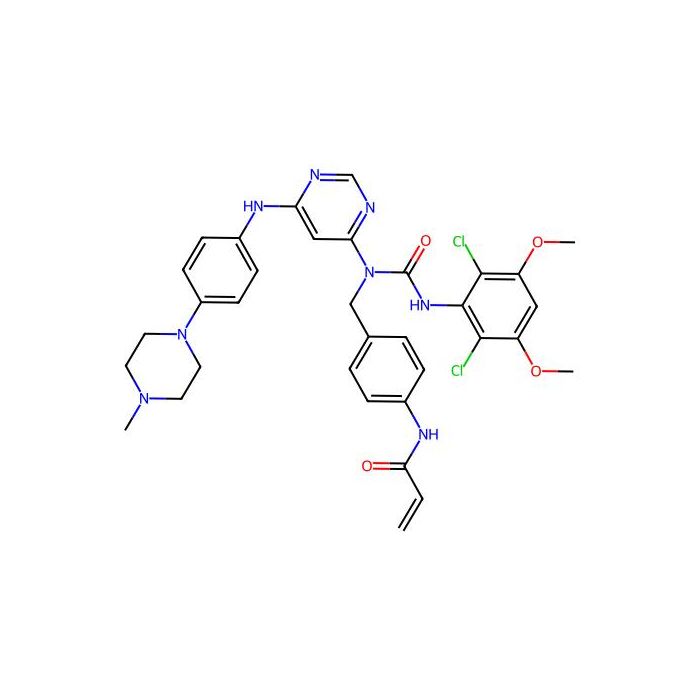
Determine the necessary mass, volume, or concentration for preparing a solution.
| Activity Type | Activity Value -log(M) | Mechanism of Action | Activity Reference | Publications (PubMed IDs) |
|---|

FIIN-3 is an irreversible inhibitor of FGFR with an IC 50 of 13.1, 21, 31.4, and 35.3 nM for FGFR1 , FGFR2 , FGFR3 and FGFR4 , respectively.
In Vitro
FIIN-3 potently inhibits both WT FGFRs (EC 50 in the 1- to 41-nM range) and the gatekeeper mutant of FGFR2 (EC 50 of 64 nM). FIIN-3 also strongly inhibits EGFR, with an EC 50 of 43 nM. FIIN-3 shows good potency against gatekeeper mutant V564F; FIIN-3 also is potent against the gatekeeper-plus-1 mutant E565K; FIIN-3 also displays antiproliferative activity (with an EC 50 of 135 nM) against Ba/F3 cells transformed by the EGFR vIII fusion protein, which has a WT EGFR kinase domain. FIIN-3 shows even better activity against EGFR mutant L858R (EC 50 of 17 nM) and moderate activity, displaying an EC 50 of 231 nM, against the EGFR mutant L858R/T790M mutant. In WT FGFR2 Ba/F3 cells, FIIN-3 completely inhibits the FGFR2 autophosphorylation on Tyr656/657 at concentrations as low as 3 nM. In FGFR2 V564M Ba/F3 cells, FIIN-3 is capable of inhibiting the FGFR2 mutant V564M autophosphorylation with partial inhibition at 100 nM and complete inhibition observed at 300 nM. MCE has not independently confirmed the accuracy of these methods. They are for reference only.
Form:Solid
IC50& Target:FGFR1 13.1 nM (IC 50 ) FGFR2 21 nM (IC 50 ) FGFR3 31.4 nM (IC 50 ) FGFR4 35.3 nM (IC 50 )
Taxonomy Tree
| Kingdom | Organic compounds |
|---|---|
| Superclass | Organoheterocyclic compounds |
| Klasse | Diazinanes |
| Subclass | Piperazines |
| Intermediate Tree Nodes | Not available |
| Direct Parent | Phenylpiperazines |
| Alternative Parents | N-arylpiperazines Dimethoxybenzenes N-phenylureas Anilides Methoxyanilines Anisoles Dialkylarylamines Dichlorobenzenes Phenoxy compounds N-arylamides Alkyl aryl ethers Aminopyrimidines and derivatives N-methylpiperazines Imidolactams Aryl chlorides Heteroaromatic compounds Acrylic acids and derivatives Secondary carboxylic acid amides Amino acids and derivatives Ureas Trialkylamines Secondary amines Azacyclic compounds Hydrocarbon derivatives Organic oxides Organochlorides Carbonyl compounds Organopnictogen compounds |
| Molecular Framework | Aromatic heteromonocyclic compounds |
| Substituents | Phenylpiperazine - N-arylpiperazine - N-phenylurea - Dimethoxybenzene - M-dimethoxybenzene - Anilide - Methoxyaniline - Anisole - 1,3-dichlorobenzene - Phenol ether - Phenoxy compound - Tertiary aliphatic/aromatic amine - N-arylamide - Dialkylarylamine - Aniline or substituted anilines - Methoxybenzene - Chlorobenzene - Halobenzene - Aminopyrimidine - N-alkylpiperazine - N-methylpiperazine - Alkyl aryl ether - Imidolactam - Benzenoid - Aryl chloride - Aryl halide - Monocyclic benzene moiety - Pyrimidine - Heteroaromatic compound - Acrylic acid or derivatives - Carbonic acid derivative - Amino acid or derivatives - Carboxamide group - Secondary carboxylic acid amide - Tertiary amine - Tertiary aliphatic amine - Urea - Carboxylic acid derivative - Ether - Secondary amine - Azacycle - Organic oxygen compound - Amine - Organic nitrogen compound - Carbonyl group - Organohalogen compound - Organochloride - Organopnictogen compound - Organonitrogen compound - Organic oxide - Hydrocarbon derivative - Organooxygen compound - Aromatic heteromonocyclic compound |
| Beschreibung | This compound belongs to the class of organic compounds known as phenylpiperazines. These are compounds containing a phenylpiperazine skeleton, which consists of a piperazine bound to a phenyl group. |
| External Descriptors | Not available |
| Activity Type | Activity Value -log(M) | Mechanism of Action | Activity Reference | Publications (PubMed IDs) |
|---|
| Activity Type | Activity Value -log(M) | Mechanism of Action | Activity Reference | Publications (PubMed IDs) |
|---|
| Activity Type | Activity Value -log(M) | Mechanism of Action | Activity Reference | Publications (PubMed IDs) |
|---|
| Activity Type | Relation | Activity value | Units | Action Type | Journal | PubMed Id | doi | Assay Aladdin ID |
|---|
| Activity Type | Relation | Activity value | Units | Action Type | Journal | PubMed Id | doi | Assay Aladdin ID |
|---|
| Activity Type | Relation | Activity value | Units | Action Type | Journal | PubMed Id | doi | Assay Aladdin ID |
|---|
| Activity Type | Relation | Activity value | Units | Action Type | Journal | PubMed Id | doi | Assay Aladdin ID |
|---|
| Activity Type | Relation | Activity value | Units | Action Type | Journal | PubMed Id | doi | Assay Aladdin ID |
|---|
| Activity Type | Relation | Activity value | Units | Action Type | Journal | PubMed Id | doi | Assay Aladdin ID |
|---|
| Activity Type | Relation | Activity value | Units | Action Type | Journal | PubMed Id | doi | Assay Aladdin ID |
|---|
| Activity Type | Relation | Activity value | Units | Action Type | Journal | PubMed Id | doi | Assay Aladdin ID |
|---|
| Löslichkeit | DMSO : 10 mg/mL (14.46 mM; Need ultrasonic and warming) |
|---|---|
| Empfindlichkeit | Light sensitive |
| Molekulargewicht | 691.600 g/mol |
| XLogP3 | 5.600 |
| Hydrogen Bond Donor Count | 3 |
| Hydrogen Bond Acceptor Count | 9 |
| Rotatable Bond Count | 11 |
| Exact Mass | 690.224 Da |
| Monoisotopic Mass | 690.224 Da |
| Topological Polar Surface Area | 124.000 Ų |
| Heavy Atom Count | 48 |
| Formal Charge | 0 |
| Complexity | 1020.000 |
| Isotope Atom Count | 0 |
| Defined Atom Stereocenter Count | 0 |
| Undefined Atom Stereocenter Count | 0 |
| Defined Bond Stereocenter Count | 0 |
| Undefined Bond Stereocenter Count | 0 |
| The total count of all stereochemical bonds | 0 |
| Covalently-Bonded Unit Count | 1 |
Only product-data-derived protocols are permitted in this section.
General reminder:
All statements below are for research context only. No medical or clinical claims are made.
Literature characterization of FIIN-class probes:
Caveats (general):
Item-specific bioactivity data (potency, Kd/IC50, kinome selectivity): Not specified for this item; users should consult primary literature and/or generate internal benchmarking with appropriate controls.
This compound is a small-molecule probe and does not serve as a buffering agent. No acid/base equilibria suitable for pH control are provided in this listing.
Practical notes for using FIIN-3 in buffered assays (general):
Item-specific buffer compatibility or pKa values: Not specified for this item; refer to CoA/Spec Sheet and verify empirically under your assay conditions.
This listing is a bioactive probe, not a process solvent or bulk reagent; “green alternatives” are therefore not directly applicable to the product itself. Nevertheless, greener handling strategies can be applied to its use in research workflows.
Greener handling strategies (general):
If performing custom synthesis or analog preparation (general):
Trade-offs:
This product is supplied strictly for research use only. It is not an API, excipient, or GMP material, and is not intended for human or veterinary use.
Context for formulation scientists (general, non-clinical):
Item-specific pharmacopeial status, residual solvent profile, or excipient compatibility: Not specified for this item; refer to CoA/Spec Sheet if available, and conduct independent qualification as required by your institution.
Compliance reminder:
Item-specific physico-chemical specifications are not listed for this catalog entry. Do not infer performance-critical values from generic sources; use the lot-specific CoA where available.
Practical guidance (general):
What Moligand™ typically implies (general):
Item-specific facts:
Recommendations for QC on receipt (best practice):
This product is a bioactive small-molecule probe, not a synthetic reagent or solvent. Accordingly, classical synthetic “reaction applications” (e.g., use as a base, ligand, or coupling partner) do not apply.
Research applications (general, literature-based for FIIN-class probes):
Assay design tips (general):
Note: No item-specific activity data, potency values (IC50/Ki), or selectivity panels are provided in this listing; consult primary literature and/or generate in-house data under your assay conditions.
Not applicable. FIIN-3 is not intended for use as a reagent in chemical transformations, so typical “reaction conditions” (catalysts, temperatures, yields) are not relevant to its end use as a probe.
For biological experiments (general guidance; literature/common practice):
Item-specific kinetic parameters (kinact/Ki), potency, and stability in specific media: Not specified for this item; users should establish these under their conditions and consult primary literature for initial benchmarking.
Authoritative safety guidance is provided in the product SDS. This section gives general laboratory best practices for small-molecule kinase probe compounds.
Handling and PPE:
Storage and stability:
Incompatibilities and precautions (general):
First aid (summary; defer to SDS):
Waste disposal:
FIIN-3 is used as a small-molecule probe, not as a reaction solvent. Solvent considerations therefore focus on dissolving, storing, and dosing the compound into assays.
General solubility guidance (literature/common practice for kinase probes):
Polarity/miscibility profile (general):
Practical tips:
Comparison (general):
Item-specific storage and shipping:
Reconstitution (general best practice for small-molecule probes):
Working solution preparation (general):
Stability notes:
Overview: FIIN-3 is a research-use small molecule from the Moligand™ collection, commonly referenced in the literature as a covalent FGFR pathway probe. Item-specific identifiers are limited in this listing; consult the CoA/SDS for definitive identifiers.
Structural features (general, literature):
Notes:
FIIN-3 is supplied as a finished small-molecule probe, not as a reagent or intermediate. Consequently, it is not typically employed as a building block in routine organic synthesis.
General medicinal chemistry context (literature):
Item-specific synthetic or reactivity data (e.g., as a nucleophile/electrophile in bench reactions): Not applicable/not specified for this item.
If users intend to derivatize the scaffold (general advice):
Only product-data-derived specificity claims are permitted in this section.
Note: While FIIN-class probes are discussed in the literature in the context of FGFR family kinases, no target claims are made here beyond what is provided in the product data.
Unser Leitfaden zur Qualitätsauswahl behandelt Reinheit, Stabilisatorstatus und Anwendungseignung für alle Varianten in unserem Katalog.
Moligand™ Qualitätsleitfaden ansehen →