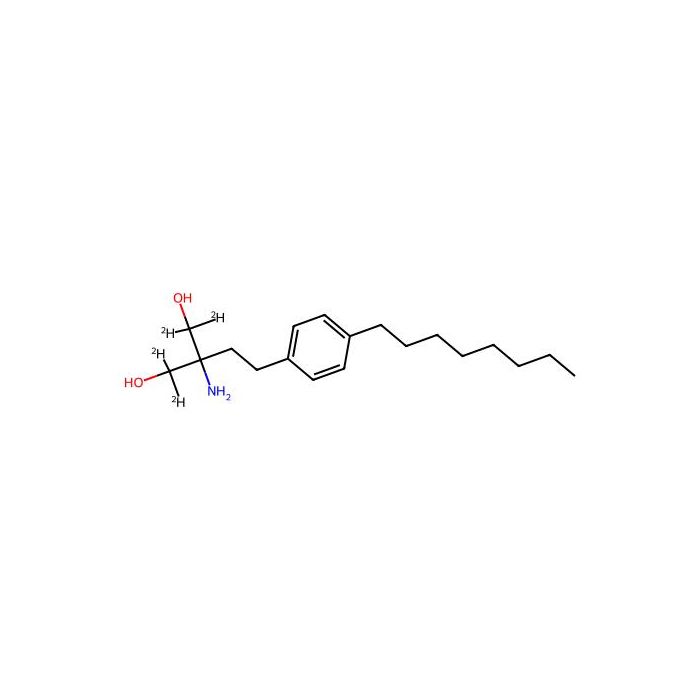
Fingolimod-d 4 is the deuterium labeled Fingolimod. Fingolimod (FTY720 free base) is a sphingosine 1-phosphate (S1P) antagonist with an IC50 of 0.033 nM in K562 and NK cells. Fingolimod also is a pak1 activator , a immunosuppressant.
In Vitro
Stable heavy isotopes of hydrogen, carbon, and other elements have been incorporated into drug molecules, largely as tracers for quantitation during the drug development process. Deuteration has gained attention because of its potential to affect the pharmacokinetic and metabolic profiles of drugs. MCE has not independently confirmed the accuracy of these methods. They are for reference only.
Form:Solid
Spezifikationen
Spezifikationen & Reinheit
≥98%
Biochemische und physiologische Mechanismen
Fingolimod-d 4 is the deuterium labeled Fingolimod. Fingolimod (FTY720 free base) is a sphingosine 1-phosphate (S1P) antagonist with an IC50 of 0.033 nM in K562 and NK cells. Fingolimod also is a pak1 activator , a immunosuppressant.
Storage
Store at 2-8°C,Desiccated
Verschickt in
Wet ice
Dieses Produkt erfordert Kühlkettenversand. Grundversand und andere Economy-Optionen sind nicht verfügbar.
This compound belongs to the class of organic compounds known as aralkylamines. These are alkylamines in which the alkyl group is substituted at one carbon atom by an aromatic hydrocarbyl group.
External Descriptors
Not available
1. Djoumbou Feunang Y, Eisner R, Knox C, Chepelev L, Hastings J, Owen G, Fahy E, Steinbeck C, Subramanian S, Bolton E, Greiner R, and Wishart DS. ClassyFire: Automated Chemical Classification With A Comprehensive, Computable Taxonomy. Journal of Cheminformatics, 2016, 8:61.
Determine the necessary mass, volume, or concentration for preparing a solution.
Dilution Calculator
Determine the dilution needed to prepare a stock solution.
Reconstitution Calculator
Bewertungen
Kundenbewertungen
Application Protocols
Use-case: LC–MS/MS internal standard for quantitation of fingolimod.
Example workflow (general guidance; adjust to your SOP):
Stock solution: dissolve Fingolimod-d4 in LC–MS–grade methanol, acetonitrile, or DMSO to prepare a concentrated stock (e.g., mg/mL range as permitted by solubility). Record exact concentration gravimetrically.
Working IS solution: dilute stock with 50:50 water:MeOH (or ACN) containing 0.1% formic acid to an IS spiking solution appropriate for your calibration range. Store in low-bind vials.
Sample spiking: add a fixed volume of IS solution to all calibrators, QCs, and unknowns before extraction (protein precipitation, LLE, or SPE). Vortex thoroughly.
Chromatography: reversed-phase U(H)PLC on C18 or phenyl-hexyl; gradient elution from aqueous 0.1% formic acid to high organic.
MS detection: ESI(+); monitor MRM for fingolimod and Fingolimod-d4 with a +4 Da mass offset. Tune collision energies for optimal qualifier/quantifier transitions.
Quantitation: construct calibration curves (matrix-matched if possible) using analyte/IS peak area ratios; apply appropriate weighting (e.g., 1/x or 1/x2) following validation.
Notes:
Verify isotopic purity and absence of cross-talk between analyte and IS channels.
Assess recovery, matrix effects, and stability during validation in accordance with regulatory guidance.
For research use only.
Biological Roles
Context for research only (no clinical claims): Fingolimod (FTY720) is a sphingosine analog. In cells, it can be phosphorylated by sphingosine kinases to yield fingolimod-phosphate, which acts as a high-affinity modulator of sphingosine-1-phosphate (S1P) receptors (literature). The deuterated analog Fingolimod-d4 is chemically and biophysically equivalent for chromatographic behavior and is used to quantify the unlabeled analyte.
Key biochemical points (literature/general):
Sphingolipid pathway: Fingolimod mimics sphingosine; phosphorylation generates a zwitterionic phosphate with strong S1P receptor affinity and functional agonism leading to receptor internalization (literature).
Transport/partitioning: The parent base is lipophilic and partitions into membranes; protonation state influences cellular uptake and distribution (literature).
Metabolism (research context): Oxidation, dealkylation, and phosphorylation are documented transformations in biological systems. Isotope-labeled standards enable kinetic and mass-balance studies in complex matrices by correcting for matrix effects in MS.
Use of Fingolimod-d4 in biology labs:
Internal standard in LC–MS/MS assays for fingolimod and fingolimod-phosphate after suitable chromatographic separation of parent and phosphorylated forms.
Supports quantitation in cell lysates, media, or tissue extracts to link exposure to biochemical readouts in basic research.
Note: This product is supplied strictly for research use only.
Buffer Applications
This product is not a buffering reagent. However, it is frequently handled in assay buffers during bioanalytical workflows.
Practical handling tips (general):
Stock preparation: dissolve Fingolimod-d4 in LC–MS–grade methanol, acetonitrile, or DMSO. For aqueous dilutions, include organic modifier (e.g., 10–50% MeOH/ACN) and 0.1% formic acid or similar volatile acid to maintain solubility and promote positive ion formation during LC–MS.
Adsorption control: add a small amount of carrier (e.g., 0.1–0.5% BSA or 0.01–0.1% Tween 20) only if compatible with your assay to reduce nonspecific binding to plastics; verify that additives do not suppress ionization.
pH considerations: maintain mildly acidic conditions for LC–MS to stabilize the protonated amine and improve chromatographic peak shape (general practice).
For electrophoresis or classical buffer recipes, this compound is not applicable. Focus on the Solvent Selection and Application Protocols sections for relevant guidance.
Green Alternatives
While deuterated standards themselves have no direct “green” substitutes for isotopic labeling, method choices can reduce environmental footprint.
Greener method considerations (general):
Solvent economy: minimize organic solvent volumes in extraction and chromatography. Employ UPLC with shorter columns and smaller particles to reduce MeOH/ACN consumption.
Prefer methanol over acetonitrile when chromatographically acceptable, as MeOH is generally considered more sustainable and less supply-sensitive.
Explore aqueous-rich mobile phases and microflow LC–MS to cut solvent waste.
Solid-phase extraction using water-wettable sorbents may reduce solvent usage compared to LLE.
Comparison (general tendencies; not product specs):
Methanol vs ACN: MeOH is renewable-derivable and lower toxicity; ACN often provides superior peak shape for very hydrophobic bases. Balance performance vs. sustainability.
MTBE/EtOAc vs chlorinated solvents: For LLE, MTBE or ethyl acetate are greener choices than dichloromethane or chloroform and typically extract fingolimod-like bases effectively when pH is adjusted.
Operational practices:
Implement closed solvent reservoirs and waste minimization protocols.
Batch more samples per run and use inline solvent recycling where validated.
These considerations help lower the environmental impact without compromising analytical quality.
Pharmaceutical Uses
No therapeutic/clinical claims are made. Research/formulation context only.
Typical roles of Fingolimod-d4 in pharmaceutical and biopharma laboratories (general):
Reference/working standard: used as a stable-isotope internal standard for assay development, method validation (ICH/FDA/EMA), and routine QC of fingolimod in drug substance, drug product, and biological matrices.
System suitability and performance checks: monitors extraction recovery, matrix effects, and instrument performance via IS/analyte response ratios in LC–MS/MS.
Stability-indicating methods: assists in forced-degradation and long-term stability studies by normalizing signal for accurate kinetic modeling.
Calibration materials: incorporated into calibrators and QCs to establish linearity, accuracy, and precision per regulatory guidance.
Documentation to consult for regulated use:
CoA for identity, purity, isotopic enrichment, and content assay.
SDS for safe handling.
Method SOPs and validation protocols for acceptance criteria (e.g., bias, CV, carryover) when using isotope-dilution assays.
Physical Properties
Item-specific physico-chemical specifications were not supplied for this catalog entry. Please consult the product CoA/Spec Sheet for definitive values.
Appearance: Not specified for this item; refer to CoA/Spec Sheet.
Molecular weight: Not specified for this item; refer to CoA/Spec Sheet.
Molecular formula: Not specified for this item; refer to CoA/Spec Sheet.
SMILES/InChI: Not specified for this item; refer to CoA/Spec Sheet.
General/literature guidance for fingolimod-like chemotypes (for method planning; not product specifications):
Physical state: typically a white to off-white solid as the free base (literature).
Solubility profile: sparingly soluble in water; readily soluble in polar aprotic organic solvents such as methanol, acetonitrile, and DMSO (literature). Acidifying aqueous media (e.g., 0.1% formic acid) can increase apparent solubility by forming a protonated species (literature).
Ionization: primary amine; basic pKa in the ~8–10 range is common for aliphatic primary amines (literature, general).
Lipophilicity: moderate-to-high (aromatic ring plus long aliphatic chain); benefits from organic solvent content for chromatographic handling (literature).
Use the above only as planning context. For any values required for regulatory or quantitative work (e.g., density, mp, UV cutoff), rely exclusively on the item’s CoA/SDS.
Quality and Grades
Grade/Purity: Not specified for this item; refer to CoA/Spec Sheet.
Interpretation and typical expectations for deuterated reference standards (general, not specific to this lot):
Isotopic enrichment: Deuterated small-molecule standards are commonly supplied at high isotopic enrichment (e.g., ≥98 atom% D at labeled positions) to ensure a clear mass offset and minimal contribution from isotopic overlap in MS. Verify the exact enrichment on the CoA.
Chemical purity: High chemical purity is important to prevent interferences; for quantitative LC–MS/MS, impurities and residual unlabeled analyte are typically tightly controlled. Confirm by HPLC/UPLC and MS purity data on the CoA.
Identity: Vendors often provide 1H/13C NMR (reduced 1H intensity at labeled positions), HRMS (mass shift +4 Da for d4), and sometimes IR. Review these to confirm identity of both the backbone and isotopic label.
Residual solvents/water, stabilizers, and salt form: Not specified for this item; refer to CoA/Spec Sheet.
What this means for your work:
Use this standard for stable-isotope dilution workflows once you have verified isotopic purity and relative retention vs. the unlabeled analyte.
Record the exact purity and isotopic composition from your lot’s CoA to calculate response factors and prepare accurate calibrators.
Reaction and Applications
Primary application: stable-isotope internal standard for quantitative analysis of fingolimod by LC–MS/MS.
Analytical applications (general best practices):
Stable-isotope dilution: spike a fixed amount of Fingolimod-d4 into calibration standards, QCs, and study samples prior to extraction to correct for matrix effects and variable recovery.
Sample matrices: plasma/serum, whole blood, tissue homogenates, and formulation samples are commonly analyzed for fingolimod; the d4 standard enables accurate quantitation across matrices (literature practice).
Extraction: protein precipitation with ACN or MeOH, liquid–liquid extraction into MTBE/ethyl acetate, or SPE methods (mixed-mode cation exchange) are typical for basic, lipophilic analytes (literature). Incorporate the internal standard before extraction.
Chromatography/ionization: reversed-phase U(H)PLC with a C18 or phenyl-hexyl column; ESI positive mode with MRM transitions offset by +4 Da from the analyte (method development per instrument vendor guidance).
Additional research uses:
Metabolic studies: assess phosphorylation to the active phosphate (by sphingosine kinases) and other biotransformations by monitoring co-eluting labeled internal standard (literature concept).
Stability assessments: evaluate analyte stability during sample prep and storage by tracking IS/analyte response ratios over time.
Note: No synthetic or reagent applications are typical; this material is supplied for analytical/research use only.
Reaction Conditions
This product is not intended for use as a reagent in synthetic reactions. Accordingly, canonical reaction conditions are not applicable.
Analytical method conditions (general LC–MS/MS guidance provided as a practical alternative; literature/practice-based, not product specifications):
Sample preparation: spike Fingolimod-d4 early (pre-extraction). Protein precipitation with 3–4 volumes of cold ACN or MeOH is common; centrifuge and analyze supernatant or proceed to SPE.
Chromatography: reversed-phase C18 or phenyl-hexyl columns; gradients from aqueous 0.1% formic acid to 70–95% organic (MeOH or ACN). Flow and gradient depend on column dimensions and instrument.
Detection: ESI positive mode; monitor MRM transitions shifted by +4 Da relative to fingolimod. Optimize declustering/fragmentor voltages and collision energies empirically.
Carryover mitigation: strong needle washes containing isopropanol/MeOH with 0.1% acid; include high-organic post-run washes for lipophilic analytes.
These conditions are intended as starting points for method development. Optimize for your instrument and matrix, and validate per your laboratory’s SOPs.
Safety and Handling
GHS classification, pictograms, Signal Word, and H-statements: Not specified for this item; refer to the SDS for authoritative safety information.
Storage conditions (from Product Data): Store at 2–8 °C, desiccated. Shipped on wet ice.
General laboratory precautions (professional guidance):
PPE: lab coat, safety glasses, and appropriate chemically resistant gloves. Use in a fume hood to avoid inhalation of dust or solvent vapors during solution prep.
Handling: Avoid generating dust/aerosols. Fingolimod analogs are bioactive; minimize dermal/ocular exposure and practice stringent contamination control when preparing analytical standards.
Incompatibilities (general): strong oxidizers and strong acids/bases may cause degradation. Avoid prolonged exposure to moisture; keep containers tightly closed with desiccant.
First aid (overview; defer to SDS): in case of skin contact, wash with soap/water; eye contact, rinse with water for several minutes; ingestion/inhalation, seek medical attention. Provide SDS to responders.
Waste: dispose of solutions and solids as organic hazardous waste per institutional and local regulations.
Special notes for isotope-labeled reference standards:
Prepare small aliquots to avoid repeated container openings, which can lead to moisture uptake and adsorption losses.
For LC–MS applications, use LC–MS–grade solvents and low-binding plasticware/glassware to minimize analyte loss and contamination.
Solvent Selection
This compound is a lipophilic amino alcohol (fingolimod backbone) and behaves as a basic, hydrophobic analyte. Deuteration does not materially change chromatographic behavior.
Stock solutions: anhydrous methanol, acetonitrile, or DMSO are commonly used for 0.1–10 mg/mL stocks in LC–MS workflows. Choose LC–MS–grade solvents to minimize background.
Working solutions: dilute stocks into aqueous mobile phase containing an organic modifier (e.g., 30–80% MeOH/ACN) and a volatile acid (0.1% formic acid) to maintain protonation and improve peak shape (literature practice for basic analytes).
Aqueous buffers: limited solubility as the free base; improved by modest organic content and/or acidification. Adsorption losses can occur on plastics; use low-bind vials or glass.
Selection guidance vs. alternatives:
Methanol vs. acetonitrile: MeOH can enhance solubility for amino alcohols and may provide better ionization efficiency in ESI(+); ACN often affords sharper peaks and lower backpressure in U(H)PLC.
DMSO: excellent solubilizer for concentrated stocks; keep final DMSO fraction low (≤1–2%) in LC–MS injections to avoid peak distortion (general guidance).
Avoid: strong protic acids or bases in storage solutions that may cause chemical modification; non-volatile buffers for LC–MS unless required by the method.
Storage and Reconstitution
Storage (item-specific): Store at 2–8 °C, desiccated. Shipped on wet ice.
Container handling: Keep tightly closed. Minimize headspace humidity; include desiccant in secondary containment.
Reconstitution and solution handling (general best practices):
Dissolution: prepare primary stocks in dry, LC–MS–grade methanol, acetonitrile, or DMSO. Mix gently to avoid foaming; ensure complete dissolution before aliquoting.
Aliquoting: prepare single-use aliquots in low-bind vials to minimize adsorption and freeze–thaw cycles. Record concentration and preparation date.
Light/moisture: protect from prolonged light and ambient moisture exposure during handling.
Solution stability: verify stability and adsorption losses under your specific conditions (autosampler residence time, vial type, temperature). Follow your lab’s SOPs and method validation data.
Do not substitute or extrapolate storage conditions beyond those specified without internal stability data. For any long-term solution storage practices, consult your quality system and the product’s CoA/SDS.
Research Use Note: For research use only.
Structure and Identity
Fingolimod-d4 is the stable-isotope–labeled analog of fingolimod (FTY720), incorporating four non-exchangeable deuterium atoms for use primarily as an LC–MS/MS internal standard in quantitative analyses.
SKU: F648200
Product name: Fingolimod-d4 (stable-isotope–labeled small molecule)
CAS: 1346747-38-3
PubChem CID: 71316987
InChIKey (as provided): 182294
SMILES: Not specified for this item; refer to CoA/Spec Sheet.
Molecular formula: Not specified for this item; refer to CoA/Spec Sheet.
Molecular weight: Not specified for this item; refer to CoA/Spec Sheet.
Structural features (general/literature description of fingolimod backbone):
Contains a para-substituted phenyl ring attached to a long aliphatic chain bearing a primary amino group and a terminal alcohol (amino alcohol motif; literature).
Neutral (as free base) but basic due to the primary amine; can form salts (literature).
The d4 label is typically introduced at metabolically and chromatographically non-labile positions to ensure co-elution with the unlabeled analyte and a predictable mass shift for MS quantitation (general practice; literature).
2D structure in words (general to fingolimod chemotype): a single phenyl ring para-linked to a polymethylene chain terminating in CH(OH)–CH2–NH2, with internal branching that modulates lipophilicity (literature).
Synthetic Utility
Fingolimod-d4 is not typically employed as a synthetic building block. Its primary purpose is as a labeled internal standard. Nevertheless, understanding its functional groups can inform handling and compatibility during method development.
Functional motif (general/literature):
Primary amine (basic, nucleophilic) and primary alcohol (nucleophilic, can be esterified/etherified). Aromatic ring and aliphatic chain confer lipophilicity.
Implications for laboratory operations:
Derivatization (if ever pursued for specialized analytics): the amino group could be acylated or carbamylated to alter chromatographic properties; the alcohol could be phosphorylated/silylated. Such modifications would defeat its purpose as an internal standard for the native analyte, so they are rarely used.
Salt formation: formation of volatile salts (e.g., formate, acetate) can improve solubility and peak shape for LC–MS method development (literature practice for basic analytes).
Bottom line: treat Fingolimod-d4 as an analytical standard rather than a substrate/reagent. Preserve the native structure to ensure co-elution and matched ionization with the unlabeled analyte.
Target Specificity
Not applicable. This product is a small-molecule chemical standard, not an antibody, probe, or affinity reagent. No antigen/epitope, clone, isotype, or species reactivity information applies.
Häufig gestellte Fragen
What is the purity of this product?
This product is supplied at ≥98% purity (chemical assay). Lot-specific values are stated on the Certificate of Analysis.
How should this product be stored?
Store at 2–8 °C, desiccated. Keep the container tightly closed with desiccant — the material is moisture-sensitive.
How is this product shipped?
This product ships chilled on wet ice. Unpack on arrival and transfer it to the storage condition stated above.
What are the CAS number, molecular formula and molecular weight?
The CAS Number is 1346747-38-3, the molecular formula is C19H29D4NO2, and the molecular weight is 311.5 g/mol. InChIKey KKGQTZUTZRNORY-ONNKGWAKSA-N.
What documentation is provided?
Available product documentation, including Certificates of Analysis (COA), Safety Data Sheets (SDS), and specification sheets, is shown in the product document area. Document availability and access follow the current site policy.
Wir verwenden Cookies, um die ordnungsgemäße Funktion der Website sicherzustellen und, soweit zulässig, Ihr Nutzererlebnis zu verbessern. Sie können Ihre Einstellungen jederzeit unter „Einstellungen“ verwalten. Weitere Informationen finden Sie in unserer Cookie-Richtlinie.
Dürfen wir Sie über Rabattaktionen informieren?
Später erinnern
Vielen Dank! Bitte überprüfen Sie Ihren E-Mail-Posteingang, um zu bestätigen.
Products are supplied to verified businesses, institutions, and qualified professionals for research and development use only. Not for use in humans, animals, diagnosis, or therapy.