QUALITÄT & REINHEITMoligand™?Moligand™ — Aladdin's line of ligands and bioactive small molecules. Use for receptor, pathway, and binding studies needing defined small-molecule tools.10mM in DMSO
Moligand™, 10mM in DMSO Moligand™ für empfindliche chromatographische und analytische Workflows, die minimale Basislinieninterferenzen erfordern.
🌡
Lagerung & Versand
Store at -80°C Versand Dry ice packs + Cold packs. Genaue Spezifikationen finden Sie im chargenspezifischen COA.
📋
Qualitätsdokumente
SDS, COA, Datenblatt und Spezifikationsblatt stehen zum Download bereit. Chargenspezifische COA über Chargennummernsuche abrufbar.
📚
Literaturbeleg
In 0 peer-reviewten Publikationen zu Chromatographie, organischer Synthese und Kreuzkupplungsreaktionen zitiert.
Übersicht
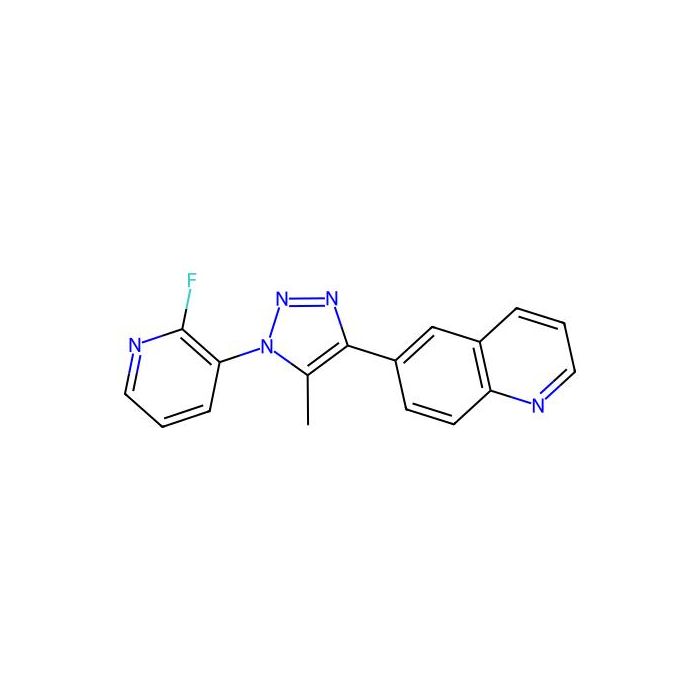
FPTQ is potent mGluR 1 antagonist with IC 50 values of 6 nM and 1.4 nM for human and mouse mGluR1 respectively FPTQ has anti-oxidant and anti-inflammatory effects in vitro and in vivo .
In Vitro
FPTQ (0.5-10 μM) does not shows any cytotoxicity was not observed at 0.5, 1, 5, and 10 μM in RAW264.7 macrophage cells. FPTQ (1-20 μM; 24 hours) reduces LPS-induced NO production at > 1 μM FPTQ, and at 10 μM, FPTQ treatment causes a 31% anti-oxidant effect in RAW264.7 macrophage cells. FPTQ (1-20 μM; 24 hours) dramaticly decreases LPS-induced expression levels of IL-1β and Il-6. At a concentration of 10 μM, FPTQ causes a 27% and 44% reduction in the mRNA expression of IL-1β and Il-6, respectively in RAW264.7 macrophage cells. MCE has not independently confirmed the accuracy of these methods. They are for reference only. RT-PCRCell Line: RAW264.7 macrophage cells Concentration: 1, 10, or 20 μM Incubation Time: 24 hours Result: Decreased IL-1β and IL-6 mRNA expression
In Vivo
FPTQ (5-20 μM) decreases the number of neutrophils migrating to the amputation site in zebrafish larvae by tail amputation. In the tailfin wound method, the number of neutrophils collecting at the wound site also decreases in a dose-dependent manner in zebrafish. In a LPS-induced inflammation zebrafish model, LPS solution is injected into the yolks of Tg(mpx:EGFP) i114 zebrafish larvae and exposed the zebrafish larvae immediately to FPTQ treatment. FPTQ (20 μM; 4 hours) significantly decreases the fluorescent neutrophils after yolk injection and has an anti-inflammatory effect during the early phase of inflammation. MCE has not independently confirmed the accuracy of these methods. They are for reference only.
FPTQ is potent mGluR 1 antagonist with IC 50 values of 6 nM and 1.4 nM for human and mouse mGluR1 respectively. FPTQ has anti-oxidant and anti-inflammatory effects in vitro and in vivo.
Storage
Store at -80°C
Verschickt in
Dry ice packs + Cold packs
Dieses Produkt erfordert Kühlkettenversand. Grundversand und andere Economy-Optionen sind nicht verfügbar.
Note
Moligand™
Aktionsart
ANTAGONIST
Namen und Kennungen
Molekulargewicht
305.31
Dokumentation
📋 Sicherheitsdatenblatt (SDS)
Umfassendes Dokument zu Gefahren, Handhabung, Lagerung und Einhaltung regulatorischer Vorschriften.
Zertifikate (CoA, COO, BSE/TSE und Analyse-Diagramm)
C of A & Other Certificates(BSE/TSE, COO):
Analytical Chart:
Lösungsrechner
Molarity Calculator
Determine the necessary mass, volume, or concentration for preparing a solution.
Dilution Calculator
Determine the dilution needed to prepare a stock solution.
Reconstitution Calculator
Bewertungen
Kundenbewertungen
Application Protocols
The following are general, non-item-specific protocols suitable for small-molecule Moligand™ compounds. Adjust based on target assay and consult the SDS/CoA.
DMSO stock preparation (general):
Warm vial to ambient in a desiccator. Quickly weigh under low humidity.
Dissolve to 10 mM in anhydrous DMSO. Vortex and, if needed, sonicate briefly. Optionally 0.22 µm filter.
Aliquot into low-bind tubes (e.g., 20–50 µL) and store at −80 °C. Avoid repeated freeze–thaw.
Enzyme inhibition assay (general):
Prepare serial dilutions in assay buffer maintaining constant 1% DMSO across wells.
Run n ≥ 3 technical replicates over 10–12 half-log concentrations.
Include vehicle, positive control, and detergent control (e.g., 0.01% Triton X-100) to detect aggregation.
Fit concentration–response using a 4PL model and report IC50 with 95% CI.
Thermal shift (DSF) binding screen (general):
Mix protein (e.g., 2–5 µM), dye (e.g., SYPRO Orange per vendor), and compound (final 50–200 µM) in matched DMSO.
Ramp 25–95 °C, 0.5–1 °C/min. Compute ΔTm vs vehicle. Confirm hits by titration.
SPR (general):
Match DMSO in analyte and running buffer (±0.1%). Inject multiple concentrations (single-cycle or multi-cycle kinetics) and fit to appropriate binding model.
Note: These are general research procedures, not item-specific validated methods.
Biological Roles
Item-specific biological function is not provided for FPTQ. No target, pathway, or endogenous role is specified in the Product Data. The points below are general considerations for small-molecule screening entities used in research:
Screening compounds may engage diverse protein classes (enzymes, GPCRs, ion channels, transporters, PPIs) depending on their structures; without structural/target data, a priori biological roles cannot be assigned.
If an eventual target is identified, characterize on-target potency, selectivity within the protein family, and off-target profiles (e.g., broad counterscreens, kinome panels, GPCR profiling) to place the compound in a biological context.
Evaluate ADME-relevant properties in vitro (solubility, permeability, metabolic stability, plasma protein binding) to understand potential cellular exposure; these are general assessments and not specifications for this SKU.
For cell-based work, confirm cytotoxicity baselines (e.g., resazurin/ATP assays) and distinguish cytostasis from target modulation.
Important restrictions:
This product is labeled “For research use only.” It is not intended for diagnostic, therapeutic, or clinical applications.
For any target-specific biological role or pathway mapping associated with FPTQ, please request the latest technical dossier or CoA that discloses structure and any available bioactivity data.
Buffer Applications
FPTQ is a small-molecule screening compound, not a buffering reagent. No buffer capacity or pKa data are provided in the Product Data. Accordingly:
It is not typically used to formulate buffer systems or control pH.
When deploying FPTQ in biochemical assays, select a buffer system optimized for the biological target (e.g., HEPES, Tris, phosphate, MES) and validate compound stability across the assay pH range.
Maintain consistent vehicle content (commonly DMSO 0.1–2% v/v) in buffer across all wells/controls to mitigate solvent artifacts.
If ionization state is relevant (once structure is available), choose buffer pH to favor solubility and minimize nonspecific aggregation. Without structure-specific pKa values, empirical solubility checks at multiple pH points (e.g., 6.0, 7.4, 8.0) are recommended.
Green Alternatives
Item-specific green metrics are not available. The guidance below addresses greener handling of small-molecule screening compounds and associated solvents (general, literature-based):
Prefer water or aqueous buffers for late-stage assay dilutions when feasible; minimize organic cosolvent to ≤1–2% v/v.
For organic stock solvents, consider replacing high-toxicity or high-VOC options with greener choices where compatible:
Comparison (general solvent context; not item-specific specs):
DMSO vs DMF: DMSO generally offers lower hazard and better biodegradability; choose DMSO for stocks when possible.
MeOH/MeCN: Methanol has higher toxicity than ethanol; use ethanol where compatible with analytics/assays.
Traditional ethers (THF/Et2O) vs 2-MeTHF/CPME for synthetic follow-up: greener ethers reduce peroxide risk and improve lifecycle scores.
Operational practices:
Use miniaturized assay volumes to reduce solvent consumption.
Implement closed-well plating to reduce VOC emissions and DMSO uptake of moisture.
Centralize solvent recovery (where permitted) and segregate halogenated from non-halogenated waste.
Note: No item-specific solvent, synthesis route, or EHS profile has been provided; consult your EHS team and the SDS for definitive guidance.
Pharmaceutical Uses
No pharmacopeial status, excipient role, or clinical use is provided or implied for FPTQ. Per Product Data, this material is for research use only.
General context (not item-specific claims):
Small-molecule screening compounds may serve as starting points for medicinal chemistry optimization. Any progression toward pharmaceutical development would require extensive characterization (CMC, safety pharmacology, toxicology, IMPD/IND-enabling studies) that are outside the scope of this listing.
There is no information indicating compliance with pharmacopeial monographs (USP/EP/JP) or GMP manufacturing controls for this SKU.
Practical guidance for formulation research (preclinical in vitro use only):
When preparing in vitro assay solutions, use analytical-grade excipients and sterile-filter if sterility is required by the assay. Control DMSO levels carefully to avoid perturbing biological systems.
Conclusion:
FPTQ should not be used as a drug substance, drug product, diagnostic reagent, or in any clinical context. For any formulation-relevant properties (hygroscopicity, polymorph, stability), refer to the CoA/Spec Sheet or request additional data.
Physical Properties
Item-specific properties (from Product Data):
Appearance: Not specified for this item; refer to CoA/Spec Sheet.
Molecular weight (MW): Not specified for this item; refer to CoA/Spec Sheet.
Molecular formula: Not specified for this item; refer to CoA/Spec Sheet.
Melting point / Boiling point / Density / Refractive index / pKa / logP: Not specified for this item; refer to CoA/Spec Sheet.
Solubility: Not specified for this item; refer to CoA/Spec Sheet.
General guidance (literature/practice; not item-specific):
For unknown small-molecule library members, initial handling commonly assumes DMSO solubility for stock solutions (e.g., 10–50 mM) with subsequent dilution into assay buffers containing 0.1–2% DMSO.
If the solid form is unclear (amorphous vs crystalline), determine by DSC or PXRD to anticipate dissolution kinetics.
Empirically assess aqueous solubility (e.g., shake-flask or nephelometry at assay-relevant pH). Measure UV–Vis or HPLC area to confirm concentration and detect aggregation/precipitation.
Record pH-dependent solubility if ionizable groups exist (requires structural data). In the absence of structure, perform a pH screen (e.g., pH 3, 7.4, 9) to bracket behavior.
Important:
Do not treat the above as specifications. For procurement or QC acceptance criteria, rely on the item’s CoA/Specification Sheet.
Quality and Grades
Item-specific grade:
Moligand™ grade (from Product Data): denotes suitability for small-molecule screening and ligand discovery workflows.
What Moligand™ typically implies (general guidance; not a specification):
Curated for hit-finding/medchem workflows, emphasizing identity confirmation and fitness for assay use (e.g., solubility in DMSO, minimal interfering impurities). Final acceptance criteria and analytical methods are defined per SKU in the CoA/Spec Sheet.
Analytical controls (recommendations for this item):
Verify identity by orthogonal methods (e.g., HPLC–MS and 1H NMR). Confirm purity by HPLC/UPLC with a suitable UV/PDA method. If available, review lot-level water content (KF) and residual solvents per CoA.
Perform a quick PAINS/reactivity screen once structure is obtained to avoid assay artifacts; run detergent controls and counter-screens if the compound shows promiscuous behavior.
What is not specified here:
Exact purity, stabilizers, residual solvent limits, metal content, water/peroxide levels, and UV cutoffs are not specified for this item; refer to CoA/Spec Sheet.
Practical note:
For plate-based screening, normalize concentration by quantitative weighing and confirm by LC–UV vs a calibrated standard. Maintain controlled DMSO percentage across wells to ensure assay comparability.
Reaction and Applications
From Product Data, FPTQ is offered as a Moligand™ small-molecule suitable for discovery screening. No synthetic transformation role is specified. The following outlines research applications for such compounds (general guidance):
Screening and hit discovery:
Employ in biochemical/biophysical assays (enzyme inhibition/activation, receptor binding, protein–protein interaction modulation) to identify preliminary hits.
Use orthogonal biophysical methods: DSF/thermal shift, nanoDSF, SPR, MST, NMR ligand-observe (STD, WaterLOGSY) to confirm binding.
Cellular assays:
Test for target engagement via CETSA or NanoBRET (if compatible). Begin with low micromolar ranges, controlling for cytotoxicity and aggregation via counterscreens.
Assay interference controls:
Include detergent controls, redox/cysteine reactivity panels, and UV–Vis scans to detect chromophores that may interfere with readouts.
Follow-up chemistry (if structure is available):
SAR expansion by analogue-by-catalog or bespoke synthesis guided by hotspots in the structure. Apply matched molecular pair analysis and property optimization (logD, TPSA, solubility) while tracking ligand efficiency.
Note:
No manufacturer-provided “intended biological target” or “assay class” is specified. All applications are for research use only. For detailed instructions, see Application Protocols and consult the SDS/CoA for lot-specific handling information.
Reaction Conditions
No item-specific reaction conditions are applicable to FPTQ as supplied; it is offered as a finished small-molecule screening compound rather than a reagent for promoting specific chemical reactions.
General guidance (only if performing confirmatory synthesis or analogue preparation once the structure is known; literature-based, not item-specific specs):
Choose solvents based on solubility and stability (DMSO/DMF/MeCN for polar substrates; 2-MeTHF/EtOAc/toluene for less polar systems).
Typical temperature ranges: 0–120 °C depending on transformation class; employ inert atmosphere for air/moisture-sensitive steps.
Catalysts and bases: select per transformation (e.g., Pd catalysts for cross-coupling, amine bases or carbonates; hydrogenation with Pd/C under H2 at 1–50 bar for reducible motifs).
Reaction times and yields are substrate-dependent; establish small-scale scouts and monitor by LC–MS/TLC.
Because FPTQ’s structure is not disclosed here, no numeric conditions, named reaction specifics, or expected yields can be responsibly provided for this item.
Safety and Handling
Item-specific hazard information:
Signal word / H-statements / GHS classification / Pictograms: Not specified for this item; refer to the SDS.
Storage and shipping (from Product Data):
Storage: Store at −80 °C.
Shipping: Shipped on dry ice packs + cold packs to maintain low temperature and integrity.
General laboratory safety (professional guidance; defer to SDS):
Use standard PPE: lab coat, safety glasses, and appropriate chemical-resistant gloves. Work in a chemical fume hood when weighing or preparing solutions.
Avoid inhalation of dust or aerosols and prevent skin/eye contact. Wash thoroughly after handling.
Incompatibilities are structure-dependent; in the absence of structural data, segregate from strong oxidizers/reductants, strong acids/bases, and reactive metals. Keep desiccated to minimize hydrolysis for potentially labile functionalities.
First aid overview: in case of skin or eye contact, rinse with water for at least 15 minutes; remove contaminated clothing. If inhaled, move to fresh air. If ingested, seek medical attention. Always consult the SDS for authoritative instructions.
Waste disposal: collect in suitable, labeled organic waste according to your institution’s and local regulations. Do not discharge to drains.
Special note for screening compounds:
Minimize freeze–thaw cycles (aliquot) and exposure to humidity/light to reduce degradation, racemization, or peroxide/photoinduced pathways (if applicable; see SDS when available).
Solvent Selection
Item-specific solvent data are not provided. The guidance below is general best practice for small-molecule screening compounds.
Primary stock solvent:
DMSO is typically preferred given broad solvency and biochemical assay compatibility up to ~1–2% v/v in final assays (general literature). Prepare 10–50 mM stocks, filter (0.22 µm) if needed, and store at −20 to −80 °C in tightly sealed, low-bind vials.
Secondary solvents for characterization (general):
Polar aprotic: DMF, acetonitrile for LC and sample prep.
Alcohols: methanol, ethanol for LC–MS quench and intermediate solubilization.
Nonpolar/medium polarity: ethyl acetate, MTBE, toluene, or CPME for workups/extractions when doing synthetic confirmation or analog preparation.
Assay dilution considerations:
Maintain constant final DMSO across wells/replicates to avoid vehicle effects.
For poorly soluble entities, add co-solvents compatible with the assay (≤0.5% DMF or MeCN) or use surfactants (e.g., 0.01–0.05% Tween-20) if allowed.
Quick decision guide (general):
If precipitation is observed on dilution into aqueous buffer, pre-warm, sonicate briefly, or formulate a concentrated DMSO stock and titrate slowly while vortexing.
For biophysics (SPR, DSF), ensure final DMSO is matched in sample and reference to negate refractive index effects.
Note: No item-specific solubility or miscibility values are available; consult the CoA/Spec Sheet or request solubility profiling.
General best practices for small-molecule screening compounds (not item-specific specs):
Keep vials tightly sealed in a desiccated, low-oxygen environment (e.g., in a desiccator or with inert gas headspace) to limit hydrolysis or oxidation.
Upon receipt, allow the shipment to equilibrate to room temperature in a sealed secondary container before opening to avoid moisture condensation.
For reconstitution, DMSO is commonly used for primary stocks (e.g., 10–50 mM). If aqueous solubility is sufficient, prepare buffered solutions immediately before use and avoid extended storage at ambient temperature.
Aliquot stock solutions to minimize freeze–thaw cycles; track aliquot age and number of thaws. Store frozen stocks at −80 °C; for working stocks, −20 °C may be acceptable for short periods depending on stability.
Protect from light if chromophores are suspected; use amber vials or foil wrap as precaution.
Not provided for this item:
Exact solubility, hygroscopicity, stability half-life, or reconstitution solvent specifications. For lot-specific recommendations and any stabilizers, refer to the CoA/Spec Sheet and SDS.
Structure and Identity
Brief overview: FPTQ (SKU: F655843) is offered as a Moligand™ small-molecule screening compound for research use.
Item-specific facts (from Product Data):
Product name: FPTQ
CAS: 864863-72-9
Grade: Moligand™
Category: Small molecules and compound library (小分子和化合物库)
InChIKey: Not specified for this item; refer to CoA/Spec Sheet.
SMILES: Not specified for this item; refer to CoA/Spec Sheet.
Molecular formula: Not specified for this item; refer to CoA/Spec Sheet.
Molecular weight: Not specified for this item; refer to CoA/Spec Sheet.
Structural features:
Item-specific structural information (ring systems, functional groups, stereochemistry) is not provided in the current listing. Please consult the CoA/SDS or contact Aladdin Scientific for the latest structure data linked to CAS 864863-72-9.
General note:
Without SMILES/InChI, a text description of the 2D structure cannot be provided here. If you require structure-enabled procurement controls (e.g., substructure flags, PAINS filters), request the structural record associated with this SKU.
Synthetic Utility
The Product Data do not provide structural information for FPTQ; therefore, no item-specific synthetic transformations or functional group reactivity can be described.
General notes for library compounds (non-item-specific):
If FPTQ’s structure becomes available and contains common medicinal chemistry handles (e.g., aryl halides, nitriles, amides, heteroaryl cores), it may be amenable to cross-couplings (Suzuki, Buchwald–Hartwig), nucleophilic substitutions, reductive aminations, or late-stage functionalization.
For confirmatory synthesis or analogue expansion, establish a robust analytical suite (LC–MS, 1H/13C NMR, HRMS). Determine stability under reductive/oxidative conditions before planning transformations.
Current limitations:
Without SMILES/InChI or functional group data, providing concrete synthetic schemes, protecting-group strategies, or retrosynthetic pathways would be speculative and is not included here.
Action:
Please request the structural dossier or CoA if synthetic derivatization or route scouting is desired.
Target Specificity
Item-specific data regarding biological target(s), enzyme class, receptor family, or binding epitope for FPTQ are not provided in the Product Data.
What you can do (general discovery workflow):
If evaluating target specificity, run biochemical IC50/Ki determination across the intended target and close homologs/family members.
No target-specific information is available for this SKU. Please consult the CoA/technical data sheet or contact Aladdin Scientific for any target annotations that may be associated with CAS 864863-72-9.
Häufig gestellte Fragen
What is Moligand??
Moligand? is one of Aladdin Scientific's premium product lines, formulated for high-purity applications across multiple workflows. Compared to standard grades in the same workflow, Moligand? products typically offer tighter specifications, more rigorous QC, and stronger lot-to-lot consistency.
How should this product be stored?
Store at ?80 °C. Ultra-low temperature storage is required to maintain the specified shelf life.
How is this product shipped?
This product ships frozen with dry ice and cold packs. Unpack on arrival and transfer it to the storage condition stated above; handle dry ice with insulated gloves in a ventilated area.
What are the CAS number, molecular formula and molecular weight?
The CAS Number is 864863-72-9, the molecular formula is C17H12FN5, and the molecular weight is 305.31 g/mol.
What documentation is provided?
Available product documentation, including Certificates of Analysis (COA), Safety Data Sheets (SDS), and specification sheets, is shown in the product document area. Document availability and access follow the current site policy.
Benötigen Sie Hilfe bei der Auswahl der Qualität?
Unser Leitfaden zur Qualitätsauswahl behandelt Reinheit, Stabilisatorstatus und Anwendungseignung für alle Varianten in unserem Katalog.
Wir verwenden Cookies, um die ordnungsgemäße Funktion der Website sicherzustellen und, soweit zulässig, Ihr Nutzererlebnis zu verbessern. Sie können Ihre Einstellungen jederzeit unter „Einstellungen“ verwalten. Weitere Informationen finden Sie in unserer Cookie-Richtlinie.
Dürfen wir Sie über Rabattaktionen informieren?
Später erinnern
Vielen Dank! Bitte überprüfen Sie Ihren E-Mail-Posteingang, um zu bestätigen.
Products are supplied to verified businesses, institutions, and qualified professionals for research and development use only. Not for use in humans, animals, diagnosis, or therapy.