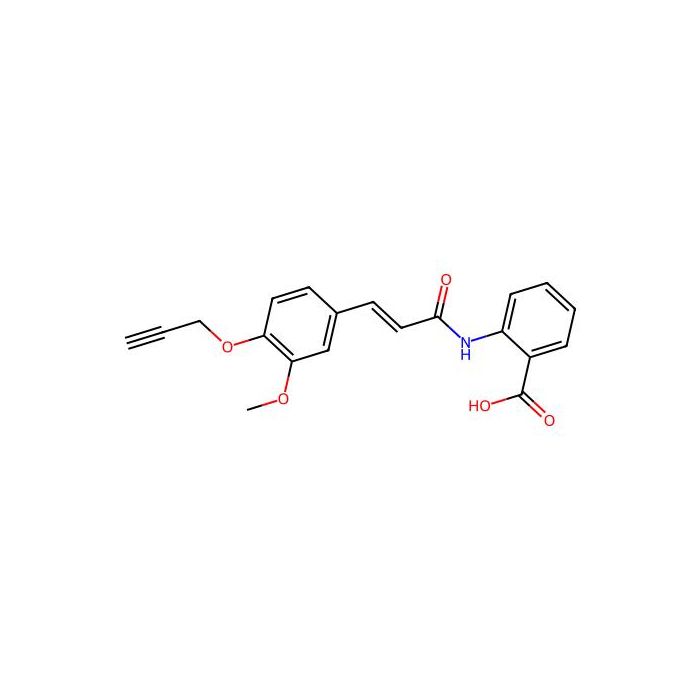
10mM in DMSO für empfindliche chromatographische und analytische Workflows, die minimale Basislinieninterferenzen erfordern.
🌡
Lagerung & Versand
Store at -80°C Versand Dry ice packs + Cold packs. Genaue Spezifikationen finden Sie im chargenspezifischen COA.
📋
Qualitätsdokumente
SDS, COA, Datenblatt und Spezifikationsblatt stehen zum Download bereit. Chargenspezifische COA über Chargennummernsuche abrufbar.
📚
Literaturbeleg
In 0 peer-reviewten Publikationen zu Chromatographie, organischer Synthese und Kreuzkupplungsreaktionen zitiert.
Übersicht
FT011 is an anti-fibrotic agent, reduces mRNA expression of collagens I and III and inhibits collagen synthesis.
In Vivo
FT011 (100 mg/kg b.i.d., p.o., for 4 weeks) improves the cardiac function and and myocardial remodeling in myocardial infarction rats . MCE has not independently confirmed the accuracy of these methods. They are for reference only. Animal Model: Seventy male Sprague Dawley (SD) rats (weighing 200-250 g) Dosage: 100 mg/kg Administration: B.I.D., p.o. on day 7 after surgery, for 4 weeks Result: Increased ejection fraction, fraction shortening and preload recruitable stroke work.
Spezifikationen
Spezifikationen & Reinheit
10mM in DMSO
Biochemische und physiologische Mechanismen
FT011 is an anti-fibrotic agent, reduces mRNA expression of collagens I and III and inhibits collagen synthesis.
Storage
Store at -80°C
Verschickt in
Dry ice packs + Cold packs
Dieses Produkt erfordert Kühlkettenversand. Grundversand und andere Economy-Optionen sind nicht verfügbar.
Zertifikate (CoA, COO, BSE/TSE und Analyse-Diagramm)
C of A & Other Certificates(BSE/TSE, COO):
Analytical Chart:
Lösungsrechner
Molarity Calculator
Determine the necessary mass, volume, or concentration for preparing a solution.
Dilution Calculator
Determine the dilution needed to prepare a stock solution.
Reconstitution Calculator
Bewertungen
Kundenbewertungen
Application Protocols
Item-specific tested applications and dilutions: Not specified for this item.
General protocol examples for small-molecule handling (not item-specific):
Preparing a DMSO stock:
Weigh desired amount quickly to limit moisture uptake. Dissolve in anhydrous DMSO to 10–50 mM. Vortex and, if needed, sonicate briefly. Filter through 0.2 µm PTFE if particulates persist.
Aliquot into low-bind microtubes under inert gas (optional) and store at −80 °C.
Cell-based assay dosing:
Prepare serial dilutions in DMSO (e.g., 10-point 1:3). Add to pre-warmed culture medium to achieve final DMSO ≤0.1–0.5% v/v. Mix thoroughly and dose cells promptly.
Include vehicle-only controls at the highest DMSO percentage and, if available, a reference compound.
Biochemical assay setup:
Dilute compound into assay buffer with matched solvent content for all wells. Pre-incubate with enzyme/protein if the mechanism suggests time-dependence; maintain constant temperature.
Stability check:
At end of assay, collect supernatant and analyze by LC-MS to confirm compound presence and rule out precipitation/degradation.
Biological Roles
Item-specific biological function/target: Not specified for this item; refer to primary literature using CAS 1001288-58-9 or PubChem CID 23648966, and confirm against the product’s CoA.
General context (not item-specific; no clinical claims):
As a cataloged small molecule, FT011 may be evaluated in discovery biology as a chemical tool candidate to interrogate pathways of interest. Before interpreting biological data, verify compound identity, purity, and solution stability under assay conditions.
Characterize potential assay interference by testing for:
Aggregation (use low levels of nonionic detergents and DLS where available).
Redox cycling/fluorescence overlap (evaluate counter-screens and orthogonal detection methods).
Reactive functionality (screen for covalent adducts in glutathione or protein-mimetic assays if applicable after reviewing structure in the CoA/literature).
Establish a concentration–response relationship with appropriate vehicle controls and, if relevant, inactive analog controls from the same chemical series to mitigate chemotype bias.
Data integrity:
Report solvent content (e.g., final DMSO %) and any precipitation/turbidity observed.
Confirm exposure levels by measuring compound in assay supernatant or lysate via LC-MS/MS if quantitative pharmacology or exposure–response correlations are required.
Buffer Applications
Applicability note: FT011 is not a buffering reagent. No item-specific buffer systems are provided.
Practical guidance for using small molecules in buffered assays (general):
Stock preparation: Dissolve in DMSO (10–50 mM). Immediately dilute into assay buffer (e.g., PBS, HEPES, or Tris-based) to a final organic fraction typically ≤0.1–1% v/v.
Precipitation control: Add compound last to pre-warmed (room temperature) buffer under vigorous mixing; verify clarity visually and, if critical, by DLS or nephelometry.
pH considerations: If the compound has acid/base functionality (unknown here), ionization may shift with pH. Establish solubility/assay performance across the relevant pH window (e.g., pH 6.5–8.0 for many biochemical assays).
Additives: 0.01–0.05% nonionic detergent (Tween-20, Triton X-100, or Pluronic F-127) can reduce nonspecific binding/aggregation in some assays. Include identical additives in controls.
Storage of diluted solutions: Prepare fresh working dilutions; avoid storing compound in aqueous buffer for extended periods unless stability has been verified by LC-MS.
Green Alternatives
Context: For screening compounds like FT011, the main environmental footprint often arises from solvent use during dissolution, dispensing, and analytical characterization rather than from the compound itself.
Greener solvent substitutions (general guidance):
Replace high-toxicity dipolar aprotics when possible:
Instead of DMF/NMP: Evaluate Cyrene (dihydrolevoglucosenone) or ethyl lactate for certain processing steps; note differences in polarity and stability with strong bases.
Optimize DMSO usage:
Use minimal volumes and maintain concentrated stocks to reduce waste; consider aqueous co-solvent systems that retain solubility at lower DMSO fractions.
Alcohols and esters:
Favor ethanol or isopropanol over methanol and acetonitrile where compatible with assays/instrumentation.
Process considerations:
Microvolume dispensing (acoustic/positive displacement) reduces solvent consumption and plastic waste.
Plate sealing quality reduces evaporation and need for rework.
Trade-offs (general):
Greener alternatives may alter solubility and assay performance; run side-by-side controls to ensure target readouts and compound stability are maintained.
Item-specific green notes: Not specified for this item; consult internal sustainability guidelines for solvent selection and waste minimization in your workflow.
Pharmaceutical Uses
Item-specific pharmacopeial status/excipient role: Not specified for this item; no compendial monograph indicated.
Applicability note: This product is supplied strictly for research use only. It is not intended for human or veterinary use, diagnostic procedures, or as an excipient in commercial formulations.
General preformulation considerations for research compounds (not item-specific; non-clinical):
Solubility enhancement screens: Evaluate cosolvents (DMSO/ethanol/PEG400), pH adjustment (if ionizable), and enabling systems (cyclodextrins, micelles) for in vitro dosing solutions.
Stability assessments: Conduct forced-degradation studies (light, heat, oxidative, and pH stress) to understand liabilities prior to extended studies; analyze by LC-UV/MS.
Adsorption and materials compatibility: Screen for loss to plastics/elastomers; consider glass vials or low-bind plastics for low concentration work.
Documentation: Maintain clear chain-of-custody, batch records, and analytical verification when using the compound in formulation-relevant research experiments.
Physical Properties
Item-specific (from Product Data):
Appearance: Not specified for this item; refer to CoA/Spec Sheet.
Grade/Purity: Not specified for this item; refer to CoA/Spec Sheet.
Molecular weight: Not specified for this item; refer to CoA/Spec Sheet.
Physical constants (literature/computed — not item specifications):
Boiling point, melting point, density, refractive index, logP, pKa, and UV cutoff: Not available here for this item. Consult primary literature or PubChem CID 23648966 and verify with the item’s CoA.
Practical guidance (general):
Solubility screening workflow for unknown small molecules:
Start with anhydrous DMSO to prepare a 10–50 mM primary stock; gently warm (≤40 °C) and vortex/sonicate as needed.
If DMSO-insoluble, test DMF, NMP, and then mixed organic/aqueous systems (e.g., 50% acetonitrile/water or 50% ethanol/water) while monitoring for precipitation upon dilution.
Record exact solvent lot, concentration, and preparation temperature; confirm concentration by UV-Vis or quantitative 1H NMR if the chromophore/protons allow.
Hygroscopicity and polymorphism are unknown for this listing; check the CoA and evaluate by DSC/TGA or PXRD if solid-state form is critical to your workflow.
For LC-MS method development, begin with 0.1% formic acid in water/acetonitrile (ESI+ and ESI− scans) to assess ionization behavior; adjust modifiers based on observed adducts.
Quality and Grades
Item-specific (from Product Data):
Grade/Purity: Not specified for this item; refer to CoA/Spec Sheet.
How to interpret grade (general guidance, not item-specific):
Screening/library compounds are typically provided at research grade suitable for biochemical and cell-based assays. Purity is commonly established by HPLC/UPLC with UV and/or MS detection; absolute values and thresholds must be verified on the item’s CoA (e.g., area% at specific wavelength, residual solvent profile).
Where applicable, structural identity is usually confirmed by NMR and/or HRMS; chiral purity (ee) is only applicable if the molecule is stereogenic and will be reported when controlled.
Stabilizers/inhibitors: If present, they will be declared on the CoA/label. Absence of such a note does not guarantee none are present—verify before sensitive applications (e.g., biophysical binding assays).
Practical QC considerations:
Verify purity and identity on receipt by LC-MS using your assay-relevant mobile phases; compare retention and mass trace with vendor data.
If potency or assay interference is a concern, screen for PAINS motifs (literature tools) and test for aggregation (e.g., with low detergent levels in assays) after confirming structure from the CoA.
Document any reformatting (aliquoting/plate stamping) in an internal CoC to maintain traceability to the original lot.
Reaction and Applications
Applicability note: Based on the category “small molecules and compound libraries,” FT011 is intended primarily as a research chemical for screening, probe development, and method benchmarking rather than as a general-purpose synthetic reagent.
Item-specific application notes from catalog: Not specified for this item.
General research applications (not item-specific):
Assay development: Use as a test article in biochemical or cell-based assays to establish signal windows, vehicle controls, and plate uniformity.
SAR and analoging workflows: If structural information is available from the CoA/literature, analogs can be selected to explore substituent effects and optimize physicochemical properties for tool compound development.
Analytical development: Useful for calibrating LC-MS/MS methods (retention behavior, ionization state) and for validating sample prep (protein precipitation, SPE recovery) in discovery workflows.
Practical tips:
Prepare concentrated DMSO stocks and immediately dilute into assay buffer to minimize precipitation.
Where redox activity or photolability is suspected (unknown here), protect from light and oxygen; use amber vials, degassed buffers, and inert headspace.
Confirm stability under assay conditions by pre-incubating the compound in assay buffer and reanalyzing by LC-MS to ensure no rapid decomposition or adsorption to plastics.
Reaction Conditions
Item-specific reaction/catalysis guidance: Not specified for this item; FT011 is not presented as a general reagent or catalyst.
General handling/processing conditions for small-molecule research compounds:
Solution preparation: Dissolve in dry DMSO under ambient atmosphere unless the compound is known to be oxygen/moisture sensitive (unknown here). If sensitivity is suspected, use inert gas purge and anhydrous solvents.
Light/oxidation control: Use amber vials and minimize headspace oxygen for compounds with potential photolabile or redox-active motifs; add antioxidants only after confirming compatibility.
Plate-based dispensing: For 96–1536 well formats, equilibrate plates to room temperature before unsealing to minimize condensation; use acoustic or positive-displacement dispensing for accuracy with viscous solvents like DMSO.
Stability checks: Incubate working solutions under assay conditions for representative times (e.g., 1–24 h) and analyze by LC-MS to assess degradation, adsorption, or precipitation.
Recovery/yield notions are not applicable here since no synthetic transformation is specified for this item.
Safety and Handling
Item-specific (from Product Data):
GHS Classification: Not specified for this item; refer to SDS.
Signal word / Hazard statements / Pictograms: Not specified for this item; refer to SDS.
Storage conditions: Store at −80 °C.
Shipment: Dry ice packs + cold packs.
General laboratory precautions (not item-specific; follow your institutional EHS policies):
Handle in a chemical fume hood, wearing appropriate PPE: lab coat, safety glasses, and nitrile gloves. Avoid inhalation of dust/aerosols and contact with skin or eyes.
Unknown hazard profile: Treat as potentially harmful. Avoid ingestion, and prevent release to drains. Decontaminate surfaces after handling.
Solution handling: Use low-temperature storage for DMSO or other solvent stocks; minimize freeze–thaw by aliquoting. Label with concentration, solvent, and date.
Incompatibilities: Absent item-specific data, keep away from strong oxidizers/reducers and strong acids/bases until compatibility is established by small-scale testing.
First aid (overview; defer to SDS):
Skin/eye contact: Rinse with water for ≥15 min; remove contaminated clothing; seek medical attention if irritation persists.
Inhalation: Move to fresh air; seek medical advice if symptoms occur.
Ingestion: Rinse mouth; do not induce vomiting; seek medical attention.
Waste: Collect in a halogenated or non-halogenated organic waste stream as appropriate to the solvent matrix; follow local regulations.
Solvent Selection
Item-specific solubility: Not specified for this item; refer to CoA/Spec Sheet.
General guidance for small-molecule library members:
Primary stock solvent: DMSO is the default for most heteroaromatic and drug-like molecules. Prepare 10–50 mM stocks, filter if needed (PTFE, 0.2 µm), and store at −20 to −80 °C in sealed, low-bind vials.
Alternative solvents when DMSO is unsuitable: DMF, NMP, ethanol, methanol, or acetonitrile. For aqueous delivery, dilute the organic stock into buffered media immediately before use to a final organic fraction typically ≤0.1–1% v/v.
Miscibility/compatibility:
Cell-based assays: Prefer DMSO or ethanol at ≤0.5% final; verify vehicle tolerance of your cell line.
Biophysical assays (SPR/ITC): Match solvent in sample and reference; consider additive salts (e.g., 150 mM NaCl) to suppress nonspecific interactions.
Solubility troubleshooting:
Gentle warming (up to 40 °C) and sonication often help. Avoid strong bases/acids unless the compound’s ionization state is known and stable.
Co-solvent approach: 10–20% DMSO in buffer, or 5–10% ethanol, assessing turbidity by DLS or optical density.
Documentation: Record solvent grade (anhydrous vs. aqueous), water content, and exact preparation steps in ELNs for reproducibility.
Storage and Reconstitution
Item-specific (from Product Data):
Storage: Store at −80 °C.
Shipping: Dry ice packs + cold packs.
Reconstitution (general guidance; not item-specific specifications):
Solid form (if supplied as solid; appearance not specified): Equilibrate the container to room temperature in a desiccator before opening to prevent moisture condensation. Weigh quickly and reseal promptly.
Solubilization: Prepare a concentrated stock in anhydrous DMSO (typical 10–50 mM). If alternative solvents are required (DMF, ethanol, acetonitrile), validate stability and solubility.
Aliquoting: Dispense into single-use aliquots (e.g., 10–50 µL) in low-bind, airtight vials or plates to avoid repeated freeze–thaw cycles.
Storage of solutions: Keep at −80 °C for long-term and −20 °C for short-term, unless instability is observed. Protect from light if chromophoric groups are suspected (structure not provided).
Freeze–thaw: Minimize cycles; thaw on ice or at room temperature, mix gently, and use immediately. Discard aliquots showing precipitation or discoloration.
Stability/shelf-life: Not specified for this item; confirm by periodic LC-MS/HPLC analysis (e.g., initial, 1 month, 3 months) under your storage conditions.
Documentation: Record solvent, concentration, preparation date, and storage location; link to the lot-specific CoA/Spec Sheet in your inventory system.
Structure and Identity
Item-specific (from Product Data):
SKU: F655266
Product Name: FT011
CAS: 1001288-58-9
PubChem CID: 23648966
Molecular formula: Not specified for this item; refer to CoA/Spec Sheet.
Molecular weight: Not specified for this item; refer to CoA/Spec Sheet.
SMILES: Not specified for this item; refer to CoA/Spec Sheet.
InChIKey: Not specified for this item; refer to CoA/Spec Sheet.
Structural description:
Item-specific structural features (ring systems, functional groups, stereochemistry): Not specified for this item; refer to CoA/Spec Sheet.
General/literature guidance:
FT011 is cataloged as a research small molecule within a screening/compound library category. Without a disclosed structure here, users should consult the CAS or CID entry and the product CoA for definitive structural identifiers, tautomeric form (if relevant), and any stereochemical specifications before method development, quantitation, or registration in ELNs/ChemDraw inventories.
Synthetic Utility
Applicability note: FT011 is offered as a research small molecule rather than a synthetic building block; item-specific functional groups and reactivity are not provided.
Item-specific reactivity/handles: Not specified for this item; refer to CoA/Spec Sheet and literature associated with CAS 1001288-58-9.
General guidance (if derivatization is desired after confirming structure from CoA/literature):
Identify modifiable positions (e.g., carboxyls for amide coupling, aryl halides for cross-coupling, heteroaromatic nitrogens for N-oxidation/alkylation) only after structural verification.
Protect labile motifs during multistep work (avoid strong base/oxidants if enones/thiocarbonyls or other sensitive moieties are present—structure dependent).
Analytical control: Track reactions by LC-MS with dual-polarity scans; confirm purity by quantitative NMR or HPLC area% with orthogonal detection when possible.
Retrosynthetic considerations: Without structure disclosure here, no reliable retrosynthetic analysis can be provided. Consult primary literature and adapt conditions based on confirmed functional group tolerance.
Target Specificity
Item-specific data: Not specified for this item. No target, pathway, or binding profile is provided in the Product Data.
Guidance (general; not item-specific):
If FT011 is to be used as a chemical probe candidate, determine target engagement using orthogonal methods (e.g., thermal shift, CETSA, SPR, ITC, enzymatic kinetics) and confirm selectivity across related isoforms or off-target panels.
Use matched inactive or less-active analogs and counter-screens to rule out assay artifacts.
Report conditions (buffer, temperature, cofactors, solvent %) with any specificity data to ensure reproducibility.
Wir verwenden Cookies, um die ordnungsgemäße Funktion der Website sicherzustellen und, soweit zulässig, Ihr Nutzererlebnis zu verbessern. Sie können Ihre Einstellungen jederzeit unter „Einstellungen“ verwalten. Weitere Informationen finden Sie in unserer Cookie-Richtlinie.
Dürfen wir Sie über Rabattaktionen informieren?
Später erinnern
Vielen Dank! Bitte überprüfen Sie Ihren E-Mail-Posteingang, um zu bestätigen.
Products are supplied to verified businesses, institutions, and qualified professionals for research and development use only. Not for use in humans, animals, diagnosis, or therapy.