Fatty acyl - Fatty acid - Unsaturated fatty acid - Dicarboxylic acid or derivatives - Carboxylic acid salt - Organic alkali metal salt - Carboxylic acid - Organic oxygen compound - Organic oxide - Hydrocarbon derivative - Organic potassium salt - Organic salt - Organooxygen compound - Carbonyl group - Aliphatic acyclic compound
Beschreibung
This compound belongs to the class of organic compounds known as dicarboxylic acids and derivatives. These are organic compounds containing exactly two carboxylic acid groups.
External Descriptors
Not available
1. Djoumbou Feunang Y, Eisner R, Knox C, Chepelev L, Hastings J, Owen G, Fahy E, Steinbeck C, Subramanian S, Bolton E, Greiner R, and Wishart DS. ClassyFire: Automated Chemical Classification With A Comprehensive, Computable Taxonomy. Journal of Cheminformatics, 2016, 8:61.
Zertifikate (CoA, COO, BSE/TSE und Analyse-Diagramm)
C of A & Other Certificates(BSE/TSE, COO):
Analytical Chart:
Chemische und physikalische Eigenschaften
Molekulargewicht
192.250 g/mol
XLogP3
Hydrogen Bond Donor Count
0
Hydrogen Bond Acceptor Count
4
Rotatable Bond Count
0
Exact Mass
191.923 Da
Monoisotopic Mass
191.923 Da
Topological Polar Surface Area
80.300 Ų
Heavy Atom Count
10
Formal Charge
0
Complexity
108.000
Isotope Atom Count
0
Defined Atom Stereocenter Count
0
Undefined Atom Stereocenter Count
0
Defined Bond Stereocenter Count
1
Undefined Bond Stereocenter Count
0
The total count of all stereochemical bonds
1
Covalently-Bonded Unit Count
3
Lösungsrechner
Molarity Calculator
Determine the necessary mass, volume, or concentration for preparing a solution.
Dilution Calculator
Determine the dilution needed to prepare a stock solution.
Reconstitution Calculator
Bewertungen
Kundenbewertungen
Application Protocols
No assay-specific or method validation data are provided for this item. The following generic laboratory procedures relate to common uses of potassium fumarate; they are illustrative starting points and must be optimized and validated in your lab.
Preparation of a 0.5 M potassium fumarate stock (example): Weigh the required amount based on assay on CoA. Add to deionized water to ~80% final volume. Stir until dissolved. Adjust pH as required (e.g., with KOH or fumaric acid). Bring to volume. Filter-sterilize (0.22 µm) if sterility is needed. Store at ambient temperature if stability is confirmed, otherwise refrigerate.
Conversion to fumaric acid: Dissolve salt in minimal warm water. Slowly add 6 M HCl to pH ~1–2 with stirring. Cool in an ice bath to complete precipitation. Collect solid by vacuum filtration, wash with cold water, and dry under vacuum.
Preparation of calcium fumarate (metathesis): To an aqueous solution of potassium fumarate (0.5 M), add an equimolar aqueous solution of CaCl2 dropwise at room temperature. A precipitate of calcium fumarate may form. Stir 30–60 min, filter, wash with cold water, and dry.
Hydrogenation to potassium succinate (aqueous): Charge a Parr bottle with aqueous potassium fumarate, add Pd/C (wet), purge with N2 then H2, and stir under 3 bar H2 at 30 °C until uptake ceases. Filter catalyst carefully and analyze by IC/HPLC.
Always consult the SDS and verify item-specific assay, hydration, and impurity profile before preparing precise solutions.
Biological Roles
General/literature context (not product-specific; no medical claims):
Fumarate is a central metabolite in the tricarboxylic acid (TCA) cycle, formed by oxidation of succinate via succinate dehydrogenase and converted to malate by fumarase (fumarate hydratase). It participates in cellular energy metabolism and redox balance.
As a dicarboxylate and α,β-unsaturated species, fumarate can undergo succination reactions with cysteine residues (forming S-(2-succinyl)cysteine) under conditions of elevated fumarate, serving as a marker of mitochondrial dysfunction (biochemical literature).
Fumarate and related dicarboxylates (malate, succinate) function in anion transporters (e.g., dicarboxylate transporters) and influence mitochondrial substrate-level flux.
In microbes, fumarate can act as a terminal electron acceptor in anaerobic respiration (fumarate reductase pathways), interconverting with succinate.
Research uses leveraging these roles:
Preparation of defined media or assay buffers containing potassium fumarate to study transporter specificity, TCA enzyme kinetics, or metabolic fluxes in vitro.
Use as a counterion for forming fumarate salts of amines for solubility and stability studies (physicochemical profiling of candidate molecules).
Note: The above describes biochemical roles of the fumarate anion in general. This catalog item is provided strictly for research use in laboratory settings and is not intended for use in humans or clinical applications.
Buffer Applications
Relevance: The fumaric acid/fumarate pair provides buffering capacity in the acidic range. Potassium fumarate supplies the conjugate base; pH is set by adjusting the ratio with the free acid or KOH.
Effective pH range (literature): approximately pH 3.0–5.0, centered around the pKa values of fumaric acid (pKa1 ~3.0; pKa2 ~4.4 at 25 °C).
Preparation (general guidance):
To prepare a target pH, dissolve potassium fumarate in water and adjust pH by adding fumaric acid (to decrease pH) or KOH (to increase pH), monitoring with a calibrated pH meter.
Ionic strength can be tuned with inert salts (e.g., KCl) if needed.
Compatibility: Suitable for systems where phosphate or citrate are undesirable (e.g., certain metal-catalyzed reactions or enzyme assays sensitive to phosphate/citrate complexation). Verify metal binding if trace metals are critical; fumarate shows moderate, generally weak complexation compared with citrate.
Conductivity/UV: Fumarate buffers are non-volatile and contribute to conductivity; they exhibit low UV absorbance above ~230 nm, making them compatible with many spectrophotometric assays (confirm with your batch as UV background is not specified for this item).
Practical tips:
Ensure complete dissolution; gentle warming and stirring help. Avoid high temperatures that may lead to degradation under strongly acidic/basic conditions.
For LC–MS, fumarate is non-volatile and typically avoided in mobile phases; consider volatile alternatives if needed.
Note: No item-specific assay, concentration limits, or solution stability data are provided—consult the CoA/SDS and validate in your system.
Green Alternatives
Context: Potassium fumarate is already a water-compatible, non-volatile, and generally low-hazard salt. Green chemistry considerations revolve around solvent choice, energy input, and lifecycle impacts.
Prefer water as solvent: Reactions or buffer uses should be conducted in water whenever feasible. Avoid unnecessary organic cosolvents.
Alternative buffers (comparison):
Acetate, citrate, and phosphate are common green buffer systems. Choice depends on pH range and downstream compatibility.
Ammonium-based volatile buffers (formate/acetate) can be advantageous for LC–MS workflows due to ease of removal.
Volatility: fumarate non-volatile (persistent ionic load); acetate semi-volatile (as acetic acid) in some contexts.
Metal complexation: citrate > fumarate > acetate; if metal chelation is undesirable, acetate may be preferable.
Greener sourcing/processing:
Fumarate can be produced biotechnologically (e.g., from renewable feedstocks) and hydrogenated enzymatically to succinate; selecting biobased sources reduces carbon footprint.
Energy efficiency: Many operations (buffering, salt metathesis) proceed at ambient temperature and pressure, minimizing energy input.
Waste minimization:
Because potassium fumarate is benign and water-soluble, aqueous wastes can often be treated by dilution and pH neutralization per local regulations. Avoid heavy-metal co-contaminants to keep waste streams simple.
Trade-offs:
Non-volatility complicates removal from products; if volatile buffering is required, consider ammonium formate/acetate instead.
Pharmaceutical Uses
No therapeutic claims are made. The following are formulation/processing contexts from general literature for fumarate salts:
Counterion for amine salts: The fumarate anion is widely used to form fumarate salts of basic APIs and intermediates, improving crystallinity, stability, or solubility (e.g., fumarate vs hydrochloride). Potassium fumarate can serve as a fumarate source in salt screening and crystallization development.
Excipient considerations: Fumarate salts (e.g., calcium, magnesium, potassium) have been explored as excipients or pH-modifiers in solid dosage forms. Selection depends on hygroscopicity, compressibility, and compatibility with actives.
Processing: In wet granulation or solution processing, aqueous potassium fumarate solutions can adjust microenvironmental pH or provide fumarate for in situ salt formation with basic actives.
Regulatory: Some fumarate salts appear in pharmacopeial monographs (e.g., for specific API salts). This listing does not imply any pharmacopeial status—verify regulatory grade and monograph compliance where required.
Analytical development: Fumarate as a known counterion facilitates ion-balance assays, counterion content testing, and charge balance calculations in API salt forms.
Important: The grade/purity and elemental limits for this catalog item are not specified. If considering any GMP-adjacent work, obtain a suitable grade with documented impurity controls, residual solvent status, and microbial limits, and perform full compatibility testing.
Physical Properties
Item-specific properties
Appearance: Not specified for this item; refer to CoA/Spec Sheet.
Storage conditions: Room temperature (provided).
General/literature information for potassium fumarate salts (for context only; not specifications for this item):
Physical form: typically a white, crystalline, non-volatile ionic solid.
Solubility: fumarate salts are generally water-soluble (solubility increases relative to free fumaric acid, which is sparingly soluble). Poorly soluble in most nonpolar organic solvents; limited solubility in lower alcohols depending on hydration and stoichiometry.
Melting/decomposition: many dicarboxylate salts decompose on heating rather than exhibit a sharp melt; dehydration may precede decomposition. Values vary with hydration state.
Hygroscopicity: variable; some potassium carboxylates show low to moderate hygroscopicity. Store tightly closed to avoid moisture uptake.
pKa values (fumaric acid, literature): pKa1 ~3.0; pKa2 ~4.4 (25 °C, aqueous). These govern buffer capacity when paired with appropriate counterions. Note: pKa values refer to the free acid; the salt’s solution behavior reflects these equilibria.
Partitioning: effectively non-volatile and non-lipophilic; logP is not meaningful for inorganic salts; distribution is governed by ionic strength and hydration.
Density: typical inorganic-organic salts are around 1.3–1.8 g/cm3; item-specific value not available.
Refractive index and UV cutoff: Not typically reported for solids of this class.
Important: Do not use the above as product specifications. For exact physical constants and any hydration state, consult the product’s CoA/Spec Sheet.
Quality and Grades
Grade/Purity: Not specified for this item; refer to CoA/Spec Sheet.
Guidance on interpreting grades (general):
Analytical/Reagent grade indicates tight control of inorganic impurities (metals), organic residuals, and loss on drying; suitable for most analytical and synthetic applications.
Biochemical/Cell culture grades (if offered for fumarate salts) emphasize bioburden/endotoxin and trace metal control. Confirm via CoA where applicable.
Food/pharma excipient grades (e.g., NF/Ph.Eur. for fumarate salts) specify identity, assay, limits for chloride/sulfate/metals, and pH of solutions; not implied here unless explicitly labeled.
Stabilizers/additives:
None are indicated for this item. If any anti-caking agents or hydration states are used, they will be listed on the CoA/label. Always verify if a defined hydration (e.g., monohydrate) is supplied, as assay and solution prep should be adjusted accordingly.
What is specific to this listing:
Storage: Room temperature; shipped under normal conditions, indicating no special temperature control is required under typical logistics.
For research use only.
Recommendations:
For quantitative work (buffers, titrations, salt metathesis), confirm assay, loss on drying (LOD), and water content on the CoA, and adjust solution prep to the actual potency.
If UV transparency is required (e.g., spectrophotometric assays), select a grade with low UV-absorbing impurities (HPLC/UV grade), when available, or verify background absorbance of your batch.
Reaction and Applications
This product functions primarily as a source of the fumarate anion in aqueous media and as a potassium counterion. Representative research uses include:
Buffer and pH control (literature): Using the fumaric acid/fumarate conjugate pair to maintain pH in the acidic range (~pH 3–5). Potassium as counterion avoids sodium introduction in sodium-sensitive systems.
Salt metathesis/ion exchange: Potassium fumarate can exchange its K+ with other cations to prepare alternative fumarate salts (e.g., quaternary ammonium, transition-metal fumarates) via precipitation or ion-exchange resins.
Precursor to succinate (literature): Catalytic hydrogenation of fumarate to succinate under Pd/C, Raney Ni, or biocatalytic conditions in water. Useful for isotope labeling studies and metabolic pathway investigations.
Diels–Alder chemistry (context): While free fumaric acid is a classic dienophile, its salts are less reactive as dienophiles due to anion stabilization; however, in situ acidification or phase-switch strategies can generate the free acid for cycloadditions.
Michael-type additions (context): The activated alkene of fumaric acid participates in conjugate additions under acidic or neutral conditions. Salt form can be converted to the acid to engage in such transformations.
Crosslinking polymers (literature): Fumarate groups are used in polyester synthesis and hydrogel networks. Potassium fumarate can act as a monomer feedstock after acidification/derivatization (e.g., diester formation).
Practical tips:
For reactions requiring the free acid, convert by acidification with mineral acid, isolate fumaric acid (sparingly soluble) by filtration, or use in situ pH adjustment.
Maintain ionic strength awareness; potassium ions may influence phase behavior or enzyme activity in aqueous systems.
Reaction Conditions
The following are general literature guidelines for common operations involving fumarate salts. They are not product specifications and should be optimized for each system.
Acidification to fumaric acid: Dissolve potassium fumarate in water (0.1–1.0 M). Add 1–2 equivalents of strong acid (e.g., HCl, H2SO4) with stirring at 20–25 °C to pH <2. Fumaric acid precipitates; filter, wash with cold water, and dry. Typical isolations are high-yielding (>85%) if stoichiometry and temperature are controlled.
Hydrogenation to succinate: Aqueous solution (0.1–0.5 M), Pd/C (5–10 wt% of substrate) or Raney Ni, H2 (1–5 bar), 20–50 °C, 2–8 h. Monitor by HPLC/IC. Neutral to slightly basic pH mitigates acid-catalyzed side reactions. Workup by filtration and concentration, or ion-exchange isolation of succinate.
Salt metathesis: Combine aqueous potassium fumarate (0.2–1.0 M) with an equimolar solution of the target cation (e.g., CaCl2, quaternary ammonium halide). Adjust temperature to control crystallization. Many poorly soluble fumarates precipitate directly; isolate by filtration. Yields commonly >70% for sparingly soluble products.
Buffer preparation: Prepare 10–100 mM solutions for biochemical assays. Adjust pH with fumaric acid or KOH to 3.0–5.0. Validate buffer capacity and ionic strength for the specific assay.
Diels–Alder (via free acid or diester): For reactivity, convert to diesters (dimethyl/diethyl fumarate). Typical conditions: diene (1–5 equiv), 60–120 °C (thermal) or Lewis acid catalysis; solvent choices include toluene, xylene, or acetonitrile; reaction times 4–24 h.
Notes:
Always verify solubility limits of the salt at your working temperature and ionic strength.
Catalyst compatibility can be affected by residual chloride or sulfate from acidification; consider neutralization and purification prior to sensitive steps.
Safety and Handling
Authoritative safety data must be taken from the product-specific SDS.
GHS classification (for this item):
Signal word: Not specified for this item; refer to SDS.
Hazard statements (H-): Not specified for this item; refer to SDS.
Pictograms: Not specified for this item; refer to SDS.
General safety considerations for potassium dicarboxylate salts (informational):
Expected hazards: typically low acute toxicity; may cause mild eye/skin irritation and GI discomfort if ingested. Dust may cause respiratory irritation.
PPE: laboratory coat, safety glasses or face shield, and appropriate gloves (e.g., nitrile). Use dust control (fume hood or local exhaust) when handling powders.
Handling: avoid creating dust and inhalation; avoid contact with strong acids (liberation of fumaric acid) and strong oxidizers. Keep containers tightly closed to limit moisture uptake.
Storage incompatibilities: separate from strong acids, strong oxidizing agents, and sources of ignition (good general practice, though product is non-combustible). Avoid prolonged exposure to humidity if the salt is hygroscopic.
First aid (overview; consult SDS):
Inhalation: move to fresh air; seek medical advice if symptoms persist.
Skin/eye contact: rinse with water for several minutes; remove contaminated clothing; obtain medical attention for persistent irritation.
Ingestion: rinse mouth; do not induce vomiting; seek medical advice.
Fire: product itself is non-flammable; however, decomposition under fire conditions can produce irritating fumes. Use extinguishing media suitable for surrounding materials.
Waste disposal: follow institutional and local regulations for non-hazardous organic salts; neutral aqueous solutions can often be disposed per local guidance after approval.
Solvent Selection
Applicability: As an ionic potassium salt, fumarate salts are primarily used in aqueous media. Solvent selection is straightforward and driven by intended application (buffers, salt effects, biocatalysis, or salt metathesis).
Polarity class: Highly polar ionic compound; best handled in water or high dielectric constant mixtures.
Dielectric constant (context): Water (ε ~78, 25 °C) supports full ion dissociation; lower alcohols (MeOH, EtOH) partially solvate salts, with reduced solubility relative to water.
Miscibility/solubility profile (general):
Water: expected to be soluble; confirm concentration limits empirically.
Alcohols: limited to moderate solubility; cosolvent systems (water–alcohol) can be used.
Aprotic organics (MeCN, DMSO, DMF): DMSO/DMF often dissolve many potassium salts; MeCN generally poor. Verify compatibility with your downstream process.
For buffer preparation in the pH 3–5 regime, use water; adjust pH with fumaric acid (for acidic side) or KOH (for basic side) to set the desired protonation state.
For salt metathesis, employ biphasic systems (water/organic) to drive precipitation of poorly soluble counterions, or use water/ethanol to tune solubility.
For enzymatic/biochemical assays, maintain ionic strength and osmolarity; avoid organic cosolvents that perturb enzyme activity unless validated.
Comparison (contextual): If low sodium is required, potassium fumarate is preferred over sodium fumarate. If minimal ionic strength is desired, volatile buffers (e.g., ammonium formate/acetate) may be better.
Storage and Reconstitution
Storage conditions (item-specific): Room temperature, as provided. Store in a tightly closed container, in a dry place, away from strong acids and oxidizers.
Shipped in: Normal conditions (no special thermal control indicated).
Appearance: Not specified for this item; refer to CoA/Spec Sheet.
Reconstitution and solution handling (general guidance):
Solubility: Expect good solubility in water. If dissolution is slow, use gentle warming and stirring. Avoid strong heating or exposure to extremes of pH unless required by the protocol.
pH adjustment: For buffer preparation, adjust pH with fumaric acid (to lower pH) or KOH (to raise pH). Use a calibrated pH meter. Be aware of CO2 uptake when using KOH solutions; keep them tightly closed.
Filtration/sterility: For sterile applications, 0.22 µm membrane filtration is appropriate. Avoid filters that may leach plasticizers under acidic conditions.
Stability of solutions: Not specified for this item; refer to CoA/Spec Sheet. As a general rule, aqueous solutions of simple potassium salts are stable for days to weeks at ambient temperature if protected from microbial growth; refrigerate or add suitable preservatives if compatible.
Freeze–thaw: Solid material is stable to routine temperature fluctuations during shipping. Avoid repeated freeze–thaw of solutions; prepare single-use aliquots if long-term storage is needed.
Labeling reminder: This material is for research use only. Verify exact assay, hydration state, and any limits (e.g., metals, residual solvents) on the product CoA before preparing critical reagents.
Structure and Identity
Short description: Fumaric acid potassium(1:x) denotes the potassium salt(s) of fumaric acid (trans-butenedioic acid), where the anionic counterion is trans-1,2-ethenedioate (fumarate). The exact potassium-to-anion stoichiometry for this catalog item is not specified.
SKU: F194992
Product name: Fumaric acid potassium(1:x)
CAS: 7704-72-5 (as provided)
InChIKey: 336154 (as provided)
SMILES: Not specified for this item; refer to CoA/Spec Sheet.
Molecular formula: Not specified for this item; refer to CoA/Spec Sheet.
Molecular weight: Not specified for this item; refer to CoA/Spec Sheet.
Structural features (general, literature):
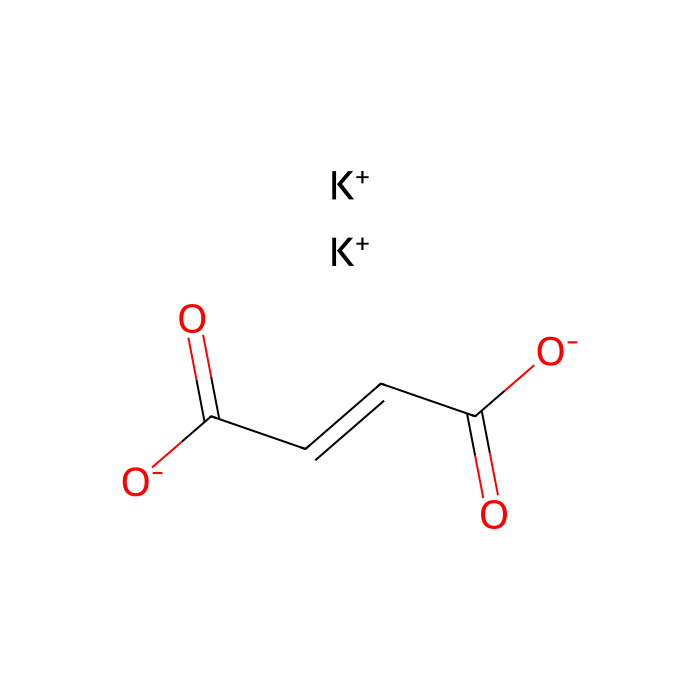
The conjugate base of fumaric acid is the fumarate anion, HOOC–CH=CH–COO− in its monoanion form and −OOC–CH=CH–COO− in its dianion form. The C=C is trans (E) across the 1,2-alkene.
Functional groups: two carboxylate groups; an sp2 C=C alkene; no stereocenters; planar backbone around the C=C.
Potassium counterion(s): monovalent K+ cations balance the charge of the fumarate mono- or dianion in the solid state; hydration/coordination can vary.
2D description (general):
A trans-alkene with a carboxylate at each vinylic carbon. In the dianion, both termini are deprotonated carboxylates. In salts, K+ ions are ion-paired to the carboxylate oxygens in an extended ionic lattice.
Identity notes:
Because the listing specifies potassium(1:x), the precise stoichiometry (e.g., KH-fumarate vs K2-fumarate or mixed basicity) is unspecified for this item. Consult the Certificate of Analysis for definitive structural identifiers.
Synthetic Utility
Functional group reactivity and roles (general, literature):
Source of the fumarate dianion (trans-butenedioate), enabling preparation of other fumarate salts via metathesis or ion exchange.
Precursor to fumaric acid: Acidify an aqueous solution of potassium fumarate with a mineral acid (e.g., HCl) to precipitate free fumaric acid (sparingly soluble), enabling subsequent transformations (esterification, cycloadditions).
Transformations of the fumarate motif:
Hydrogenation to succinate (aqueous Pd/C, Raney Ni, or bio-catalysts) for redox chemistry studies or as a step in C4 platform molecule synthesis.
Esterification (via free acid) to diesters (e.g., dimethyl/diethyl fumarate), which are versatile monomers and dienophiles.
Diels–Alder reactions of fumaric acid/diesters with dienes to install succinate frameworks stereoselectively (endo/exo control via temperature/solvent).
Michael additions to the α,β-unsaturated system under suitable activation (commonly as esters or mixed anhydrides; free salts are less electrophilic).
Salt effects: Potassium as counterion can influence crystallization behavior and ionic strength, which can be leveraged to drive precipitation or phase behavior in synthesis and purification.
Practical guidance:
For organic-phase chemistry, convert to the free acid or esterified derivatives to engage classic electrophilic reactivity.
For aqueous-phase redox or biocatalytic work, use the potassium salt directly; control pH between 6–8 to minimize acid/base stress on catalysts/enzymes unless a specific pH is required.
When preparing non-alkali fumarate salts (e.g., transition metals), conduct metathesis under nitrogen if the target metal salt is air- or CO2-sensitive.
Target Specificity
This product is a small-molecule salt and is not an antibody, protein, or nucleic acid reagent. Target specificity (epitope, isotype, species reactivity) is not applicable.
Antigen/epitope: Not applicable.
Clone/isotype: Not applicable.
Species reactivity: Not applicable.
For application-relevant information, see Reaction & Applications, Buffer Applications, and Synthetic Utility.
Wir verwenden Cookies, um die ordnungsgemäße Funktion der Website sicherzustellen und, soweit zulässig, Ihr Nutzererlebnis zu verbessern. Sie können Ihre Einstellungen jederzeit unter „Einstellungen“ verwalten. Weitere Informationen finden Sie in unserer Cookie-Richtlinie.
Dürfen wir Sie über Rabattaktionen informieren?
Später erinnern
Vielen Dank! Bitte überprüfen Sie Ihren E-Mail-Posteingang, um zu bestätigen.
Products are supplied to verified businesses, institutions, and qualified professionals for research and development use only. Not for use in humans, animals, diagnosis, or therapy.