Zertifikate (CoA, COO, BSE/TSE und Analyse-Diagramm)
C of A & Other Certificates(BSE/TSE, COO):
Analytical Chart:
Lösungsrechner
Molarity Calculator
Determine the necessary mass, volume, or concentration for preparing a solution.
Dilution Calculator
Determine the dilution needed to prepare a stock solution.
Reconstitution Calculator
Bewertungen
Kundenbewertungen
Application Protocols
Verified application data (from Product Data): Not provided.
General research-use protocol (tool compound handling; literature-informed, not product-specific):
Stock preparation: Dissolve funapide in anhydrous DMSO to 10–50 mM. Filter through 0.22 µm PTFE if needed. Aliquot and store at −80°C to avoid repeated freeze–thaw.
In vitro assays (e.g., patch-clamp or fluorescence-based voltage assays):
Dilute stock into external solution or assay buffer to the desired concentration range (for tool compounds typically spanning low-nM to low-µM). Maintain constant DMSO across all wells/conditions.
Include vehicle controls and known positive/negative controls for assay validation.
Equilibrate compounds with cells for a defined pre-incubation (e.g., 5–30 min) before recording; optimize for your system.
Data quality:
Confirm final compound concentration by preparing gravimetrically validated stocks and tracking dilutions.
Assess compound carryover/adsorption by including washout tests and plate-type controls.
Note: Adjust steps to your institutional SOPs; for any critical parameters (concentration, incubation time), validate empirically.
Biological Roles
Scope: Non-clinical, biochemical/physiological context only (literature). Not for human or veterinary use.
Literature overview:
Funapide is reported as a small-molecule modulator of voltage-gated sodium channels (NaV), used as a tool compound to interrogate sodium-channel–mediated excitability in excitable cells.
Such compounds help delineate roles of specific NaV isoforms (e.g., Nav1.x family) in action potential initiation, propagation, and neuronal signaling.
By selectively altering channel gating or conductance, researchers can map downstream effects on neurotransmission, synaptic plasticity, and pain-transduction pathways in cellular and tissue models.
Experimental utility:
Serves as a benchmark inhibitor/modulator in electrophysiology (patch clamp) and high-content screening to validate assay robustness and dynamic range.
Enables structure–activity relationship (SAR) comparisons when profiling novel NaV-targeting chemotypes.
Cautionary notes:
Confirm isoform selectivity and off-target profile under your assay conditions; sodium-channel pharmacology is sensitive to temperature, holding potential, and use-dependence.
Ensure the final DMSO percentage does not perturb membrane properties or channel function; include vehicle controls.
Item-specific biological data: Not specified for this item; refer to primary literature and the product CoA for any available characterization.
Buffer Applications
Not a buffer component: Funapide is not used to establish or maintain pH. Conventional buffering systems (HEPES, PBS, Tris, MOPS) should be selected based on your biological assay requirements.
Practical handling in buffers (general):
Prepare concentrated DMSO stock and dilute into the working buffer immediately before use. Target final DMSO ≤0.1–0.5% v/v unless your system tolerates more.
To mitigate precipitation in aqueous media, consider:
Slow addition of stock to vigorously stirred buffer.
Inclusion of 0.01–0.1% non-ionic surfactant (e.g., Tween-20, Pluronic F-68) if compatible.
pH optimization within biologically acceptable limits if ionizable groups are present.
Filter working solutions (0.22 µm) when compatible with the assay to remove particulates.
Item-specific buffer compatibility: Not specified for this item; validate empirically for your application.
Green Alternatives
Context: “Green alternatives” generally concerns solvents and reagents. Funapide is a bioactive small molecule tool compound rather than a process reagent; therefore substitution is usually not applicable.
If your goal is to reduce environmental impact in studies using funapide as a control compound:
Minimize DMSO usage by preparing higher-concentration stocks and using low final assay percentages (≤0.1% v/v when compatible with the biology).
Employ micro-scale assay formats (96/384/1536-well) to reduce compound and solvent consumption.
Use aqueous buffers with biodegradable surfactants where feasible and validate solubility.
Ensure proper waste segregation for halogenated vs non-halogenated streams; many drug-like organics should be collected as hazardous organic waste.
Substitution note: There is no “green substitute” for the bioactivity profile of funapide; if a mechanistic control is needed, consider alternative tool compounds with similar target profiles but validate potency, selectivity, and safety characteristics independently (literature-based decision).
Pharmaceutical Uses
Formulation role (general research context):
Funapide may be used as a reference standard/tool compound in preclinical research to evaluate sodium-channel modulation. It is not supplied for therapeutic or diagnostic use.
In formulation method development (non-clinical), typical approaches include solubilization in DMSO/PEG/ethanol co-solvent systems or cyclodextrin inclusion complexes for in vivo exploratory studies; ensure institutional approvals and follow animal welfare regulations when applicable.
Pharmacopeial status: Not specified for this item; no pharmacopeial monograph is indicated in the Product Data.
Excipient compatibility and stability data: Not specified for this item; assess experimentally.
Compliance note: For any GLP/GMP or regulated application, obtain and review full specifications, impurity profile, and stability data from the CoA/Spec Sheet; this catalog item is for research use only.
Physical Properties
Item-specific specifications: Not specified for this item; refer to CoA/Spec Sheet.
Typical properties for small-molecule ion-channel tool compounds (general/literature guidance; not item specifications):
Physical state: often isolated as a solid (free base or salt) with moderate lipophilicity.
Aqueous solubility: frequently low at neutral pH; DMSO stocks (10–50 mM) are commonly used for bioassays.
pKa/logP: sodium-channel blockers often exhibit basic centers (pKa ~7–10) and logP in the 2–5 range to access the channel pore; verify for funapide via literature before use.
Prepare concentrated DMSO stocks (e.g., 10 mM), then dilute into assay buffer immediately prior to use to minimize precipitation.
If form/solubility is uncertain, perform a small-scale solubility screen across DMSO, DMF, ethanol, and aqueous buffers at intended pH.
For analytical characterization, reversed-phase HPLC with gradients of water (0.1% formic acid) and acetonitrile is typically effective.
Quality and Grades
Grade/purity (from Product Data): Not specified for this item; refer to CoA/Spec Sheet.
Interpreting purity and quality for small-molecule tool compounds (general guidance):
High chemical purity (typically ≥95% by HPLC/LC-MS) and structural confirmation (NMR/MS) are recommended for quantitative biology.
Low residual solvents and well-defined counterion/salt form improve assay reproducibility; verify on the CoA.
For screening libraries, batch-to-batch identity is typically controlled by LC-MS and HPLC retention; confirm acceptance criteria on the Spec Sheet.
Stabilizers/additives: Not specified for this item; refer to CoA/Spec Sheet.
UV/fluorescence background: If using in optical assays, confirm absorbance/fluorescence background of the lot to avoid assay interference.
Reaction and Applications
Applicability as a reagent: Funapide is not typically used as a synthetic reagent or solvent. It is primarily a bioactive reference compound in ion-channel research.
Research applications (general/literature):
Employed as a chemical probe to modulate voltage-gated sodium channels in cellular or electrophysiological systems to dissect channel function and signaling pathways.
Useful as a positive control in screening campaigns targeting NaV isoforms; enables benchmarking of assay performance (potency windows, signal-to-background).
Practical considerations:
Prepare concentrated DMSO stocks (e.g., 10 mM) and aliquot to minimize freeze–thaw.
Verify compound identity/purity in the working batch (LC-MS/HPLC) for quantitative pharmacology.
For chemical synthesis use-cases: Not typically applicable; choose appropriate reagents listed under Synthetic Utility if you require building blocks or catalysts.
Reaction Conditions
Not applicable as a reagent: Funapide is not typically employed as a reagent, catalyst, or solvent in synthetic transformations; therefore no standard reaction conditions apply.
Analytical preparation (general best practices):
Stock solution: Dissolve accurately weighed compound in anhydrous DMSO to a convenient concentration (e.g., 10 mM); vortex and sonicate if needed.
Working solutions: Dilute into assay buffer or mobile phase immediately prior to use to mitigate precipitation.
Stability checks: Conduct short-term stability in vehicle (room temperature/4°C) and long-term in frozen aliquots; analyze by LC-MS/HPLC.
If your workflow requires chemical transformation of the molecule, first obtain structural details (CoA/Spec Sheet) and consult literature for any reported functional group compatibility; no item-specific reactivity data are provided.
Safety and Handling
Hazard classification (from Product Data):
Signal word: Not specified for this item; refer to SDS.
H-statements: Not specified for this item; refer to SDS.
GHS classification and pictograms: Not specified for this item; refer to SDS.
General laboratory safety guidance (professional best practice; defer to SDS for authoritative details):
Handle in a chemical fume hood while wearing appropriate PPE: lab coat, safety glasses, and suitable gloves (e.g., nitrile). Avoid inhalation of dust or aerosols.
Prevent skin/eye contact; wash thoroughly after handling. Avoid ingestion and environmental release.
Incompatibilities: strong oxidizers and strong acids/bases may degrade typical drug-like organics; segregate accordingly.
First aid (overview; consult SDS): in case of skin/eye contact, rinse with water for at least 15 minutes and seek medical attention if irritation persists. If inhaled, move to fresh air; if ingested, seek medical advice.
Spill response: absorb small spills with inert material, collect for disposal; ventilate area. Dispose in accordance with institutional and local regulations.
Research use only: Not for human or veterinary use. Always consult the Aladdin SDS specific to this SKU prior to work.
Solvent Selection
Intended use: Funapide is a bioactive small molecule supplied for research. Solvent selection focuses on preparing analytical standards and assay stocks rather than serving as a reaction solvent.
Item-specific solubility: Not specified for this item; refer to CoA/Spec Sheet.
Practical selection (general/literature for drug-like solids):
Primary stock solvent: DMSO is typically preferred due to high solvating power for lipophilic molecules and compatibility with biological assays at ≤0.1–1% v/v.
Co-solvents for method development: DMF, acetonitrile, methanol, or ethanol can aid dissolution; subsequent dilution into aqueous buffers should be slow to minimize precipitation.
Buffers: PBS or HBSS with 0.1–1% DMSO and 0.01–0.1% non-ionic surfactant (e.g., Tween-20 or Pluronic F-68) may help maintain solubility for in vitro work.
Analytical compatibility: Reversed-phase LC using water (0.1% FA) and acetonitrile/methanol is generally effective; confirm with test injections.
Comparison (general):
DMSO vs DMF: DMSO is more biocompatible for cellular assays; DMF is useful for dissolution but less favored in biology.
Aqueous-only: Often insufficient for hydrophobic drug-like molecules; use co-solvents or pH adjustment when chemically appropriate.
Storage and Reconstitution
Storage (from Product Data):
Store at −80°C.
Shipped with dry ice packs + cold packs to maintain low temperature during transit.
Stability notes (general best practices for small-molecule solids/films; verify on CoA for this item):
Keep container tightly closed under dry, inert conditions. Protect from light and moisture to prevent degradation.
For long-term storage, consider desiccation and headspace purging with inert gas (N2/Ar) if compatible with container system.
Reconstitution (general guidance):
Bring vial to room temperature in a desiccator before opening to avoid water condensation.
Prepare a concentrated stock in anhydrous DMSO (e.g., 10–50 mM). Mix thoroughly; gentle warming (≤40°C) and brief sonication can aid dissolution if permitted by stability.
Aliquot stock into low-bind tubes; store at −80°C. Avoid repeated freeze–thaw cycles; thaw on ice and use promptly.
Inspect solutions for precipitation or discoloration before use; discard if instability is observed.
Item-specific solubility and stability limits: Not specified for this item; refer to CoA/Spec Sheet.
Structure and Identity
Item-specific identifiers (from Product Data):
SKU: F656164
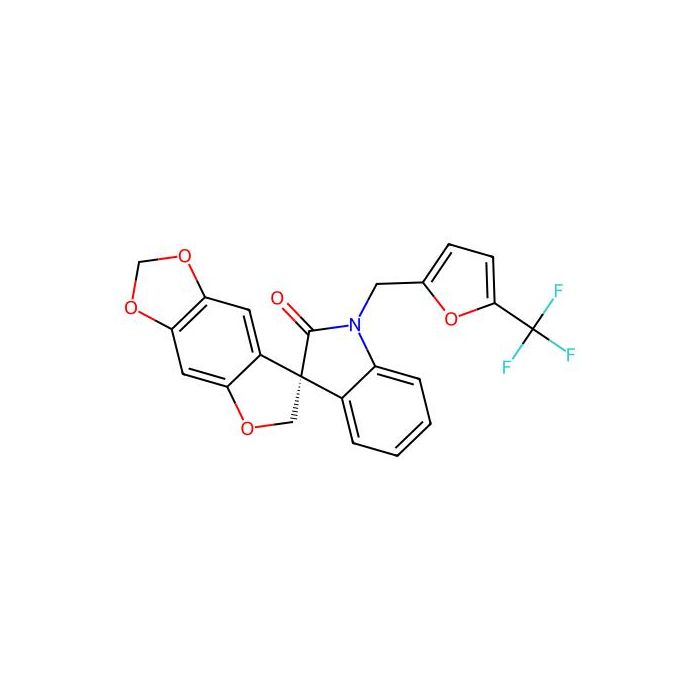
Product name: Funapide
CAS: 1259933-16-8
PubChem CID: 49836093
InChIKey: Not specified for this item; refer to CoA/Spec Sheet.
SMILES: Not specified for this item; refer to CoA/Spec Sheet.
Molecular formula: Not specified for this item; refer to CoA/Spec Sheet.
Molecular weight: Not specified for this item; refer to CoA/Spec Sheet.
Structural description (general/literature):
Funapide (also known in literature as a small-molecule voltage-gated sodium channel modulator) is reported as a drug-like, heteroatom-containing aromatic compound typical of ion-channel tool compounds.
2D structural features (literature, qualitative): aromatic ring system(s), amide/urea/tertiary amine-like functionality often present in NaV modulators; overall lipophilic scaffold with polar heteroatoms to engage channel vestibule residues.
Notes:
Where exact structural line notations (SMILES/InChI) or elemental formula are required for regulatory or analytical work, consult the product CoA/Specification Sheet or authoritative databases using the CAS or CID given above.
Synthetic Utility
Not a building block: Funapide is a finished bioactive small molecule and is not typically used as a synthetic intermediate or reagent.
If synthetic modification is of interest (general guidance):
Derivatization of drug-like scaffolds for SAR can involve amide/urea transformations, heteroaryl substitutions, or side-chain modifications, but specific reactive handles for funapide are not provided in the Product Data.
Prior to any derivatization campaign, determine the exact structure (SMILES/InChI) and identify strategic vectors that retain NaV engagement while tuning ADME or selectivity.
For preparative chemistry needs: Select dedicated reagents, catalysts, and building blocks from our catalog appropriate to your target synthesis; funapide itself is not recommended as a synthon.
Target Specificity
Item-specific target data (from Product Data): Not provided.
Policy note: This section reports only product-specific, catalog-verified target attributes (e.g., isoform selectivity, Ki/IC50). As none are supplied in the Product Data, please consult the product CoA/Spec Sheet and primary literature for detailed target profiling under defined assay conditions.
Wir verwenden Cookies, um die ordnungsgemäße Funktion der Website sicherzustellen und, soweit zulässig, Ihr Nutzererlebnis zu verbessern. Sie können Ihre Einstellungen jederzeit unter „Einstellungen“ verwalten. Weitere Informationen finden Sie in unserer Cookie-Richtlinie.
Dürfen wir Sie über Rabattaktionen informieren?
Später erinnern
Vielen Dank! Bitte überprüfen Sie Ihren E-Mail-Posteingang, um zu bestätigen.
Products are supplied to verified businesses, institutions, and qualified professionals for research and development use only. Not for use in humans, animals, diagnosis, or therapy.