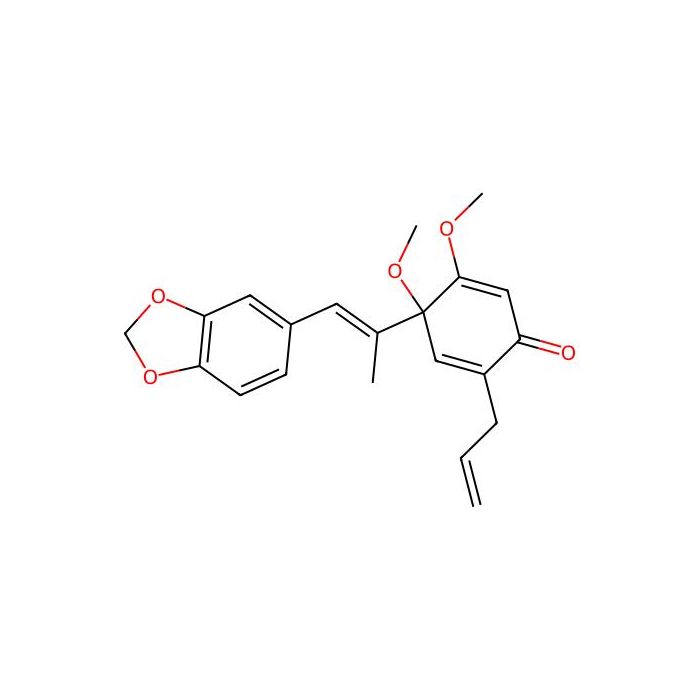
This compound belongs to the class of organic compounds known as bicyclic monoterpenoids. These are monoterpenoids containing exactly 2 rings, which are fused to each other.
External Descriptors
Neolignans
1. Djoumbou Feunang Y, Eisner R, Knox C, Chepelev L, Hastings J, Owen G, Fahy E, Steinbeck C, Subramanian S, Bolton E, Greiner R, and Wishart DS. ClassyFire: Automated Chemical Classification With A Comprehensive, Computable Taxonomy. Journal of Cheminformatics, 2016, 8:61.
Zertifikate (CoA, COO, BSE/TSE und Analyse-Diagramm)
C of A & Other Certificates(BSE/TSE, COO):
Analytical Chart:
Chemische und physikalische Eigenschaften
Molekulargewicht
354.400 g/mol
XLogP3
3.900
Hydrogen Bond Donor Count
0
Hydrogen Bond Acceptor Count
5
Rotatable Bond Count
6
Exact Mass
354.147 Da
Monoisotopic Mass
354.147 Da
Topological Polar Surface Area
54.000 Ų
Heavy Atom Count
26
Formal Charge
0
Complexity
659.000
Isotope Atom Count
0
Defined Atom Stereocenter Count
0
Undefined Atom Stereocenter Count
1
Defined Bond Stereocenter Count
1
Undefined Bond Stereocenter Count
0
The total count of all stereochemical bonds
1
Covalently-Bonded Unit Count
1
Lösungsrechner
Molarity Calculator
Determine the necessary mass, volume, or concentration for preparing a solution.
Dilution Calculator
Determine the dilution needed to prepare a stock solution.
Reconstitution Calculator
Bewertungen
Kundenbewertungen
Application Protocols
No vendor-tested protocols are provided for this item. For general laboratory use, consider the following adaptable procedures:
Stock solution preparation (general):
Weigh an appropriate amount quickly to minimize ambient exposure if the compound is moisture/light sensitive (verify via CoA/SDS).
Dissolve in a suitable solvent (e.g., DMSO, ethanol, acetonitrile) to prepare a concentrated stock. Filter through 0.22 µm PTFE/nylon if particulate is present.
Record exact concentration gravimetrically or by quantitative NMR if a primary standard is required.
Analytical QC:
Run RP-HPLC with a standard scouting gradient (e.g., 5–95% ACN in water with 0.1% formic acid) and orthogonal normal-phase TLC/flash to assess purity.
Confirm identity by 1H/13C NMR and HRMS against literature for CAS 28178-92-9.
Stability checks:
Store aliquots at the recommended temperature and sample periodically to assess degradation by LC–MS.
Adjust and validate these steps according to your lab’s SOPs and the compound’s confirmed characteristics.
Biological Roles
Item-specific biological roles, pathways, or targets for Futoquinol are not provided in this listing.
Guidance for researchers (general)
If Futoquinol is to be used as a biochemical probe or reference, review primary literature associated with CAS 28178-92-9 (and PubChem CID 5281817) for reported interactions, enzyme modulation, or pathway relevance.
Establish baseline physicochemical properties (solubility, stability in buffer, light/air sensitivity) before biological testing to prevent assay artifacts.
For cellular work, pre-validate:
Cytotoxicity range in your cell model
Carrier solvent tolerance (e.g., final DMSO ≤0.1–0.5%)
Adsorption losses to plastics/glass
No clinical or therapeutic claims are made. This product is supplied strictly for research use only.
Buffer Applications
Futoquinol is not presented as a buffering reagent, and no acid–base parameters or pKa values are provided.
If dissolution into aqueous buffers is required (general guidance):
Prepare a concentrated stock in a water-miscible solvent (e.g., DMSO or ethanol) and dilute into buffer with vigorous mixing to the desired final concentration while keeping the cosolvent fraction low (typically ≤0.1–1% v/v, as your assay permits).
Evaluate stability across pH 5–8 and in the presence of common buffer components (PBS, HEPES, Tris) by LC–MS to detect hydrolysis, oxidation, or precipitation.
Use surfactants (e.g., 0.01–0.05% Tween-20) only if compatible with your assay and after verifying no interaction with the analyte of interest.
Green Alternatives
When planning workups, purifications, or stock solutions involving Futoquinol, consider greener solvent choices. The compound-specific constraints are unknown for this item; therefore select alternatives that maintain performance while reducing hazard and environmental impact.
Greener solvent substitutions (general guidance)
Replace chlorinated solvents where possible:
DCM/CHCl3 → ethyl acetate, MTBE, cyclopentyl methyl ether (CPME), or toluene depending on polarity needs
Replace petroleum ether/hexanes in normal-phase:
Hexanes → heptane or cyclohexane; for tunable elution strength, blend with EtOAc
Replace THF in reactions/extractions:
THF → 2-MeTHF (bio-based, less peroxide-prone) when compatible
Aqueous workups
Favor brine-free or low-salt separations; consider in situ solvent swap to greener media for crystallization
Comparison snapshot (general)
2-MeTHF vs THF: better sustainability and hydrophobicity; may change solubility/selectivity
EtOAc vs DCM: lower toxicity and waste burden; higher boiling point may impact concentration times
Always validate substitutions experimentally with the compound in question to ensure yield, purity, and stability are not compromised.
Pharmaceutical Uses
No pharmacopeial status, excipient function, or formulation role is provided for this item.
General considerations for formulation scientists (non-clinical, research only)
If used as a small-molecule research tool or process intermediate, confirm impurity profile and residual solvents per internal specifications before use in development studies.
For preformulation screening, evaluate:
Solubility in biorelevant media (FaSSIF/FeSSIF, pH 1–7.5 buffers)
Solid-state form (XRPD/DSC) and hygroscopicity
Chemical stability (oxidative, photolytic, hydrolytic)
No therapeutic claims are made for this product. It is supplied strictly for research and laboratory use.
Physical Properties
The following item-specific physical constants are not provided in the Product Data:
Melting point: Not specified for this item; refer to CoA/Spec Sheet.
Boiling point: Not specified for this item; refer to CoA/Spec Sheet.
Density: Not specified for this item; refer to CoA/Spec Sheet.
Refractive index: Not specified for this item; refer to CoA/Spec Sheet.
pKa/logP: Not specified for this item; refer to CoA/Spec Sheet.
UV–Vis characteristics (cutoff/λmax): Not specified for this item; refer to CoA/Spec Sheet.
Solubility profile: Not specified for this item; refer to CoA/Spec Sheet.
Practical guidance (general, not item-specific)
If solubility is unknown, screen in a micro-scale panel: water, PBS (pH 7.4), methanol, ethanol, acetonitrile, acetone, isopropanol, DMSO, DMF, EtOAc, toluene, and hexanes. Start at 1–10 mg/mL.
For analytical method setup, determine a provisional extinction coefficient or analytical wavelength by scanning 200–400 nm in your intended solvent.
If the compound is non-volatile or thermally labile, use DSC/TGA for thermal behavior before drying or processing at elevated temperature.
Quality and Grades
Grade/Purity: Not specified for this item; refer to CoA/Spec Sheet.
Guidance on interpreting grade (general)
If labeled as Analytical Reagent (AR) or equivalent, expect impurities controlled for routine analytical use.
If labeled as ≥98–99% purity, confirm by supplier chromatographic assay (HPLC/GC) with supporting spectroscopic identity (NMR/HRMS).
If HPLC grade (for solvents/solubilizers), low UV absorbance and particulate levels are typically controlled; for solids, HPLC suitability would imply low non-volatile residue and defined UV background.
Stabilizers/inhibitors: Not specified for this item; refer to CoA/Spec Sheet. Presence of stabilizers may influence downstream reactions and analytical baselines.
Best practices
Verify batch-specific identity and purity via CoA before regulated or quantitative work.
Document acceptance criteria (assay, water content, residual solvents, heavy metals) as required by your workflow; item-specific limits are Not specified for this item; refer to CoA/Spec Sheet.
Reaction and Applications
Manufacturer application details are not provided for this listing. In the absence of structure-specific guidance, consider the following general research workflows:
As an analytical reference standard: verify purity by HPLC/GC and identity by NMR/HRMS, then use for calibration or system suitability (if applicable to your program).
As a synthetic building block or probe: consult literature for CAS 28178-92-9 to identify compatible transformations and protecting-group strategies before route selection.
In screening assays: prepare DMSO or appropriate organic stocks; establish solubility/aggregation thresholds (e.g., using nephelometry or DLS) to avoid assay artifacts.
Practical tips (general)
Conduct a small test reaction to confirm chemical compatibility with your chosen conditions. Monitor by TLC/LC–MS.
If unknown oxidation state or redox-active motifs are suspected, handle under inert atmosphere and minimize exposure to air/light until stability is established.
For purification, start with normal-phase flash or RP-HPLC scouting gradients; adjust based on UV response and polarity.
Please consult peer-reviewed literature keyed to CAS 28178-92-9 (and PubChem CID 5281817) for any named reactions or specific application niches of Futoquinol.
Reaction Conditions
Specific, validated reaction conditions for Futoquinol are not provided in this listing. The following general guidance supports method development once the structure and functional groups are confirmed:
Atmosphere: If oxidation sensitivity is unknown, default to inert gas (N2/Ar) during reactions and transfers.
Solvents: Choose based on solubility and stability; start with EtOAc, toluene, MeCN, MeOH/EtOH, DCM, THF/2-MeTHF, or DMSO/DMF for polar reactions. Validate greener choices where possible.
Temperature: Scout 0–80 °C. Use DSC/TGA to set safety limits before heating above 60 °C.
Bases/acids: Begin with mild reagents (Na2CO3, K2CO3, DIPEA; AcOH, TFA) and escalate only if required.
Catalysis: If cross-coupling is relevant (structure-dependent), test Pd(PPh3)4, Pd2(dba)3/XPhos, or Ni catalysts under standard conditions. For oxidations/reductions, start with TEMPO/Oxone or catalytic hydrogenation (Pd/C) under controlled conditions.
Workup: Favor liquid–liquid extraction with EtOAc or MTBE; monitor emulsions; use brine judiciously.
Yields/times: Establish by small-scale DoE; no item-specific yields are provided here.
All conditions must be validated experimentally for Futoquinol once its functional group landscape is verified.
Safety and Handling
GHS signal word, hazard statements, classification, and pictograms: Not specified for this item; refer to the SDS.
Research use: For research use only. Not for human or veterinary use.
General laboratory precautions (defer to SDS for authoritative guidance)
Handle in a fume hood with appropriate PPE: lab coat, safety glasses, and chemical-resistant gloves.
Avoid inhalation of dust/vapors and contact with skin/eyes. Prevent ingestion. Wash hands thoroughly after handling.
Incompatibilities and reactivity are structure-dependent. Until known, segregate from strong oxidizers, acids/bases, and reducing agents; avoid excessive heat and open flames.
If hygroscopic or air/light sensitive (verify in CoA/SDS), minimize exposure to ambient atmosphere, use amber glassware as needed, and purge storage vials with inert gas.
First-aid overview (summary; consult SDS)
Skin/eye contact: Rinse with plenty of water for at least 15 minutes; remove contaminated clothing; seek medical attention if irritation persists.
Inhalation: Move to fresh air; monitor breathing; seek medical attention if symptoms occur.
Ingestion: Rinse mouth; do not induce vomiting; seek medical attention.
Spill and disposal
For small spills, absorb with inert material and dispose of according to institutional and local regulations. Decontaminate surfaces appropriately. Dispose of unused material as chemical waste per SDS recommendations.
Solvent Selection
Item-specific solubility and polarity data are not provided. Use a pragmatic screening approach:
Begin at 1–10 mg/mL. Sonication and mild warming (≤40 °C) can assist dissolution if the compound is thermally stable (verify by DSC/TGA or literature).
For biological assays, DMSO stocks (10–100 mM) diluted into aqueous buffers are common when water solubility is limited; prefilter through 0.22 µm if needed.
For chromatography, match solvent to stationary phase: start with MeOH/H2O or ACN/H2O for RP-HPLC; hexanes/EtOAc or hexanes/DCM for normal-phase TLC/flash.
Comparison considerations (general)
Prefer lower-toxicity, higher-boiling, and recyclable solvents (e.g., 2-MeTHF vs THF, EtOAc vs DCM) when performance permits.
If the compound is base/acid sensitive, avoid strong basic (e.g., amines) or strongly acidic media during dissolution.
All solvent choices should be confirmed against the compound’s confirmed structure and stability profile.
Storage and Reconstitution
Storage conditions (item-specific): Store at −20 °C (as provided). Minimize freeze–thaw by aliquoting on first use.
Shipping (item-specific): Shipped in an ice chest with ice pads to maintain a low-temperature chain.
Appearance: Not specified for this item; refer to CoA/Spec Sheet.
General guidance
Protect from moisture and light until stability is established; consider amber vials and desiccation (P2O5/silica gel) as appropriate.
If the compound is air-sensitive, backfill vials with inert gas (N2/Ar) before freezing.
Reconstitution (when ready to use)
Solvent: Not specified for this item; refer to CoA/Spec Sheet. If unknown, begin with small-scale solubility screening in DMSO, ethanol, acetonitrile, or buffer-compatible cosolvents.
Procedure: Allow container to equilibrate to room temperature before opening to prevent condensation. Weigh quickly, dissolve with gentle mixing/sonication, and filter if necessary (0.22 µm).
Working solutions: Prepare fresh as needed. For longer-term storage of solutions, validate stability at the intended temperature (e.g., −20 °C or 4 °C) and protect from light.
Always consult the product’s SDS and batch CoA for definitive handling and storage instructions.
SMILES: Not specified for this item; refer to CoA/Spec Sheet.
Molecular formula: Not specified for this item; refer to CoA/Spec Sheet.
Molecular weight: Not specified for this item; refer to CoA/Spec Sheet.
Structural features
Item-specific structural features are not provided in this listing. If structure is required for method development or regulatory documentation, consult the Certificate of Analysis (CoA), Spec Sheet, or authoritative databases that index CAS 28178-92-9 (e.g., PubChem using CID 5281817) to obtain the canonical structure, stereochemistry, and functional groups.
2D structure description (general guidance)
Without a provided SMILES/InChI, a definitive 2D description cannot be given. For planning analytical characterization: use 1H/13C NMR, HRMS, and, if needed, IR/UV–Vis to confirm identity against literature spectra for CAS 28178-92-9.
Notes
Ensure any structure-dependent calculations (e.g., exact mass, logP) are derived from the confirmed structure you will use in your lab records. Always reconcile supplier documentation with literature identifiers before scale-up.
Synthetic Utility
Item-specific functional groups and reactivity are not supplied in the Product Data. For route design or derivatization involving Futoquinol:
Confirm structure unequivocally (NMR, HRMS) using a reliable reference for CAS 28178-92-9.
Map potential reactive handles (e.g., phenolic OH, carbonyls, halides, unsaturation) once identified, and plan orthogonal protection/deprotection steps accordingly.
Establish chemoselectivity via micro-scale scouts. If multiple functional groups are present, consider:
Selective acylation/alkylation conditions (if phenolic or alcoholic OH groups exist)
Redox manipulations under mild conditions to avoid over-oxidation/reduction
Cross-coupling feasibility if aryl/alkenyl halides or pseudohalides are present
Analytical control
Track reactions by LC–MS and orthogonal TLC/HPLC methods. Assign structures of intermediates before scale escalation.
Purification
Begin with silica flash or RP-HPLC depending on polarity. If the compound is air/light sensitive, conduct chromatography under inert atmosphere/amber lighting where feasible.
Target Specificity
This product is a small-molecule chemical reagent, not a biological macromolecule or antibody. No target specificity, antigen/epitope information, or species reactivity applies to this item.
Wir verwenden Cookies, um die ordnungsgemäße Funktion der Website sicherzustellen und, soweit zulässig, Ihr Nutzererlebnis zu verbessern. Sie können Ihre Einstellungen jederzeit unter „Einstellungen“ verwalten. Weitere Informationen finden Sie in unserer Cookie-Richtlinie.
Shall we send you a message when we have discounts available?
Remind me later
Thank you! Please check your email inbox to confirm.
Products are supplied to verified businesses, institutions, and qualified professionals for research and development use only. Not for use in humans, animals, diagnosis, or therapy.