QUALITÄT & REINHEITCarrier Free?Carrier-free — supplied without added carrier protein/stabilizer. Use when carriers (e.g. BSA) would interfere with conjugation or sensitive assays.ExactAb™?ExactAb™ — Aladdin's antibody line emphasizing precision and validated quality. Use for reliable, specificity-validated antibody applications.Azide Free?Azide-free — without sodium azide preservative. Use in conjugations, cell work, or assays where azide is toxic or inhibitory.Validated?Validated grade — performance confirmed in defined applications before release. Use when you want documented assurance the reagent works as stated.High Performance?High-performance grade with optimized purity and performance characteristics. Use for sensitive analyses where ordinary grades fall short.See COA
Carrier Free, ExactAb™, Azide Free, Validated, High Performance, See COA Azide Free,Carrier Free,ExactAb™,High Performance,Validated für empfindliche chromatographische und analytische Workflows, die minimale Basislinieninterferenzen erfordern.
🌡
Lagerung & Versand
Store at -20°C,Avoid repeated freezing and thawing Versand Ice chest + Ice pads. Genaue Spezifikationen finden Sie im chargenspezifischen COA.
📋
Qualitätsdokumente
SDS, COA, Datenblatt und Spezifikationsblatt stehen zum Download bereit. Chargenspezifische COA über Chargennummernsuche abrufbar.
📚
Literaturbeleg
In 0 peer-reviewten Publikationen zu Chromatographie, organischer Synthese und Kreuzkupplungsreaktionen zitiert.
Übersicht
Rabbit anti Human Galectin 1 Antibody, Polyclonal, could be used for WB, IHC and so on. Application WB: 0.01-2 µg/mL IHC: 5-20 µg/mL Protein Function May regulate apoptosis, cell proliferation and cell differentiation. Binds beta-galactoside and a wide array of complex carbohydrates. Inhibits CD45 protein phosphatase activity and therefore the dephosphorylation of Lyn kinase.
Spezifikationen
Product Name
Galectin 1 Antibody - Primärer Antikörper, specific to Galectin 1, Rabbit IgG
Synonyme
14 kDa laminin-binding protein antibody | 14 kDa lectin antibody | Beta galactoside binding lectin antibody | Beta galactoside binding lectin L 14 I antibody | beta galactoside binding protein antibody | Beta-galactoside-binding lectin L-14-I antibody | D
Spezifikationen & Reinheit
Carrier Free, ExactAb™, Azide Free, Validated, High Performance, See COA
Wirtsspezies
Kaninchen
Spezifität
Galectin 1
Immunogen
Recombinant Galectin 1 expressed in E.coli (AA 1-135)
Positive Kontrolle
WB: K562, A549, HUVEC, NIH/3T3 and C6 cell lysates. IHC: Human rectum and renal cancer tissues, Rat testis, colon and lung tissues, Porcine colon, uterus, small intestine, cardiac muscle and stomach tissues.
Konjugation
Unconjugated
Note
Azide Free, Carrier Free, ExactAb™, High Performance, Validated
Isotyp
Rabbit IgG
SDS-PAGE
150 kDa
Verfahren zur Reinigung
Antigen affinity purified and Protein A purified
Konzentration
See COA
Product Line
Biologische Produkte
Lagerung und Versand
Form
Liquid
Storage
Store at -20°C,Avoid repeated freezing and thawing
Verschickt in
Ice chest + Ice pads
Stabilität und Lagerung
Store at 4℃ short term (1-2 weeks). Store at -20℃ long term (24 months). Upon receipt, it is recommended to aliquot. Avoid freeze/thaw cycle.
Bilder
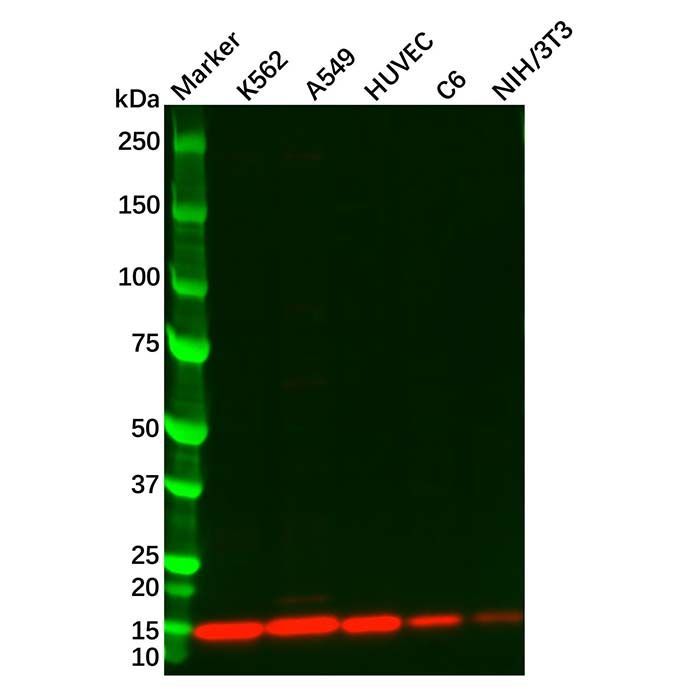
Galectin 1 Antibody (Ab104554) - Western Blot All lanes: Galectin 1 Antibody (Ab104554) at 1/1000 dilution Samples: Lysates at 20 µg per lane Secondary: Goat Anti-Rabbit IgG H&L (HRP) (Ab170144) at 1/20000 dilution
Predicted band size: 15 kDa Observed band size: 15 kDa Exposure time: 2.3 s
Galectin 1 Antibody (Ab104554) - IHC DAB staining on IHC Samples: Human Rectum Tissue Primary Ab: 20 µg/mL Galectin 1 Antibody (Ab104554) Second Ab: 2 µg/mL HRP-Linked Caprine Anti-Rabbit IgG Polyclonal Antibody.
Galectin 1 Antibody (Ab104554) - IHC DAB staining on IHC Samples: Human Renal cancer Tissue Primary Ab: 20 µg/mL Galectin 1 Antibody (Ab104554) Second Ab: 2 µg/mL HRP-Linked Caprine Anti-Rabbit IgG Polyclonal Antibody.
Galectin 1 Antibody (Ab104554) - IHC DAB staining on IHC Sample: Rat Testis Tissue Primary Ab: 10 µg/mL Galectin 1 Antibody (Ab104554) Second Ab: 2 µg/mL HRP-Linked Caprine Anti-Rabbit IgG Polyclonal Antibody.
Galectin 1 Antibody (Ab104554) - IHC DAB staining on IHC Sample: Rat Colon Tissue Primary Ab: 10 µg/mL Galectin 1 Antibody (Ab104554) Second Ab: 2 µg/mL HRP-Linked Caprine Anti-Rabbit IgG Polyclonal Antibody.
Galectin 1 Antibody (Ab104554) - IHC DAB staining on IHC Sample: Rat Lung Tissue Primary Ab: 10 µg/mL Galectin 1 Antibody (Ab104554) Second Ab: 2 µg/mL HRP-Linked Caprine Anti-Rabbit IgG Polyclonal Antibody.
Determine the necessary mass, volume, or concentration for preparing a solution.
Dilution Calculator
Determine the dilution needed to prepare a stock solution.
Reconstitution Calculator
Bewertungen
Kundenbewertungen
Application Protocols
No tested application protocols, recommended dilutions, or positive controls are provided in the product data for this SKU.
Applications: Not specified for this item; refer to CoA/Spec Sheet.
Suggested dilutions/conditions: Not specified for this item; refer to CoA/Spec Sheet.
Guidance: Establish application-specific conditions empirically using titration series and appropriate controls. Consult the literature for Galectin-1 detection best practices and align with your instrumentation and sample type.
Biological Roles
Galectin-1 (gene symbol LGALS1) is a prototype member of the galectin family of β-galactoside–binding lectins with a conserved carbohydrate recognition domain (CRD).
General biology (literature):
Carbohydrate interactions: Binds N-acetyllactosamine-containing glycans on glycoproteins and glycolipids; dimerization enhances avidity and lattice formation on cell surfaces.
Immune regulation: Modulates T cell homeostasis and activation, can promote apoptosis of activated T cells, and influences dendritic cell and macrophage phenotypes—shaping immune tolerance versus activation in a context-dependent manner.
Cell adhesion and migration: Interacts with extracellular matrix components (e.g., laminins), affecting angiogenesis, neurite outgrowth, and tumor cell motility.
Redox sensitivity: Cysteine residues confer redox-dependent switching between reductive (glycan-binding) and oxidized (non-binding) states, linking function to tissue oxidative status.
Intracellular roles: Beyond extracellular lectin activity, intracellular Galectin-1 participates in pre-mRNA splicing and modulates signaling complexes.
Research implications:
Expression and localization of Galectin-1 are often evaluated to understand immune microenvironments, tumor–stroma interactions, neurobiology, and vascular remodeling. An antibody targeting Galectin-1 enables detection, quantitation, and spatial mapping in these systems.
Note: Biological roles summarized here are general knowledge and do not imply any diagnostic or therapeutic use of this product. This SKU is for research use only.
Buffer Applications
This antibody is supplied Carrier Free and Azide Free, enabling flexible buffer design tailored to downstream methods.
General buffer recommendations (literature/practice; not item-specific specs):
Stock/working buffers: PBS (10 mM phosphate, 137 mM NaCl, 2.7 mM KCl), pH 7.2–7.6; or TBS (20–50 mM Tris, 150 mM NaCl), pH 7.4–8.0.
Stabilizers (optional): For storage aliquots, consider adding 5–10% glycerol or 100–300 mM trehalose; for very low working concentrations, 0.05–0.1% inert proteins (e.g., BSA) can reduce adsorption—but adding carriers forfeits the “carrier-free” advantage and may interfere with some assays.
Detergents: For IF/FC permeabilization, non-ionic detergents (e.g., 0.05–0.1% Triton X-100 or saponin) can be used if compatible with your protocol; avoid in ELISA coating or label-free kinetics unless validated.
pH/ionic strength: Maintain near-neutral pH. High salt (≥300 mM NaCl) can reduce nonspecific interactions but may weaken some antigen–antibody bindings; optimize empirically.
Practical tips:
Use low-protein-binding plastics and pre-wet tips to minimize loss.
Filter buffers (0.22 μm) and maintain sterility; no azide is present in this product.
For conjugation workflows (HRP, fluorophores, biotin), ensure buffer lacks primary amines (for NHS chemistry) and thiols (for maleimide chemistry).
Green Alternatives
Antibody reagents do not have direct “green solvent” alternatives; however, greener choices can be made in handling and formulation.
Considerations (general):
Azide Free: This product avoids sodium azide, a toxic preservative that poses aquatic hazards and plumbing incompatibilities. If preservation is needed, consider short-term refrigerated storage, sterile filtration, or biocompatible stabilizers (e.g., trehalose) rather than azide—subject to application compatibility.
Minimize plastic waste: Use reusable chilled racks, pool aliquoting sessions to reduce consumables, and select low-bind, recyclable plastics where validated.
Cold chain efficiency: Consolidate shipments and promptly transfer to storage to reduce dry ice/coolant consumption.
Energy-conscious storage: Where permissible, aliquot for -20°C storage as specified and avoid unnecessary ultra-cold storage.
Trade-offs:
Preservative-free and carrier-free formats are environmentally favorable but may increase risk of contamination or adsorption losses—mitigated by sterile technique and low-bind labware.
Small comparison (general):
Preservative: None (this item) vs. Sodium azide (common). Pros: live-cell/enzyme compatibility, fewer hazards. Cons: requires stricter asepsis and aliquoting to maintain stability.
Pharmaceutical Uses
This product is labeled For research use only and is not intended for diagnostic or therapeutic applications.
Contextual, non-clinical uses (general):
Bioprocess analytics: Antibodies against Galectin-1 can support process development studies, such as host-cell response profiling or glycosylation-related pathway monitoring in cell culture research.
Assay development: Building blocks for laboratory ELISAs, immunocapture LC–MS sample prep, or surface-based biosensors to quantify Galectin-1 in research matrices.
Reference reagents: Internal controls for method qualification in preclinical research labs (e.g., selectivity and specificity assessments), without implying any regulatory status.
Regulatory/status notes:
No pharmacopeial monograph or cGMP manufacturing claims are provided for this item. Any use in regulated workflows requires independent qualification and risk assessment by the user.
Physical Properties
As an antibody reagent, conventional small-molecule physical constants are not applicable. Item-specific values are not provided in the product data.
Item-specific data:
Appearance: Not specified for this item; refer to CoA/Spec Sheet.
Concentration: Not specified for this item; refer to CoA/Spec Sheet.
Formulation/excipients: Grade indicates Carrier Free and Azide Free; exact buffer composition is not specified for this item; refer to CoA/Spec Sheet.
pH, osmolality, protein content: Not specified for this item; refer to CoA/Spec Sheet.
General (literature/practice; not specific to this SKU):
Antibodies are globular proteins typically soluble in PBS or TBS over physiological pH ranges (≈6.8–8.0), with stability impacted by ionic strength, pH, and excipients (e.g., sugars, amino acids, and inert carrier proteins).
Typical storage solutions may include stabilizers (e.g., trehalose, glycerol) to mitigate freeze–thaw damage; this product is labeled Carrier Free and Azide Free, so addition of carriers/preservatives is at the user’s discretion if compatible with the intended application.
Viscosity and refractive index follow aqueous buffer properties; no meaningful BP/MP apply.
Practical notes:
Avoid surfactants or high salt when downstream assays are sensitive (e.g., SPR, ITC). If low nonspecific binding is required, minimal protein additives are preferred—balanced against adsorption losses when working at very low antibody concentrations.
Quality and Grades
This SKU is supplied with the following grade attributes: Carrier Free, ExactAb™, Azide Free, Validated, High Performance.
What these mean (general definitions; not item-specific specifications):
Carrier Free: Formulated without protein carriers (e.g., BSA). Advantages: enables accurate mass-normalized assays, compatible with conjugation/labeling, avoids carrier-derived background. Tradeoff: increased risk of adsorption to plastics at low concentrations; use low-bind consumables.
Azide Free: No sodium azide preservative—important for live-cell, enzymatic, or conjugation workflows where azide is inhibitory or hazardous. Consider sterile technique or alternate preservatives if needed for long-term storage.
ExactAb™: Brand/line designation indicating controlled manufacturing and format consistency. Consult the CoA for exact construct (host, isotype, clonality, and lot-specific purity).
Validated: Performance has been internally verified. Because application- and species-specific validations are not listed here, users should consult the CoA/Spec Sheet or perform in-house qualification under their conditions.
High Performance: Indicates robust lot-to-lot quality goals (e.g., purity, low aggregates), but exact numerical metrics are not specified for this item; refer to CoA/Spec Sheet.
Quality control recommendations (user side):
Verify integrity by SDS-PAGE and, if available, SEC-HPLC for aggregation.
Confirm specificity in your matrix using positive/negative controls and, if feasible, antigen competition.
Reaction and Applications
As an immunoreagent, the Galectin 1 Antibody is used in affinity-based detection/capture rather than in chemical synthesis.
Typical research applications (general guidance; not specific validations for this SKU):
Western blot (WB): Detection of Galectin-1 in cell/tissue lysates. Optimize blocking (carrier-free format eases interpretation), primary incubation conditions, and secondary selection to minimize background.
Immunohistochemistry (IHC) / Immunofluorescence (IF): Spatial localization of Galectin-1 in fixed tissues/cells. Antigen retrieval and fixation chemistry (PFA vs. methanol) can strongly influence epitope accessibility.
Flow cytometry (FC): If the target epitope is extracellular or if permeabilization is used. Titrate carefully and include Fc-block where appropriate.
ELISA / ECL / MSD: Plate-based quantitation of Galectin-1 in biological samples; carrier-free format is beneficial for custom conjugation or label-free detection modalities.
Immunoprecipitation (IP)/Co-IP: Enrichment of Galectin-1 and interacting partners to support proteomic analyses.
Experimental tips (general):
Use low-protein-binding tubes/tips to mitigate loss from adsorption (especially with carrier-free antibodies).
Validate specificity with positive controls (Galectin-1 overexpression or recombinant protein) and negative controls (knockdown/knockout).
For cross-species work, confirm species reactivity on the CoA; not specified in this listing.
Reaction Conditions
Classical chemical reaction conditions do not apply. For immunoassay and affinity applications, consider the following general, literature-based conditions (not item-specific and to be optimized by the user):
Western blot: Transfer to PVDF/nitrocellulose, block with 3–5% BSA or non-fat milk (carrier presence may influence background), primary incubation 1–16 h at 4–25°C in PBS/TBS + 0.05% Tween-20, followed by species-matched secondary.
IHC/IF: Optimize fixation (4% PFA vs. cold methanol), antigen retrieval (citrate pH 6.0 or Tris-EDTA pH 9.0), and permeabilization (0–0.3% Triton X-100 or saponin). Incubate primary at 4°C overnight for maximal signal-to-noise.
ELISA: Coat plates with capture reagent (antigen or antibody) in carbonate buffer pH 9.6 or PBS, block, incubate with sample, then detect with labeled secondary. Maintain detergent at ≤0.05% in wash buffers.
Flow cytometry: Stain in PBS + 1–2% serum/albumin on ice or at 4°C; include Fc block as needed. Permeabilize if targeting intracellular pools.
Note: Exact dilutions, incubation times, and temperatures for this SKU are not specified in the product data; users should perform titration and control experiments to establish optimal conditions.
Safety and Handling
Safety information specific to this item is not provided in the product data. Always review the SDS before use.
Item-specific hazard data:
GHS classification: Not specified for this item; refer to SDS.
Signal word / H-statements / pictograms: Not specified for this item; refer to SDS.
General guidance for protein antibodies (literature/practice):
Handle as a biological protein reagent. While not infectious, avoid ingestion, inhalation of aerosols, or contact with eyes/skin.
Personal protective equipment: lab coat, nitrile gloves, safety glasses. Work in a clean area using low-protein-binding plastics to reduce adsorption losses.
If azide were present, special care with copper plumbing would be warranted; this item is labeled Azide Free.
First aid (general): In case of eye/skin contact, flush with water. If inhaled, move to fresh air. If ingested, rinse mouth. Seek medical attention if symptoms occur. Defer to SDS for authoritative instructions.
Incompatibilities (general): Extreme pH (<5 or >9), strong oxidants, repeated freeze–thaw cycles, and elevated temperatures can denature antibodies.
Spill response: Wipe with compatible absorbent, then clean with water/detergent. Dispose of according to institutional biosafety/chemical waste procedures.
Storage and transport:
Store at -20°C; avoid repeated freeze–thaw (per product data). Shipped on cold packs (ice chest + ice pads). Maintain cold chain upon receipt.
Solvent Selection
This product is an aqueous protein reagent; organic solvent selection is not typically applicable.
Working medium: Antibodies are generally handled in aqueous buffers (e.g., PBS, TBS). Organic co-solvents can denature proteins and are not recommended unless part of a validated protocol (e.g., low percentages for permeabilization).
For practical considerations on buffer choice, see the Buffer Applications section.
Storage and Reconstitution
Item-specific instructions (from Product Data):
Storage conditions: Store at -20°C.
Handling caution: Avoid repeated freezing and thawing.
Shipping: Shipped in an ice chest with ice pads. Maintain cold chain upon receipt.
Additional general guidance (literature/practice; not item-specific specifications):
Upon first use, consider aliquoting into low-bind tubes to minimize freeze–thaw cycles and adsorption losses.
If lyophilized or received at high concentration, reconstitute/dilute with sterile, neutral pH buffer (e.g., PBS, pH ~7.4). If conjugation or enzyme-sensitive work is planned, ensure buffer lacks interfering components (amines/thiols) as needed.
For short-term storage (days to weeks), 2–8°C can be acceptable if sterility is maintained. For longer-term storage, keep at -20°C per product data; adding cryoprotectants (e.g., glycerol, trehalose) is a common practice if compatible with your application.
Do not vortex vigorously; gently invert or pipette to mix. Centrifuge briefly to collect contents before opening.
Note: Exact formulation, concentration, and reconstitution volume for this SKU are not specified in the product data. Refer to the CoA/Spec Sheet when available and validate stability under your specific use conditions.
Structure and Identity
Galectin 1 Antibody is a protein reagent (immunoglobulin) directed against the Galectin-1 antigen. Item-specific molecular identifiers for small molecules (SMILES, InChI) do not apply to antibodies.
Molecular formula: Not specified for this item; refer to CoA/Spec Sheet.
Molecular weight: Not specified for this item; refer to CoA/Spec Sheet. (Note: actual MW depends on isotype/glycosylation.)
SMILES: Not applicable to antibodies
InChI / InChIKey: Not applicable to antibodies
Structural features (general, literature):
Antibodies are composed of immunoglobulin domains arranged in two heavy and two light chains, stabilized by disulfide bonds and extensive β-sheet structure.
Typical antibodies present antigen-binding sites (paratopes) in the variable regions that recognize specific epitopes on the target antigen (here, Galectin-1).
If monoclonal, a single paratope targets a defined epitope; if polyclonal, a mixture of paratopes recognizes multiple epitopes. (Clonality for this item: Not specified.)
2D/organization (general description):
Y-shaped quaternary architecture with two Fab arms (antigen-binding) and one Fc region (effector/format-dependent). Exact format (species, isotype, Fc modifications) is not specified for this item.
Identity checks (practical):
Confirm identity by application-specific readouts (WB banding pattern, IHC staining of known-positive tissues, ELISA against recombinant Galectin-1), and by vendor-provided CoA/Spec Sheet once accessed.
Synthetic Utility
Not typically applicable. As an antibody reagent, this product is not used as a building block or reagent in chemical synthesis.
Where relevant in analytical chemistry (general):
Can serve as a biorecognition element in affinity separations or immunoaffinity extraction prior to analytical detection (e.g., LC–MS, proteomics).
Useful for surface functionalization of biosensors (SPR, BLI) to enable selective capture of Galectin-1.
For chemical synthesis guidance, refer instead to small-molecule or peptide reagents; for this product, see Reaction & Applications for immunoassay-related use cases.
Target Specificity
Information limited to what is provided in the product data for this SKU.
Antigen/Target: Galectin-1 (commonly known as LGALS1)
Clone: Not specified for this item; refer to CoA/Spec Sheet.
Host species / clonality (mono/polyclonal): Not specified for this item; refer to CoA/Spec Sheet.
Epitope/domain: Not specified for this item; refer to CoA/Spec Sheet.
Species reactivity (human/mouse/rat, etc.): Not specified for this item; refer to CoA/Spec Sheet.
Cross-reactivity: Not specified for this item; refer to CoA/Spec Sheet.
Conjugate/label: Not specified for this item; refer to CoA/Spec Sheet.
Recommendation: Confirm target specificity in your system using positive and negative biological controls and, when feasible, peptide/protein competition or orthogonal detection methods.
Häufig gestellte Fragen
What does ExactAb? mean?
ExactAb? indicates the product has been validated for use in rigorous antibody validation workflows. Validation may include positive/negative control samples, signal-to-noise testing, and protocol-specific QC. Lot-specific test data is published on the Certificate of Analysis where available.
What does Carrier Free mean?
Carrier Free indicates that the material has been processed and tested for specialty industrial processing. Specifications focus on the impurities that affect performance in that application — for example, metal content for electronics, particle size for batteries, refractive index for optics, or moisture content for moisture-sensitive processes.
How should this product be stored?
Store at ?20 °C. Avoid repeated freeze–thaw cycles. Aliquot into single-use volumes before freezing.
How is this product shipped?
This product ships in an insulated container with ice pads. Unpack on arrival and transfer it to the storage condition stated above.
What documentation is provided?
Available product documentation, including Certificates of Analysis (COA), Safety Data Sheets (SDS), and specification sheets, is shown in the product document area. Document availability and access follow the current site policy.
Which species reactivity has this antibody been validated against?
Validated reactivity is listed on the PDP and on each lot's datasheet. We validate against the most commonly tested species for the target (Galectin 1 Antibody); cross-reactivity in untested species may exist but is not guaranteed. Contact technical support for specific species inquiries.
Benötigen Sie Hilfe bei der Auswahl der Qualität?
Unser Leitfaden zur Qualitätsauswahl behandelt Reinheit, Stabilisatorstatus und Anwendungseignung für alle Varianten in unserem Katalog.
Wir verwenden Cookies, um die ordnungsgemäße Funktion der Website sicherzustellen und, soweit zulässig, Ihr Nutzererlebnis zu verbessern. Sie können Ihre Einstellungen jederzeit unter „Einstellungen“ verwalten. Weitere Informationen finden Sie in unserer Cookie-Richtlinie.
Dürfen wir Sie über Rabattaktionen informieren?
Später erinnern
Vielen Dank! Bitte überprüfen Sie Ihren E-Mail-Posteingang, um zu bestätigen.
Products are supplied to verified businesses, institutions, and qualified professionals for research and development use only. Not for use in humans, animals, diagnosis, or therapy.

 ZJ24F1011834