GDC-0152 - Moligand™, ≥98% , Antagonist of baculoviral IAP repeat containing 2;Antagonist of baculoviral IAP repeat containing 3;Antagonist of baculoviral IAP repeat containing 7;Antagonist of X-linked inhibitor of apoptosis, CAS No.873652-48-3, Antagonist of baculoviral IAP repeat containing 2;Antagonist of baculoviral IAP repeat containing 3;Antagonist of baculoviral IAP repeat containing 7;Antagonist of X-linked inhibitor of apoptosis
GDC-0152 - Moligand™, ≥98% , Antagonist of baculoviral IAP repeat containing 2;Antagonist of baculoviral IAP repeat containing 3;Antagonist of baculoviral IAP repeat containing 7;Antagonist of X-linked inhibitor of apoptosis, CAS No.873652-48-3, Antagonist of baculoviral IAP repeat containing 2;Antagonist of baculoviral IAP repeat containing 3;Antagonist of baculoviral IAP repeat containing 7;Antagonist of X-linked inhibitor of apoptosis
QUALITÄT & REINHEITMoligand™?Moligand™ — Aladdin's line of ligands and bioactive small molecules. Use for receptor, pathway, and binding studies needing defined small-molecule tools.≥98%
Dieses Produkt erfordert Kühlkettenversand. Grundversand und andere Economy-Optionen sind nicht verfügbar.
Note
Moligand™
Aktionsart
ANTAGONIST
Mechanismus der Wirkung
Antagonist of baculoviral IAP repeat containing 2;Antagonist of baculoviral IAP repeat containing 3;Antagonist of baculoviral IAP repeat containing 7;Antagonist of X-linked inhibitor of apoptosis
This compound belongs to the class of organic compounds known as oligopeptides. These are organic compounds containing a sequence of between three and ten alpha-amino acids joined by peptide bonds.
External Descriptors
Not available
1. Djoumbou Feunang Y, Eisner R, Knox C, Chepelev L, Hastings J, Owen G, Fahy E, Steinbeck C, Subramanian S, Bolton E, Greiner R, and Wishart DS. ClassyFire: Automated Chemical Classification With A Comprehensive, Computable Taxonomy. Journal of Cheminformatics, 2016, 8:61.
Determine the necessary mass, volume, or concentration for preparing a solution.
Dilution Calculator
Determine the dilution needed to prepare a stock solution.
Reconstitution Calculator
Bewertungen
Kundenbewertungen
Application Protocols
Only protocols provided in the product data can be listed.
Tested applications, recommended concentrations/dilutions, and positive controls: Not specified for this item; refer to CoA/Spec Sheet.
General suggestions (for planning only; not item-specific recommendations):
For biochemical binding studies, users often begin with DMSO stocks (e.g., 10 mM) and perform serial dilutions to cover nM–µM ranges appropriate to the target’s expected affinity. Validate assay solvent tolerance and include proper controls. These are generic planning considerations and not product instructions.
Biological Roles
Context from the scientific literature (not item-specific claims):
SMAC/DIABLO is a mitochondrial protein that, upon release into the cytosol, binds inhibitor-of-apoptosis proteins (IAPs) and relieves caspase inhibition, thereby promoting apoptotic signaling.
GDC-0152 is widely cited as a SMAC-mimetic small molecule that engages IAP BIR domains, functioning as an antagonist of XIAP and cellular IAPs in biochemical and cellular models (literature). This can facilitate downstream activation of caspase cascades in appropriately primed systems.
IAP modulation intersects with TNFα signaling and NF-κB pathway nodes; SMAC mimetics may promote degradation of cIAPs and alter ubiquitination-dependent signaling (literature). Such effects are highly context-dependent and model-specific.
Best practices for biological use (research only):
Validate target engagement with orthogonal assays (e.g., pull-downs with BIR domains, CETSA/thermal shift, or bioluminescence resonance energy transfer) to confirm on-target effects.
Titrate solvent controls and include counter-screens to rule out nonspecific cytotoxicity or redox/assay-interference artifacts.
Recognize that cellular responses depend on cell line, pathway priming, and co-stimulation; empirical optimization is necessary.
Important: No medical, diagnostic, or therapeutic use is intended or implied. This product is supplied exclusively for research use.
Buffer Applications
This compound is not a buffer component. However, buffer choice influences its performance in biochemical and cell-based assays.
Practical guidance (general, not item-specific):
Biochemical binding assays: Use HEPES or PBS-based buffers (pH 7.2–7.5) with 0.01–0.05% nonionic detergent (e.g., Tween-20) to reduce nonspecific adsorption; include 0.05–0.5% BSA if protein stickiness is observed.
Solvent tolerance: Validate DMSO tolerance of the assay (commonly ≤0.1–1.0% v/v). Maintain constant DMSO across wells.
Metal ions/reductants: Additives such as DTT/TCEP or divalent cations may affect target proteins; evaluate compatibility for BIR-domain constructs.
Filtration: 0.22 µm filtration of buffers can reduce particulate-induced noise in optical assays.
Not applicable:
This product does not function as a pH buffer and does not have a defined buffering range. No item-specific buffer formulations are provided in the current data.
Green Alternatives
This product is a discrete bioactive small molecule, not a commodity solvent or process reagent; therefore, “green alternative” comparisons are not typically applicable to the compound itself.
Greener handling considerations (workflow-level):
Solvent footprint: Favor DMSO at minimal final assay percentages (e.g., ≤0.1–0.5% v/v where compatible) to reduce organic solvent load in aqueous assays.
Aqueous delivery: Consider cyclodextrin inclusion complexes or PEG-400 co-solvent systems to reduce reliance on high DMSO fractions in in vivo–irrelevant models (for in vitro research only).
Miniaturization: Use low-volume, high-density screening formats (e.g., 384/1536-well) and acoustic dispensing to reduce solvent and compound mass consumption.
Comparison (workflow choices, not item-specific):
DMSO vs DMF/NMP
DMSO: Lower volatility/toxicity profile and broader assay acceptance; hygroscopic.
DMF/NMP: Strong solubilizers but with greater toxicological/ESG concerns; reserve for pre-dissolution if essential.
Waste management:
Segregate halogenated vs non-halogenated solvent waste per institutional policy.
Use on-demand aliquoting to minimize expired stocks and reduce chemical waste.
Pharmaceutical Uses
This product is provided strictly for research use and is not an excipient or approved pharmaceutical ingredient.
Context from literature (non-clinical, not item-specific claims):
GDC-0152 is described in the scientific literature as a SMAC-mimetic/IAP antagonist used as a chemical probe for pathway studies and as a reference scaffold in early discovery research.
Formulation considerations for research models (in vitro only):
Stock preparation: DMSO stocks are common; ensure the final DMSO content in biological assays remains within tolerated limits for the system under study.
Aqueous delivery aids: Co-solvents (e.g., PEG-400) or carrier proteins may improve dispersion in cell media; pre-screen for cell compatibility.
Regulatory note:
No pharmacopeial monograph or GMP manufacturing details are provided. The compound is not intended for human or veterinary use. Any in vivo work (e.g., in model organisms) requires institutional approvals and independent verification of quality suitable for the intended use.
Physical Properties
Item-specific measured properties
Appearance: Not specified for this item; refer to CoA/Spec Sheet.
Molecular weight: Not specified for this item; refer to CoA/Spec Sheet.
Molecular formula: Not specified for this item; refer to CoA/Spec Sheet.
Melting point: Not specified for this item; refer to CoA/Spec Sheet.
Boiling point: Not specified for this item; refer to CoA/Spec Sheet.
Density: Not specified for this item; refer to CoA/Spec Sheet.
LogP/logD: Not specified for this item; refer to CoA/Spec Sheet.
Aqueous solubility: Not specified for this item; refer to CoA/Spec Sheet.
UV/Vis: Not specified for this item; refer to CoA/Spec Sheet.
General handling insights (literature/practice, not specifications):
Small-molecule screening ligands of this class are commonly supplied as solids or as DMSO solutions; they are typically soluble at stock levels (e.g., 10–50 mM) in anhydrous DMSO and may require co-solvent or surfactant for aqueous dilution.
Many SMAC mimetics contain multiple polar functionalities alongside hydrophobic pharmacophores, often yielding modest intrinsic water solubility but good DMSO solubility (literature).
For spectroscopic tracking in binding assays, generic UV absorbance near 210–230 nm is often usable for small-molecule peptide-mimetics; specific extinction coefficients for this item are not available in the supplied data.
Important note: Do not treat the above as item specifications. Where exact numeric values are required for method validation or regulatory documentation, consult the product’s CoA/Spec Sheet and SDS.
Quality and Grades
Grade: Moligand™
What this generally signifies (program-level context; not an item-specific specification):
Moligand™ designates inclusion in a curated small-molecule/ligand collection for screening, chemical biology, or probe discovery. Materials are intended for research use only and typically prioritize identity confirmation and suitability for in vitro assay workflows.
Identity confirmation is commonly supported by orthogonal analytical techniques (e.g., LC–MS, 1H NMR) at the program level; however, exact methods and acceptance criteria for this specific item are Not specified for this item; refer to CoA/Spec Sheet.
How to use this grade effectively:
Apply standard compound management practices: maintain frozen master stocks, minimize freeze–thaw cycles, and prepare single-use aliquots for screening.
For bioassay use, confirm solubility and absence of interfering impurities under your specific assay conditions (e.g., check by LC–UV/MS in your buffer system).
What is specific to this item:
Purity, stabilizers, water/peroxide/metal limits, and UV cutoff are Not specified for this item; refer to CoA/Spec Sheet.
Documentation:
For batch-specific data (purity, analytical traces, residual solvents), consult the lot CoA. For hazard/handling guidance, consult the SDS.
Reaction and Applications
This product is supplied as a research ligand/chemical probe candidate rather than as a general-purpose synthetic reagent.
Not typically applicable:
It is not commonly used as a stoichiometric reagent, catalyst, or solvent in preparative organic synthesis. No named-reaction utility specific to this molecule is provided in the product data.
Relevant applications (research use, literature context):
Chemical biology and target engagement studies: Frequently used in the literature as a SMAC-mimetic tool compound to antagonize inhibitor-of-apoptosis proteins (IAPs), enabling pathway interrogation (e.g., caspase activation readouts) in cell-based assays.
Biophysical binding assays: Suitable for SPR, ITC, fluorescence polarization, or TR-FRET measurements against BIR-domain constructs (general for this chemotype; confirm purity/solubility for your setup).
Probe development: A reference chemotype for structure–activity relationship (SAR) exploration around IAP–SMAC binding motifs.
Practical tips:
Prepare concentrated DMSO stocks and confirm absence of aggregates (e.g., DLS or detergent controls), as aggregators can confound inhibition readouts.
Include solvent controls and, where possible, orthogonal readouts (e.g., biochemical binding plus cellular markers) to reduce assay artifacts.
Note: The above reflects general literature use of the GDC-0152 chemotype and should not be interpreted as item-specific performance claims.
Reaction Conditions
Not applicable as a synthetic reagent.
No item-specific reaction conditions (e.g., as a catalyst or substrate) are provided or typically relevant. This product is used as a finished small-molecule research ligand.
If derivatization is desired (general, user-driven R&D):
Any functionalization or tagging (e.g., biotinylation/fluorophore coupling) should be planned based on a verified structure and SAR knowledge to avoid disrupting IAP-binding pharmacophores. Conditions are highly case-dependent and beyond the scope of this listing.
Safety and Handling
Authoritative safety information must be obtained from the product SDS. The following is general guidance for research-use small molecules.
GHS and hazard details (item-specific):
Signal word: Not specified for this item; refer to SDS.
Hazard statements (H-Statements): Not specified for this item; refer to SDS.
GHS classification and pictograms: Not specified for this item; refer to SDS.
General laboratory precautions (good practice):
PPE: Wear lab coat, safety glasses, and appropriate chemically resistant gloves (e.g., nitrile). Use in a fume hood to avoid inhalation of dust or vapors from solvents (DMSO/DMF) used for dissolution.
Avoid skin contact with DMSO solutions; DMSO may enhance dermal absorption of dissolved substances.
Prevent aerosolization and dust formation. Handle solids gently; cap vials promptly.
Incompatibilities: As a generic organic small molecule, keep away from strong oxidizers and strong acids/bases unless process knowledge supports compatibility.
First-aid overview (consult SDS for details):
Inhalation: Move to fresh air; seek medical attention if symptoms persist.
Skin/eye contact: Rinse with water for ≥15 minutes; remove contaminated clothing; seek medical attention if irritation persists.
Ingestion: Rinse mouth; do not induce vomiting; obtain medical advice.
Spill and disposal:
Small spills: Absorb with inert material (e.g., vermiculite), collect in chemical waste.
Disposal: Dispose through licensed chemical waste according to institutional and local regulations.
Storage conditions (item-specific):
Store at −20°C. Keep container tightly closed, desiccated, and protected from light as a precaution unless otherwise stated on the label.
Solvent Selection
Purpose-fit solvent choices for small-molecule screening stocks and assay dilutions:
Primary stock solvent (common practice):
DMSO (anhydrous): Widely used due to broad solubilizing power and chemical compatibility with screening workflows. Filter-sterilize if needed (0.22 µm PTFE) and store at −20°C in aliquots to reduce freeze–thaw.
Secondary/auxiliary solvents (as needed):
DMF, NMP: Alternative polar aprotic solvents for pre-dissolution when DMSO solubility is limited (consider cytotoxicity in live-cell assays and limit final solvent %).
Co-solvents/surfactants for aqueous delivery: small % v/v DMSO, PEG-400, ethanol (≤1–2%), or non-ionic surfactants (e.g., 0.01–0.05% Tween-20) can aid dispersion; validate assay tolerance.
Aqueous media considerations:
Prepare intermediate DMSO stocks and serially dilute into assay buffer right before use to minimize precipitation.
Use carrier protein (e.g., 0.1% BSA) to mitigate adsorption to plastics for hydrophobic ligands.
Solvent compatibility tips (general):
Avoid prolonged exposure to strong bases/acids that may compromise peptidomimetic motifs (if present) or amide linkages (literature generality for SMAC mimetics).
Minimize water uptake in DMSO stocks (work quickly; cap tightly; use desiccant).
Selection rationale:
Start with DMSO due to predictable miscibility with aqueous buffers at low percentages and wide assay acceptance. Escalate to co-solvents only if precipitation or delivery issues persist.
Note: No item-specific solubility data are provided; verify solubility/compatibility under your exact assay conditions.
Storage and Reconstitution
Storage (item-specific):
Store at −20°C. Shipped in an ice chest with ice pads to maintain cold chain.
General best practices (not item-specific specifications):
Protect from light and moisture. Equilibrate to room temperature before opening to minimize condensation. Reseal promptly under dry atmosphere where possible.
Prepare single-use aliquots of DMSO stock to avoid repeated freeze–thaw. Store aliquots at −20°C (or below) in tightly sealed, chemically resistant vials.
Reconstitution guidance (planning considerations; not product instructions):
Solvent: Anhydrous DMSO is commonly used for small-molecule screening stocks. Confirm solubility empirically.
Working solutions: Dilute into assay buffers immediately before use. Maintain uniform final DMSO % across all samples and controls. If precipitation occurs, consider gentle warming (≤37°C), brief sonication, or addition of compatible co-solvent/surfactant; re-filter if assay permits.
Stability notes:
No item-specific stability data (e.g., in solution at ambient temperature, photostability) are provided. For critical studies, verify stability by LC–MS/LC–UV over the intended handling window.
Documentation:
For definitive instructions, including any special stabilizers or expiry dating, refer to the product label and CoA/Spec Sheet.
Structure and Identity
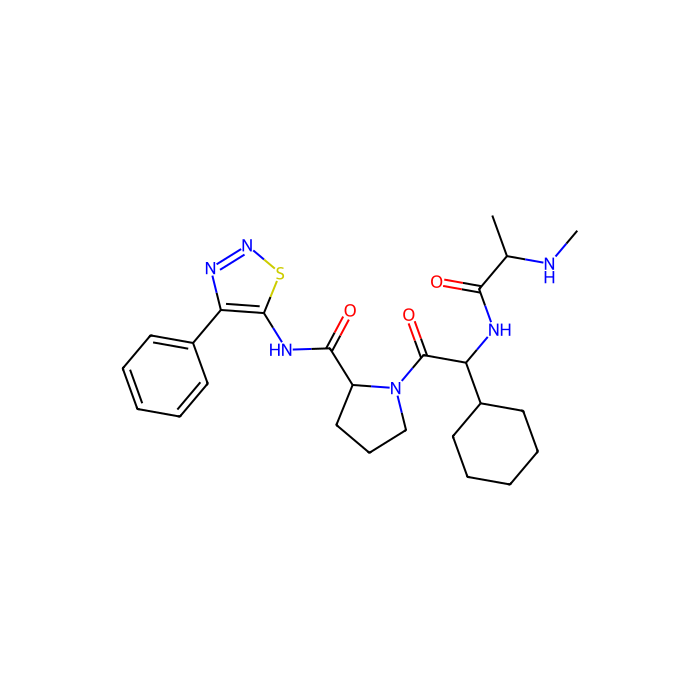
Brief overview: GDC-0152 is a research-use small molecule commonly categorized as a SMAC-mimetic/IAP antagonist in the chemical biology literature. Item-specific structural identifiers are partially provided below; consult the CoA/SDS for authoritative identifiers.
SKU: G129293
Product name: GDC-0152
CAS: 873652-48-3
PubChem CID: 46940575
InChIKey: 412261 (truncated in supplied data; full InChIKey not specified for this item; refer to CoA/Spec Sheet.)
SMILES: Not specified for this item; refer to CoA/Spec Sheet.
Molecular formula: Not specified for this item; refer to CoA/Spec Sheet.
Molecular weight: Not specified for this item; refer to CoA/Spec Sheet.
Structural features (general, literature context, not item-specific specifications):
GDC-0152 is widely referenced as a small-molecule peptidomimetic engineered to mimic the N-terminus of mitochondrial protein SMAC/DIABLO, enabling engagement of inhibitor-of-apoptosis proteins (IAPs) via their BIR domains (literature).
Typical SMAC mimetics present multiple hydrogen-bond donors/acceptors and hydrophobic pharmacophores configured to engage XIAP/cIAP BIR grooves (literature). A precise 2D atom-connectivity description is not provided in the current item data.
2D description (qualitative):
Not specified for this item; refer to CoA/Spec Sheet. Based on literature classification, the scaffold is a non-polymeric, non-metal organic small molecule designed for protein–protein interaction disruption.
Synthetic Utility
Not a general synthetic building block or reagent.
This compound is supplied primarily as a bioactive small molecule for target/pathway interrogation and screening. It is not typically used as a coupling partner, catalyst, or auxiliary in standard organic synthesis workflows.
Literature context (general):
SMAC-mimetic scaffolds have informed peptidomimetic design principles (e.g., β-turn mimics, hydrophobic anchor placement) but are rarely repurposed as intermediates due to their complexity and target-optimized functionalities.
Practical recommendation:
For synthetic campaigns, reference the primary literature on SMAC-mimetic syntheses to derive suitable building blocks or fragments rather than modifying the finished probe molecule.
Target Specificity
Only product-data–derived specificity can be listed here.
Item-specific target(s), binding constants, and selectivity data: Not specified for this item; refer to CoA/Spec Sheet or primary references cited by your laboratory.
Note: While the broader literature often classifies GDC-0152 as a SMAC-mimetic that engages IAP family proteins, such details are not provided in the supplied product data and are therefore not asserted here as item-specific specifications.
Häufig gestellte Fragen
What is Moligand??
Moligand? is one of Aladdin Scientific's premium product lines, formulated for high-purity applications across multiple workflows. Compared to standard grades in the same workflow, Moligand? products typically offer tighter specifications, more rigorous QC, and stronger lot-to-lot consistency.
How should this product be stored?
Store at ?20 °C. Freezer storage is required to maintain the specified shelf life.
How is this product shipped?
This product ships in an insulated container with ice pads. Unpack on arrival and transfer it to the storage condition stated above.
What are the CAS number, molecular formula and molecular weight?
The CAS Number is 873652-48-3, the molecular formula is C25H34N6O3S, and the molecular weight is 498.64 g/mol. InChIKey WZRFLSDVFPIXOV-LRQRDZAKSA-N.
What is the purity of this product?
This product is supplied at ≥98% purity (chemical assay). Lot-specific values are stated on the Certificate of Analysis.
What documentation is provided?
Available product documentation, including Certificates of Analysis (COA), Safety Data Sheets (SDS), and specification sheets, is shown in the product document area. Document availability and access follow the current site policy.
Benötigen Sie Hilfe bei der Auswahl der Qualität?
Unser Leitfaden zur Qualitätsauswahl behandelt Reinheit, Stabilisatorstatus und Anwendungseignung für alle Varianten in unserem Katalog.
Wir verwenden Cookies, um die ordnungsgemäße Funktion der Website sicherzustellen und, soweit zulässig, Ihr Nutzererlebnis zu verbessern. Sie können Ihre Einstellungen jederzeit unter „Einstellungen“ verwalten. Weitere Informationen finden Sie in unserer Cookie-Richtlinie.
Dürfen wir Sie über Rabattaktionen informieren?
Später erinnern
Vielen Dank! Bitte überprüfen Sie Ihren E-Mail-Posteingang, um zu bestätigen.
Products are supplied to verified businesses, institutions, and qualified professionals for research and development use only. Not for use in humans, animals, diagnosis, or therapy.

 H2631174