≥99% for sensitive chromatographic and analytical workflows requiring minimal baseline interference.
🌡
Storage & shipping
Store at -20°C Ships Ice chest + Ice pads Check lot-specific COA for exact specifications.
📋
Quality documents
SDS, COA, datasheet, and spec sheet available for download. Lot-specific COA accessible via lot number lookup.
📚
Literature proof
Cited in 0 peer-reviewed publications across chromatography, organic synthesis, and cross-coupling reactions.
Übersicht
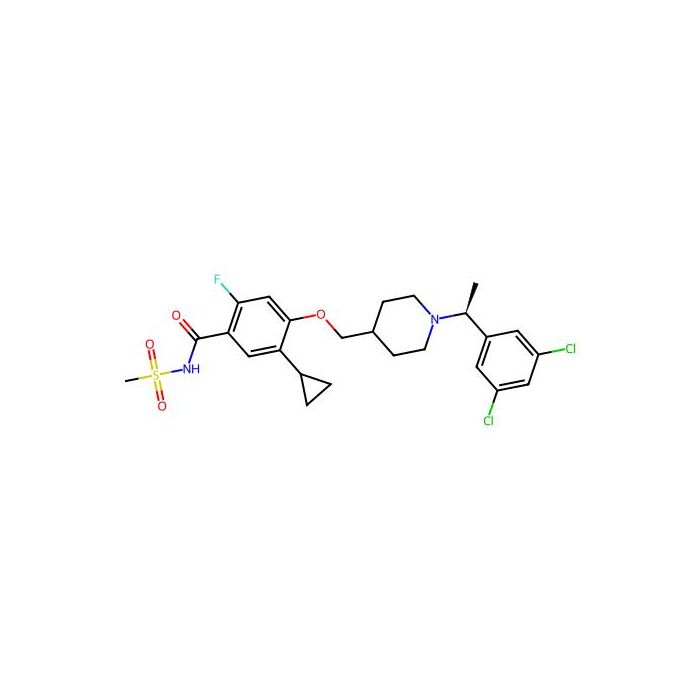
GDC-0310 is a selective acyl-sulfonamide Na v 1.7 inhibitor, with an IC 50 of 0.6 nM for hNa v 1.7
In Vitro
GDC-0310 exhibits an EC 50 of 1.1 μM in vivo and a K i of 1.8 nM for Na v 1.7. MCE has not independently confirmed the accuracy of these methods. They are for reference only.
In Vivo
GDC-0310 shows substantially improved Na v selectivity and ADME properties . GDC-0310 exhibits t1/2 values of 5 h, 46 h and 4.4 h in rat (5 mg/kg, iv), dog (1 mg/kg, iv) and cynomolgus monkeys (2 mg/kg, iv), respectively . MCE has not independently confirmed the accuracy of these methods. They are for reference only.
Form:Solid
IC50& Target:hNa v 1.4 3.4 nM (IC 50 ) hNa v 1.2 38 nM (IC 50 ) hNa v 1.6 198 nM (IC 50 ) hNa v 1.1 202 nM (IC 50 ) hNa v 1.5 551 nM (IC 50 ) Na v 1.7 0.6 nM (IC 50 )
Specifications
Spezifikationen & Reinheit
≥99%
Biochemische und physiologische Mechanismen
GDC-0310 is a selective acyl-sulfonamide Na v 1.7 inhibitor, with an IC 50 of 0.6 nM for hNa v 1.7.
Storage
Store at -20°C
Verschickt in
Ice chest + Ice pads
Dieses Produkt erfordert Kühlkettenversand. Grundversand und andere Economy-Optionen sind nicht verfügbar.
Zertifikate (CoA, COO, BSE/TSE und Analyse-Diagramm)
C of A & Other Certificates(BSE/TSE, COO):
Analytical Chart:
Chemische und physikalische Eigenschaften
Löslichkeit
DMSO : 4 mg/mL (7.36 mM; ultrasonic and warming and heat to 60°C)
Molekulargewicht
543.500 g/mol
XLogP3
5.700
Hydrogen Bond Donor Count
1
Hydrogen Bond Acceptor Count
6
Rotatable Bond Count
8
Exact Mass
542.121 Da
Monoisotopic Mass
542.121 Da
Topological Polar Surface Area
84.100 Ų
Heavy Atom Count
35
Formal Charge
0
Complexity
822.000
Isotope Atom Count
0
Defined Atom Stereocenter Count
1
Undefined Atom Stereocenter Count
0
Defined Bond Stereocenter Count
0
Undefined Bond Stereocenter Count
0
The total count of all stereochemical bonds
0
Covalently-Bonded Unit Count
1
Lösungsrechner
Molarity Calculator
Determine the necessary mass, volume, or concentration for preparing a solution.
Dilution Calculator
Determine the dilution needed to prepare a stock solution.
Reconstitution Calculator
Bewertungen
Kundenbewertungen
Application Protocols
Validated application data (e.g., concentrations, incubation times, assay formats) are not provided for this item.
General small-molecule handling workflow (guidance)
Stock solution: Prepare at a verified concentration in anhydrous DMSO (commonly 10 mM). Record exact mass and volume; confirm by UV or LC–MS if critical.
Working solutions: Dilute into assay buffer or media keeping final DMSO at tolerated levels (e.g., 0.1–0.5% for cells; as validated for enzymes). Include vehicle controls.
Dose–response: Use a logarithmic dilution series (e.g., 10–12 points, 3-fold steps) to define potency; replicate across independent days.
Stability checks: Assess carryover and adsorption by including “no-target” controls and measuring recovery after incubation.
Contact Aladdin Scientific for any available internal method notes tied to SKU G650382.
Biological Roles
The specific molecular target(s), pathway engagement, and mode of action for GDC-0310 are not provided in the current product data. As such, no definitive biological role can be asserted here. Consult peer-reviewed literature or internal validation to determine on-pathway biomarkers, binding data (Kd/IC50), and selectivity profiles if applicable.
General guidance for tool-compound deployment (non-clinical)
Use in biochemical or cell-based assays to probe pathway hypotheses, confirm target engagement, and establish concentration–response relationships.
Verify compound identity/purity and assay stability (in buffer/cell media) prior to biological readouts. Consider adsorption to plastics and light sensitivity.
Establish DMSO ceiling for your system (commonly ≤0.1–0.5% v/v for primary cells; up to 1–2% for some enzyme assays). Perform matched vehicle controls.
If mechanism is unknown or mixed, perform orthogonal assays (biochemical vs cellular) and counterscreens to deconvolute off-target effects.
Note: No clinical/therapeutic claims are made. This product is supplied strictly for research use only.
Buffer Applications
GDC-0310 is not a buffering agent. However, it is commonly handled in assay buffers once dissolved in an organic stock solvent.
Practical notes (general)
Stock preparation: Dissolve in anhydrous DMSO to a convenient concentration (e.g., 10 mM; confirm actual solubility first). Aliquot and store at −20°C.
Aqueous dilution: Add the DMSO stock to pre-warmed buffer with vigorous mixing to reach the desired final micromolar concentration while keeping DMSO at assay-tolerated levels (e.g., 0.1–1% v/v as permitted).
Typical buffers: PBS, HEPES, or assay-specific components (Tris, MOPS) with optional 0.01% nonionic surfactant to prevent adsorption/precipitation if compatible with the biology.
Filtration: If particulate persists, pass through 0.22 µm PVDF or PTFE filters (avoid nylon if adsorption is observed).
Since pKa and intrinsic aqueous solubility are not specified for this item, empirical small-scale compatibility tests are recommended before scaling up.
Green Alternatives
For a finished small-molecule tool compound like GDC-0310, “green alternatives” mainly concern solvent choices for dissolution, handling, and analytical workflows rather than replacing the compound itself.
Greener solvent considerations (general; not item-specific specifications):
Prefer aqueous buffers with minimal co-solvent where biologically compatible.
Use ethanol or 2-propanol as co-solvents instead of DMF/NMP when feasible, recognizing potential limits in solubility and protein compatibility.
For chromatography, consider water–acetonitrile over water–methanol when ACN availability allows lower overall solvent consumption due to stronger elution and lower backpressure.
Compact comparison (general)
DMSO: Excellent solvency for drug-like molecules; low volatility; moderate environmental concern; widely tolerated biologically at ≤0.1–1%.
Ethanol: Renewable sourcing possible; higher volatility; often biocompatible; may have lower solvency for hydrophobic compounds.
2-MeTHF/CPME: Useful greener ethers for synthetic steps; less relevant here unless you are performing derivatization chemistry.
Operational greening tips
Prepare concentrated stocks to minimize total solvent use.
Aliquot stocks to reduce waste from repeated freeze–thaw.
Use microscale assays and 96/384-well formats to cut solvent volumes and waste.
Pharmaceutical Uses
This product is sold for research use only and is not intended for human or veterinary use, clinical diagnostics, or as an active pharmaceutical ingredient.
Formulation-related research (general guidance)
As a reference compound, GDC-0310 may be used in pre-formulation or biopharmaceutics research (e.g., solubility, stability, and permeability studies) when permitted by your institution. Item-specific excipient compatibility, polymorph data, or salt form are not provided and should be established experimentally if needed.
No pharmacopeial monograph or excipient listing is provided for this item. Any translation into dosage-form research would require additional characterization (solid form, residual solvents, impurity profile) beyond the scope of this catalog listing.
Physical Properties
Item-specific properties
Appearance: Not specified for this item; refer to CoA/Spec Sheet.
Molecular weight (item): Not specified for this item; refer to CoA/Spec Sheet.
Melting point: Not specified for this item; refer to CoA/Spec Sheet.
Boiling point: Not applicable for typical solid drug-like molecules; if needed, refer to CoA/Spec Sheet.
Density: Not specified for this item; refer to CoA/Spec Sheet.
Refractive index: Not applicable for solids; not specified for this item.
Solubility (practical lab note, general): Many drug-like screening compounds are readily soluble in DMSO (10–50 mM) and can be diluted into aqueous assay buffers with care to avoid precipitation. Actual solubility for GDC-0310 is not specified; verify experimentally.
LogP/logD, pKa: Not specified for this item; see literature or CoA if available.
General guidance (literature/practice; not item specifications)
Stock solution preparation is commonly performed in anhydrous DMSO at 10 mM as a convenient concentration for HTS/biochemical assays. Perform a small solubility screen (DMSO, DMF, ethanol, 1:1 DMSO:water) to confirm compatibility with your assay matrix.
If precipitation is observed on aqueous dilution, consider using co-solvent micropercentages (0.1–1% DMSO or ethanol) or surfactant-containing buffers (e.g., 0.01% Tween-20) as permitted by your assay.
Quality and Grades
Grade/purity: Not specified for this item; refer to CoA/Spec Sheet for assay purity, identification tests (NMR/LC–MS/HRMS), and residual solvent limits.
What to expect in the CoA/Spec Sheet (typical for small-molecule screening compounds; general guidance)
Identity: LC–MS or HRMS, 1H NMR, optional 13C NMR, and HPLC/UPLC retention time.
Purity reporting: HPLC/UPLC area% at multiple wavelengths (often 210/254 nm). If chiral, an enantiomeric excess by chiral HPLC may be included when applicable.
Water/peroxide/metal content, UV cutoff: Not specified for this item; refer to CoA/Spec Sheet.
Implications for use
Screening-grade compounds are suitable for biochemical/cellular assays, hit validation, and orthogonal testing provided purity and identity meet your lab’s thresholds (commonly ≥95% area by HPLC). For in vivo exploratory work or GLP contexts, request extended characterization and impurity profiling.
Stabilizers/additives
None specified for this item. If the CoA lists form (free base/salt, solvate/hydrate) or stabilizers, adjust stock concentration calculations accordingly.
Reaction and Applications
This product is supplied as a finalized small-molecule reference compound within a screening/compound library category rather than as a synthetic reagent. Consequently, it is not typically used as a reagent or catalyst in transformations. Typical research applications include:
Use as a tool compound or reference standard in biochemical or cell-based assays to interrogate target pathways, perform control experiments, or benchmark assay performance. The specific molecular target for GDC-0310 is not provided here; consult primary literature or internal validation data.
Analytical reference: Establish LC–MS/UPLC retention time and fragmentation patterns; useful for bioanalytical method development (calibration curves, spike-and-recovery) where permitted.
SAR support: Comparative testing alongside analogs to derive structure–activity relationships.
Physicochemical profiling: Solubility, stability (pH/light), and permeability measurements to guide assay conditions.
If you intend to derivatize or immobilize this molecule, obtain the full structure and functional group map from the CoA/SDF. Without confirmed functional groups, guidance on coupling chemistry (e.g., amide formation, click, Suzuki handles) cannot be provided responsibly.
Reaction Conditions
Not typically applicable. GDC-0310 is a finished tool compound rather than a reagent. No reaction conditions, catalysts, or synthetic protocols are specified for this item.
If you intend to use GDC-0310 as a substrate in biochemical reactions or as a ligand in binding assays, establish conditions empirically:
Solvent: DMSO stock diluted into assay buffer to tolerated levels (commonly 0.1–1% v/v).
Temperature: Maintain at the assay’s physiological or enzyme-optimum temperature; minimize prolonged exposure to elevated temperatures to avoid degradation.
Light/pH: If unknown, test stability across your operational pH and protect from strong light.
For chemical synthesis involving GDC-0310 modifications, consult the primary literature for the specific scaffold once identified; no general conditions can be responsibly recommended without structural knowledge.
Safety and Handling
Regulatory and classification
GHS classification, signal word, pictograms, and H-statements: Not specified for this item; refer to SDS.
Research Use: For research use only.
Handling
Use in a chemical fume hood. Avoid inhalation of dust/aerosols and contact with skin/eyes.
Recommended PPE: lab coat, nitrile gloves, and safety glasses; upgrade to splash goggles and double-gloving for bulk handling or solution prep.
Storage and stability
Storage condition (item-specific): Store at −20°C (per product data). Protect from light and moisture. Keep container tightly closed.
Shipping: Ice chest + ice pads (kept cool to preserve integrity during transit). Allow to equilibrate to room temperature in sealed vial before opening to minimize condensation.
Incompatibilities and hygiene
Keep away from strong oxidizers and strong acids/bases until compatibility is known. Avoid repeated freeze–thaw of stock solutions; aliquot upon first dissolution.
First aid (general guidance; defer to SDS)
Skin/eye contact: Rinse with water for at least 15 minutes; remove contaminated clothing.
Inhalation: Move to fresh air; seek medical attention if symptoms persist.
Ingestion: Rinse mouth; seek medical advice. Provide SDS to responders.
Waste
Dispose of as organic laboratory chemical waste according to institutional and local regulations. Decontaminate surfaces with appropriate solvent and detergent.
Solvent Selection
Because item-specific solubility data are not provided, select solvents using standard practices for drug-like small molecules.
Primary stock solvent (practice-based):
DMSO: Most common for HTS/biochemical assays; typically supports 10–50 mM stocks. Hygroscopic—use anhydrous grade and minimize water pickup.
Secondary/alternative solvents:
DMF or NMP: Useful if DMSO solubility is limited; verify assay tolerance.
Ethanol or isopropanol: Good for spectroscopic prep and as a co-solvent for aqueous dilution; volatility can complicate dosing precision.
Acetonitrile: LC–MS friendly; often compatible with analytical workflows.
Aqueous systems:
Direct aqueous solubility is unknown. For working solutions, dilute DMSO stocks into buffer to ≤0.1–1% DMSO v/v as assay permits. Add small amounts of nonionic surfactant if precipitation occurs.
Comparison (general)
DMSO vs DMF: DMSO is less volatile and broadly tolerated by enzymes/cells at low %; DMF can improve solubility but is often less tolerated biologically.
EtOH vs ACN: Ethanol is more biocompatible; acetonitrile is favored for LC analytics but can denature proteins.
Practical tips
Warm gently (25–37°C) and vortex/sonicate to assist dissolution; avoid prolonged heating. Filter working solutions (0.22 µm) if particulate persists.
Storage and Reconstitution
Item-specific conditions
Storage temperature: Store at −20°C (per product data). Keep desiccated and protect from light. Tightly cap immediately after use.
Shipping: Ice chest with ice pads to maintain a cool chain during transit.
Reconstitution (general guidance)
Allow vial to equilibrate to room temperature in a desiccator before opening to prevent moisture condensation.
Prepare stock solutions in anhydrous DMSO at a concentration supported by actual solubility (commonly 10 mM as a starting point). If higher concentrations are required, verify visually and by analytical means (e.g., LC–MS).
Filter sterilize working solutions if intended for cell-based assays (0.22 µm PVDF/PTFE) and use promptly.
Aliquoting and stability
Aliquot stock solutions into single-use vials or low-bind tubes to avoid repeat freeze–thaw. Store aliquots at −20°C or below.
Avoid prolonged exposure of solutions to room temperature or light. Track cumulative freeze–thaw cycles.
Specifications not provided
Appearance, purity grade, water content, and exact solubility are not specified for this item; refer to the CoA/Spec Sheet or request from Aladdin Scientific.
Structure and Identity
Product name: GDC-0310 (research small molecule, screening library item)
CAS: 1788063-52-4
PubChem CID: 118110531
InChIKey: Not specified for this item; refer to CoA/Spec Sheet.
SMILES: Not specified for this item; refer to CoA/Spec Sheet.
Molecular formula: Not specified for this item; refer to CoA/Spec Sheet.
Molecular weight: Not specified for this item; refer to CoA/Spec Sheet.
Structural features
Item-specific structural features (ring systems, heteroatoms, stereocenters) are not provided in the current product data. Refer to the CoA/SDS or primary literature citation for GDC-0310 for definitive structural depiction and atom connectivity.
2D structure (descriptive)
Without the SMILES/InChI or a structural graphic, a reliable text description of the 2D scaffold cannot be provided here. If you require a structural rendering for procurement documentation or internal registration, contact Aladdin Scientific support for the current structure file (SDF/MOL) tied to this SKU.
Synthetic Utility
GDC-0310 is supplied as a finished small molecule and is not primarily intended as a synthetic building block.
Without a disclosed structure and functional group map for this SKU, it is not possible to recommend reliable transformations (e.g., cross-coupling handles, amide couplings, protecting-group strategies) or late-stage diversification tactics.
If you plan to derivatize GDC-0310 for probe development (e.g., biotinylation, fluorophore tagging, photoaffinity handles), please obtain the structural file (SDF/MOL) and confirm reactive sites, stability, and potential liabilities (e.g., hydrolysis-prone motifs) before route design.
For scale-up or custom analog synthesis, contact Aladdin Scientific for custom synthesis services referencing SKU G650382; we can review the latest structure and propose a route under confidentiality.
Target Specificity
Target, binding site/epitope, and selectivity data are not provided for this item. No antigen/epitope information is applicable, as this is a small molecule and not an antibody.
For biochemical usage, consult peer-reviewed literature or internal data packages for potency (IC50/Ki/Kd), on/off-target selectivity panels, and species cross-reactivity if relevant to your assays.
Wir verwenden Cookies, um die ordnungsgemäße Funktion der Website sicherzustellen und, soweit zulässig, Ihr Nutzererlebnis zu verbessern. Sie können Ihre Einstellungen jederzeit unter „Einstellungen“ verwalten. Weitere Informationen finden Sie in unserer Cookie-Richtlinie.
Shall we send you a message when we have discounts available?
Remind me later
Thank you! Please check your email inbox to confirm.
Products are supplied to verified businesses, institutions, and qualified professionals for research and development use only. Not for use in humans, animals, diagnosis, or therapy.