Glass spheres - 9-13 μm particle size , CAS No.65997-17-3

CAS: 65997-17-3 Cat. No.: G770583 EG-Nummer: 266-046-0
Zu bestellen verfügbar
QUALITÄT & REINHEIT 9-13 μm particle size
Storage
Room temperature
Shipped In
Normal
★
Größe
Deutschland (EU)
USA*
Preis
Menge
25g
G770583-25g
Auf Bestellung · 8–12 Wochen

55,45€

64,99€
Speichern 9,55 € (14.69%)
100g
G770583-100g
Auf Bestellung · 8–12 Wochen
209,04€
Enter a quantity for the sizes you want to add.
🧪
Warum diese Qualität

9-13 μm particle size für empfindliche chromatographische und analytische Workflows, die minimale Basislinieninterferenzen erfordern.

🌡

Lagerung & Versand

Room temperature Versand Normal. Genaue Spezifikationen finden Sie im chargenspezifischen COA.

📋

Qualitätsdokumente

SDS, COA, Datenblatt und Spezifikationsblatt stehen zum Download bereit. Chargenspezifische COA über Chargennummernsuche abrufbar.

📚

Literaturbeleg

In 7 peer-reviewten Publikationen zu Chromatographie, organischer Synthese und Kreuzkupplungsreaktionen zitiert.

Spezifikationen

Spezifikationen & Reinheit
9-13 μm particle size
Storage
Room temperature
Verschickt in
Normal
Namen und Kennungen
Kanonisches Lächeln
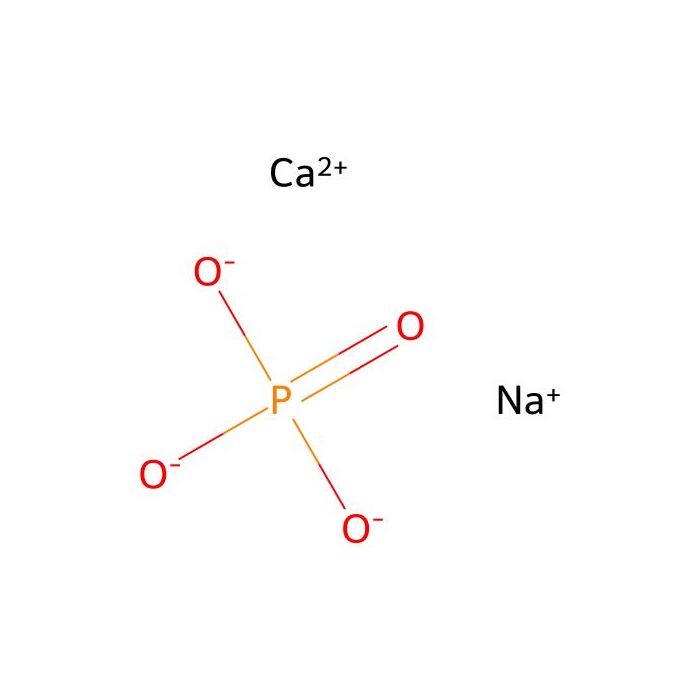
[O-]P(=O)([O-])[O-].[Na+].[Ca+2]
IUPAC Name
calcium;sodium;phosphate
InChIKey
QXJJQWWVWRCVQT-UHFFFAOYSA-K
INCHI
1S/Ca.Na.H3O4P/c;;1-5(2,3)4/h;;(H3,1,2,3,4)/q+2;+1;/p-3
Isomere SMILES
[O-]P(=O)([O-])[O-].[Na+].[Ca+2]

Dokumentation

📋 Sicherheitsdatenblatt (SDS)

Umfassendes Dokument zu Gefahren, Handhabung, Lagerung und Einhaltung regulatorischer Vorschriften.

<<<<<<< HEAD SDS herunterladen → ======= SDS herunterladen → >>>>>>> release248-p3

✅ Analysezertifikat (COA)

Chargenspezifische Qualitätsdaten. Geben Sie Ihre Chargennummer ein, um das genaue COA abzurufen.

COA nachschlagen →

📊 Datenblatt

Kurzübersicht über Produktspezifikationen und Anwendungen.

Datenblatt ansehen →

🔬 Spezifikationsblatt

Vollständige Qualitätsmerkmale und Akzeptanzkriterien für diese Qualität.

Spezifikationsblatt ansehen →

Erweiterte Daten

Taxonomic Classification

Taxonomy Tree

KingdomInorganic compounds
SuperclassMixed metal/non-metal compounds
KlasseAlkaline earth metal oxoanionic compounds
SubclassAlkaline earth metal phosphates
Intermediate Tree Nodes Not available
Direct ParentAlkaline earth metal phosphates
Alternative Parents Inorganic sodium salts  Inorganic oxides  Inorganic calcium salts  
Molecular FrameworkNot available
Substituents Alkaline earth metal phosphate - Inorganic calcium salt - Inorganic sodium salt - Inorganic oxide - Inorganic salt
BeschreibungThis compound belongs to the class of inorganic compounds known as alkaline earth metal phosphates. These are inorganic compounds in which the largest oxoanion is phosphate, and in which the heaviest atom not in an oxoanion is an alkaline earth metal.
External Descriptors Not available
3D-Struktur
Interaktives chemisches Strukturmodell


Zertifikate (CoA, COO, BSE/TSE und Analyse-Diagramm)
C of A & Other Certificates(BSE/TSE, COO):
Analytical Chart:
Chemische und physikalische Eigenschaften
Molekulargewicht158.040 g/mol
XLogP3
Hydrogen Bond Donor Count0
Hydrogen Bond Acceptor Count4
Rotatable Bond Count0
Exact Mass157.906 Da
Monoisotopic Mass157.906 Da
Topological Polar Surface Area86.300 Ų
Heavy Atom Count7
Formal Charge0
Complexity36.800
Isotope Atom Count0
Defined Atom Stereocenter Count0
Undefined Atom Stereocenter Count0
Defined Bond Stereocenter Count0
Undefined Bond Stereocenter Count0
The total count of all stereochemical bonds0
Covalently-Bonded Unit Count3
FAQs und Artikel
Four Core Applications of Epoxy Resins: Bonding, Protection, Load-Bearing, and Insulation Protection
Silicone Resin Coating Formulation Design: From Application Conditions to Matching Resins, Pigments and Fillers, Curing, and Substrates
Vinyl Ester Resin Systems: Structural Features, Curing Mechanism, and Key Application Considerations
Application Positioning, Scenario Selection, and Key Use Considerations for Chlorinated Rubber Resin in Coatings
How to Select Vinyl-Related Resins: Building Formulation Judgment Based on Substrate, Performance Targets, and Failure Risks
Applicability Boundaries, Failure Risks, and Alternative System Selection for Chlorinated Rubber Resin in Coatings
Why Do Daily Chemical Products Become Opaque? Formation Mechanisms of Milky Turbidity, Pearlescence, and Coverage, and How to Select the Right Ingredients
Color-Development Mechanisms, Formulation Forms, and Selection/Application Logic of Colorants in Personal Care Products
Solid Supports in Packed Gas Chromatography Columns: Definition, Mechanisms of Action, Classification, and Selection
Citations of This Product
Lösungsrechner
Bewertungen

Kundenbewertungen

Dürfen wir Sie über Rabattaktionen informieren?

Später erinnern

Vielen Dank! Bitte überprüfen Sie Ihren E-Mail-Posteingang, um zu bestätigen.

Hoppla! Benachrichtigungen sind deaktiviert.