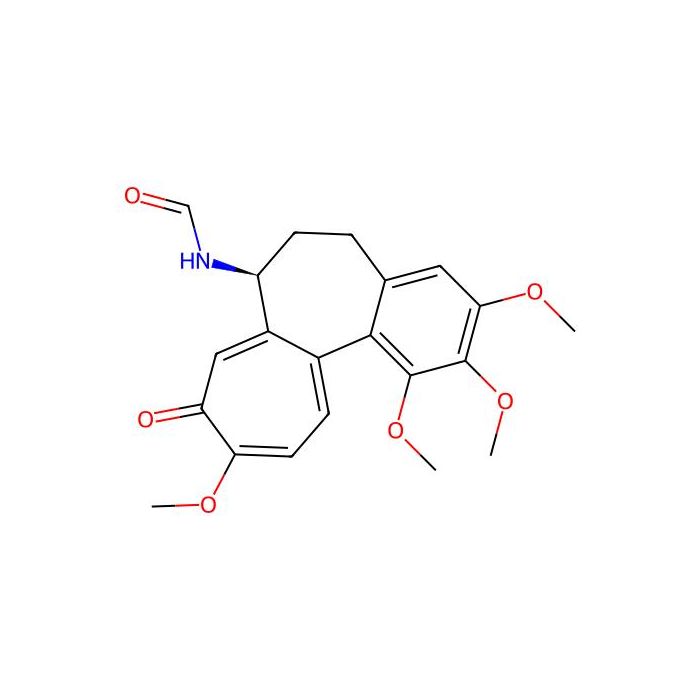
Determine the necessary mass, volume, or concentration for preparing a solution.
| Activity Type | Activity Value -log(M) | Mechanism of Action | Activity Reference | Publications (PubMed IDs) |
|---|

Taxonomy Tree
| Kingdom | Organic compounds |
|---|---|
| Superclass | Hydrocarbon derivatives |
| Klasse | Tropones |
| Subclass | Not available |
| Intermediate Tree Nodes | Not available |
| Direct Parent | Tropones |
| Alternative Parents | Anisoles Alkyl aryl ethers Secondary carboxylic acid amides Cyclic ketones Organopnictogen compounds Organonitrogen compounds Organic oxides |
| Molecular Framework | Aromatic homopolycyclic compounds |
| Substituents | Anisole - Tropone - Alkyl aryl ether - Benzenoid - Carboxamide group - Secondary carboxylic acid amide - Cyclic ketone - Ether - Carboxylic acid derivative - Organic oxygen compound - Organooxygen compound - Organonitrogen compound - Organic nitrogen compound - Carbonyl group - Organopnictogen compound - Organic oxide - Aromatic homopolycyclic compound |
| Beschreibung | This compound belongs to the class of organic compounds known as tropones. These are compounds containing a tropone ring, which is a cycloheptatrienone ring bearing a ketone group. |
| External Descriptors | Not available |
| Activity Type | Activity Value -log(M) | Mechanism of Action | Activity Reference | Publications (PubMed IDs) |
|---|
| Activity Type | Relation | Activity value | Units | Action Type | Journal | PubMed Id | doi | Assay Aladdin ID |
|---|
| Activity Type | Relation | Activity value | Units | Action Type | Journal | PubMed Id | doi | Assay Aladdin ID |
|---|
| Activity Type | Relation | Activity value | Units | Action Type | Journal | PubMed Id | doi | Assay Aladdin ID |
|---|
| Activity Type | Relation | Activity value | Units | Action Type | Journal | PubMed Id | doi | Assay Aladdin ID |
|---|
| Molekulargewicht | 385.400 g/mol |
|---|---|
| XLogP3 | 1.000 |
| Hydrogen Bond Donor Count | 1 |
| Hydrogen Bond Acceptor Count | 6 |
| Rotatable Bond Count | 5 |
| Exact Mass | 385.153 Da |
| Monoisotopic Mass | 385.153 Da |
| Topological Polar Surface Area | 83.100 Ų |
| Heavy Atom Count | 28 |
| Formal Charge | 0 |
| Complexity | 697.000 |
| Isotope Atom Count | 0 |
| Defined Atom Stereocenter Count | 1 |
| Undefined Atom Stereocenter Count | 0 |
| Defined Bond Stereocenter Count | 0 |
| Undefined Bond Stereocenter Count | 0 |
| The total count of all stereochemical bonds | 0 |
| Covalently-Bonded Unit Count | 1 |
No vendor-tested application protocols are specified for this item. The following general-purpose protocols can help standardize handling in chemical biology and analytics.
All procedures should be validated and adapted to your assay and instrumentation. For authoritative instructions, consult your institutional SOPs and the lot-specific CoA/SDS.
Item-specific biological annotations are not provided in the current listing. The compound is supplied strictly for research use only and not for use in humans or clinical applications.
General literature context:
Best practices for researchers:
Note: No medical, diagnostic, or therapeutic use is intended or implied. For any claims regarding target engagement or pathway modulation, cite primary literature tied unambiguously to CAS 7411-12-3 and the same stereochemical form.
This product is a discrete small molecule rather than a buffering agent. It is not typically used to formulate buffer systems.
Practical guidance if aqueous use is required:
For true buffering applications (pH control, electrophoresis), use dedicated buffering reagents with known pKa/pH ranges.
Because Gloriosine is a specific small molecule used as a research reagent/standard rather than a process solvent, "green alternatives" pertain mainly to the handling solvents and workflow around the compound rather than substitution of the compound itself.
Greener handling strategies (general):
Illustrative comparison (general):
Always confirm that greener substitutions do not compromise solubility, stability, or analytical performance for your specific lot.
No excipient/functionality or pharmacopeia status is specified for this item. This product is supplied strictly for research use only and is not intended for human or veterinary use.
General context for researchers in preformulation and analytics:
Note: Do not infer any therapeutic indications or dosage from this listing. There are no pharmacopeial monographs cited for this product in the current data.
Item-specific physicochemical specifications are not provided in the current listing.
General literature guidance (non-item-specific):
Important: Do not use literature or predicted values as acceptance criteria for this specific lot. For authoritative physical data tied to SKU G667873, consult the lot-specific CoA/SDS.
Grade/purity and stabilizers are not specified for this SKU in the current listing.
General guidance on interpretation:
Recommendations for this item:
Manufacturer Applications: Not specified for this item in the current listing. This compound is offered within a small-molecule/compound library context and is typically used as a reference standard, screening hit, or chemical probe candidate in research settings (research use only).
Expanded research applications (general, literature-level):
Practical tips:
Note: Without item-specific structural and reactivity data, do not assume compatibility with strong acids/bases, oxidants, or elevated temperatures; run micro-scale stability checks first.
No item-specific reaction condition data are provided. If you plan transformations on this molecule, adopt a cautious, small-scale, data-driven approach.
General guidance for derivatizing alkaloid-like small molecules (literature-level):
Analytical controls:
Note: Conditions above are general, literature-style guidance and may not be appropriate for this exact substance without verification of functional groups and stability.
Safety information specific to this item is limited in the current listing; always defer to the SDS for authoritative guidance.
Best-practice PPE and engineering controls:
First-aid overview (general):
Storage and incompatibilities:
Disposal:
Note: For risk assessment and specific exposure limits, consult the SDS and institutional EHS.
Item-specific solubility and polarity parameters are not provided for this product. Selection should therefore be guided by small test dissolutions and your assay constraints.
General guidance for alkaloid-like small molecules (literature-level):
Small comparison (general):
Ensure solvent choice is validated empirically with a micro-scale test and analytical confirmation (HPLC/UPLC) for your exact lot.
Reconstitution (general guidance):
Stability considerations:
Freeze–thaw guidance:
Always consult the lot-specific CoA and SDS for definitive storage, stability, and reconstitution information for SKU G667873.
Gloriosine is listed in our small-molecule and compound library category; item-specific structural identifiers are limited in the current product data.
Structural features (general, literature-level context):
Notes for users:
With limited structure-specific details in the product data, the following guidance focuses on general utility of natural-product-like small molecules in synthesis and method development.
Practical notes:
Not applicable. This product is a small molecule, not an antibody or biologic. No target specificity data (antigen, epitope, species reactivity, clone, isotype) are provided or applicable to this item.
For researchers exploring molecular targets: