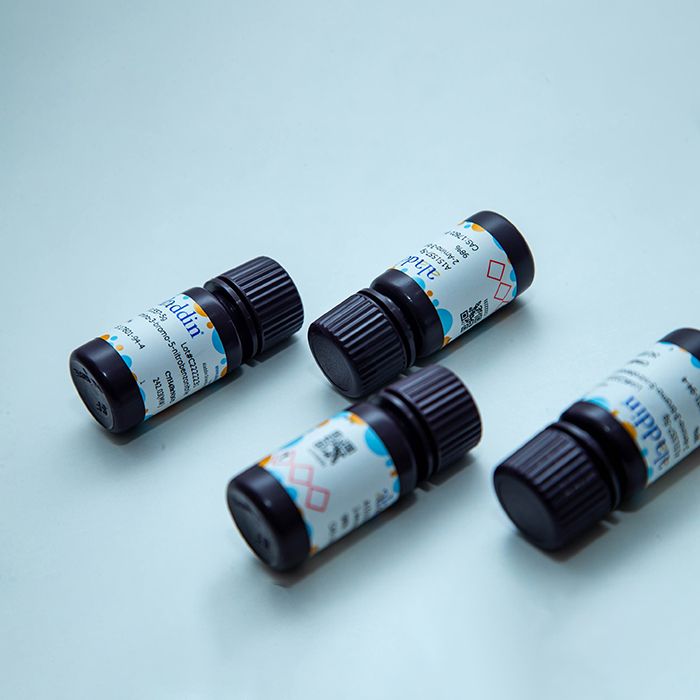
≥99% für empfindliche chromatographische und analytische Workflows, die minimale Basislinieninterferenzen erfordern.
🌡
Lagerung & Versand
Desiccated,Store at -80°C Versand Dry ice packs + Cold packs. Genaue Spezifikationen finden Sie im chargenspezifischen COA.
📋
Qualitätsdokumente
SDS, COA, Datenblatt und Spezifikationsblatt stehen zum Download bereit. Chargenspezifische COA über Chargennummernsuche abrufbar.
📚
Literaturbeleg
In 0 peer-reviewten Publikationen zu Chromatographie, organischer Synthese und Kreuzkupplungsreaktionen zitiert.
Übersicht
GLP-2(3-33), generated naturally by dipeptidylpeptidase IV (DPPIV), acts as a partial agonist on GLP-2 receptor ( EC 50 =5.8 nM).
In Vitro
GLP-2 is secreted as a 33-amino acid peptide, but is rapidly degraded at an N-terminus site to GLP-2(3-33) in circulation, in large part, by dipeptidylpeptidase IV (DPPIV). GLP-2 (3-33) acts as a partial agonist with potential competitive antagonistic properties on the GLP-2 receptor. In the GLP-2 receptor-binding assay, the binding IC 50 for GLP-2 1–33 was 3.1 nM, and it was 41 nM for GLP-2 3-33. Thus, GLP-2 3–33 had 7.5% binding affinity compared to GLP-2 1-33. MCE has not independently confirmed the accuracy of these methods. They are for reference only.
In Vivo
GLP-2(3-33) (60 ng; once a day i.p. for 4 weeks) increases dyslipidemia and hepatic lipid accumulation in HFD-fed mice. MCE has not independently confirmed the accuracy of these methods. They are for reference only. Animal Model: Male C57BL/6J (B6) mice (HFD)Dosage: 60 ng Administration: Once a day i.p. for 4 weeks Result: Significantly affected plasma lipids; Showed increase of triglycerides and cholesterol and reduction of HDL; Significantly increased plasma ALT and AST and intrahepatic lipid concentration.
Form:Solid
Spezifikationen
Spezifikationen & Reinheit
≥99%
Biochemische und physiologische Mechanismen
GLP-2(3-33), generated naturally by dipeptidylpeptidase IV (DPPIV), acts as a partial agonist on GLP-2 receptor ( EC 50 =5.8 nM).
Storage
Desiccated,Store at -80°C
Verschickt in
Dry ice packs + Cold packs
Dieses Produkt erfordert Kühlkettenversand. Grundversand und andere Economy-Optionen sind nicht verfügbar.
Aktionsart
AGONIST
Reinheit
≥99%
Namen und Kennungen
Molekulargewicht
3557.89
Dokumentation
📋 Sicherheitsdatenblatt (SDS)
Umfassendes Dokument zu Gefahren, Handhabung, Lagerung und Einhaltung regulatorischer Vorschriften.
Zertifikate (CoA, COO, BSE/TSE und Analyse-Diagramm)
C of A & Other Certificates(BSE/TSE, COO):
Analytical Chart:
Lösungsrechner
Molarity Calculator
Determine the necessary mass, volume, or concentration for preparing a solution.
Dilution Calculator
Determine the dilution needed to prepare a stock solution.
Reconstitution Calculator
Bewertungen
Kundenbewertungen
Application Protocols
Not specified for this item; no tested applications, recommended dilutions, or control conditions are provided in the Product Data. Refer to CoA/Spec Sheet.
Users should develop and validate protocols appropriate to their assay system.
Biological Roles
Background (literature, not item‑specific claims):
GLP‑2 (glucagon‑like peptide‑2) is a 33‑amino‑acid intestinal peptide hormone derived from proglucagon processing in enteroendocrine L‑cells. It signals primarily via the GLP‑2 receptor (GLP‑2R), a class B G‑protein‑coupled receptor expressed in gastrointestinal tissues and certain neural elements.
The N‑terminus of GLP‑2 is critical for receptor activation. Truncation to GLP‑2(3‑33) typically reduces or abolishes agonist efficacy and is widely described as a competitive antagonist or weak partial agonist at GLP‑2R in cellular systems. This property enables use as a tool compound to dissect endogenous GLP‑2 signaling cascades (e.g., cAMP/PKA pathways, gene expression changes) in vitro.
Metabolism: Endogenous GLP‑2 is rapidly cleaved by dipeptidyl peptidase‑4 (DPP‑4) at the N‑terminus (a common regulatory step for proglucagon peptides). N‑terminal truncation (3‑33) mimics a metabolite form with diminished receptor activation (literature observation for the GLP‑2 family).
Systems context: GLP‑2 signaling intersects with nutrient sensing and mucosal physiology; in model systems, pathway interrogation with GLP‑2(3‑33) helps attribute responses specifically to GLP‑2R, distinguishing them from GLP‑1 or glucagon pathways.
Note: The above summarizes accepted biochemical roles from the literature. No functional specifications, potencies, or activity guarantees are provided for this catalog item.
Buffer Applications
This product is a peptide reagent and not a buffering agent. It is not typically used to establish or maintain pH in laboratory systems.
Practical note:
Choose buffers based on assay requirements (e.g., PBS, HEPES, or Tris at physiological pH) that are compatible with peptide stability and the intended biological readout. Avoid extreme pH and high ionic strengths that could destabilize peptide conformation or promote aggregation.
Green Alternatives
For peptide research reagents like GLP‑2(3‑33), the environmental footprint is influenced largely by solvent choice and cold‑chain logistics. While the product itself is aqueous‑compatible, greener handling can reduce solvent burden.
Preferred media: Water and buffered saline are inherently greener than aprotic organics. Start with purely aqueous dissolution when feasible.
Co‑solvent choices (comparative, literature):
Acetonitrile vs. DMSO: ACN is volatile and easier to remove but more flammable; DMSO is less volatile, often lower acute toxicity, but can facilitate dermal transport—both should be minimized. Methanol/ethanol can sometimes substitute in small percentages if assay‑compatible.
Operational practices:
Use minimal volumes of organic co‑solvents; target ≤10% v/v in final assay solutions where possible.
Favor recyclable glass vials for HPLC where compatible and use aqueous mobile phases with lower ACN content (e.g., shallower gradients, elevated column temperature) when method performance allows.
Consolidate shipments and coordinate deliveries to reduce dry ice consumption and packaging waste, while respecting stability requirements.
Illustrative comparison (qualitative):
Aqueous buffer only: Highest greenness, lowest hazard, may require pH tuning for full solubility.
Aqueous + ≤10% ACN: Good chromatographic performance, moderate flammability footprint.
Aqueous + ≤10% DMSO: Good solubilization for hydrophobic sequences, low volatility but persistent; minimize concentration.
These recommendations are general and should be balanced against assay performance and peptide stability needs.
Pharmaceutical Uses
No clinical or therapeutic uses are claimed or implied for this research product.
Formulation‑ and development‑oriented context (general, non‑item‑specific):
Reference standard: GLP‑2(3‑33) can serve as a reference material in bioanalytical method development (e.g., LC‑MS/MS quantitation of GLP‑2‑related peptides) and chromatographic system suitability testing.
In vitro/ex vivo assay control: Used as a tool compound to benchmark GLP‑2R pathway specificity, providing negative/antagonist control against GLP‑2(1‑33) in receptor activation studies.
Preformulation research: Solubility, adsorption, and stability assessments in candidate excipient systems (e.g., histidine or phosphate buffers, sucrose/trehalose) may be conducted when designing peptide handling protocols for research.
Regulatory status:
Pharmacopeial monographs are not generally available for this truncated peptide; no pharmacopeial grade is claimed here. Any use beyond nonclinical research requires independent qualification and is outside the scope of this listing.
Physical Properties
Item-specific specifications are not provided in the Product Data for GLP‑2(3‑33).
Appearance: Not specified for this item; refer to CoA/Spec Sheet.
Molecular weight (exact): Not specified for this item; refer to CoA/Spec Sheet.
Molecular formula: Not specified for this item; refer to CoA/Spec Sheet.
Solubility: Not specified for this item; refer to CoA/Spec Sheet.
pKa/logP/refractive index: Not applicable/Not specified for peptide solids; refer to CoA/Spec Sheet.
General literature guidance for GLP‑2‑family research peptides (non‑specification):
Physical state: Typically supplied lyophilized as a white to off‑white solid for stability.
Solubility behavior: Peptides of this size (≈30–35 aa) commonly dissolve in water or aqueous buffers; initial wetting with small volumes of sterile water or dilute acetic acid (≤0.1%) can assist dissolution. For hydrophobic sequences, co‑solvents such as acetonitrile (≤20%) or DMSO may be used before dilution into buffered media (literature best practice).
Stability: Lyophilized peptides are generally stable when stored desiccated at ultra‑low temperature. In solution, stability depends on sequence and pH; working aliquots are typically kept at −20 to −80 °C and protected from repeated freeze–thaw (literature).
Important: The above are general properties for research peptides and are not item‑specific specifications. For exact analytical values (e.g., peptide content, counterion, water content, TFA salt status), consult the CoA/Spec Sheet.
Quality and Grades
Grade/purity: Not specified for this item; refer to CoA/Spec Sheet.
Context for peptide quality (general guidance for professional users):
Typical peptide grades include research grade (crude to >90%), HPLC‑purified grade (e.g., ≥95% by HPLC), and analytical/reference grades with comprehensive characterization (HPLC, MS, sometimes amino acid analysis). Lower UV background and defined counterion content are desirable for bioassays and analytical calibration.
Characterization package commonly includes: Analytical RP‑HPLC chromatogram (purity), ESI/ MALDI mass spectrum (observed mass vs. calculated), net peptide content (NPC) adjusting for water/counterions, and identity confirmation (where applicable). Specific values for this item are not provided here.
Counterion/salt form: TFA, acetate, or HCl salts are common for peptide trifluoroacetate removal or solubility tuning. The counterion for this item is not specified; consult CoA for salt form and NPC to enable accurate molarity.
Endotoxin/bioburden: For cell‑based work, low endotoxin and sterile filtration are often sought; not specified for this item.
What is specific to this listing:
Storage and shipping controls are defined (desiccated; store at −80 °C; shipped on dry ice + cold packs), supporting peptide integrity. All other quality attributes should be taken from the CoA/Spec Sheet provided with the lot.
Reaction and Applications
This product is a bioactive research peptide fragment rather than a small‑molecule reagent; it is primarily used in biological assay contexts rather than synthetic reactions. Item‑specific application data are not provided; the points below summarize literature uses of GLP‑2(3‑33)–type peptides.
Receptor pharmacology (literature): GLP‑2(3‑33) is widely reported as an N‑terminally truncated analog that functions as a competitive antagonist or weak partial agonist at the GLP‑2 receptor (GLP‑2R, a class B GPCR). It is used to interrogate GLP‑2R signaling pathways in vitro and ex vivo.
Assay modalities (literature):
cAMP accumulation assays in GLP‑2R‑expressing cells to quantify antagonism vs. GLP‑2(1‑33) stimulation.
β‑arrestin recruitment, calcium flux (if applicable), and reporter gene readouts.
Radioligand or fluorescent ligand displacement where binding probes are available.
Analytical uses: As a reference standard for LC‑MS or HPLC method development targeting GLP‑2‑family peptides; assessment of retention, peak shape, and system suitability (general peptide analytics).
Practical tips:
Prepare accurate molar stocks using net peptide content from the CoA (if provided) to correct for counterions/water.
Minimize peptide adsorption by using low‑bind plastics and adding compatible carrier protein when permissible.
Avoid repeated freeze–thaw; aliquot stocks and keep on ice during handling.
Note: No item‑specific bioassay validation or potencies are provided in the Product Data; users should establish assay conditions empirically.
Reaction Conditions
Classical organic reaction conditions are not applicable. For bioconjugation or assay preparation, the following literature‑based conditions are typical for peptides (general guidance; not item‑specific):
Stock preparation: 0.1–1.0 mM stocks in sterile water, PBS, or assay buffer; for poorly soluble sequences, include ≤10–20% DMSO or acetonitrile before dilution. Confirm concentration using absorbance (if aromatic residues present) or quantitative amino acid analysis; adjust for net peptide content from CoA.
Bioconjugation (if amines present): NHS‑ester coupling in aqueous buffer at pH 7.5–8.5, 0–25 °C, 0.5–2 h, using 2–10 equiv reagent; quench with Tris or glycine; purify by RP‑HPLC. Maintain low DMSO where possible to preserve peptide conformation.
Stability handling: Work on ice or at 4 °C for extended manipulations. Avoid metal contaminants and light if the sequence contains oxidation‑sensitive residues (e.g., Met, Trp, Tyr; specific content not provided here).
Assay incubation: For receptor assays, 10 pM–10 µM concentration ranges are common for potency/antagonism profiling (literature ranges for class B GPCR ligands). Optimize empirically with appropriate controls.
These conditions are general literature practices for peptides and should be validated for your specific system. No item‑specific reaction or assay parameters are provided in the Product Data.
Safety and Handling
GHS classification, signal word, H‑statements, and pictograms: Not specified for this item; refer to the SDS.
Research use note: For research use only.
General laboratory safety guidance for peptide solids (non‑SDS, literature best practice):
PPE: Wear lab coat, nitrile gloves, and safety glasses. Use a certified chemical fume hood to minimize inhalation of dust/aerosols during weighing and reconstitution.
Handling: Avoid generating dust. Use low‑bind plasticware or siliconized glassware to limit adsorption. For sterile applications, reconstitute with sterile, filtered solvents using aseptic technique.
Incompatibilities: Strong oxidizers and strong acids/bases may degrade peptide bonds and side chains; avoid prolonged exposure. Metal contamination can catalyze oxidation of susceptible residues (if present); use clean, inert tools.
First aid overview: If inhaled, move to fresh air; if on skin or in eyes, rinse with water for several minutes; if ingested, rinse mouth. Seek medical attention as appropriate. Always follow institutional safety procedures.
Spills: Gently dampen powders to avoid dusting; collect with disposable towels or HEPA‑filtered vacuum; dispose in accordance with local regulations.
Waste: Dispose of peptide solutions and contaminated materials as chemical waste per institutional guidelines.
Authoritative safety information is contained in the SDS; consult it before use.
Solvent Selection
Item-specific solubility is not specified; consult the CoA/Spec Sheet. The following solvent guidance reflects general practice for GLP‑2‑family research peptides.
Primary solvent class: Aqueous. Begin with sterile water or buffered saline (e.g., PBS) at neutral pH. If dissolution is incomplete, adjust strategy as below.
Stepwise dissolution strategy (literature best practice):
Wet the peptide with a minimal volume of sterile water or dilute acetic acid (≤0.1%) to disrupt surface aggregation.
If hydrophobicity is suspected, pre‑dissolve in a small volume of DMSO or acetonitrile (10–30% v/v final after dilution) before adding buffer.
For basic peptides, a brief pH increase (≤pH 8.5) can aid solubility; for acidic peptides, a brief pH decrease (pH 5–6) can help. Avoid extreme pH and prolonged exposure.
Miscibility profile: Water with limited amounts of organic co‑solvents (ACN, MeOH, DMSO). Avoid strong denaturants unless required for specific assays.
Adsorption mitigation: Use low‑bind tubes and add inert carrier (e.g., 0.1% BSA) where compatible with assays to reduce surface losses (literature practice).
When to choose alternatives:
If long‑term stability in aqueous media is problematic, store as concentrated stock in water or water/DMSO at −80 °C and prepare fresh working dilutions immediately before use.
Storage and Reconstitution
Item-specific storage and shipping:
Storage conditions: Desiccated; Store at −80 °C.
Shipped in: Dry ice packs + Cold packs.
Not specified for this item; refer to CoA/Spec Sheet for any additional storage details, solution stability, and reconstitution guidance.
General peptide handling practices (literature; non‑specification):
Allow the container to equilibrate to room temperature in a desiccator before opening to prevent moisture condensation.
Reconstitution: Start with sterile water or assay buffer. If needed, use a small volume of DMSO or acetonitrile to aid solubilization, then dilute with buffer. Avoid extreme pH and prolonged exposure to room temperature.
Aliquoting: Prepare single‑use aliquots at convenient working concentrations; store aliquots at −80 °C. Avoid repeated freeze–thaw cycles.
Stability in solution: Peptide solutions are generally most stable at ≤−20 °C for short term and −80 °C for longer term; minimize light and air exposure. Verify activity/purity periodically by HPLC/MS for critical applications.
Always prioritize instructions on the lot‑specific CoA and SDS.
Structure and Identity
GLP-2(3-33) is an N-terminally truncated peptide fragment derived from human glucagon-like peptide‑2 (GLP‑2), encompassing residues 3 through 33 of the native sequence.
Item-specific identifiers (this product):
CAS: 275801-62-2
Molecular formula: Not specified for this item; refer to CoA/Spec Sheet.
Molecular weight: Not specified for this item; refer to CoA/Spec Sheet.
InChIKey: Not specified for this item; refer to CoA/Spec Sheet.
SMILES: Not specified for this item; refer to CoA/Spec Sheet.
Structural class and features (general peptide chemistry):
Type: Linear peptide fragment corresponding to GLP‑2 residues 3–33 (31 amino acids total, literature), lacking the first two N‑terminal residues of full-length GLP‑2.
Functional groups: Multiple amide bonds (peptide backbone), side-chain functionalities dependent on sequence (e.g., amines, acids, alcohols, amides, aromatics), terminal N‑ and C‑termini (amidation state sequence‑dependent; not specified for this item).
2D description (verbal): A linear polypeptide chain of 31 α‑amino acid residues joined by trans‑amide linkages; side chains project alternately from the backbone, presenting a mixed polar/nonpolar surface typical of class B GPCR peptide ligands (literature, GLP‑2 family).
Stereochemistry (general):
Proteinogenic L‑amino acid configuration at each chiral center unless otherwise noted; no D‑residues or noncanonical residues are specified for this item.
Notes:
Exact sequence, modifications (e.g., C‑terminal amidation, N‑terminal acetylation), and calculated elemental/monoisotopic masses are not specified for this catalog item; consult the CoA/Spec Sheet for definitive identity attributes.
Synthetic Utility
As a bioactive peptide fragment, GLP‑2(3‑33) is not a conventional building block for small‑molecule synthesis. Its primary value is as a biochemical tool. Nonetheless, chemists may leverage it in the following research contexts (general guidance):
Analytical calibration: Use as a peptide standard for LC‑MS method development (ionization behavior, charge state distribution, retention on RP‑HPLC). This supports validation of peptide mapping and intact mass workflows.
Bioconjugation studies: If the sequence contains accessible primary amines (N‑terminus and/or Lys residues; specific content not provided for this item), standard conjugation chemistries (e.g., NHS‑ester coupling, isothiocyanates) can be explored for probe attachment, followed by activity assessment to ensure GLP‑2R interaction properties are preserved.
Solid‑phase peptide synthesis (SPPS) benchmarking: Serve as a target for process benchmarking of Fmoc‑SPPS assembly and purification workflows (HPLC method optimization, counterion exchange), comparing in‑house material to a commercial reference.
Receptor‑ligand SAR: As a truncated analog, it can anchor structure–activity relationship studies investigating N‑terminal determinants of GLP‑2R activation vs. antagonism (literature concept).
Note: Sequence, modifications, and exact reactive handle content for this catalog item are not specified; consult the CoA/Spec Sheet before designing conjugation or derivatization experiments.
Target Specificity
Not specified for this item; refer to CoA/Spec Sheet.
Note: While GLP‑2(3‑33) peptides are commonly used to interrogate GLP‑2 receptor (GLP‑2R) signaling in research (literature), this listing provides no validated target, epitope, species reactivity, clone, or isotype information.
Häufig gestellte Fragen
What is the purity of this product?
This product is supplied at ≥99% purity (chemical assay). Lot-specific values are stated on the Certificate of Analysis.
How should this product be stored?
Store at ?80 °C, desiccated. Keep the container tightly closed with desiccant — the material is moisture-sensitive.
How is this product shipped?
This product ships frozen with dry ice and cold packs. Unpack on arrival and transfer it to the storage condition stated above; handle dry ice with insulated gloves in a ventilated area.
What are the CAS number, molecular formula and molecular weight?
The CAS Number is 275801-62-2, the molecular formula is C156H242N40O53S, and the molecular weight is 3557.89 g/mol.
What documentation is provided?
Available product documentation, including Certificates of Analysis (COA), Safety Data Sheets (SDS), and specification sheets, is shown in the product document area. Document availability and access follow the current site policy.
Wir verwenden Cookies, um die ordnungsgemäße Funktion der Website sicherzustellen und, soweit zulässig, Ihr Nutzererlebnis zu verbessern. Sie können Ihre Einstellungen jederzeit unter „Einstellungen“ verwalten. Weitere Informationen finden Sie in unserer Cookie-Richtlinie.
Dürfen wir Sie über Rabattaktionen informieren?
Später erinnern
Vielen Dank! Bitte überprüfen Sie Ihren E-Mail-Posteingang, um zu bestätigen.
Products are supplied to verified businesses, institutions, and qualified professionals for research and development use only. Not for use in humans, animals, diagnosis, or therapy.