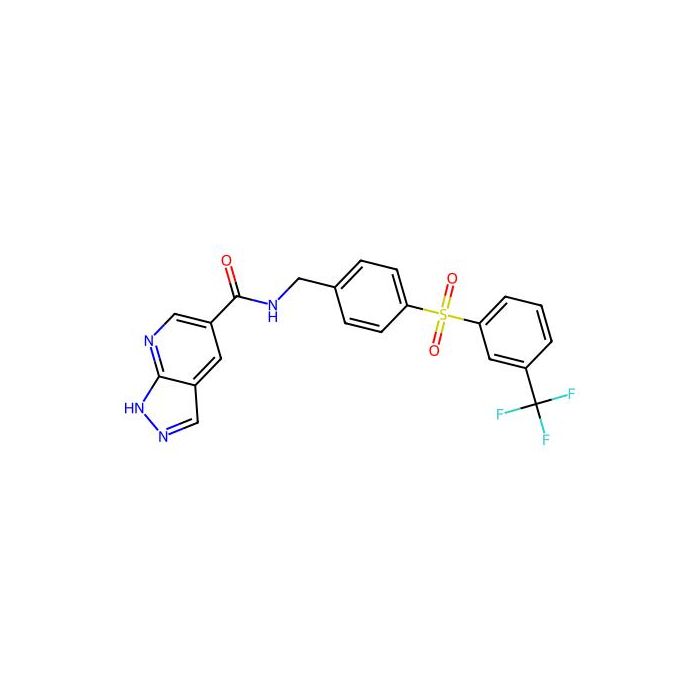
GNE-618 is a potent, orally active nicotinamide phosphoribosyl transferase (NAMPT) inhibitor with an IC 50 of 6 nM. GNE-618 depletes NAD levels and induces tumor cell death. Anti-tumor activity
In Vitro
GNE-618 reduces levels of NAD with an EC 50 of 2.6 nM in the NSCLC cell line Calu-6. GNE-618 (10-30 nM; 72 hours) reveals an increase in the sub-2N population and a decreases in the percentage of cells in the G1 and M phases of the cell cycle in Calu-6 cells. GNE-618 also reduces cellular proliferation of Calu-6 cells as determined using two different assay formats, either measuring ATP (EC 50 of 13.6 ± 1.8 nM) or total protein content (SRB assay; EC 50 of 25.8 ± 4.2 nM)MCE has not independently confirmed the accuracy of these methods. They are for reference only.
In Vivo
GNE-618 (100 mg/kg; p.o.; twice daily for 5 days) significantly inhibits tumor growth by 88% and has minimal effects on body weight in STO#81 patient-derived gastric model . MCE has not independently confirmed the accuracy of these methods. They are for reference only.
Form:Solid
IC50& Target:IC50: 6 nM (NAMPT)
Spezifikationen
Spezifikationen & Reinheit
≥99%
Biochemische und physiologische Mechanismen
GNE-618 is a potent, orally active nicotinamide phosphoribosyl transferase (NAMPT) inhibitor with an IC 50 of 6 nM. GNE-618 depletes NAD levels and induces tumor cell death. Anti-tumor activity.
Storage
Store at -20°C
Verschickt in
Ice chest + Ice pads
Dieses Produkt erfordert Kühlkettenversand. Grundversand und andere Economy-Optionen sind nicht verfügbar.
Aktionsart
INHIBITOR
Reinheit
≥99%
Namen und Kennungen
Molekulargewicht
460.43
Erweiterte Daten
Zertifikate (CoA, COO, BSE/TSE und Analyse-Diagramm)
C of A & Other Certificates(BSE/TSE, COO):
Analytical Chart:
Chemische und physikalische Eigenschaften
Löslichkeit
DMSO : 125 mg/mL (271.49 mM; Need ultrasonic)
Lösungsrechner
Molarity Calculator
Determine the necessary mass, volume, or concentration for preparing a solution.
Dilution Calculator
Determine the dilution needed to prepare a stock solution.
Reconstitution Calculator
Bewertungen
Kundenbewertungen
Application Protocols
No item-specific validated application protocols are provided in the Product Data. The following is a generic example for small-molecule use in cell assays (for illustration; not item-specific):
Example: 10-point half-log dose–response in adherent cells
Prepare a 10 mM DMSO stock (or the highest soluble concentration determined empirically).
Perform a 1:3 or 1:5 serial dilution in DMSO across 10 tubes to create a dosing ladder.
Add diluted stocks to culture media to achieve final concentrations (e.g., 0.001–30 µM), keeping final DMSO constant (e.g., 0.1%). Mix thoroughly and inspect for precipitation.
Seed cells in 96-well plates and allow to adhere overnight. Treat with compound dilutions in triplicate; include vehicle controls and, if available, a positive control compound.
Incubate 24–48 h at 37 °C, 5% CO2. Measure endpoint (e.g., reporter activity, viability, imaging).
Analyze data with a four-parameter logistic fit, verify Hill slope and top/bottom constraints, and inspect raw signals for edge effects.
For biochemical assays, adapt the above by using assay buffer, pre-incubation with target as required, and appropriate detection modality (FP, FRET, enzymatic turnover). Document plate maps, reagent lots, and exact solvent percentages.
Biological Roles
Endogenous/physiological role: Not applicable. GNE-618 is a research small molecule and is not known to be an endogenous metabolite or nutrient.
Target/mechanism: Not specified for this item; refer to primary literature or CoA/Spec Sheet if available. Do not assume a target or MoA without confirmatory data.
General considerations for screening compounds (not item-specific):
Target engagement: Use orthogonal methods (e.g., biochemical binding, biophysical assays like DSF/CETSA/NanoBRET) to corroborate any functional readouts.
Off-target and assay interference: Evaluate potential PAINS and redox-active behaviors; include aggregation controls (e.g., 0.01–0.05% non-ionic detergent) when warranted.
ADME proxies: For preliminary triage, measure permeability (PAMPA/Cell lines), metabolic stability (microsomes/S9), and solubility versus pH if structural data become available.
Cytotoxicity controls: Include general viability assays alongside phenotypic endpoints to distinguish on-target effects from nonspecific toxicity.
Ethical and regulatory:
For research use only (Product Data). Not for diagnostic or therapeutic applications. No clinical or in vivo use is implied by this listing.
Documentation:
Record exact identifiers (CAS 1362151-42-5, SKU G649309) and batch information in ELN/LIMS. If you require a specific stereochemical form or salt, confirm via CoA before initiating biological studies.
Buffer Applications
Buffer formulation is not typically applicable to this product, which is a discrete small-molecule screening compound rather than a buffering agent.
Practical notes (general):
If dosing into aqueous buffers, first dissolve the compound in a miscible organic solvent (commonly DMSO), then add to buffer with vigorous mixing to the desired final concentration, keeping final organic content as low as your assay permits.
Confirm absence of precipitation visually and, where possible, by a quick analytical check (e.g., UV scan, DLS for aggregates) after dilution into the working buffer.
Green Alternatives
While item-specific solvents are not prescribed, greener practices can be applied to handling and screening of small molecules like GNE-618 (general, not item-specific):
Reduce DMSO load: Minimize final assay DMSO to the lowest compatible percentage (often ≤0.1–0.5%) to reduce solvent usage and potential biological artifacts.
Prefer water-rich systems: Where feasible, use aqueous buffers with enabling excipients (e.g., cyclodextrins) to lessen reliance on dipolar aprotic solvents.
Miniaturize screens: Use smaller assay volumes and higher-density plates to reduce total solvent and compound consumption.
Streamline analytics: Employ short LC gradients and aqueous-rich mobile phases (e.g., water/MeOH with volatile buffers) to cut organic solvent waste.
Illustrative comparison (general):
DMSO: excellent solubilizer; widely compatible; environmental/worker exposure considerations; handle with care and minimize volume.
2‑Hydroxypropyl‑β‑cyclodextrin: enables aqueous delivery of hydrophobes; can alter bioavailability/assay outcomes; cost and added components to validate.
Trade-offs:
Greener options may reduce solvency power or introduce confounders. Validate vehicle effects, maintain rigorous controls, and document any excipients used.
Waste management:
Segregate halogenated vs non-halogenated organics. Utilize solvent recycling where available. Neutralize aqueous waste per local regulations.
Pharmaceutical Uses
This product is provided strictly for research use only and is not intended for human or veterinary use, clinical diagnostics, or as an active pharmaceutical ingredient (API).
Pharmacopeial status: Not specified for this item; refer to CoA/Spec Sheet if any compendial references apply.
Formulation role: Not specified. It is not offered as an excipient or processing aid.
Research/development context (general, not item-specific):
Early discovery teams may use such compounds as tool molecules in target validation or as references in analytical method development. Any preclinical formulation or PK/PD exploration requires comprehensive characterization (purity, identity, stability, solid form) not provided here.
For any in vivo enabling work (not covered by this product’s research-only scope), additional quality controls (endotoxin, sterility, residual solvents, salt form) and regulatory compliance would be necessary; this listing does not include such qualifications.
Physical Properties
Item-specific physicochemical data are not included in the Product Data. The following fields are provided for clarity:
Appearance: Not specified for this item; refer to CoA/Spec Sheet.
Molecular weight: Not specified for this item; refer to CoA/Spec Sheet.
Molecular formula: Not specified for this item; refer to CoA/Spec Sheet.
Melting point (MP): Not specified for this item; refer to CoA/Spec Sheet.
Boiling point (BP): Not specified for this item; refer to CoA/Spec Sheet.
Density: Not specified for this item; refer to CoA/Spec Sheet.
Refractive index: Not applicable/Not specified for this solid-library context; refer to CoA/Spec Sheet if available.
LogP/logD, pKa: Not specified for this item; refer to CoA/Spec Sheet.
Solubility: Not specified for this item; refer to CoA/Spec Sheet.
Storage: Store at −20 °C (Product Data).
General laboratory guidance (not item-specific; literature/common practice for screening compounds):
Stock solution preparation is commonly performed in anhydrous DMSO due to broad solubilizing power for diverse chemotypes. If aqueous use is needed, co-solvent or solubilizers (e.g., PEGs, cyclodextrins) may be explored. Always confirm compatibility with your assay.
For analytical work (HPLC/LC–MS), begin with mixed aqueous–organic eluents (e.g., water/ACN or water/MeOH with 0.1% FA or NH4OAc), then optimize based on retention/ionization behavior once the structure is known.
Absent item-specific stability data, avoid prolonged exposure to heat, moisture, or light, and minimize freeze–thaw cycles by aliquoting initial stocks.
Quality and Grades
Grade/Purity: Not specified for this item; refer to CoA/Spec Sheet.
Context and expectations for library compounds (general, not item-specific):
Library-grade small molecules for screening are typically provided with batch analytical characterization (e.g., LC–MS purity, MS ion, and when feasible, 1H NMR). The exact test suite and acceptance criteria vary by supplier and intended use.
For high-content biology or SAR, many users require LC purity ≥95% by a single method. However, because this product’s specific grade is not listed, verify purity, counter-ions, and residual solvent content in the CoA before critical studies.
UV background and fluorescent impurities can confound biochemical or cell-based readouts. If your assay is spectroscopic, consider obtaining or performing orthogonal purity checks (e.g., HPLC-UV at multiple wavelengths, HPLC-CAD, LC–MS, HRMS).
Solid form (salt/free base, polymorph) can affect solubility and potency readouts. Confirm the exact form on the CoA/Spec Sheet and record it in ELN/LIMS for reproducibility.
If stability-in-solution is critical (e.g., long incubations), perform a fit-for-purpose stability study (autosampler stability, bench-top stability, freeze–thaw) under your assay conditions.
Reaction and Applications
This product is supplied as a research small molecule for screening and probe discovery rather than as a general-purpose synthetic reagent. Accordingly, the most relevant applications are in chemical biology and assay development (general guidance; not item-specific):
Biochemical assays: Evaluate enzyme or receptor interactions using dose–response curves. Include vehicle controls at matched % solvent.
Cell-based assays: Assess target engagement phenotypes or pathway readouts. Confirm solubility and absence of precipitation across the dosing series.
Mechanism studies: Use time-course studies, washout experiments, and orthogonal assays (e.g., CETSA/TPP for target engagement; NanoBRET/FP for binding proxies) to interrogate MoA.
Selectivity profiling: Counter-screen across related targets to identify off-target liabilities; employ pan-assay interference (PAINS) filters and redox/aggregate controls (e.g., low non-ionic detergent, dynamic light scattering where appropriate).
Analytical support: Develop LC–MS methods for exposure/uptake quantitation in cells or microsomes; perform stability checks in assay buffer and media.
Not typically applicable: Named organic transformations and stoichiometric synthetic uses are generally not relevant for this item. If your intent is preparative chemistry, obtain the full structure and consider custom synthesis route scouting.
Practical tips:
Prepare concentrated DMSO master stocks, aliquot, and minimize freeze–thaw.
Verify top concentration solubility visually and analytically.
Track plate edge effects and evaporation for long assays; use lids and humidity control.
Reaction Conditions
Classical organic reaction conditions are not generally applicable to this product because it is offered as a discrete screening compound rather than a reagent. However, general assay-use conditions are often relevant (not item-specific):
Stock preparation: Prepare concentrated stock in anhydrous DMSO (commonly 10–50 mM, as permitted by solubility). Aliquot to avoid repeated freeze–thaw.
Working concentrations: For biochemical assays, typical ranges are 0.1 nM–100 µM; for cell assays, 1 nM–50 µM, depending on the system. Confirm solubility and absence of aggregation across the series.
Vehicle controls: Match the highest solvent percentage across all wells/tubes (e.g., 0.1–0.5% DMSO), and verify that the vehicle does not perturb the assay.
Temperature/time: Biochemical assays often at ambient or 25–37 °C; cell assays at 37 °C with 5% CO2; incubation from minutes to 48 h depending on endpoint kinetics.
Compatibility checks: Assess stability in the chosen buffer/media over the assay time (short LC–MS check recommended). Inspect for precipitation after dilution from DMSO.
Note: All values above are general literature practices for small-molecule screening and are not specifications for this item. Optimize to your specific target, cell model, and readout modality.
Safety and Handling
Safety data are not specified in the Product Data for this item. Treat as a laboratory chemical of unknown hazards and consult the SDS for authoritative guidance.
GHS classification, Signal word, H-statements, Pictograms: Not specified for this item; refer to SDS.
Primary storage: Store at −20 °C (Product Data). Keep container tightly closed. Allow vials to warm to ambient temperature before opening to minimize condensation.
Engineering controls: Handle in a chemical fume hood when weighing, dissolving, or transferring dry powders/solutions.
PPE: Lab coat, safety glasses, and nitrile gloves at minimum. Upgrade PPE based on risk assessment.
Incompatibilities (general): Avoid strong oxidizers and strong acids/bases unless compatibility is known. Do not mix with unknown reactants. segregate from food items and animal facilities.
Hygiene: Avoid inhalation of dust or aerosols and contact with skin or eyes. Wash hands thoroughly after handling. Do not pipette by mouth.
First aid (general overview; defer to SDS): Inhalation—move to fresh air; Skin—wash with soap/water; Eyes—rinse with water for several minutes; Ingestion—rinse mouth. Seek medical attention if symptoms occur.
Spill/leak: Absorb small spills with inert material (e.g., vermiculite), collect in a sealable container for disposal. Decontaminate area.
Waste: Dispose through licensed chemical waste streams according to local regulations.
Transport/receipt: Shipped in an ice chest with ice pads (Product Data). Inspect for vial integrity and dryness on receipt.
Solvent Selection
GNE-618 is part of a small-molecule screening library; item-specific solubility is not provided. The following guidance reflects common practice for discovery compounds (general, not item-specific):
Primary solvent for stocks: DMSO due to high solvating power across polarities and compatibility with many biochemical and cell assays.
Alternative solvents: DMF, ethanol, methanol, or PEG-containing systems can be used when DMSO is unsuitable. Aqueous delivery often requires co-solvent (<1% v/v DMSO/EtOH final) or solubilizers (cyclodextrins, surfactants) depending on the chemotype.
Aqueous buffers: If dilution into buffer is required, pre-wet with a small amount of organic solvent before addition to high-water media to minimize precipitation. Verify by visual inspection and analytical confirmation.
Material compatibility: Adsorption to plastics (particularly at low nM–µM) can cause apparent potency loss. Consider low-binding plates or glass vials for master stocks.
Typical solvent considerations (general):
DMSO: broad solubility; maintain final assay %DMSO ≤0.1–0.5% for sensitive cells/enzymes when possible.
Ethanol: volatile; biological tolerance varies; watch for evaporation effects in long incubations.
Aqueous + carriers: 2‑hydroxypropyl‑β‑cyclodextrin or small % Tween-80 may aid delivery, but validate biological inertness.
Always titrate solvent conditions alongside vehicle controls and document exact lots, concentrations, and plate maps for reproducibility.
Storage and Reconstitution
Storage conditions: Store at −20 °C (Product Data). Protect from moisture. Tightly cap vials after use. Allow to warm in a desiccator to room temperature before opening to reduce condensation.
Shipping: Ice chest with ice pads (Product Data). Inspect upon arrival; if thawing occurred, promptly restore to −20 °C and check integrity.
Shelf life/stability: Not specified for this item; refer to CoA/Spec Sheet. In absence of data, avoid repeated freeze–thaw and prolonged exposure to light/air.
Reconstitution (general guidance; not item-specific):
Solvent: Dissolve in high-purity, anhydrous DMSO to prepare a concentrated master stock. If aqueous dosing is needed, dilute into buffer or media with vigorous mixing, keeping final DMSO low and constant across samples.
Concentration: Determine empirically based on solubility; common master stocks are 10–50 mM. Filter (0.22 µm) if sterile solutions are required for cell work.
Aliquoting: Dispense single-use aliquots in inert vials or low-bind tubes to minimize adsorption and freeze–thaw cycles.
Record-keeping: Document lot, concentration, solvent, preparation date, and storage location in ELN/LIMS. Label vials with light/temperature precautions if applicable.
Note: For research use only. Not for human or veterinary use. Always consult the product’s CoA and SDS for definitive, batch-specific instructions.
Structure and Identity
GNE-618 is supplied as a small-molecule screening compound within Aladdin Scientific’s small-molecule and compound library collection.
SKU: G649309
Product Name: GNE-618
Category: Small molecules and compound libraries (研究/筛选用途)
CAS: 1362151-42-5
Molecular formula: Not specified for this item; refer to CoA/Spec Sheet.
Molecular weight: Not specified for this item; refer to CoA/Spec Sheet.
SMILES: Not specified for this item; refer to CoA/Spec Sheet.
InChI / InChIKey: Not specified for this item; refer to CoA/Spec Sheet.
Structural features (general notes):
Item-specific structural identifiers are not provided in the Product Data. No assumptions are made about ring systems, heteroatoms, stereochemistry, or ionizable groups.
“GNE-” is a naming convention used in the literature for discovery-stage small molecules; however, no target, scaffold class, or structural motif is specified here. Users should consult the batch CoA or internal references if a specific chemotype is required for their work.
2D description (general):
As a library screening compound, GNE-618 is intended for use as a discrete, well-defined small molecule. Absent structural data, its atom connectivity and functional groups cannot be summarized here. Please request the CoA/Spec Sheet for definitive identifiers suitable for registration in ELN/LIMS, cheminformatics, or inventory systems.
Synthetic Utility
GNE-618 is supplied as a finished small-molecule library member and is not positioned as a building block or reagent for organic synthesis.
Potential uses adjacent to synthesis (general; not item-specific):
Analytical reference standard: Can be used to develop and validate chromatographic methods (HPLC/UPLC/LC–MS) for identity and purity tracking in discovery workflows, once structure and ionization behavior are known from the CoA.
Stability-indicating methods: Forced-degradation studies (acid/base, oxidative, thermal, photolytic) may be designed to understand degradation pathways under assay/storage conditions; this supports robust handling and shelf-life assessment.
Impurity profiling: If employed as an internal standard or comparator, develop orthogonal methods (e.g., HPLC-UV and LC–MS) to separate potential synthetic impurities or isomers.
If your intent is to use this material as a synthetic intermediate:
Obtain the full structural identity (SMILES/InChI), functional group map, and stereochemical information from the CoA or primary literature.
Reassess compatibility of planned transformations (oxidations/reductions, cross-couplings, protective group strategies) with the compound’s functional groups before proceeding.
Target Specificity
Target, pathway, or binding profile: Not specified for this item; refer to CoA/Spec Sheet or primary literature if available.
Species reactivity, selectivity panels, and off-target data: Not specified for this item.
Guidance (general; not item-specific):
Establish selectivity by counter-screening against related family members and representative off-targets.
Verify direct binding or engagement using orthogonal biophysical or cellular techniques (e.g., SPR, ITC, NanoBRET, CETSA).
Incorporate chemical controls (close analogs/inactive variants) where possible to strengthen causal inference in biological studies.
Häufig gestellte Fragen
What is the purity of this product?
This product is supplied at ≥99% purity (chemical assay). Lot-specific values are stated on the Certificate of Analysis.
How is this product shipped?
This product ships in an insulated container with ice pads. Unpack on arrival and transfer it to the storage condition stated above.
What are the CAS number, molecular formula and molecular weight?
The CAS Number is 1362151-42-5, the molecular formula is C21H15F3N4O3S, and the molecular weight is 460.43 g/mol.
What documentation is provided?
Available product documentation, including Certificates of Analysis (COA), Safety Data Sheets (SDS), and specification sheets, is shown in the product document area. Document availability and access follow the current site policy.
Wir verwenden Cookies, um die ordnungsgemäße Funktion der Website sicherzustellen und, soweit zulässig, Ihr Nutzererlebnis zu verbessern. Sie können Ihre Einstellungen jederzeit unter „Einstellungen“ verwalten. Weitere Informationen finden Sie in unserer Cookie-Richtlinie.
Dürfen wir Sie über Rabattaktionen informieren?
Später erinnern
Vielen Dank! Bitte überprüfen Sie Ihren E-Mail-Posteingang, um zu bestätigen.
Products are supplied to verified businesses, institutions, and qualified professionals for research and development use only. Not for use in humans, animals, diagnosis, or therapy.