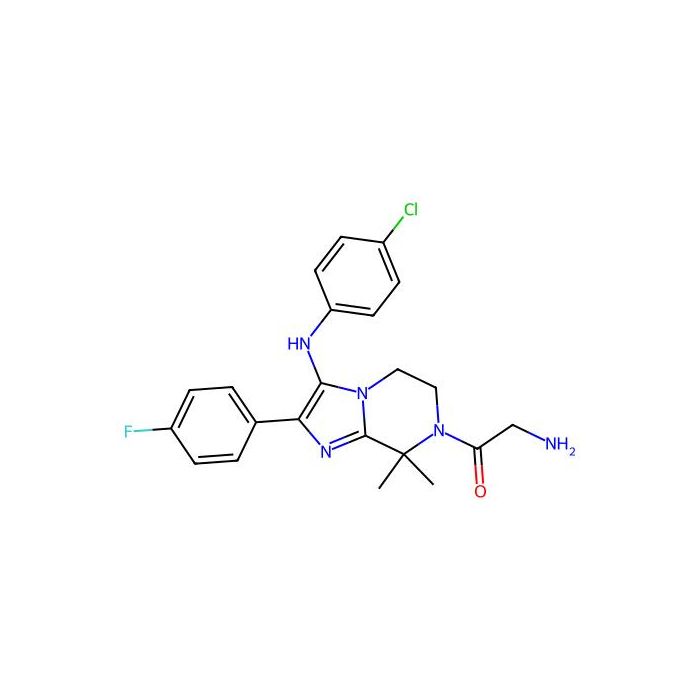
GNF179 is an optimized 8,8-dimethyl imidazolopiperazine analog that exhibits antimalarial potency ( IC 50 of 4.8 nM against the multidrug resistant strain W2). GNF179 is orally active
In Vitro
GNF179 does not rapidly inhibit parasite protein biosynthesis nor is it likely to target parasite cytochrome bc1, which has been validated as a hepatic stage target for Atovaquone . GNF179 may act against sporozoites instead of hepatic stages. GNF179 (5-100 nM; 48 h) shows high inhibition of gametocyte sexual life cycle progression in the mosquito as it abolished oocyst formation at 5 nM. MCE has not independently confirmed the accuracy of these methods. They are for reference only.
In Vivo
GNF179 (15 mg/kg; p.o.; single dose) shows antimalarial activity in rodent malaria model . MCE has not independently confirmed the accuracy of these methods. They are for reference only. Animal Model: Naïve Balb/C mice infected with P. berghei Dosage: 15 mg/kg Administration: Oral, single dose Result: Protected against an infectious P. berghei sporozoite. Animal Model: Naïve Balb/C mice Dosage: 3 or 20 mg/kg Administration: IV or PO (Pharmacokinetic Analysis) Result: Pharmacokinetics of GNF179 in naïve Balb/C mice . Dose AUC (0-∞) (hrs*µM) AUC/dose t 1/2 (hrs) MRT (hrs) CL (ml/min/kg) V ss (L/kg) C 0 or C max (µM) F (%) 3 mg/kg i.v. 8.88 3.0 8.9 9.0 22 11.8 6.1 nd 20 mg/kg p.o. 20.70 1.0 8.4 nd nd nd 1.2 58 AUC, Area Under the Curve; T 1/2 , half life; CL, clearance; V SS , steady-state volume of distribution; C 0 , initial concentration; C max maximum concentration; F, fraction of dose absorbed; hrs, hours; nd, not determined.
IC50& Target:Plasmodium
Spezifikationen
Spezifikationen & Reinheit
10mM in DMSO
Biochemische und physiologische Mechanismen
GNF179 is an optimized 8,8-dimethyl imidazolopiperazine analog that exhibits antimalarial potency ( IC 50 of 4.8 nM against the multidrug resistant strain W2). GNF179 is orally active.
Storage
Store at -80°C
Verschickt in
Dry ice packs + Cold packs
Dieses Produkt erfordert Kühlkettenversand. Grundversand und andere Economy-Optionen sind nicht verfügbar.
Aktionsart
INHIBITOR
Namen und Kennungen
Molekulargewicht
427.90
Erweiterte Daten
Zertifikate (CoA, COO, BSE/TSE und Analyse-Diagramm)
C of A & Other Certificates(BSE/TSE, COO):
Analytical Chart:
Lösungsrechner
Molarity Calculator
Determine the necessary mass, volume, or concentration for preparing a solution.
Dilution Calculator
Determine the dilution needed to prepare a stock solution.
Reconstitution Calculator
Bewertungen
Kundenbewertungen
Application Protocols
No tested applications or validated protocols are provided for this item in the Product Data. The following are general best practices for small-molecule screening and chemical biology experiments and must be optimized by the user.
Compound handling and stock preparation:
Allow vial to equilibrate to room temperature in a desiccator before opening to prevent condensation. Weigh rapidly in a fume hood.
Prepare a 10–50 mM stock in anhydrous DMSO. Vortex and, if needed, sonicate briefly. Filter through a low-protein-binding 0.2 µm PTFE filter if particulate persists.
Aliquot into amber, low-bind microtubes to avoid repeated freeze–thaw.
Assay setup (general):
Perform 8–12 point concentration–response curves (3-fold serial dilutions). Keep final DMSO constant across all wells (e.g., 0.1% v/v).
Include orthogonal readouts or counterscreens to identify assay interference (fluorescence quenchers/enhancers, redox cyclers, aggregators). Add 0.01–0.05% non-ionic detergent if compatible to reduce colloidal aggregation artifacts.
Record stability over assay time by LC–MS of representative wells or by re-injecting reserved samples.
Data quality:
Calculate Z′ factor for plate assays, include intra-/inter-plate controls, and replicate across days. Report full curve fits with Hill slopes and confidence intervals.
Note: These are general recommendations and are not validated for this specific item.
Biological Roles
Biological/biochemical context (literature/general; not an item-specific claim):
GNF179 has been reported in the research literature as a bioactive small molecule used to interrogate parasite biology. Publications have associated GNF-series compounds with modulation of Plasmodium cellular pathways; specific targets and mechanisms should be confirmed from primary sources when designing experiments.
Compounds of this class are not endogenous metabolites; they function as exogenous chemical probes in cellular assays.
Typical research use includes phenotypic screening, target deconvolution studies, and SAR campaigns to understand structure–activity relationships across parasite life-cycle stages in vitro.
Practical considerations for biological experiments:
Establish concentration–response curves (8–12 points, 3-fold dilutions) and replicate across independent days to assess assay robustness (Z′, signal window) and potential time-dependence of effects.
Evaluate potential off-target liabilities using orthogonal assay formats and counterscreens (e.g., cytotoxicity in host cells, reporter-interference assays if optical readouts are used).
Assess compound stability in assay media (protein binding, serum stability, and adsorption to plasticware) as these can shift apparent potency.
Important note:
No clinical, diagnostic, or therapeutic use is intended or permitted. This material is supplied strictly for research use only, as indicated in the Product Data.
Buffer Applications
This product is a bioactive small molecule and is not used as a buffering agent. Therefore, classic buffer-system guidance (e.g., pKa, buffer capacity, formulation recipes) does not apply.
Practical notes for assay media (general, not item-specific):
When preparing biological buffers or cell culture media containing the compound, dissolve the compound first in a miscible organic solvent (commonly DMSO), then dilute into the buffer with vigorous mixing to avoid precipitation. Maintain consistent final organic co-solvent percentages across controls and treatments.
Use low-binding plastics and, if assay-compatible, 0.01–0.05% non-ionic surfactant to reduce adsorption losses at very low concentrations.
For buffer selection in bioassays, follow the requirements of your target system (e.g., HEPES-buffered media for cell culture, phosphate or Tris buffers for biochemical assays) independent of this compound.
Green Alternatives
Because this product is a specific bioactive small molecule (not a solvent or bulk reagent), “green alternatives” primarily concern solvent and process choices during handling and any custom synthesis rather than substitution of the molecule itself.
Greener solvent choices for dissolution/processing (general guidance):
Prefer water with minimal DMSO where feasible in assays (optimize to ≤0.1–0.5% DMSO v/v). If higher co-solvent is needed, validate biological compatibility.
Ethanol can substitute for a portion of DMSO in some biochemical assays, offering lower toxicity and easier removal, but may impact membrane integrity in cell assays.
Avoid high-toxicity amide solvents (DMF, NMP) in biological workflows; if required for stock preparation, keep concentrations minimal and fully remove or dilute before use.
Packaging and waste minimization:
Prepare higher-concentration master stocks to reduce solvent volume and packaging footprint, then aliquot to minimize freeze–thaw cycles and waste.
Use amber vials to reduce photodegradation and the need for repeated preparations.
If performing custom synthesis/scale-up of analogs:
Consider process-intensified routes, catalytic couplings over stoichiometric reagents, and greener solvents (2-MeTHF, CPME, propylene carbonate) where compatible with the chemistry (general green-chemistry practice, not specific to this item).
Note: No item-specific environmental hazard or degradability data are provided; consult SDS for any ecotoxicity information.
Pharmaceutical Uses
No pharmaceutical/excipient status or compendial monograph is provided for this item, and it is sold strictly for research use only.
Context (general, non-clinical):
Discovery-stage small molecules like GNF179 are often handled as research tools for in vitro and ex vivo studies. They are not manufactured under GMP for human administration and have no stated pharmacopeial grade in the Product Data.
If formulating for non-clinical research (e.g., in vitro or permitted animal studies under institutional approvals), typical vehicles may include DMSO-based stocks diluted into aqueous systems or, for permitted in vivo studies, ternary vehicles (e.g., PEG-400/saline/co-solvent) developed de novo. Any such use must be evaluated for stability, tolerability, and compliance with local regulations.
Item-specific statements:
Grade/purity: Not specified for this item; refer to CoA/Spec Sheet.
No medical, diagnostic, or therapeutic claims are made or implied. Do not use in humans.
Physical Properties
Item-specific physicochemical properties are not provided in the Product Data for this SKU.
Appearance: Not specified for this item; refer to CoA/Spec Sheet.
Melting point (MP): Not specified for this item; refer to CoA/Spec Sheet.
Boiling point (BP): Not applicable/unknown for a high-MW, non-volatile research compound; specific value not specified for this item; refer to CoA/Spec Sheet.
Density: Not specified for this item; refer to CoA/Spec Sheet.
Solubility: Not specified for this item; refer to CoA/Spec Sheet. (General practice for screening compounds is dissolution in anhydrous DMSO; see Storage & Reconstitution.)
LogP/logD: Not specified for this item; refer to CoA/Spec Sheet.
pKa(s): Not specified for this item; refer to CoA/Spec Sheet.
Refractive index: Not applicable to solids; not specified for this item; refer to CoA/Spec Sheet.
General considerations (literature/practice, not item-specific):
Discovery-screening molecules frequently display limited aqueous solubility; co-solvent systems (DMSO→buffer dilution) or surfactant-assisted vehicles may be used for biological assays.
If analytical development is planned, determine exact solubility, extinction coefficients, and stability in chosen assay media by small-scale pretests (LC–MS tracking recommended). Avoid assuming solubility based on scaffold class; confirm empirically.
Hygroscopicity, polymorphism, and amorphous vs crystalline form can influence handling; verify on receipt with the provided CoA/specification.
Quality and Grades
Grade/Purity: Not specified for this item; refer to CoA/Spec Sheet.
Interpretation and guidance:
In discovery and screening contexts, grade commonly denotes suitability for in vitro research use, with characterization by NMR/LC–MS/HPLC purity. Exact analytical methods, purity thresholds (e.g., ≥95% HPLC), and residual solvent/elemental analyses should be verified on the item’s CoA.
UV cutoffs, water/peroxide content, and trace metal specifications are not applicable unless stated; none are specified for this item.
If the compound is used in quantitative biology or chemical biology, confirm identity and purity upon receipt (orthogonal check by LC–MS and 1H NMR recommended) to ensure assay reproducibility.
Stabilizers: None specified for this item. If the compound is air/light/moisture sensitive (structure-dependent), stabilizers or packaging under inert gas may be used; consult CoA/packaging notes.
What this means for users:
For biochemical assays, purity impacts on-target vs off-target effects and background fluorescence/absorbance. If lower background is required (e.g., HTS readouts, photophysical assays), request or measure spectral interferences and purity profile.
For medicinal chemistry follow-up, consider re-purifying (prep-HPLC) if ultra-high purity or specific solid-state form is critical. Always retain batch records linking internal sample IDs to the supplied CoA.
Reaction and Applications
This catalog item is positioned as a research small molecule/compound library member rather than a general synthetic reagent. No manufacturer application text is provided for chemical reactions.
Research applications (general/literature context, not item-specific claims):
Chemical biology and phenotypic screening: Compounds in this class are often used as tool molecules for target identification/validation, chemogenomic profiling, and structure–activity relationship (SAR) exploration.
Probe development: When supported by literature, analogs of GNF-series molecules have been used to study parasite-specific biochemical pathways. If using for target deconvolution, consider CETSA, DARTS, photoaffinity analogs, or CRISPR-based chemogenomic mapping.
Analytical/assay tips:
Verify identity and purity (LC–MS and HPLC) before screening. Track potential instability (e.g., hydrolysis/oxidation) by time-course LC–MS in assay media.
Adsorption and loss: Low-nM work can be impacted by adsorption to plastics. Prefer low-bind polypropylene plates/tubes; pre-condition tips/vials with diluted compound or 0.01% Tween-20 when compatible.
Interference controls: Include counterscreens for fluorescence/absorbance interference and redox activity (e.g., PAINS filters are heuristic only; perform orthogonal assays).
Synthetic chemistry usage: Not typically employed as a building block or reagent; if derivatization is intended for SAR, ensure you have a well-annotated structure and IP freedom-to-operate prior to route design.
Reaction Conditions
Not applicable in the traditional sense: this item is not offered as a reagent for chemical transformations, and no manufacturer reaction conditions are provided.
If undertaking custom chemistry on this scaffold (general, not item-specific):
Solvents: Select based on the confirmed functional groups; polar aprotic solvents (DMF, DMSO, NMP) and green alternatives (2-MeTHF, CPME) are commonly useful for heteroaromatic couplings.
Temperatures/catalysts: Choose according to the reaction class (e.g., Pd-catalyzed cross-couplings typically 50–110°C under inert atmosphere; amide couplings at ambient to 60°C with modern coupling reagents). These are general literature conditions and must be tailored to the actual structure.
Workup/purification: Anticipate strong retention on reverse-phase media for polar, heteroatom-rich scaffolds; prep-HPLC may be necessary for high purity.
For biological assays (use-phase conditions, not synthesis):
Stock preparation typically at 10–50 mM in DMSO; working concentrations are assay-dependent and should be established via titration. Maintain consistent DMSO across all wells/conditions. Confirm stability over the assay timeframe.
Safety and Handling
Hazard classification for this specific item is not provided in the Product Data. Always consult the SDS for authoritative safety information.
Signal word (GHS): Not specified for this item; refer to SDS.
H-statements / P-statements: Not specified for this item; refer to SDS.
GHS pictograms: Not specified for this item; refer to SDS.
General laboratory precautions (good practice for small-molecule bioactive compounds):
PPE: laboratory coat, safety glasses, and appropriate chemical-resistant gloves (e.g., nitrile). Handle powders in a fume hood to avoid inhalation and to limit exposure to dust/aerosols.
Avoid skin contact and ingestion. Prevent aerosolization during weighing (use antistatic tools, weigh boats with covers). For DMSO stocks, remember DMSO can enhance dermal absorption—wipe spills promptly and wear intact gloves.
Storage incompatibilities: Keep segregated from strong oxidizers and strong acids/bases unless compatibility is established. Avoid prolonged exposure to light, heat, and moisture.
First aid (overview; defer to SDS): Eye/skin contact—rinse with water for ≥15 min; remove contaminated clothing. Inhalation—move to fresh air. Ingestion—rinse mouth; seek medical attention in all cases of exposure.
Waste: Dispose according to institutional hazardous chemical waste procedures. Avoid drain disposal.
Special risks: None are specified for this item. If the compound contains latent electrophiles or photolabile groups (structure-dependent), additional precautions may apply—verify via SDS/CoA.
Solvent Selection
Item-specific solubility is not provided. The following guidance reflects common practice for small-molecule screening compounds and should be validated empirically for this item.
Primary solvent for stocks: Anhydrous DMSO is typically used to prepare concentrated stocks (e.g., 10–50 mM) for HTS/cellular assays. Verify clarity and absence of particulates after dissolution and brief sonication.
Aqueous dilution: Prepare working solutions by serial dilution of DMSO stocks into assay buffer/media, keeping final DMSO ≤0.1–0.5% v/v for mammalian cells or per your assay’s tolerance. Pre-warm buffers if solubility is temperature sensitive.
Alternative co-solvents (general): DMF or ethanol can sometimes aid dissolution; however, DMSO generally provides the broadest compatibility with biochemical and cell-based assays. For in vitro enzyme assays, consider glycerol or PEG-400 cosolvent traces if needed and assay-compatible.
Polarity and miscibility (general): DMSO is fully miscible with water and most polar organics. Ethanol is miscible with water; DMF is water-miscible but more toxic. Avoid non-polar solvents for biological assays unless strictly required.
Comparison (general, not item-specific):
DMSO: highest solvating power for diverse chemotypes; enhances dermal absorption (handle carefully).
Ethanol: lower solvating power; better volatility for rapid drying.
DMF: strong solvent; higher toxicity; use sparingly in bioassays.
Always confirm stability of the compound in the chosen solvent over intended storage/use intervals (freeze–thaw resilience, photostability, and hydrolytic stability).
Storage and Reconstitution
Storage conditions (from Product Data):
Store at −80°C.
Shipped on dry ice packs + cold packs to preserve low temperature during transit.
Storage best practices:
Keep the container tightly closed under an inert, dry atmosphere if possible. Allow to warm in a desiccator to room temperature before opening to avoid moisture condensation.
After initial opening, promptly prepare small working aliquots to minimize freeze–thaw cycles. Store aliquots at −80°C (preferred) or −20°C if short-term use and stability data permit.
Protect from light; use amber vials.
Reconstitution (general guidance; not item-specific):
Solvent: Anhydrous DMSO is commonly used for initial dissolution of screening compounds. Start at 10–50 mM; adjust based on observed solubility. For aqueous use, dilute the DMSO stock into buffer/media with vigorous mixing to the desired final concentration, maintaining consistent DMSO across samples.
Inspect for clarity. If precipitation occurs upon dilution, reduce concentration, increase temperature slightly, or include a small amount of co-solvent compatible with the assay.
Stability notes:
No item-specific stability, hygroscopicity, or light-sensitivity data are provided. Verify stability in storage solvent (DMSO) and in assay media over the intended use period by analytical methods (HPLC/LC–MS). Refer to the CoA/Spec Sheet and SDS for any additional handling instructions.
Research use note: For research use only.
Structure and Identity
GNF179 is a research small molecule from a screening/chemogenomic context. Item-specific structural identifiers are not provided in the Product Data.
SKU: G654993
Product name: GNF179
CAS: 1261114-01-5 (catalog reference)
Molecular formula: Not specified for this item; refer to CoA/Spec Sheet.
Molecular weight: Not specified for this item; refer to CoA/Spec Sheet.
SMILES: Not specified for this item; refer to CoA/Spec Sheet.
InChIKey: Not specified for this item; refer to CoA/Spec Sheet.
Structural features (general/literature context):
GNF179 is reported in the literature as a drug-like, heteroaromatic small molecule probe; detailed atom-by-atom structure should be confirmed from the primary reference or CoA.
No stereochemical information, salt form, or solvate state is specified for this catalog item.
2D structure description (general guidance):
Without item-specific identifiers, a reliable textual description of ring systems and functional groups cannot be provided here. Please consult the Certificate of Analysis (CoA), specification sheet, or primary literature for a definitive depiction and identifiers appropriate for method development, analytical tracking (HPLC/LC–MS), and regulatory documentation in research settings.
Synthetic Utility
This product is supplied as a finished bioactive small molecule and is not positioned as a general-purpose synthetic reagent or building block.
Guidance for chemists intending derivatization (general, not item-specific):
Prior to any semi-synthesis or analog preparation, obtain the definitive chemical structure and functional group map (from CoA/literature) to identify feasible vectors for modification and protect labile moieties.
Plan convergent routes enabling late-stage diversification around putative pharmacophore features. Modern cross-couplings (Suzuki–Miyaura, Buchwald–Hartwig) and heteroaromatic functionalizations are common tactics for related scaffolds, subject to the actual structure.
Establish robust analytical methods (LC–MS, purity by HPLC/UPLC, qNMR) for both the parent molecule and derivatives.
Because no structure, functional groups, or protecting-group liabilities are provided in the Product Data, concrete synthetic transformations or named-reaction suitability cannot be responsibly specified for this SKU.
Target Specificity
Item-specific target data are not provided in the Product Data.
GNF-series small molecules have been studied as chemical probes in parasitology. Publications have associated related compounds with modulation of parasite intracellular pathways; specific molecular targets, selectivity profiles, and resistance mutation mapping should be verified from primary sources prior to experimental planning.
For rigorous target deconvolution, combine orthogonal methods: chemical genetics (resistance selection and whole-genome sequencing), proteomics-based target capture (when analogs allow), and biophysical engagement assays (e.g., CETSA, SPR with purified protein when available).
Important: Do not infer target specificity for this exact catalog item without consulting the CoA/specification and the primary literature. Any biological use should include appropriate positive/negative controls and orthogonal confirmation.
Häufig gestellte Fragen
How should this product be stored?
Store at ?80 °C. Ultra-low temperature storage is required to maintain the specified shelf life.
How is this product shipped?
This product ships frozen with dry ice and cold packs. Unpack on arrival and transfer it to the storage condition stated above; handle dry ice with insulated gloves in a ventilated area.
What are the CAS number, molecular formula and molecular weight?
The CAS Number is 1261114-01-5, the molecular formula is C22H23ClFN5O, and the molecular weight is 427.90 g/mol.
What documentation is provided?
Available product documentation, including Certificates of Analysis (COA), Safety Data Sheets (SDS), and specification sheets, is shown in the product document area. Document availability and access follow the current site policy.
Wir verwenden Cookies, um die ordnungsgemäße Funktion der Website sicherzustellen und, soweit zulässig, Ihr Nutzererlebnis zu verbessern. Sie können Ihre Einstellungen jederzeit unter „Einstellungen“ verwalten. Weitere Informationen finden Sie in unserer Cookie-Richtlinie.
Dürfen wir Sie über Rabattaktionen informieren?
Später erinnern
Vielen Dank! Bitte überprüfen Sie Ihren E-Mail-Posteingang, um zu bestätigen.
Products are supplied to verified businesses, institutions, and qualified professionals for research and development use only. Not for use in humans, animals, diagnosis, or therapy.