GSK-J4 - Moligand™, ≥98% , Inhibitor of lysine demethylase 5B;Inhibitor of lysine demethylase 5C;Inhibitor of lysine demethylase 6A;Inhibitor of lysine demethylase 6B, CAS No.1373423-53-0, Inhibitor of lysine demethylase 5B;Inhibitor of lysine demethylase 5C;Inhibitor of lysine demethylase 6A;Inhibitor of lysine demethylase 6B
GSK-J4 - Moligand™, ≥98% , Inhibitor of lysine demethylase 5B;Inhibitor of lysine demethylase 5C;Inhibitor of lysine demethylase 6A;Inhibitor of lysine demethylase 6B, CAS No.1373423-53-0, Inhibitor of lysine demethylase 5B;Inhibitor of lysine demethylase 5C;Inhibitor of lysine demethylase 6A;Inhibitor of lysine demethylase 6B
QUALITÄT & REINHEITMoligand™?Moligand™ — Aladdin's line of ligands and bioactive small molecules. Use for receptor, pathway, and binding studies needing defined small-molecule tools.≥98%
GSK-J4 wurde verwendet, um die Wirkung der KDM2B (Jumonji (JmjC) Domain Histon 3 Lysin 36 (H3K36) Di-Demethylase) Hemmung auf das Überleben und DNA-Reparatur-Potenzial von Glioblastomzellen zu untersuchen. Es wurde auch im Sulforhodamin B (SRB) Zellwachstumstest und im Zelllebensfähigkeitstest verwendet.
Spezifikationen
Synonyme
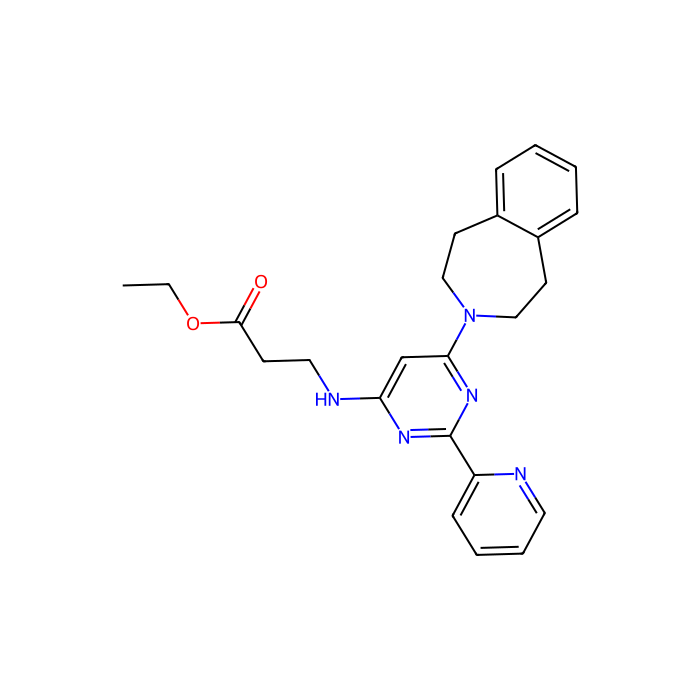
Ethyl 3-((6-(4,5-dihydro-1H-benzo[d]azepin-3(2H)-yl)-2-(pyridin-2-yl)pyrimidin-4-yl)amino)propanoate | ETHYL 3-{[2-(PYRIDIN-2-YL)-6-(1,2,4,5-TETRAHYDRO-3-BENZAZEPIN-3-YL)PYRIMIDIN-4-YL]AMINO}PROPANOATE | 1-Naphthalenemethanamine, alpha-methyl- | GSK J4 | N-[2-(2-Pyridinyl)-6-(1,2,4,5-tetrahydro-3H-3-benzazepin-3-yl)-4-pyrimidinyl]-beta-al Show more
Spezifikationen & Reinheit
Moligand™, ≥98%
Biochemische und physiologische Mechanismen
GSK-J4 ist ein zelldurchlässiges Prodrug, das von Makrophagen-Esterasen schnell zu GSK-J1, einem potenten selektiven Jumonji-H3K27-Demethylase-Inhibitor, hydrolysiert wird. Jumonji-C-Domäne-enthaltende Histondemethylasen (JHDMs) sind Fe(II)- und α-Ketoglu
Storage
Lagerung bei -20°C, getrocknet
Verschickt in
Eistruhe + Eispads
Note
Moligand™
Aktionsart
INHIBITOR
Mechanismus der Wirkung
Inhibitor of lysine demethylase 5B;Inhibitor of lysine demethylase 5C;Inhibitor of lysine demethylase 6A;Inhibitor of lysine demethylase 6B
Hinweis
Wenn möglich, sollten Sie die Lösungen noch am selben Tag zubereiten und verwenden. Wenn Sie jedoch Stammlösungen im Voraus herstellen müssen, empfehlen wir Ihnen, die Lösung als Aliquote in dicht verschlossenen Fläschchen bei -20 °C zu lagern. Diese sind in der Regel bis zu einem Monat haltbar. Vor der Verwendung und vor dem Öffnen des Fläschchens empfehlen wir, das Produkt mindestens 1 Stunde lang auf Raumtemperatur kommen zu lassen. Benötigen Sie weitere Ratschläge zur Löslichkeit, Verwendung und Handhabung? Besuchen Sie unsere Seite mit den häufig gestellten Fragen (FAQ) für weitere Informationen.
This compound belongs to the class of organic compounds known as pyridinylpyrimidines. These are compounds containing a pyridinylpyrimidine skeleton, which consists of a pyridine linked (not fused) to a pyrimidine by a bond.
External Descriptors
Not available
1. Djoumbou Feunang Y, Eisner R, Knox C, Chepelev L, Hastings J, Owen G, Fahy E, Steinbeck C, Subramanian S, Bolton E, Greiner R, and Wishart DS. ClassyFire: Automated Chemical Classification With A Comprehensive, Computable Taxonomy. Journal of Cheminformatics, 2016, 8:61.
Determine the necessary mass, volume, or concentration for preparing a solution.
Dilution Calculator
Determine the dilution needed to prepare a stock solution.
Reconstitution Calculator
Bewertungen
Kundenbewertungen
Application Protocols
No item-specific, validated protocols are provided in the Product Data for SKU G276086.
General guidance (non-prescriptive, for planning only):
Stock preparation: Many users prepare 10–50 mM stocks in dry DMSO, then perform serial dilutions in assay-compatible media while keeping final DMSO levels consistent across controls.
Controls: Include vehicle-only and, where possible, orthogonal probes or genetic controls to confirm on-target effects.
Readouts: Selection of biochemical or cellular endpoints (e.g., histone mark quantification) depends on assay design and is not specified for this product.
Please consult your institutional SOPs and primary literature for detailed, validated procedures tailored to your system. For any application-specific recommendations or constraints, refer to the CoA/Spec Sheet.
Biological Roles
Literature context (research use only):
Target class: GSK-J4 is widely used in chemical biology as a prodrug inhibitor targeting Fe(II)/2-oxoglutarate-dependent histone demethylases of the KDM6 subfamily (KDM6A/UTX and KDM6B/JMJD3). These enzymes remove methyl groups from H3K27me3/me2, a key repressive chromatin mark.
Mechanistic rationale: After cellular uptake, esterases hydrolyze GSK-J4 to the corresponding diacid (GSK-J1), which engages the Jumonji catalytic pocket, chelates Fe(II), and competes with 2-oxoglutarate, thereby attenuating demethylation activity in biochemical and cellular assays.
Biological pathways: Modulation of KDM6A/B activity alters the balance of H3K27 methylation, providing a handle to interrogate gene regulation, developmental programs, inflammatory signaling, and differentiation pathways in model systems. These studies aim to elucidate epigenetic control mechanisms rather than to make clinical claims.
Selectivity considerations: Reported selectivity versus other JmjC demethylases varies by assay and concentration. Off-target interactions can emerge at higher exposures; thorough concentration–response and orthogonal validation (e.g., genetics or alternative chemotypes) are recommended.
Probe best practices: Include appropriate vehicle controls, matched inactive or orthogonal probes if available, and verify on-target effects via biochemical readouts (e.g., global/locally increased H3K27 methylation) alongside phenotypic outcomes.
Note: All uses are intended strictly for laboratory research. No medical, diagnostic, or therapeutic applications are implied.
Buffer Applications
This product is a bioactive small-molecule probe rather than a buffering agent. It is not used to establish or maintain solution pH, nor is it a common component of electrophoresis or chromatography buffer systems.
Practical note (general):
When dosing into buffered systems (e.g., PBS, HEPES-buffered media), prepare a concentrated DMSO stock and add to the buffer with vigorous mixing to minimize precipitation. Maintain consistent vehicle concentrations across control and treatment samples.
Item-specific buffer recipes, pKa values, buffer ranges, and related specifications are not applicable for this compound.
Green Alternatives
GSK-J4 is a defined bioactive probe rather than a process solvent or commodity reagent, so conventional “green substitution” frameworks (e.g., replacing a solvent with a greener one) are not typically applicable.
Context and options:
Functional alternatives (not greener per se): Other chemical probes that modulate the same biological pathway (e.g., alternative KDM6 inhibitors or orthogonal epigenetic modulators) may be used for mechanistic triangulation, but these are not environmental substitutions.
Solvent practices (general): If your workflow centers on stock preparation and dosing, you can improve greenness by minimizing DMSO volumes, using micro-volume dosing, and recovering/segregating solvent waste appropriately. Where scientifically acceptable, ethanol or aqueous vehicles with minimal DMSO content can reduce reliance on polar aprotic solvents, though assay biology must dictate feasibility.
Comparison (general planning):
DMSO vs ethanol for stock preparation:
DMSO: superior solvating power; widely used; higher environmental persistence concerns; excellent for high-concentration stocks.
Ethanol: renewable feedstocks available; better EHS profile; may limit achievable stock concentration and can perturb cells at modest % v/v.
Bottom line:
There is no true “green alternative” to GSK-J4 as a specific probe. Emphasize solvent minimization, right-sizing experiments, and responsible waste management to improve sustainability of your usage.
Pharmaceutical Uses
GSK-J4 supplied under Moligand™ grade is for research use only. It is not produced under GMP and is not intended for human or veterinary use, diagnostics, or as a drug substance/product.
Context (general, non-clinical):
Role in R&D: In pharmaceutical discovery labs, GSK-J4 is employed as a chemical biology tool to probe epigenetic targets (KDM6A/B) in target validation, assay development, and mechanism-of-action studies. These activities inform basic science and early-stage research only.
Formulation relevance: As a screening probe, it is typically used in simple solvent vehicles (e.g., DMSO stocks) and not formulated as a finished dosage form. Excipient compatibility, pharmacopeial status, and Quality by Design parameters are therefore not applicable here.
Item-specific regulatory designations (e.g., USP/Ph.Eur. monographs, ICH impurity controls) are not specified for this item and generally do not apply to research-grade probes.
Physical Properties
Item-specific (from Product Data):
Appearance: Not specified for this item; refer to CoA/Spec Sheet.
Storage conditions: Store at −20 °C, desiccated.
Shipping: Ice chest + ice pads.
Not specified for this item; refer to CoA/Spec Sheet:
Melting point, boiling point, density, refractive index, UV cutoff, water/peroxide/metal limits, exact solubility limits, partition coefficient.
Literature/general information for user planning (not item specifications):
Form: Typically supplied as an off-white to light-colored solid in many catalogs; hygroscopicity can vary by salt/form.
Solubility: Frequently prepared as concentrated stock solutions in anhydrous DMSO (e.g., 10–50 mM), then diluted into aqueous media with careful mixing to minimize precipitation. Actual solubility depends on lot and form; verify on CoA.
Aqueous behavior: Direct dissolution in water/buffer is usually poor; co-solvent strategies (DMSO first, then stepwise dilution into buffer/medium) are commonly employed in screening labs.
Stability considerations: Protected from moisture and light, GSK-J4 is typically stable for long-term storage at −20 °C in solid form. In solution (especially in aqueous media), ester hydrolysis can occur over time; prepare fresh working dilutions.
pKa/logP: Specific numerical values vary by source and are not provided here; consult primary literature or compute for your use case.
Practical tip (general): Allow vials to equilibrate to room temperature in a desiccated environment before opening to prevent moisture condensation on the solid.
Interpretation and implications (general information about the grade):
Moligand™ denotes compounds curated for chemical biology and screening workflows. Typical expectations for this grade include verified identity (e.g., NMR/HRMS) and suitability for in vitro biochemical or cell-based assays. Exact assay purity thresholds, residual solvent limits, and absorbance profiles are not specified for this item; refer to the CoA/Spec Sheet for lot-specific details.
Stabilizers: Not specified for this item; refer to CoA/Spec Sheet. In the absence of stabilizers, storage under dry, inert, and low-temperature conditions is recommended to minimize ester hydrolysis and other degradative pathways.
Batch documentation: For screening applications, users commonly check lot-specific analytical data (e.g., HPLC trace, purity, water content, residual metals) when available. Since such parameters are not listed here, consult the CoA to align with your QC requirements.
Fit for purpose: Moligand-grade GSK-J4 is intended for research use only (e.g., target validation, pathway interrogation, assay development). It is not produced under GMP conditions and is unsuitable for diagnostic or therapeutic use.
Recommendations:
If your workflow requires ultra-low UV absorbance, precise trace-metal control, or defined counterions, confirm specifications on the CoA and consider additional in-house qualification (e.g., re-HPLC, LC–MS) aligned with your assay sensitivity.
Reaction and Applications
This product is supplied as a bioactive probe for research, not as a general synthetic reagent. Accordingly, its most relevant “applications” are in chemical biology and assay development rather than in organic transformations.
General research applications (literature, non-item-specific):
Epigenetic target interrogation: GSK-J4 is a widely used tool compound to probe Jumonji C (JmjC) family demethylases, particularly KDM6 subfamily members (JMJD3/KDM6B and UTX/KDM6A). It is a cell-permeable ester prodrug that is hydrolyzed intracellularly to the active acid (GSK-J1), which chelates the Fe(II) center and competes with 2-oxoglutarate in the catalytic site.
Selectivity context: Literature commonly reports strong functional inhibition of KDM6A/B in cells; however, exact selectivity profiles depend on assay format and concentration. Users should confirm target engagement under their specific conditions.
Not a synthetic reagent:
GSK-J4 is not typically used for bond-forming reactions, catalysis, or as a building block. If you require a demethylase-binding scaffold for medicinal chemistry, consult primary literature for synthetic routes starting from the parent chemotype (GSK-J1) rather than modifying this finished prodrug.
Practical notes:
Prepare fresh working solutions and include vehicle controls. Consider time-course experiments due to potential prodrug activation kinetics in different cell types.
Reaction Conditions
Not typically applicable. GSK-J4 is not used as a reagent or catalyst in preparative organic reactions; therefore, standard parameters such as temperature windows, catalysts, equivalents, and yields are not relevant.
General laboratory handling (for solution preparation only; not a reaction protocol):
Solvent: Anhydrous DMSO is commonly used to prepare concentrated stocks.
Temperature/light: Room temperature dissolution is usually sufficient; protect from strong light and moisture during handling.
Stability in solution: In aqueous media, slow hydrolysis can occur; prepare working solutions freshly and avoid extended incubations prior to dosing when possible.
For synthetic reaction conditions concerning the preparation of the GSK-J1/J4 chemotype, consult primary literature; such procedures are outside the scope of this product listing.
Safety and Handling
Authoritative safety data are provided in the product SDS. The following summarizes general laboratory precautions for small-molecule screening probes like GSK-J4.
Item-specific (from Product Data):
GHS classification, signal word, H-statements, pictograms: Not specified for this item; refer to SDS.
General guidance (not a substitute for SDS):
Likely hazards: Many bioactive small molecules may cause skin/eye irritation or respiratory discomfort; treat as harmful if swallowed or inhaled. Avoid generation of dust/aerosols.
PPE: Lab coat, nitrile gloves (change regularly), and chemical splash goggles. Use a certified chemical fume hood when weighing or preparing solutions.
Handling: Minimize exposure to ambient humidity to preserve material integrity. Cap vials promptly. Avoid contact with strong acids/bases that can catalyze ester hydrolysis.
Incompatibilities (general): Strong oxidizers; strong acids/bases under elevated temperature; prolonged light/moisture exposure that can promote degradation.
First aid (overview): If skin contact occurs, wash thoroughly with soap and water. If eye exposure, flush with water for at least 15 minutes and seek medical attention. If inhaled, move to fresh air; if ingested, rinse mouth and seek medical attention. Always follow institutional protocols.
Spills: Avoid dust formation; absorb small spills with inert material (e.g., vermiculite), place in chemical waste. Decontaminate surfaces with suitable organic solvent followed by detergent.
Waste: Collect solid and solution waste in labeled containers for disposal per local regulations.
Always defer to the SDS for definitive hazard classification and response measures.
Solvent Selection
Because GSK-J4 is a hydrophobic, masked-ester prodrug, solvent choice is primarily about achieving reliable dissolution for stock preparation and ensuring compatibility with downstream biological media.
Item-specific:
No item-specific solubility data provided; refer to CoA/Spec Sheet for definitive guidance.
Literature/general practice (for planning only):
Primary solvent: Anhydrous DMSO is the most common choice for preparing concentrated stocks (e.g., 10–50 mM), given typical high solubility and chemical compatibility.
Secondary vehicles: For working concentrations in aqueous buffers or cell culture media, dilute the DMSO stock gradually with vigorous mixing to prevent precipitation. Maintain final DMSO content (often ≤0.1–0.5% v/v in cellular assays) according to assay tolerance.
Alternative co-solvents: DMF or ethanol can dissolve many esterified probes but may be less favored in live-cell assays due to cytotoxicity; evaluate empirically and keep vehicle controls.
Polarity/miscibility (general):
DMSO: polar aprotic, fully miscible with water; excellent for initial dissolution.
Ethanol: protic, water-miscible; may support lower stocks than DMSO and can impact cell physiology at modest percentages.
Aqueous buffers: poor direct solubility is common; use co-solvent strategy.
Filtration: If sterile solutions are required, dissolve fully first, then pass through a compatible 0.22 μm PTFE/PES filter. Avoid adsorption losses by minimizing filter surface area and validating recovery.
Tip: Warm (room temperature) DMSO and brief sonication can aid dissolution; avoid prolonged heating that may accelerate ester hydrolysis.
Storage and Reconstitution
Item-specific storage and logistics (from Product Data):
Storage conditions: Store at −20 °C, desiccated.
Shipping: Ice chest + ice pads.
Not specified for this item; refer to CoA/Spec Sheet:
General handling notes (for planning; not item specifications):
Allow vial to warm to room temperature in a desiccated environment before opening to prevent moisture condensation.
After first opening, promptly recap and, if possible, backfill with inert gas and return to −20 °C desiccated storage.
For solution preparation, dry DMSO is commonly used; prepare aliquots to minimize freeze–thaw cycles. Avoid repeated thawing of the solid or solutions.
Always consult the CoA/Spec Sheet and the SDS for lot-specific guidance on stability and any additional handling recommendations.
Structure and Identity
GSK-J4 is a well-known bioactive small-molecule probe supplied here as part of Aladdin’s Moligand™ collection for screening and chemical biology.
Item-specific (from Product Data):
CAS: 1373423-53-0
CID: 71729975
InChIKey: 393973 (as provided; verify on CoA/Spec Sheet for full key)
SMILES: Not specified for this item; refer to CoA/Spec Sheet.
Molecular formula: Not specified for this item; refer to CoA/Spec Sheet.
Molecular weight: Not specified for this item; refer to CoA/Spec Sheet.
Literature/General structural information (for context only, not item specification):
GSK-J4 is the cell-permeable, masked-ester prodrug of the histone demethylase inhibitor GSK-J1. Intracellular esterases hydrolyze GSK-J4 to the active acid (GSK-J1).
Structural features typically include: an aromatic heterocycle core and diester functionalities that enhance cell permeability; the active form (GSK-J1) coordinates Fe(II) at the KDM6 catalytic site while competing with 2-oxoglutarate (2-OG).
Functional group highlights: two masked carboxylates as esters (prodrug), amide/heteroaryl donors/acceptors tailored for Fe(II)/2-OG demethylase binding.
A heteroaromatic ring system bearing two carboxyl-derived ester arms (in GSK-J4) arranged such that, upon hydrolysis, the diacid (GSK-J1) presents a bidentate metal-binding motif. Substituents provide H-bonding and shape complementarity to the Jumonji catalytic pocket.
Notes:
Exact stereochemistry is generally not a defining feature (commonly drawn as achiral or racemic where applicable). Confirm all definitive identifiers (SMILES, InChIKey, formula, MW) on the CoA/Spec Sheet for this specific lot.
Synthetic Utility
GSK-J4 is a finished bioactive probe and is not commonly used as a synthetic intermediate or reagent.
General notes (contextual, literature-based):
Chemotype: The GSK-J1/GSK-J4 scaffold is an Fe(II)/2-oxoglutarate demethylase-binding chemotype. Medicinal chemistry around this scaffold focuses on fine-tuning permeability (via prodrugging), metal-binding geometry, and selectivity among JmjC demethylases. In practice, such optimization starts from earlier intermediates rather than from GSK-J4 itself.
Functional groups: The masked diester in GSK-J4 is designed for bioconversion; hydrolysis regenerates the active diacid (GSK-J1). While, in principle, the esters could be manipulated, the value of GSK-J4 lies in its intact prodrug function rather than as a feedstock for further synthesis.
Retrosynthetic insight: Access to this chemotype typically proceeds through assembly of the heteroaromatic core followed by installation of acid handles and final esterification to deliver the prodrug. Users seeking building-block level entries should consult primary literature for precursor availability rather than modifying this final probe.
Conclusion: If your goal is synthetic diversification, source or prepare upstream intermediates. Reserve GSK-J4 for its intended role as a bioactive tool compound in assays.
Target Specificity
Item-specific, experimentally verified target data are not provided in the Product Data.
General literature context (for orientation only; verify in your system):
Primary targets commonly associated with GSK-J4 in chemical biology are KDM6A (UTX) and KDM6B (JMJD3), members of the Jumonji C (JmjC) domain-containing histone demethylases that remove H3K27me3/me2 marks.
Mode of action: Prodrug conversion to GSK-J1 enables Fe(II) coordination and 2-oxoglutarate competition in the catalytic pocket.
Off-target considerations: Selectivity profiles can vary by assay type (biochemical vs cellular) and concentration; orthogonal validation is recommended.
For definitive, lot-specific target engagement data, IC50/Ki values, or selectivity panels, please refer to the CoA/Spec Sheet or generate in-house under your assay conditions.
Häufig gestellte Fragen
What is the purity of this product?
This product is supplied at ≥98% purity (chemical assay). Lot-specific values are stated on the Certificate of Analysis.
What is Moligand??
Moligand? is one of Aladdin Scientific's premium product lines, formulated for high-purity applications across multiple workflows. Compared to standard grades in the same workflow, Moligand? products typically offer tighter specifications, more rigorous QC, and stronger lot-to-lot consistency.
How should this product be stored?
Store at ?20 °C, desiccated. Keep the container tightly closed with desiccant — the material is moisture-sensitive.
How is this product shipped?
This product ships in an insulated container with ice pads. Unpack on arrival and transfer it to the storage condition stated above.
What are the CAS number, molecular formula and molecular weight?
The CAS Number is 1373423-53-0, the molecular formula is C24H27N5O2, and the molecular weight is 417.51 g/mol. InChIKey WBKCKEHGXNWYMO-UHFFFAOYSA-N.
What documentation is provided?
Available product documentation, including Certificates of Analysis (COA), Safety Data Sheets (SDS), and specification sheets, is shown in the product document area. Document availability and access follow the current site policy.
Benötigen Sie Hilfe bei der Auswahl der Qualität?
Unser Leitfaden zur Qualitätsauswahl behandelt Reinheit, Stabilisatorstatus und Anwendungseignung für alle Varianten in unserem Katalog.
Wir verwenden Cookies, um die ordnungsgemäße Funktion der Website sicherzustellen und, soweit zulässig, Ihr Nutzererlebnis zu verbessern. Sie können Ihre Einstellungen jederzeit unter „Einstellungen“ verwalten. Weitere Informationen finden Sie in unserer Cookie-Richtlinie.
Dürfen wir Sie über Rabattaktionen informieren?
Später erinnern
Vielen Dank! Bitte überprüfen Sie Ihren E-Mail-Posteingang, um zu bestätigen.
Products are supplied to verified businesses, institutions, and qualified professionals for research and development use only. Not for use in humans, animals, diagnosis, or therapy.

 J2630041