Determine the necessary mass, volume, or concentration for preparing a solution.
| Activity Type | Activity Value -log(M) | Mechanism of Action | Activity Reference | Publications (PubMed IDs) |
|---|

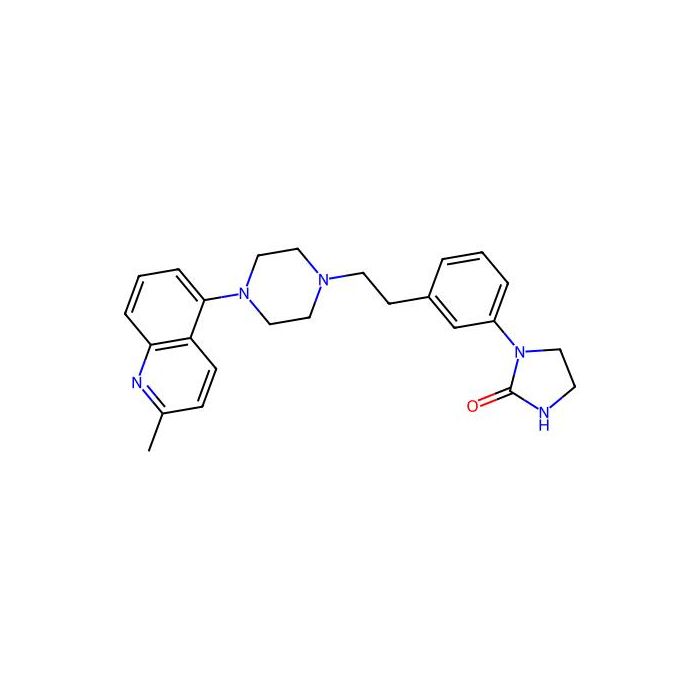
GSK163090 is a potent, selective and orally active 5-HT 1A/1B/1D receptor antagonist with pK i values of 9.4/8.5/9.7, respectively. GSK163090 inhibits the functional activity of serotonin reuptake transporter (SerT) with a pK i value of 6.1. GSK163090 has antidepressant and anxiolytic activities
In Vitro
GSK163090 (compound 36) is devoid of agonist activity at R1 receptors, but rather it demonstrates a moderate functional antagonismof the phenylephrineinduced contraction of rabbit aorta (pIC 50 =6.9). At 1 μM concentration, the ratio of the apparent permeabilities measured from basolateral-to-apical (BA) to apical-to-basolateral (AB) indicated that GSK163090 is a moderate P-glycoprotein (P-gp) substrate (BA/AB = 2.8). MCE has not independently confirmed the accuracy of these methods. They are for reference only.
In Vivo
In male Sprague-Dawley rats, GSK163090 (compound 36) treatment shows clear dose-dependent inhibition of the 8-OH-DPAT-induced hyperlocomotor activity (hLMA), with ED 50 values ranging from 0.03 to 1 mg/kg . MCE has not independently confirmed the accuracy of these methods. They are for reference only.
IC50& Target:5-HT 1A Receptor 9.4 (pKi) 5-HT 1B Receptor 8.5 (pKi) 5-HT 1D Receptor 9.7 (pKi) D 2 Receptor 6.3 (pKi) D 3 Receptor 6.7 (pKi) 5-HT 2A Receptor 6 (pKi) 5-HT 2B Receptor 6.3 (pKi) 5-HT 2C Receptor 5.8 (pKi) Human 5-HT 6 Receptor <5.3 (pKi) Human 5-HT 7 Receptor 6.8 (pKi)
| Activity Type | Activity Value -log(M) | Mechanism of Action | Activity Reference | Publications (PubMed IDs) |
|---|
| Activity Type | Activity Value -log(M) | Mechanism of Action | Activity Reference | Publications (PubMed IDs) |
|---|
| Activity Type | Activity Value -log(M) | Mechanism of Action | Activity Reference | Publications (PubMed IDs) |
|---|
Find and download the COA for your product by matching the lot number on the packaging.
| Lot Number | Certificate Type | Datum | Artikel |
|---|---|---|---|
 K2616194 | Certificate of Analysis | Nov 18, 2026 | G656138 |
No item-specific, validated protocols are provided for GSK163090.
General, non-item-specific protocols for small-molecule screening
These steps are offered as general best practices and are not validated specifically for GSK163090.
Item-specific biological target(s) and mechanism are not provided for GSK163090.
General context for small-molecule research tools (non-item-specific)
Note: All uses are for research only. No clinical or diagnostic claims are made or implied for this product.
There is no specific buffer system associated with this item. However, for deploying small molecules in biochemical or cellular assays, buffer selection is critical to maintain compound solubility and assay robustness.
General guidance (not item-specific)
Practical recipe example (illustrative)
Note: The above constitutes general practice, not item-specific specifications.
Greener practices for dissolution and screening of small molecules focus on solvent choice, waste minimization, and process design. Since item-specific solubility is unknown, the following are general, literature-aligned recommendations.
Comparison (general, not item-specific)
| Practice | Conventional | Greener alternative | Trade-offs | |---|---|---|---| | Vehicle | High-volume DMSO at low conc. | High-conc. DMSO stocks, minimal final % | Requires accurate low-volume dispensing | | Solvent for prep | MeCN/DMF for cleanup | EtOH/water or 2-MeTHF where viable | Solubility limits | | Waste | Bulk organic streams | Segregated micro-waste; on-plate quench | Logistics, training |
Documentation and controls
No pharmacopeial or formulation role is specified for GSK163090. The product is supplied strictly for research use only.
General formulation context for discovery compounds (non-item-specific)
Compliance note
Item-specific physical constants are not provided in the product data.
General guidance (literature/practice, not item-specific)
Item-specific grade and purity are not listed.
Context for screening compounds (general guidance)
Implications for use
This product is positioned as a code-named small molecule for research screening rather than as a synthetic reagent or catalyst.
General guidance for assay deployment (non-item-specific)
If synthetic derivatization is intended
Not applicable. This product is not presented as a reagent or catalyst, and no structure or functional groups are provided to define reaction behavior.
General note (for users intending follow-up chemistry once structure is known)
Hazard classification specific to this item is not supplied in the current data. Treat as a bioactive small molecule of unknown hazard.
Best-practice precautions (general laboratory guidance)
Special risks and handling
With structure and ionization state not provided, select solvents using a robust, stepwise approach commonly used for small-molecule libraries.
Recommended primary solvent
Secondary/co-solvents (if needed)
Small comparison (general, not item-specific)
| Vehicle | Pros | Considerations | |---|---|---| | DMSO | Strong solvency; water-miscible; stable | Keep final assay % low; skin absorption risk | | EtOH/MeOH | Easy handling; fast evaporation | Cell tolerance limits; volatility | | PEG400 | Solubilizes hydrophobes | Viscous; may affect assays | | Buffer (HEPES/PBS) | Biocompatible | Solubility/pH limited |
Practical tips
Item-specific conditions (from Product Data)
General best practices (non-item-specific)
Note: Any unspecified attributes (e.g., exact shelf life, stabilizers, salt form) are: Not specified for this item; refer to CoA/Spec Sheet.
Concise identity overview for the screening compound GSK163090.
Structural features
Practical notes for identity confirmation (general guidance)
GSK163090 is offered as a code-named small molecule for screening; without disclosed structure or functional groups, it is not positioned as a synthetic building block.
General considerations if pursuing analogs (non-item-specific)
Note: GSK163090 is a code-named compound; absent explicit target data, it should be treated as a general screening molecule until characterized in your laboratory or corroborated by primary literature associated with CAS 844903-58-8 or CID 11292933.