QUALITÄT & REINHEITMoligand™?Moligand™ — Aladdin's line of ligands and bioactive small molecules. Use for receptor, pathway, and binding studies needing defined small-molecule tools.10mM in DMSO
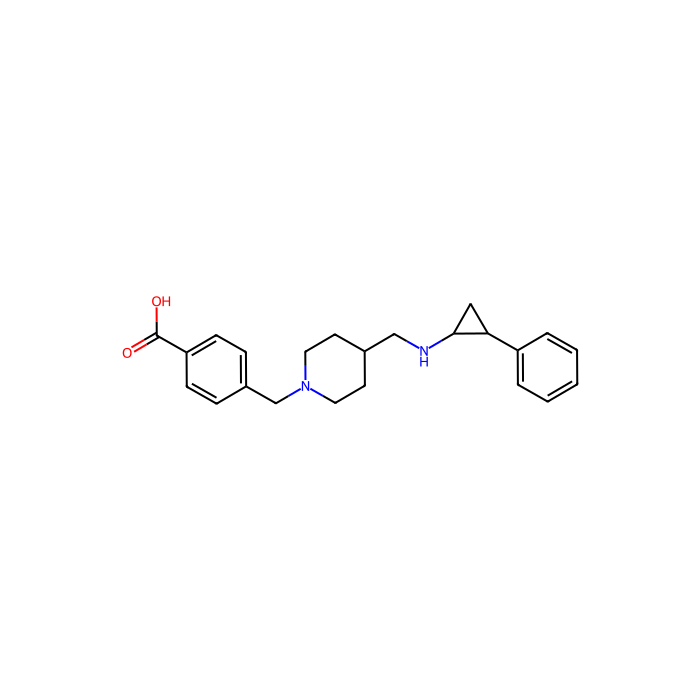
GSK2879552 is a selective, orally bioavailable, irreversible, mechanism-based inactivator of lysine-specific demethylase 1 (LSD1)/corepressor, with potential antineoplastic activity.
Spezifikationen
Synonyme
4-[[4-[[((1R,2S)-2-Phenylcyclopropyl)amino]methyl]piperidin-1-yl]methyl]benzoic acid | GSK 2879552 [WHO-DD] | 4-((4-((((1R,2S)-2-Phenylcyclopropyl)amino)methyl)piperidin-1-yl)methyl)benzoic acid | 4-((4-(((trans-2-phenylcyclopropyl)amino)methyl)piperidin-1-yl)methyl)benzoic acid | 4-[[4-[[[(1R,2S)-2-phenylcyclopropyl]amino]methyl]piperidi Show more
Spezifikationen & Reinheit
Moligand™, 10mM in DMSO
Biochemische und physiologische Mechanismen
GSK2879552 an orally active, selective and irreversible inhibitor of lysine specific demethylase 1 (LSD1/ KDM1A) , with potential antineoplastic activity.
Storage
Store at -80°C
Verschickt in
Dry ice packs + Cold packs
Dieses Produkt erfordert Kühlkettenversand. Grundversand und andere Economy-Optionen sind nicht verfügbar.
This compound belongs to the class of organic compounds known as n-benzylpiperidines. These are heterocyclic Compounds containing a piperidine ring conjugated to a benzyl group through one nitrogen ring atom.
External Descriptors
Not available
1. Djoumbou Feunang Y, Eisner R, Knox C, Chepelev L, Hastings J, Owen G, Fahy E, Steinbeck C, Subramanian S, Bolton E, Greiner R, and Wishart DS. ClassyFire: Automated Chemical Classification With A Comprehensive, Computable Taxonomy. Journal of Cheminformatics, 2016, 8:61.
Determine the necessary mass, volume, or concentration for preparing a solution.
Dilution Calculator
Determine the dilution needed to prepare a stock solution.
Reconstitution Calculator
Bewertungen
Kundenbewertungen
Application Protocols
Only tested/validated applications from the Product Data may be listed. For SKU G580401, no specific tested application protocols are provided.
Tested applications: Not specified for this item; refer to CoA/Spec Sheet.
Recommended concentrations/dilutions: Not specified for this item; refer to CoA/Spec Sheet.
Positive controls: Not specified for this item; refer to CoA/Spec Sheet.
General use suggestions (for planning only; not item-specific specifications):
Enzymatic assay setup: Prepare a fresh 10 mM DMSO stock; titrate in half-log or quarter-log series (e.g., 0.3 nM–30 μM final) maintaining constant DMSO. Include vehicle and inactive-analog controls.
Cell-based assay: Start with a broad concentration range (e.g., 1–1000 nM) and refine based on preliminary readouts. Monitor cytotoxicity and confirm pathway modulation using orthogonal endpoints (e.g., histone mark changes by western blotting).
Data QC: Record lot number, stock preparation date, and storage conditions with each experiment for reproducibility.
For validated, lot-specific protocols and acceptance criteria, please refer to the CoA/Spec Sheet delivered with the product.
Biological Roles
Scope: This section provides biochemical context relevant to small-molecule probes used to interrogate epigenetic enzymes. It does not imply therapeutic use.
General epigenetic context (literature-level):
Lysine demethylation: Histone lysine methylation is dynamically regulated. Flavin-dependent demethylases (e.g., KDM1/LSD1 family) catalyze demethylation of mono-/dimethyl-lysines, influencing chromatin structure and transcription.
LSD1/KDM1A biology: LSD1 forms complexes with transcriptional regulators (e.g., CoREST) and modulates gene programs related to differentiation and proliferation. Inhibition of LSD1 is widely used in research to probe lineage-specific transcription and enhancer function.
Use of selective small-molecule inhibitors as research tools:
Probe utility: A selective LSD1-targeting small molecule can be used to validate on-target effects by comparing with inactive analogs, time-dependent inhibition profiles, and rescue experiments (e.g., overexpression or washout studies).
Phenotypic readouts: Changes in histone marks (e.g., H3K4me1/2 accumulation), expression of lineage markers, and chromatin accessibility (ATAC-seq) are common endpoints.
Off-target considerations: Many epigenetic probes may interact with related amine oxidases or other off-targets at elevated concentrations; concentration–response and chemoproteomics can help assess selectivity.
Practical notes:
For cell assays, confirm intracellular exposure via LC–MS/MS where feasible. Include vehicle controls (DMSO) and time-course sampling to connect biochemical inhibition to downstream transcriptional changes.
Reminder: All uses are for research only. Follow your institution’s biosafety and chemical safety policies.
Buffer Applications
Not typically applicable as a buffering reagent.
Practical guidance for assay buffers (general):
Working solutions are commonly prepared by diluting a DMSO stock of the compound into a pre-formulated assay buffer (e.g., PBS, HEPES, or Tris-based buffers) to the desired final concentration.
Maintain consistent final DMSO percentage across all wells/conditions (including vehicle controls), typically ≤0.1–0.5% v/v to preserve cell viability and enzymatic activity.
Consider protein carriers (e.g., 0.1% BSA) to reduce nonspecific adsorption to plastics for hydrophobic molecules; verify that carriers do not interfere with the assay readout.
For pH control and ionic strength selection, refer to the buffer system best suited for your biological assay. This product itself does not function as a buffer component.
Green Alternatives
Context: GSK2879552 is a research small molecule; green chemistry considerations mainly relate to solvent and workflow choices used for dissolution, storage, and assays rather than replacement of the compound itself.
Greener handling strategies (general guidance):
Lower-impact solvents for working solutions: Where compatible with solubility and assay requirements, prefer aqueous buffers with minimal DMSO (≤0.1–0.2% v/v) to reduce VOC load and operator exposure.
Solvent minimization: Use high-concentration DMSO stocks and dispense microliter volumes via acoustic/positive-displacement systems to reduce waste.
Micro-scale operations: Conduct screening in miniaturized plate formats (384–1536 well) to reduce solvent and compound consumption.
Storage optimization: Aliquot into small volumes to avoid repeated thawing and disposal of partially degraded solutions.
Comparison of common solvents (general):
DMSO: High solvency and relatively low volatility/toxicity compared with chlorinated solvents; still aim to minimize usage and ensure proper waste handling.
Ethanol/water mixes: Greener for certain analytics but often inadequate for achieving high-concentration stocks of hydrophobic ligands.
Trade-offs:
Reducing DMSO percentage can improve green metrics but risks precipitation and variable exposure in biological assays; verify solubility margins and compound recovery from plastics.
Waste and EHS:
Collect all solutions as organic or mixed waste per institutional guidelines. Avoid chlorinated solvents during analytical sample prep unless necessary for method performance.
Note: No greener “substitute compound” is provided since GSK2879552 itself is the intended probe; adjust the surrounding workflow to improve sustainability.
Pharmaceutical Uses
This product is provided strictly for research use only and is not intended for human or animal use in therapeutic, diagnostic, or dosing applications.
Formulation and development context (general, non-clinical):
As a small-molecule research probe, GSK2879552 may be formulated into non-clinical vehicles for in vitro studies (e.g., DMSO stocks diluted into culture media) or exploratory preclinical experiments performed under appropriate approvals. Any such work requires internal validation of solubility, stability, and compatibility with the biological system.
Typical non-clinical vehicles: DMSO/water or DMSO/buffer mixtures for in vitro use. For ex vivo tissues, cosolvent systems or cyclodextrins may be evaluated to enhance solubility and reduce precipitation at the site of application.
Analytical development: Reference materials like this are often used to develop and qualify LC–MS/MS bioanalytical methods (calibrators/quality controls) for quantifying exposure in in vitro matrices (e.g., microsomes, S9, cell lysate).
Regulatory note:
No pharmacopeial monograph or excipient designation is provided. Specifications such as residual solvents, elemental impurities, microbial limits, or GMP status are Not specified for this item; refer to CoA/Spec Sheet if applicable. Any translation toward regulated development requires new sourcing or qualification under appropriate quality systems.
Physical Properties
Item-specific specifications (for this SKU):
Appearance: Not specified for this item; refer to CoA/Spec Sheet.
Molecular Formula: Not specified for this item; refer to CoA/Spec Sheet.
Molecular Weight: Not specified for this item; refer to CoA/Spec Sheet.
Melting point (MP): Not specified for this item; refer to CoA/Spec Sheet.
Boiling point (BP): Not applicable/Not specified for this type; refer to CoA/Spec Sheet.
Density: Not specified for this item; refer to CoA/Spec Sheet.
Refractive index/UV cutoff: Not specified for this item; refer to CoA/Spec Sheet.
Solubility: Not specified for this item; refer to CoA/Spec Sheet.
General/literature guidance for this compound class (non-spec):
State: Typically an off-white to light-colored solid for many bioactive heteroaromatics; actual appearance may vary by lot.
Solubility behavior: Bioactive screening molecules are commonly handled as DMSO stock solutions (e.g., 10–50 mM) due to limited aqueous solubility. Aqueous working solutions are prepared by diluting the DMSO stock into buffer/medium, often with final DMSO ≤0.1–0.5% v/v for cell-based assays.
Ionization: Basic centers (if present) can be protonated; solubility in aqueous media may improve under mildly acidic conditions. Salt forms (if available) can differ in solubility and hygroscopicity; this listing indicates the free form.
Stability: Many drug-like heteroaromatics are stable as dry solids under deep-cold storage but may show slower degradation in solution, especially in aqueous/oxygenated media or at ambient light/temperature.
Important: Do not treat these general values as specifications. For precise physical constants and acceptance criteria applicable to SKU G580401, consult the CoA/Spec Sheet provided with the product.
Quality and Grades
Grade for this item:
Grade/Purity: Moligand™ (as provided). Specific purity assays, residual solvents, and analytical acceptance criteria are Not specified for this item; refer to CoA/Spec Sheet.
What Moligand™ implies (general description):
Moligand™ denotes a research-grade, small-molecule ligand suitable for screening, target validation, and chemical biology workflows. Materials in this line are typically provided with identity confirmation (e.g., NMR/LC–MS) and an assay-ready format conducive to high-throughput or medicinal chemistry follow-up. Exact test methods, thresholds, and lot-specific data are provided in the CoA.
Analytical considerations for professional users:
Identity confirmation: Verify by LC–MS retention time and accurate mass against the reference in the CoA. Optional orthogonal checks include 1H/13C NMR and HRMS as needed for GLP or internal QC.
Purity: For screening, LC area % purity is commonly used; for mechanistic/biophysical assays, orthogonal purity assessment (e.g., qNMR) can add confidence. If chiral, evaluate enantiomeric/diastereomeric purity per program needs.
Counter-ions and form: This listing specifies “free” (i.e., free base/neutral form). Differences in form (free vs. salt; solvate/hydrate) can influence solubility and assay performance.
Documentation:
For all item-specific parameters (purity %, water/solvent content, residual metals, stabilizers, and spectral data), consult the CoA/Spec Sheet. Do not substitute general expectations for specification-controlled values in regulated work.
Reaction and Applications
Scope: As a Moligand™ small-molecule tool, GSK2879552 is primarily used in discovery biology rather than as a reagent or solvent in synthetic transformations.
Research applications (general, no medical claims):
Chemical biology/target validation: Employed as a reference ligand or probe in enzymology assays, binding studies, and phenotypic screens to interrogate epigenetic pathways. Typical uses include establishing on-target activity windows, benchmarking assay performance, and serving as a control in structure–activity relationship (SAR) studies.
Biophysical characterization: Utilized in thermal shift assays (DSF), ITC, SPR, or enzyme kinetics to quantify binding affinity and thermodynamic/kinetic parameters.
Cellular studies: Applied as a small-molecule modulator in cell-based assays to evaluate pathway engagement and downstream transcriptional outcomes. Carefully control final DMSO concentration and include vehicle controls.
Analytical: Acts as a system suitability compound in LC–MS/MS method development for bioanalytical quantification in in vitro matrices (e.g., microsomes, cell lysates), with appropriate internal standards.
Practical tips:
Stock preparation: Prepare a fresh, accurately weighed amount into an anhydrous DMSO stock at a known concentration (e.g., 10 mM). Aliquot to minimize freeze–thaw.
Controls: Include positive/negative controls and time-course/conc.-response series. Confirm compound stability under assay conditions (temperature, pH, redox environment) to avoid misattribution of effects.
Data integrity: Verify identity/purity before key experiments (LC–MS, qNMR). Track lot numbers across experiments for reproducibility.
Note: This section outlines typical research applications for small-molecule probes. It is not a substitute for protocol optimization within each lab’s system.
Reaction Conditions
Not typically applicable: GSK2879552 is supplied as a research probe (final small molecule), not as a reagent for carrying out chemical reactions. Therefore, standard synthetic reaction conditions are not relevant to its routine use.
Assay-related conditions (general guidance for small-molecule probes):
Stock solutions: Prepare in anhydrous DMSO (e.g., 10–50 mM). Store aliquots at deep-cold temperatures to prolong stability. Avoid repeated freeze–thaw.
Enzymatic assays: Run at recommended buffer, pH, and cofactor levels for the target enzyme system (consult the specific enzymology protocol). Maintain consistent DMSO across conditions (≤0.1–0.5% v/v).
Cell-based assays: Typical dosing ranges span low nanomolar to low micromolar for many potent epigenetic probes; actual ranges must be empirically determined. Confirm absence of cytotoxicity from vehicle or off-target effects by including appropriate controls.
Exposure verification: For time-dependent modulators, consider preincubation steps and washout experiments. Quantify compound levels in media/cells where feasible.
Stability checks:
Conduct short-term stability assessments of working solutions at assay temperature and light exposure. Use amberware and minimize air headspace if oxidative degradation is suspected.
All values above are general literature/practice notes and are not item-specific specifications. For any chemical reaction planning involving this molecule, consult the CoA for its exact structure and evaluate compatibility with the intended conditions.
Safety and Handling
Authoritative safety information must be obtained from the SDS for SKU G580401. The following provides general laboratory guidance only.
Item-specific hazard entries (from Product Data):
Signal Word: Not specified for this item; refer to SDS.
H-Statements: Not specified for this item; refer to SDS.
GHS Classification: Not specified for this item; refer to SDS.
Pictograms: Not specified for this item; refer to SDS.
General laboratory precautions for small-molecule bioactives:
PPE: Wear lab coat, nitrile gloves, and safety glasses; consider double-gloving when handling DMSO stocks of potent bioactives.
Engineering controls: Handle powders in a fume hood or ventilated balance enclosure to minimize inhalation/dermal exposure. Avoid aerosolization when dissolving.
Avoid: Inhalation, ingestion, and skin/eye contact. Wash thoroughly after handling. Prevent environmental release; collect waste in suitable organic waste streams.
Solution handling: Prepare concentrated stocks in DMSO using sealed containers; cap immediately after use to limit evaporation and moisture ingress. Use amber vials to minimize light exposure if chromophores are present.
Incompatibilities (general): Strong oxidizers, strong acids/bases for prolonged contact, and reactive acylating/alkylating agents. Avoid extended exposure to heat and light.
First aid (overview; defer to SDS): Eye/skin contact—flush with water for at least 15 minutes, remove contaminated clothing. Inhalation—move to fresh air, seek medical evaluation if symptoms persist. Ingestion—not intended for use in humans; seek medical attention immediately.
Fire safety: Many organic solids/solutions are combustible. Use CO2, dry chemical, or foam extinguishers; avoid high-pressure water streams that may spread contamination.
Note: This product is for research use only. Follow institutional procedures and the SDS for risk assessment and controls tailored to your operation.
Solvent Selection
Applicability: GSK2879552 is supplied as a research small molecule; solvent choice concerns dissolution for stock solutions and assay compatibility rather than use as a reaction solvent.
General dissolution guidance (literature/practice for drug-like small molecules):
Primary solvent: DMSO is the standard for preparing concentrated stocks (e.g., 10–50 mM), owing to its broad solvating power and compatibility with biological assays at ≤0.1–0.5% v/v final.
Secondary solvents/co-solvents: DMF or ethanol can be used for analytical solutions; for aqueous working solutions, dilute the DMSO stock into buffer (e.g., PBS, assay buffer) under vortexing. Addition to warm buffer (room temperature to 37°C) can reduce precipitation for hydrophobic compounds.
Aqueous solubility: Typically limited for heteroaromatic bioactives in neutral buffers; slight acidification (e.g., 0.1–1% v/v HCl in water) can sometimes improve solubility for basic compounds. Validate that pH changes are compatible with the assay.
Comparison (general):
DMSO: Highest solvency, excellent for HTS storage; hygroscopic and may carry water—use anhydrous grades and minimize headspace.
DMF: Good solvency; less favored for bioassays due to cytotoxicity and regulatory concerns.
Ethanol: More biocompatible; solvency often insufficient for high-concentration stocks.
Practical tips:
Filter sterilization of final aqueous working solutions (0.22 μm) may be used if compatible with solubility; avoid filtering DMSO concentrates through some polymeric membranes that may swell.
Precipitation check: After diluting into assay media, visually confirm absence of turbidity/precipitate, particularly at higher test concentrations.
General reconstitution guidance for small-molecule research probes (not item-specific specs):
Solvent for stock: Prepare concentrated stocks in anhydrous DMSO (commonly 10 mM; higher if solubility permits). Mix thoroughly (vortex/sonicate briefly) until fully dissolved. If necessary, warm gently to room temperature during dissolution; avoid prolonged heating.
Aliquoting: Dispense into small, single-use aliquots (e.g., 10–100 μL) in inert, amber vials or low-bind tubes to minimize adsorption and freeze–thaw cycles.
Storage of solutions: Store DMSO stocks at -80°C per item guidance. Protect from light and moisture. Record preparation date and concentration on each aliquot.
Thaw/use: Thaw quickly at room temperature, use immediately, and promptly return unused aliquots to -80°C. Avoid repeated freeze–thaw to limit degradation.
Aqueous working solutions: Prepare fresh immediately before use by diluting the DMSO stock into the chosen buffer/media with vigorous mixing. Confirm absence of precipitation visually.
Stability notes:
Solid-state stability details, solution stability windows, and allowed freeze–thaw cycles are Not specified for this item; refer to CoA/Spec Sheet and SDS. If long experimental timelines are expected, perform a brief stability-indicating LC–MS check on stored stocks.
Research Use Only: Not for human or veterinary use.
Structure and Identity
Brief: GSK2879552 is a research-grade small-molecule probe supplied under the Moligand™ line for use in screening and target validation studies.
Item-specific identifiers (from Product Data):
SKU: G580401
Product Name: GSK2879552
CAS: 1401966-69-5 (free)
PubChem CID: 66571643
InChIKey: 207474 (as provided)
SMILES: Not specified for this item; refer to CoA/Spec Sheet.
Molecular Formula: Not specified for this item; refer to CoA/Spec Sheet.
Molecular Weight: Not specified for this item; refer to CoA/Spec Sheet.
Structural description (general/literature-level, not item-specific specs):
Compound type: small-molecule heteroaromatic amine–containing scaffold reported in the literature as a selective epigenetic enzyme modulator (chemical probe-class compound). Exact functional group arrangement for this SKU is not specified in the Product Data.
Common features in this class: multiple nitrogen heteroatoms, basic centers amenable to salt formation, and aromatic systems conferring target engagement; may be formulated as free base or salt in different contexts (this listing indicates “free”).
2D-structure narrative (general):
Typically consists of one or more fused or linked aromatic/heteroaromatic rings bearing basic amine functionality; substituent patterns tune potency and selectivity. Without an item-specific structural string (SMILES/InChI), a definitive atom-level description for this lot cannot be provided here; consult the accompanying CoA/SDS for the definitive structure representation.
Notes:
Where an exact structure depiction or stereochemical information is required (e.g., for docking or registration), please refer to the CoA/Spec Sheet for this catalog number.
Synthetic Utility
Primary intent: This item is a finished small-molecule probe supplied for screening and biological studies. It is not typically used as a building block or reagent for further synthesis.
Considerations if used in method development (general):
Reference standard: May serve as a reference analyte in validating synthetic purification workflows (e.g., reversed-phase HPLC method scouting) due to its drug-like polarity and heteroatom content.
Stability studies: Can be employed to test stress conditions (acid/base, oxidative, photolytic) and validate stability-indicating analytical methods.
Limitations as a synthetic building block:
Complex functionality and potential sensitivity to strong reagents/conditions limit its usefulness as a precursor in multistep synthesis.
Lack of orthogonal protecting group handles and the presence of multiple heteroatoms can complicate selective functionalization without degrading the core scaffold.
If derivatization is scientifically required:
Adopt mild, chemoselective transformations (e.g., late-stage amide coupling at preinstalled handles if present, or heteroaromatic SNAr only where activated). Verify structure via LC–MS and NMR after each step and monitor for decomposition.
Note: Because item-specific structural details are not provided in the Product Data for this SKU, no specific reactive site recommendations can be given. Consult primary literature and the CoA for definitive structural information before planning any derivatization.
Target Specificity
Only information from Product Data may be shown here.
Target/antigen name: Not specified for this item; refer to CoA/Spec Sheet.
Epitope/domain: Not applicable/not specified.
Species reactivity: Not applicable/not specified.
Clone/isotype: Not applicable/not specified.
Note: While GSK2879552 is widely discussed in the literature as a selective small-molecule probe for a defined epigenetic enzyme class, no target specificity details are provided in the Product Data for this SKU. Please consult the CoA/Spec Sheet for any lot-specific annotations.
Häufig gestellte Fragen
How should this product be stored?
Store at ?80 °C. Ultra-low temperature storage is required to maintain the specified shelf life.
What is Moligand??
Moligand? is one of Aladdin Scientific's premium product lines, formulated for high-purity applications across multiple workflows. Compared to standard grades in the same workflow, Moligand? products typically offer tighter specifications, more rigorous QC, and stronger lot-to-lot consistency.
How is this product shipped?
This product ships frozen with dry ice and cold packs. Unpack on arrival and transfer it to the storage condition stated above; handle dry ice with insulated gloves in a ventilated area.
What are the CAS number, molecular formula and molecular weight?
The CAS Number is 1401966-69-5(free), the molecular formula is C23H28N2O2, and the molecular weight is 364.48 g/mol. InChIKey LRULVYSBRWUVGR-FCHUYYIVSA-N.
What documentation is provided?
Available product documentation, including Certificates of Analysis (COA), Safety Data Sheets (SDS), and specification sheets, is shown in the product document area. Document availability and access follow the current site policy.
Benötigen Sie Hilfe bei der Auswahl der Qualität?
Unser Leitfaden zur Qualitätsauswahl behandelt Reinheit, Stabilisatorstatus und Anwendungseignung für alle Varianten in unserem Katalog.
Wir verwenden Cookies, um die ordnungsgemäße Funktion der Website sicherzustellen und, soweit zulässig, Ihr Nutzererlebnis zu verbessern. Sie können Ihre Einstellungen jederzeit unter „Einstellungen“ verwalten. Weitere Informationen finden Sie in unserer Cookie-Richtlinie.
Dürfen wir Sie über Rabattaktionen informieren?
Später erinnern
Vielen Dank! Bitte überprüfen Sie Ihren E-Mail-Posteingang, um zu bestätigen.
Products are supplied to verified businesses, institutions, and qualified professionals for research and development use only. Not for use in humans, animals, diagnosis, or therapy.