GRADE & PURITYMoligand™?Moligand™ — Aladdin's line of ligands and bioactive small molecules. Use for receptor, pathway, and binding studies needing defined small-molecule tools.≥99%
Moligand™, ≥99% Moligand™ for sensitive chromatographic and analytical workflows requiring minimal baseline interference.
🌡
Storage & shipping
Protected from light,Store at -20°C Ships Ice chest + Ice pads Check lot-specific COA for exact specifications.
📋
Quality documents
SDS, COA, datasheet, and spec sheet available for download. Lot-specific COA accessible via lot number lookup.
📚
Literature proof
Cited in 0 peer-reviewed publications across chromatography, organic synthesis, and cross-coupling reactions.
Übersicht
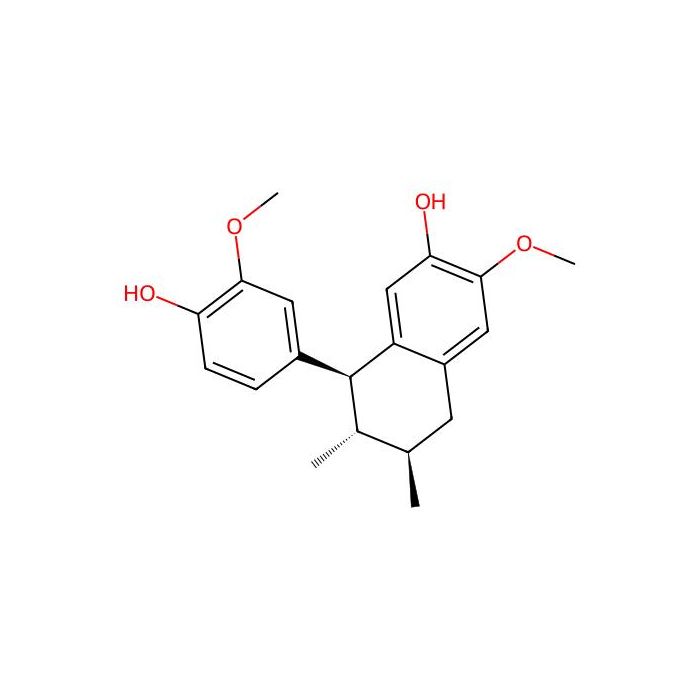
Guaiacin is a natural lignan that enhances alkaline phosphatase activity and osteoblast differentiation.
Specifications
Spezifikationen & Reinheit
Moligand™, ≥99%
Biochemische und physiologische Mechanismen
Guaiacin is a arylnaphthalene type lignin isolated from the barks of Machilus thunbergii SIEB. et ZUCC (Lauraceae). Guaiacin significantly increases alkaline phosphatase activity and osteoblast differentiation.
Storage
Protected from light,Store at -20°C
Verschickt in
Ice chest + Ice pads
Dieses Produkt erfordert Kühlkettenversand. Grundversand und andere Economy-Optionen sind nicht verfügbar.
Determine the necessary mass, volume, or concentration for preparing a solution.
Dilution Calculator
Determine the dilution needed to prepare a stock solution.
Reconstitution Calculator
Bewertungen
Kundenbewertungen
Application Protocols
No vendor-validated assay protocols are provided for this specific item. The following general workflow is commonly used for small-molecule screening compounds:
Stock preparation
Warm to room temperature under low light. Prepare a 10 mM stock in dry DMSO (or alternate solvent after solubility check).
Vortex/sonicate briefly; if needed, filter through 0.22 µm PTFE.
Record exact mass, solvent lot, and final concentration; dispense into single-use aliquots.
Assay dilution
Dilute stock into assay buffer, keeping DMSO ≤0.5–1% v/v unless your system tolerates more. Prepare a serial dilution to generate a full concentration–response curve.
Quality controls
Include vehicle control, known positive control (target-relevant), and non-specific control.
Verify concentration by UV or LC–MS where feasible; monitor plate edge effects and precipitation visually or by light scattering.
Data integrity
Document lot number, storage history, and freeze–thaw count. Repeat key measurements with fresh aliquots to rule out degradation artifacts.
Biological Roles
This catalog entry does not include curated biological role annotations for Guaiacin.
Biological function/targets: Not specified for this item; consult primary literature using the CAS (36531-08-5) or PubChem CID (11724027).
Pathways/ MOA: Not specified for this item; refer to the literature.
General guidance for researchers
When deploying screening compounds without established annotations, begin with broad phenotypic assays or chemoproteomic profiling to identify putative targets. Validate with orthogonal readouts.
Confirm compound integrity in biological matrices (e.g., serum-containing media) via stability and recovery measurements.
Control for vehicle effects (DMSO/EtOH) and include appropriate concentration–response designs to estimate potency and cytotoxicity windows.
Note: Aladdin products are for research use only and are not intended for diagnostic, therapeutic, or other clinical purposes.
Buffer Applications
Not typically applicable.
Guaiacin is supplied as a small-molecule screening compound, not as a buffering reagent. No pKa-based buffer system or electrophoresis buffer role is defined here.
For biological assays, prepare compound stocks in an appropriate organic solvent (e.g., DMSO) and dilute into your assay buffer of choice (PBS, HBSS, HEPES-buffered systems, etc.) while maintaining low organic co-solvent fractions.
Item-specific buffering information: Not specified for this item; refer to CoA/Spec Sheet if any stabilizing additives are used.
Green Alternatives
Because Guaiacin is a small-molecule screening compound rather than a solvent or process reagent, green chemistry considerations focus on the choice of dissolution media and workup rather than replacement of the compound itself.
Greener handling choices (general)
Prefer ethanol or water-based buffers where feasible, using minimal DMSO as a co-solvent to achieve solubility.
Avoid DMF and chlorinated solvents for routine stock preparation when alternatives (DMSO, EtOH) suffice.
Use microscale assay prep to minimize chemical use and waste; implement plate-based handling to reduce solvent volumes.
Illustrative comparison (general)
DMSO vs EtOH: DMSO offers superior solvency and stability; EtOH is generally greener with higher volatility for easier removal but may limit solubility.
ACN vs MeOH: ACN has excellent chromatographic properties but higher environmental and safety burdens; MeOH is often an acceptable, greener alternative if solubility/UV needs permit.
Operational tips
Select closed-vial dissolution with low headspace to reduce VOC emissions; use calibrated positive-displacement pipettes for viscous DMSO.
Pharmaceutical Uses
Not applicable for formulation or clinical use.
This product is provided for research use only. It is not manufactured to GMP standards and has no pharmacopeial monograph in this listing.
No excipient role, dosage form guidance, or clinical formulation specifications are provided for this item.
Research context (general)
In pre-formulation research, small-molecule ligands may be evaluated for solubility, stability, and permeability. Any such work with Guaiacin should be strictly non-clinical and accompanied by analytical verification of identity/purity.
If conducting enabling studies (salt/salt-free forms, co-crystals, amorphous dispersions), confirm chemical structure from primary databases and CoA first, then proceed with standard preformulation screens under light-protected conditions.
Physical Properties
Item-specific physicochemical parameters are not included in this listing.
Appearance: Not specified for this item; refer to CoA/Spec Sheet.
Molecular weight: Not specified for this item; refer to CoA/Spec Sheet.
Melting point / Boiling point: Not specified for this item; refer to CoA/Spec Sheet.
Density, refractive index: Not specified for this item; refer to CoA/Spec Sheet.
pKa / logP (literature/computational): Not provided here; consult primary databases/literature and confirm experimentally.
Solubility: Not specified for this item; refer to CoA/Spec Sheet.
Practical guidance (general, literature-informed)
For small-molecule screening compounds, typical initial dissolution solvents include DMSO, methanol, ethanol, or acetonitrile. Start with 5–20 mg/mL solubility checks on a 1–2 mg scale.
For aqueous compatibility, evaluate co-solvent systems (e.g., DMSO ≤1–2% v/v in buffer) after establishing an anhydrous stock.
Confirm solution stability by LC–MS or HPLC (UV/RI) at time 0 and after storage/assay conditions. Light protection is recommended for this item.
If crystallinity/solid form affects handling, a brief sonication or gentle warming (≤40 °C) can aid dissolution; avoid prolonged heating or high pH without stability data.
Members of the Moligand™ line are curated for research discovery workflows such as biochemical and cellular target screening, binding assays, and hit validation. Each item is intended for laboratory research use only.
Typical expectations for this class include provision as a dry solid or concentrated solution suitable for preparing DMSO stocks and compatibility with microplate-based assays. Exact purity specifications, residual solvents, and analytical data are batch-dependent.
Item-specific details
Exact purity, residual solvent limits, stabilizers, water content, metals, and UV cutoffs: Not specified for this item; refer to CoA/Spec Sheet.
Analytical characterization (e.g., HPLC, NMR, MS): Not specified for this item; refer to CoA/Spec Sheet.
User guidance
Before critical work (e.g., SAR or mechanistic studies), confirm identity/purity in-house by HPLC/UPLC and MS; consider orthogonal checks (1H NMR).
Record lot numbers and retain aliquots for future reference; small changes in impurity profile may impact assay readouts.
Reaction and Applications
Primary use-case: Member of a small-molecule ligand/screening collection (Moligand™). As listed, Guaiacin is not positioned as a general-purpose synthetic reagent; rather, it is suited for:
Biochemical and cellular screening: target binding/phenotypic assays, hit-finding, and preliminary SAR.
Biophysical characterization: ligand–target interaction studies by DSF, SPR, ITC, MST, or NMR (subject to solubility and chromophore properties).
Cheminformatics: reference structure in docking/virtual screening sets (obtain SMILES/InChI from primary databases and verify experimentally).
If used in synthesis (general guidance only)
Without a disclosed structure, no specific transformations can be recommended. If literature indicates reactive handles on Guaiacin, select conditions that preserve sensitive motifs (e.g., phenols, benzylic positions, or ether linkages) and validate stability under acid/base and oxidative environments.
For analytical method development supporting applications, start with reverse-phase LC (C18) using water/ACN + 0.1% formic acid and track purity by UV and MS.
Note: Always confirm identity, purity, and stability before and after assays or processing; light protection is recommended.
Reaction Conditions
No reaction condition data specific to Guaiacin are provided in this product entry.
General guidance (if performing transformations after verifying structure)
Solvent selection: start with MeCN, MeOH/EtOH, DCM/EtOAc, or DMSO/DMF as dictated by solubility and target transformation; choose greener options when feasible.
Temperature: begin at ambient (20–25 °C); escalate cautiously with in-process control (TLC/LC–MS).
Atmosphere: use inert gas (N2/Ar) if oxidation-sensitive motifs are suspected; the storage guidance to protect from light suggests assessing photostability before photochemical steps.
Workup: prioritize liquid–liquid extraction and solid-phase extraction compatible with the compound’s polarity; corroborate recovery by LC–MS.
Expected yields/times: Literature-dependent; establish on small scale first. No item-specific values are available.
Important: Without confirmed structure and stability data, avoid strong acids/bases, radical initiators, or high-energy light.
Safety and Handling
Safety data specific to Guaiacin are not provided in this listing.
Signal word (GHS): Not specified for this item; refer to SDS.
Hazard statements (H-phrases): Not specified for this item; refer to SDS.
GHS classification & pictograms: Not specified for this item; refer to SDS.
General laboratory precautions (consult SDS for authoritative guidance)
Handle in a chemical fume hood. Avoid inhalation, ingestion, and skin/eye contact.
Recommended PPE: lab coat, nitrile gloves, safety glasses; upgrade to splash goggles/face shield for solution prep or scale-up.
Avoid incompatible conditions until verified (strong oxidizers/reducers, strong acids/bases, elevated temperature, and light exposure). This item should be protected from light per storage guidance.
In case of contact: rinse affected area with water, remove contaminated clothing, and seek medical evaluation per SDS.
Waste disposal: Treat as organic laboratory chemical waste; segregate halogenated vs non-halogenated solvents and follow institutional and local regulations.
Special notes
For screening compounds, minimize repeated thaw–freeze cycles and maintain good documentation of stock concentrations and handling history, as degradation can alter hazard profiles.
Solvent Selection
This product is a small-molecule screening compound rather than a bulk solvent; solvent selection here refers to dissolution for stock solutions and assays.
General approach
Start with anhydrous DMSO to prepare a primary stock (e.g., 10–50 mM). If DMSO is unsuitable, assess MeOH, EtOH, or ACN.
For aqueous assays, dilute the organic stock into buffer while keeping the organic co-solvent typically ≤1–2% v/v to avoid perturbing biology.
If limited solubility persists, explore pH adjustment only after confirming chemical stability versus hydrolysis/oxidation.
Comparison (general)
DMSO: highest solvating power for diverse organics; hygroscopic, may affect cells above ~0.5–1%.
Methanol/Ethanol: greener, volatile; lower solvency for hydrophobic scaffolds vs DMSO.
Acetonitrile: good solvency and UV transparency; cytotoxicity can be higher; ensure thorough dilution.
Practical tips
Filter 0.22 µm if particulates persist and compound is stable.
Protect from light during dissolution and storage, consistent with item guidance.
Storage and Reconstitution
Storage conditions: Store at -20 °C, protected from light (per Product Data). Maintain in a dry, sealed container with desiccant if provided.
Shipping: Ice chest + ice pads (per Product Data). Inspect upon arrival; do not leave at ambient light/temperature for extended periods.
Stability: Item-specific stability not provided; verify by LC–MS/HPLC after storage. Avoid repeated freeze–thaw.
Reconstitution (general guidance)
Bring vial to room temperature before opening to minimize moisture condensation.
Prepare concentrated stock in anhydrous DMSO or another validated solvent following small-scale solubility testing.
Filter if necessary (0.22 µm PTFE) and dispense into light-protected aliquots (amber vials/plates).
Handling tips
Track aliquot usage; discard if precipitation, discoloration, or unexpected LC–MS peaks appear.
For long-term storage of DMSO stocks, keep at -20 °C in amber containers; avoid frost-free freezer cycles.
Item-specific notes
Appearance, exact solubility, and reconstitution concentration limits: Not specified for this item; refer to CoA/Spec Sheet.
Research use only.
Structure and Identity
Brief overview: Guaiacin (SKU G650572) is listed in Aladdin’s Moligand™ collection of small molecules for research screening. This catalog entry does not include a full structural record.
Product name: Guaiacin
CAS: 36531-08-5
PubChem CID: 11724027 (external reference for public structure/metadata)
Molecular formula: Not specified for this item; refer to CoA/Spec Sheet.
Molecular weight: Not specified for this item; refer to CoA/Spec Sheet.
InChIKey: Not specified for this item; refer to CoA/Spec Sheet.
SMILES: Not specified for this item; refer to CoA/Spec Sheet.
Synonyms: Not specified for this item; refer to CoA/Spec Sheet.
Structural features (general note)
This listing does not provide a 2D or 3D structural depiction. For cheminformatics workflows, retrieve the canonical SMILES/InChI from PubChem (CID 11724027) or other curated databases, then confirm against the CoA.
Without the furnished structure, functional group annotation, ring systems, and stereochemical assignments are not provided here and should be verified from primary sources before modeling, docking, or method development.
Synthetic Utility
This listing does not position Guaiacin as a general synthetic reagent or building block, and no structural information is provided here to infer reactivity.
Potential functional groups, handles for derivatization, and protecting-group strategies are not specified for this item; consult the literature for Guaiacin (CAS 36531-08-5) if derivatization is intended.
For exploratory medicinal chemistry around a screening hit, apply routine workflows: confirm structure and absolute configuration; establish a tractable synthetic route; design SAR by conservative modifications to hypothesized pharmacophores.
Analytical support: Use LC–MS for rapid reaction tracking and HPLC (C18) for purification method scouting. Protect from light in all steps until photostability is known.
Item-specific reactivity data: Not specified for this item; refer to CoA/Spec Sheet and primary literature.
Target Specificity
No target specificity information is provided for this product.
Antigen/epitope, species reactivity, clone/isotype: Not applicable; this is a small-molecule compound, not an antibody or protein reagent.
For biochemical screening, any target engagement claims must be developed and validated by the end user with appropriate positive/negative controls.
Need help choosing the grade?
Our grade selection guide covers purity, stabilizer status, and application suitability for all variants in our catalog.
Wir verwenden Cookies, um die ordnungsgemäße Funktion der Website sicherzustellen und, soweit zulässig, Ihr Nutzererlebnis zu verbessern. Sie können Ihre Einstellungen jederzeit unter „Einstellungen“ verwalten. Weitere Informationen finden Sie in unserer Cookie-Richtlinie.
Shall we send you a message when we have discounts available?
Remind me later
Thank you! Please check your email inbox to confirm.
Products are supplied to verified businesses, institutions, and qualified professionals for research and development use only. Not for use in humans, animals, diagnosis, or therapy.