GRADE & PURITYCarrier Free?Carrier-free — supplied without added carrier protein/stabilizer. Use when carriers (e.g. BSA) would interfere with conjugation or sensitive assays.ExactAb™?ExactAb™ — Aladdin's antibody line emphasizing precision and validated quality. Use for reliable, specificity-validated antibody applications.Azide Free?Azide-free — without sodium azide preservative. Use in conjugations, cell work, or assays where azide is toxic or inhibitory.Validated?Validated grade — performance confirmed in defined applications before release. Use when you want documented assurance the reagent works as stated.PBS Only?PBS-only formulation — supplied in phosphate-buffered saline with no other additives. Use when you need a clean PBS buffer free of stabilizers/carriers.≥95%See COA
Store at 4°C short term (1-2 weeks). Store at -20°C long term (24 months). Upon receipt, it is recommended to aliquot. Avoid freeze/thaw cycle.
Bilder
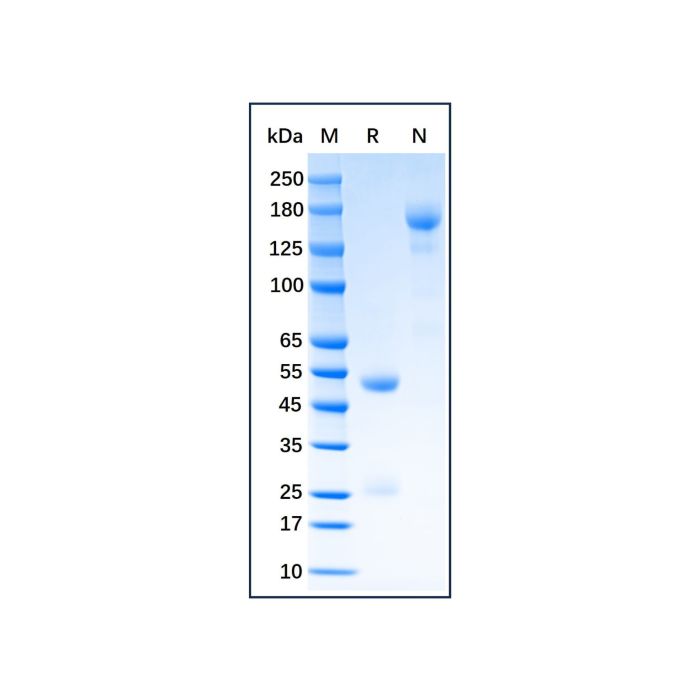
Guinea Pig IgG (Ab175978) - SDS-PAGE 3 μg/lane of Guinea Pig IgG (Ab175978) was resolved with SDS-PAGE under reducing (R) and non-reducing (N) conditions and visualized by Coomassie® Blue staining. Showing the band at 26.1 kDa (Light Chain) & 51.3 kDa (Heavy Chain), under reducing conditions; 161.4 kDa, under non-reducing conditions. The purity of the Guinea Pig IgG is greater than 95%.
Documentation
📋 Safety Data Sheet (SDS)
Comprehensive hazard, handling, storage, and regulatory compliance document.
Determine the necessary mass, volume, or concentration for preparing a solution.
Dilution Calculator
Determine the dilution needed to prepare a stock solution.
Reconstitution Calculator
Bewertungen
Kundenbewertungen
Application Protocols
Item-specific tested applications, recommended dilutions, and positive controls: Not specified for this item; refer to CoA/Spec Sheet.
General usage guidance (literature/practice; tailor to your assay)
ELISA standard/control: prepare serial dilutions in sample diluent (PBS + 1% BSA). Coat or capture as per platform; detect with anti–guinea pig IgG secondary. Optimize coating concentrations (0.5–2 µg/mL) and detection ranges empirically.
Western blot blocking/control: use as species control to evaluate secondary specificity. Block membranes with non-interfering blockers; probe with anti–guinea pig secondary to assess background.
Immunofluorescence/flow cytometry: include a guinea pig IgG isotype control at the same concentration as the test primary to gauge non-specific signals; detect with cross-adsorbed anti–guinea pig secondary.
Conjugation: see Reaction Conditions for typical labeling parameters; confirm DOL and retain activity.
Validation note
Because “Validated” is indicated without specifics, confirm performance in your exact matrix and detection system and document lot-specific conditions for reproducibility.
Biological Roles
Overview (literature/general)
Immunoglobulin G (IgG) is the predominant antibody class in mammalian serum, mediating humoral immunity. It neutralizes pathogens, opsonizes antigens for phagocytosis, and can activate complement via the classical pathway.
Structure–function: variable regions (Fab) confer antigen specificity through somatic recombination and hypermutation; the Fc region engages Fcγ receptors and complement component C1q, orchestrating effector responses.
Guinea pig IgG shares conserved immunoglobulin architecture with species-specific sequence and glycosylation patterns that modulate Fc receptor interactions and Protein A/G binding.
Biochemical features (literature)
N-linked glycosylation at Fc CH2 domain influences stability and effector function.
pH-dependent Fc receptor interactions underpin endosomal recycling pathways in some species (FcRn), affecting half-life of IgG.
Relevance in research
Serves as a species control, standard, or immunogen; provides a platform for studying cross-species Fc interactions, complement activation, and antibody engineering.
Important caveats
Biological function and in vivo effects depend on subclass, glycoform, and context; these attributes are not specified for this item and should not be inferred without data.
Buffer Applications
Item-specific note: Product is indicated as “PBS Only.” Exact pH and ionic strength are not specified; refer to CoA/Spec Sheet.
General guidance (literature/practice)
Phosphate-buffered saline (PBS) at pH ~7.2–7.4 stabilizes IgG near physiological conditions and supports binding in most immunoassays.
For ELISA and plate-based assays:
Coating: carbonate–bicarbonate buffer, pH 9.4–9.6, can improve passive adsorption of capture antibodies (not item-specified; prepare by user if needed). After coating, switch to PBS or TBS with 0.05% Tween-20 for washing.
Blocking: protein-based blockers (BSA, casein) or synthetic blockers reduce nonspecific binding. Avoid carriers if maintaining carrier-free conditions is critical.
For conjugation: exchange to application-appropriate buffers (e.g., PBS→amine-free bicarbonate for NHS ester reactions; PBS→HEPES for metal-sensitive steps). Remove azide-sensitive contaminants if present in user-added reagents.
For storage: some workflows add 2–5% trehalose or 10–50% glycerol at −20°C to limit freeze–thaw damage (glycerol not advisable if maintaining carrier/glycerol-free status is required by the application).
Green Alternatives
Product-intrinsic considerations
Azide Free: eliminates sodium azide, a toxic preservative, improving environmental and safety profiles in downstream waste streams and enabling enzyme-based detections without azide quenching.
Carrier Free: reduces proteinaceous additives, simplifying waste and minimizing interference—often permitting lower reagent consumption through improved signal-to-noise.
Greener handling practices (general)
Use reusable, low-binding containers where appropriate and compatible with sterility.
Favor aqueous buffer exchange over precipitation with organic solvents.
Shipments already use cold packs; consolidate orders to reduce packaging impact when feasible.
Comparison (general, literature)
Azide-preserved antibodies vs azide-free
Pros of azide-free: compatible with HRP/AP conjugates, live cells, copper-catalyzed click pre-reactions; reduced hazardous preservative waste.
Cons: shorter open-vial stability; requires stricter aseptic handling.
Carrier-containing vs carrier-free
Pros of carrier-free: cleaner conjugation, lower background in MS/SEC; easier quantification.
Cons: greater adsorption losses; may benefit from low concentrations of inert protein or trehalose during storage (user-added, if assay-compatible).
Net assessment
For most immunochemical workflows, azide-free, carrier-free IgG is the more sustainable and versatile choice when paired with careful aliquoting and cold-chain stewardship.
Pharmaceutical Uses
Scope limitation: This product is for research use only. No clinical or therapeutic use is claimed or supported.
Assay reagent: used to develop and qualify analytical methods (ELISA, SPR/BLI) as a reference IgG material for platform performance, specificity testing, and matrix effect assessments.
Process development: model protein for purification platform studies (Protein A/G capture, ion exchange optimization, viral clearance validation) in bioprocess R&D.
Diagnostic development (research-phase): control antibody for immunoassay calibration, stability studies, and lot-to-lot comparability testing.
Conjugate manufacturing (research): starting material for producing labeled secondaries or tracers (biotinylated, enzyme- or fluorophore-conjugated) for kit prototyping.
Regulatory note
No pharmacopeial monograph or GMP status is provided. Any use in regulated workflows requires independent qualification. Lot-specific attributes (purity, identity, bioburden, endotoxin) are Not specified for this item; refer to CoA/Spec Sheet if required.
Physical Properties
Item-specific properties
Appearance: Not specified for this item; refer to CoA/Spec Sheet.
Molecular weight (exact): Not specified for this item; refer to CoA/Spec Sheet.
Molecular formula: Not specified for this item; refer to CoA/Spec Sheet.
Buffer: “PBS Only” indicated; detailed composition (pH, ionic strength) not specified for this item; refer to CoA/Spec Sheet.
Literature/general characteristics for IgG proteins (for experimental planning; not item specifications)
Typical molecular mass: ~150 kDa (∼50 kDa heavy chains, ∼25 kDa light chains under reducing SDS-PAGE).
Isoelectric point (pI): typically ~6–9 depending on subclass and glycoform.
Solubility: highly soluble in isotonic aqueous buffers (e.g., PBS, ~1–10 mg/mL and higher), salting-out in high ammonium sulfate.
Stability range: best maintained near neutral pH (6.8–7.6) with moderate ionic strength; susceptible to aggregation upon freeze–thaw, agitation, or exposure to interfaces.
Extinction coefficient (approximate, human IgG1 reference): ε280 ≈ 203,000 M−1 cm−1; A280 of 1.0 ≈ 0.73 mg/mL (literature, sequence-dependent). Not a specification for this item.
Temperature sensitivity: retains structure at 2–8°C short-term; long-term storage typically −20°C to −80°C with cryoprotectants (literature).
Denaturants: unfolded by chaotropes (urea, guanidinium), reduced by DTT/TCEP, digested by proteases (papain, pepsin) in a controlled manner (literature).
Carrier Free: supplied without protein carriers (e.g., BSA, gelatin) and typically without glycerol. Advantageous for conjugation (biotin, fluorophores, enzymes) and mass-sensitive assays where carriers interfere. Also reduces non-specific background from carrier proteins.
ExactAb™: branded designation by the supplier; indicates a defined, quality-controlled antibody format. Exact technical attributes for this lot are not specified here; refer to CoA/Spec Sheet for details.
Azide Free: no sodium azide preservative, enabling compatibility with peroxidase-based detections, live-cell exposures, and conjugation chemistries sensitive to azide. Requires aseptic technique and proper storage to maintain sterility/stability.
Validated: indicates performance verification by the supplier. Specific validated applications and dilutions are not provided here; refer to CoA/Spec Sheet.
PBS Only: formulated in phosphate-buffered saline. Exact pH, salt concentration, and any stabilizers are not specified here; refer to CoA/Spec Sheet.
What these grades mean in practice
Conjugation-ready: absence of carriers/azide minimizes side reactions during NHS-ester, maleimide, click, or enzymatic labeling.
Analytical use: low excipient background helps in ELISA, SPR, BLI, HPLC-SEC, and MS workflows.
Handling implication: azide-free, carrier-free antibodies demand careful aliquoting and sterile technique to prevent contamination and proteolysis.
Lot-specific controls
Concentration, purity by SDS-PAGE/SEC, endotoxin, and bioburden: Not specified for this item; refer to CoA/Spec Sheet.
Reaction and Applications
This section focuses on experimental applications of Guinea Pig IgG as a research reagent (general literature guidance). No specific validated uses are claimed for this item beyond the catalog descriptors.
Common applications
Immunoassays: ELISA/ELISPOT plate blocking controls, isotype-matched control in flow cytometry or immunofluorescence (when a guinea pig primary is used), and calibration standards.
Affinity workflows: immunogen for raising anti–guinea pig secondary antibodies in other host species; ligand in Fc-binding studies (Protein A/G/L binding, species-dependent).
Conjugate development: starting material for labeling with fluorophores (e.g., Alexa Fluor dyes), biotin, enzymes (HRP, AP), or haptens for detection or pull-down assays.
Structural/biophysical: SEC-MALS and DSC calibration, SPR/BLI method development using a well-behaved IgG.
Practical tips (literature)
Minimize freeze–thaw; aliquot upon receipt. Mix gently—avoid vortexing to limit aggregation.
For NHS-ester labeling, exchange into amine-free buffer (e.g., 50 mM sodium bicarbonate, pH ~8.3). For thiol-directed labeling, generate free thiols on hinge (mild reduction) and use maleimides; remove excess reagents by desalting.
Validate Fc-binding with Protein A/G empirically, as guinea pig IgG shows species-specific binding profiles.
Use matched secondary antibodies (anti–guinea pig IgG) to avoid cross-species cross-reactivity in multiplexed assays.
Reaction Conditions
Note: No item-specific validated protocols are provided. The following are general literature conditions for common IgG manipulations.
Biotinylation (NHS-ester)
Buffer: 50 mM sodium bicarbonate, pH 8.3; IgG 0.5–2 mg/mL. Molar ratio dye:IgG 3–10:1. React 30–60 min at room temperature. Quench with Tris or glycine; desalt.
Fluorophore/enzyme conjugation (maleimide)
Generate thiols: reduce hinge with 1–5 mM TCEP for 30–60 min at RT; remove reductant. React with maleimide dye at pH 6.5–7.0 for 1–2 h. Purify by SEC.
Immobilization on beads/plates
Passive adsorption: carbonate buffer pH 9.6, 0.5–5 µg/mL coating overnight at 4°C. Block and wash in PBS/TBS + 0.05% Tween-20.
Covalent coupling: NHS-activated resin; couple in 0.1 M MES, pH 5.0–6.0 for 1–2 h; cap and wash.
Protein A/G capture (species-dependent)
Equilibrate resin in PBS; load IgG at 1–10 mg/mL; wash; elute with glycine pH 2.7–3.0 for 1–3 min; neutralize immediately. Confirm compatibility with guinea pig IgG binding empirically.
Storage during procedures
Keep on ice or at 2–8°C; avoid vigorous mixing. Add 2–5% trehalose for freeze–thaw protection when storing at −20°C (if compatible with “carrier-free” requirements).
Safety and Handling
GHS classification and hazard statements for this item: Not specified for this item; refer to SDS.
Signal word, pictograms, H-statements: Not specified for this item; refer to SDS.
General safety guidance for protein antibodies (literature/practice)
Although azide-free (per Product Data), handle as a laboratory protein reagent. Avoid ingestion, inhalation of aerosols, and contact with eyes/skin. Follow institutional biosafety procedures.
PPE: lab coat, gloves (nitrile), and safety glasses. Use biological safety cabinet if aerosol generation is possible.
Incompatibilities: avoid strong acids/bases (can denature protein), oxidizing agents, proteases, and organic solvents that precipitate proteins. Do not mix with sodium azide if downstream applications are azide-sensitive (e.g., HRP-based detection) or for live-cell exposure.
First aid (general): rinse affected skin/eyes with water; if inhaled, move to fresh air; if ingested, rinse mouth. Seek medical attention as needed. Defer to SDS for authoritative instructions.
Spill response: absorb with inert material, clean with aqueous buffer/detergent, disinfect surfaces if biological contamination is a concern.
Special risks: repeated freeze–thaw can generate particulates/aggregates; minimize to prevent unexpected immunogenicity or assay background.
Waste: dispose of aqueous protein waste per local regulations; decontaminate containers before disposal.
Solvent Selection
Applicability note: This product is an aqueous protein reagent; organic solvent selection is generally not applicable. Focus on buffer compatibility and mild additives.
Buffer system
Supplied in PBS (item-specific). Typical PBS is ~10 mM phosphate, 137 mM NaCl, pH 7.2–7.4 (literature; exact composition for this item not specified).
Compatible with low levels of non-ionic surfactants (e.g., 0.01–0.05% Tween-20) to reduce adsorption, if compatible with downstream assays.
Avoid
Strong organic solvents (acetone, acetonitrile, methanol) that precipitate/denature IgG.
Extreme pH (<5 or >9) and high ionic strength unless intentionally used for elution in affinity workflows.
When to adjust buffer
Conjugation: exchange into amine-free (for NHS-ester) or reducing-agent-free (for maleimide) buffers using spin desalting or dialysis.
Cell-based assays: maintain isotonicity and physiological pH. Consider adding stabilizers such as 2–5% trehalose for freeze–thaw protection (literature guidance).
Quick comparison (general)
PBS vs TBS: TBS can reduce phosphate-related background in alkaline phosphatase assays; PBS is preferred for many mammalian systems. Choose based on enzyme conjugate and assay chemistry.
Storage and Reconstitution
Item-specific storage and shipping
Storage conditions: Store at −20°C (per Product Data). Avoid repeated freeze–thaw cycles.
Shipped in: Ice chest + Ice pads (per Product Data). Inspect upon receipt to ensure cold-chain integrity.
Formulation details
Grade: Carrier Free, Azide Free, PBS Only (per Product Data). Exact concentration, pH, and any stabilizers: Not specified for this item; refer to CoA/Spec Sheet.
Handling recommendations (general best practice)
Upon first thaw, gently mix by inversion; avoid vortexing/foaming. Centrifuge briefly to collect contents.
Aliquot into single-use volumes under sterile conditions to minimize freeze–thaw and contamination. Use low-binding tubes to reduce adsorption losses (especially for carrier-free formulations).
Short-term storage: 2–8°C for hours to a few days, as assay permits.
Long-term storage: −20°C; for multi-month storage, consider −80°C. If compatible with your application, user-added stabilizers such as 2–5% trehalose can improve freeze–thaw resilience (literature).
Do not store with sodium azide if subsequent HRP-based detection or live-cell exposure is planned.
Reconstitution
If provided lyophilized (not specified here), reconstitute in sterile PBS or assay buffer to the desired concentration with gentle mixing. Since the state (liquid/lyo) is not specified for this item, refer to CoA/Spec Sheet for exact instructions.
Documentation
Record aliquot concentrations and storage dates; verify integrity by SDS-PAGE or functional assay before critical experiments.
CAS, CID, InChIKey, SMILES: Not specified for this item; refer to CoA/Spec Sheet.
Composition and architecture (general, literature)
Immunoglobulin G is a heterotetrameric glycoprotein (~150 kDa, literature) composed of two identical heavy (γ) chains and two identical light (κ or λ) chains linked by disulfide bonds.
Modular domains: two antigen-binding Fab arms (variable heavy/light domains) and one Fc region (constant domains) mediating effector functions.
Post-translational features: conserved N-glycosylation in Fc (species- and subclass-dependent; literature).
Quaternary structure is Y-shaped in 2D depictions: hinge connects Fab arms to Fc; disulfides stabilize the assembly.
Species/source context (general)
“Guinea Pig IgG” refers to total/purified IgG from guinea pig, typically used as an immunochemical reagent, control, or immunogen (literature). Subclass distribution (e.g., IgG1/IgG2) and light chain type are species-dependent and not item-specified here.
Molecular formula and exact molecular weight for this specific lot: Not specified for this item; refer to CoA/Spec Sheet.
Structural features relevant to handling (general)
Proteinaceous, amphiphilic macromolecule; sensitive to denaturation by extremes of pH, temperature, organic solvents, and surfactants at high concentrations (literature).
Synthetic Utility
Applicability: For antibodies, “synthetic utility” maps to bioconjugation and protein engineering rather than small-molecule synthesis.
Conjugation chemistries (general, literature)
Lysine-directed: NHS-ester activated dyes/biotin react with surface amines at pH 8.3–8.5; broad labeling with potential impact on antigen binding.
Cysteine-directed: maleimide/iodoacetamide reagents couple to reduced hinge thiols; offers site-enriched labeling after partial reduction.
Carbohydrate-directed: Fc glycan oxidation (NaIO4) followed by oxime/hydrazone ligation enables Fc-selective conjugation.
Enzymatic: sortase A, microbial transglutaminase, and glycan remodeling (EndoS2) provide higher site-specificity.
Downstream utilities
Creation of secondary reagents (anti–guinea pig detection probes), imaging agents, pull-down/affinity resins (via biotin–streptavidin or direct immobilization), and assay controls.
Practical considerations
Buffer exchange to remove amines/reducing agents before conjugation; control degree of labeling (DOL) spectrophotometrically.
Verify function post-labeling (antigen binding, if applicable; Fc interactions) and remove aggregates by SEC.
For immobilization, use oriented capture via Protein A/G when compatible with guinea pig Fc binding; otherwise use random covalent coupling (e.g., epoxy or NHS-activated surfaces).
Target Specificity
Item-specific target information: Not specified for this item; refer to CoA/Spec Sheet.
Context (general)
The product name “Guinea Pig IgG” indicates a purified immunoglobulin from guinea pig, not an antibody raised against a defined antigen. Therefore, no single antigen specificity, clone, or isotype subclass is implied here.
When used as a control, match species and isotype to the experimental primary to assess non-specific binding of secondary antibodies or Fc-mediated interactions.
For detection, pair with anti–guinea pig secondary antibodies validated in your assay format (WB, IHC, IF, FC).
Need help choosing the grade?
Our grade selection guide covers purity, stabilizer status, and application suitability for all variants in our catalog.
Wir verwenden Cookies, um die ordnungsgemäße Funktion der Website sicherzustellen und, soweit zulässig, Ihr Nutzererlebnis zu verbessern. Sie können Ihre Einstellungen jederzeit unter „Einstellungen“ verwalten. Weitere Informationen finden Sie in unserer Cookie-Richtlinie.
Shall we send you a message when we have discounts available?
Remind me later
Thank you! Please check your email inbox to confirm.
Products are supplied to verified businesses, institutions, and qualified professionals for research and development use only. Not for use in humans, animals, diagnosis, or therapy.

 ZJ23F1001252
