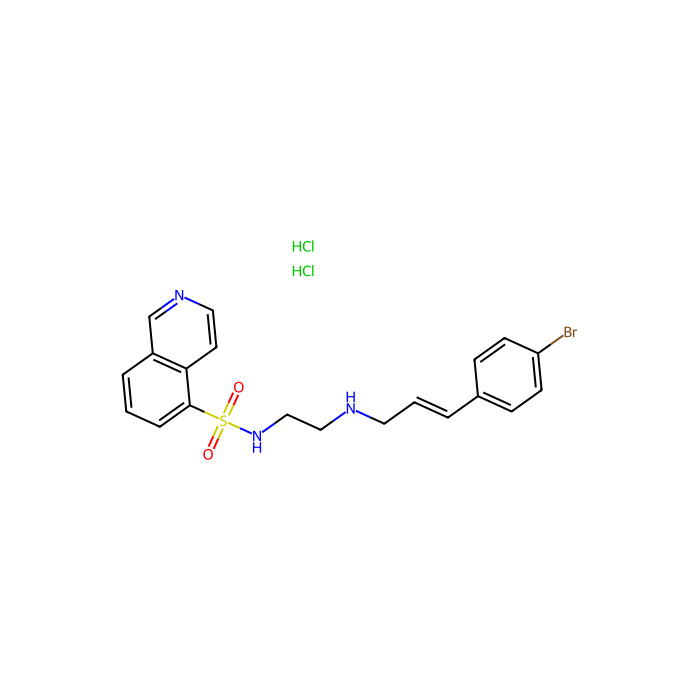
H 89 2HCl - 10mM in DMSO , CAS No.130964-39-5

CAS: 130964-39-5 Cat. No.: H408541 Summenformel: C20H20BrN3O2S.2HCl Molekulargewicht: 519.28 PubChem CID: 5702541
Zu bestellen verfügbar
GRADE & PURITY 10mM in DMSO
Synonyms
(E)-N-(2-(4-bromocinnamylamino)ethyl)isoquinoline-5-sulfonamide dihydrochloride
Storage
Store at -80°C
Shipped In
Dry ice packs + Cold packs
Size
Deutschland (EU)
USA*
Price
Qty
1ml
H408541-1ml
2 Auf Lager
83,22€
Enter a quantity for the sizes you want to add.
🧪

Why this grade

10mM in DMSO for sensitive chromatographic and analytical workflows requiring minimal baseline interference.

🌡

Storage & shipping

Store at -80°C Ships Dry ice packs + Cold packs Check lot-specific COA for exact specifications.

📋

Quality documents

SDS, COA, datasheet, and spec sheet available for download. Lot-specific COA accessible via lot number lookup.

📚

Literature proof

Cited in 1 peer-reviewed publications across chromatography, organic synthesis, and cross-coupling reactions.

Übersicht

Information

H 89 2HCl is a potentPKAinhibitor withKiof 48 nM in a cell-free assay, 10-fold selective for PKA than PKG,500-fold greater selectivity than PKC, MLCK, calmodulin kinase II and casein kinase I/II. H 89 2HCl inducesautophagy.
In vitro

H89 2HCl is a potent PKA (cAMP-dependent) protein kinase A inhibitor with Ki of 48 nM, exhibits 10-fold selectivity over PKG, exhibits >500-fold selectivity over PKC, MLCK, calmodulin kinase II and casein kinase I/II. Pretreatment of the cells with H-89 (30 μM) 1 h before the addition of forskolin markedly inhibits the forskolin-induced protein phosphorylation in a dose-dependent manner. H89 also inhibits several other kinases with IC50 of 80, 120, 135, 270, 2600 and 2800 nM for S6K1, MSK1, PKA, ROCKII, PKBα and MAPKAP-K1b, respectively. H89 also has activity at some cellular receptors and ion channels, including Kv1.3 K+ channels,β1AR and β2AR.

In vivo

H89 causes distinct modifications of protein phosphorylation, with the most robust changes in phosphorylation are fructose-1,6-biphosphatase, heterogeneous nuclear ribonucleoprotein (hnRNP), NSFL1 cofactor p47, all which have potentially regulatory connections to cAMP/PKA. H-89 (0.5, 1, 5 mg/kg) significantly attenuates prominent behavioral signs of morphine withdrawal in morphine-dependent mice.
Cell Data

cell lines:

Concentrations:~30 μM

Incubation Time:1 h

Powder Purity:≥99%

Specifications

Synonyme
(E)-N-(2-(4-bromocinnamylamino)ethyl)isoquinoline-5-sulfonamide dihydrochloride
Spezifikationen & Reinheit
10mM in DMSO
Biochemische und physiologische Mechanismen
H 89 2HCl is a potent PKA inhibitor with Ki of 48 nM in a cell-free assay, 10-fold selective for PKA than PKG,500-fold greater selectivity than PKC, MLCK, calmodulin kinase II and casein kinase I/II. H 89 2HCl induces autophagy.
Storage
Store at -80°C
Verschickt in
Dry ice packs + Cold packs
Dieses Produkt erfordert Kühlkettenversand. Grundversand und andere Economy-Optionen sind nicht verfügbar.
Namen und Kennungen
Isomere SMILES C1=CC2=C(C=CN=C2)C(=C1)S(=O)(=O)NCCNC/C=C/C3=CC=C(C=C3)Br.Cl.Cl
PubChem CID 5702541
Molekulargewicht 519.28

Documentation

📋 Safety Data Sheet (SDS)

Comprehensive hazard, handling, storage, and regulatory compliance document.

Download SDS →

✅ Certificate of Analysis (COA)

Lot-specific quality data. Enter your lot number to retrieve the exact COA.

Look up COA →

📊 Datasheet

Quick-reference summary of product specifications and applications.

View datasheet →

🔬 Specification Sheet

Full quality attributes and acceptance criteria for this grade.

View spec sheet →

Advanced Data

Zertifikate (CoA, COO, BSE/TSE und Analyse-Diagramm)
C of A & Other Certificates(BSE/TSE, COO):
Analytical Chart:
Chemische und physikalische Eigenschaften
LöslichkeitSolubility (25°C) In vitro Water: 49 mg/mL (199.37 mM); DMSO: 24 mg/mL (97.65 mM); Ethanol: 10 mg/mL (40.68 mM);
FAQs und Artikel
Urinary Follicle-Stimulating Hormone (uFSH): Source Attributes, Molecular Properties, and Research Application Frameworks
Adrenomedullin (ADM): Molecular Features, Signaling Mechanisms, and Research and Translational Applications of a Multisystem Vasoactive Peptide
Famotidine: Physicochemical Features, Mechanism of Action, and Key Points for Research Applications
Cyclic Nucleotide Signaling Pathways and Second Messenger Regulatory Mechanisms
Molecular Composition, Signal Transduction Mechanisms, and Targeted Regulatory Strategies of the Hippo Signaling Pathway
Molecular Mechanisms by Which Natural Products Regulate Adipose Browning
Citations of This Product
Referenzen
1. Zhao Huang, Li Zhou, Jiufei Duan, Siyuan Qin, Jingwen Jiang, Haining Chen, Kui Wang, Rui Liu, Minlan Yuan, Xiangdong Tang, Edouard C. Nice, Yuquan Wei, Wei Zhang, Canhua Huang.  (2024)  Oxidative Stress Promotes Liver Cancer Metastasis via RNF25-Mediated E-Cadherin Protein Degradation.  Advanced Science,      [PMID:38286671] [10.1002/advs.202306929]
Lösungsrechner
Bewertungen

Kundenbewertungen

Shall we send you a message when we have discounts available?

Remind me later

Thank you! Please check your email inbox to confirm.

Oops! Notifications are disabled.