GRADE & PURITYUltra dry?Ultra-dry grade with extremely low water content, packaged to exclude moisture. Use for moisture-sensitive reactions and air-free chemistry.≥99.9% metals basis
This compound belongs to the class of inorganic compounds known as transition metal iodides. These are inorganic compounds in which the largest halogen atom is Iodine, and the heaviest metal atom is a transition metal.
External Descriptors
Not available
1. Djoumbou Feunang Y, Eisner R, Knox C, Chepelev L, Hastings J, Owen G, Fahy E, Steinbeck C, Subramanian S, Bolton E, Greiner R, and Wishart DS. ClassyFire: Automated Chemical Classification With A Comprehensive, Computable Taxonomy. Journal of Cheminformatics, 2016, 8:61.
Determine the necessary mass, volume, or concentration for preparing a solution.
Dilution Calculator
Determine the dilution needed to prepare a stock solution.
Reconstitution Calculator
Bewertungen
Kundenbewertungen
Application Protocols
Not applicable. No validated bioassay protocols (e.g., WB, IHC, IF, FC) apply to hafnium iodide. For materials-processing uses (halide-transport purification, CVD), refer to the Reaction Conditions section for general process guidance and consult specialized literature for reactor-specific protocols.
Biological Roles
This product is an inorganic metal halide used primarily in materials science and inorganic synthesis. It has no established biological role.
Applicability:
Not a metabolite, cofactor, or biomolecule.
No known physiological function; not used in biochemistry workflows except as a materials reagent in instrument or device fabrication.
Safety note:
Any interaction with biological systems should be avoided; this product is for research use only (as indicated in Product Data). Handle to prevent release of HI/I2, which are corrosive to tissues.
For biochemical applications involving hafnium (e.g., HfO2 nanoparticles as supports), other specialized materials are typically employed; hafnium iodide itself is not used for biological function studies.
Buffer Applications
Not typically applicable. Hafnium iodide is a moisture-sensitive inorganic halide and is not used to prepare aqueous buffers or biological media. Exposure to water will hydrolyze the compound, releasing HI and forming Hf–oxo species. For relevant information, refer instead to the Reaction & Applications and Synthetic Utility sections focused on dry, non-aqueous or gas-phase processes.
Green Alternatives
“Green” considerations for hafnium sourcing or thin-film deposition revolve around minimizing corrosive halide byproducts (HI/I2), improving atom economy, and reducing energy demand.
Alternatives and trade-offs (literature/general):
HfI4 (this product):
Pros: Effective in halide-transport purification; suitable volatility for sublimation/CVD; enables very high purity Hf production.
Cons: Generates HI/I2 off‑gases (corrosive, require scrubbing); iodine handling/disposal; high temperatures for decomposition.
HfCl4:
Pros: Readily available, widely studied volatility; established ALD/CVD processes (especially with H2O/O3 for HfO2).
Cons: HCl-containing effluent; strong hygroscopicity; potential chloride contamination concerns in some applications.
Alkylamido hafnium precursors (e.g., TDMAHf, TEMAHf) for ALD/CVD of HfO2:
Pros: Halide-free byproducts (amines); lower process temperatures; excellent film conformality in ALD.
Cons: Air/moisture sensitive organometallics; potential carbon/nitrogen incorporation; cost and lifecycle impact of amine ligands.
Halide-free metallothermic routes to Hf metal (e.g., Kroll variants, electrochemical extraction):
Pros: Avoid iodide/HI streams.
Cons: Different impurity and energy profiles; may not reach the same ultra-high-purity levels achievable by halide transport.
Process-level green practices:
Implement closed-loop iodine management and HI scrubbing (alkaline wet scrubbers) with iodine recovery.
Optimize temperature gradients to reduce energy input in transport reactions.
Use life-cycle assessments when selecting among iodide, chloride, and organometallic routes.
Pharmaceutical Uses
Not applicable as a therapeutic or excipient. Hafnium iodide is not used in pharmaceutical formulations. Its relevance to pharma, if any, is indirect—e.g., materials processing or deposition of hafnium-containing films in device fabrication. No pharmacopeial monograph use is indicated.
Per Product Data: For research use only.
Physical Properties
Item-specific physical specifications (exact numeric specs) are not provided in the Product Data for this SKU. Do not treat the following as CoA specifications; they are literature/general values provided for context only.
Appearance: Reported as orange to red-orange crystalline solid (literature).
Phase behavior: Sublimes readily under reduced pressure; participates in reversible halide-transport equilibria (literature).
Thermal data (literature/general, approximate):
Many group‑4 tetraiodides exhibit melting/decomposition near 200–300 °C and sublime below the melt under vacuum; consult primary data specific to HfI4 before thermal processing.
Solubility (literature/general):
Hydrolytically sensitive; reacts with water to give Hf–oxo/iodide species and HI. Limited data on solubility in common organic solvents; any solution handling should employ rigorously anhydrous, aprotic media if attempted.
Density, refractive index, UV cutoff, water/peroxide/metal impurity limits: Not specified for this item; refer to CoA/Spec Sheet.
Practical notes (general):
Because of hydrolysis, observable properties can change upon air/moisture exposure. Verify properties on freshly handled, dry material under inert atmosphere when process design is sensitive to these parameters.
Quality and Grades
Item-specific grade (Product Data):
Grade/Purity: Ultra dry
What “Ultra dry” implies (general/typical meaning):
Manufactured, packaged, and tested to minimize adventitious moisture. Typically filled and sealed under inert atmosphere using moisture-barrier containers. Suitable for applications where hydrolysis must be rigorously avoided (e.g., halide-transport purification/deposition, water‑sensitive synthesis).
Implications for use:
Use and maintain inert conditions upon opening. Consider handling entirely in a glovebox. If transferring outside, apply air‑free technique (Schlenk) with dry carriers.
Analytical expectations:
Where applicable, Karl Fischer moisture, halide content, trace metal profiles, and residual solvent/volatiles may be provided on the CoA for the lot you receive. Exact numeric limits (e.g., water ppm, metals, UV cutoff) are Not specified for this item; refer to CoA/Spec Sheet.
Comparison to other grades (general):
Relative to standard technical grades, Ultra dry minimizes hydrolysis-derived impurities (e.g., Hf–oxo species, HI). Compared to electronic or ALD grades, Ultra dry addresses moisture but may not define volatile impurity windows or specific electronic contaminant limits unless noted on the CoA.
Stabilizers:
No stabilizer is indicated in the Product Data. If present for a given lot, it will be declared on the CoA; otherwise assume stabilizer-free and handle accordingly.
Reaction and Applications
Hafnium iodide (commonly HfI4 by literature) is a classic halide-transport and deposition precursor for hafnium metal and related materials.
Iodination of impure hafnium at moderate temperature forms volatile HfI4, which is transported to a hot filament/zone where it decomposes to pure metallic Hf, releasing HI/I2. This equilibrated cycle yields very high-purity Hf for specialty applications.
Chemical vapor deposition (CVD/HWCVD) of Hf — literature/general:
HfI4 + 2 H2 → Hf(s) + 4 HI(g) on a sufficiently hot substrate or filament. Hydrogen acts as reductant; off‑gas treatment/scrubbing for HI is required. Useful for preparing Hf films or crystal bars.
Precursor for nitride/carbide/oxide materials — literature/general:
In combination with NH3, CH4, or O2/H2O (with stringent control to prevent premature hydrolysis), HfI4 can serve in research explorations of HfN, HfC, or HfO2 formation, though chloride or organo‑hafnium precursors are more common due to volatility/handling.
Halide exchange and adduct chemistry — literature/general:
Lewis-acidic HfI4 can form donor adducts with neutral ligands (ethers, phosphines, nitriles) under rigorously dry conditions. Halide exchange with other metal halides/iodides may be used to tune reactivity or generate mixed-halide hafnium species.
Practical tips:
Maintain anhydrous/inert conditions from weighing through process to avoid formation of Hf–oxo impurities.
For transport/CVD, design corrosion-resistant flow paths and scrubbers for HI/I2. Monitor transport equilibria via temperature gradients and partial pressures.
Use high-purity, Ultra dry material to minimize nucleation of nonvolatile residues.
Reaction Conditions
The following are literature/general guidelines for processes involving hafnium iodide; they are not item-specific specifications. Always validate conditions for your apparatus and scale.
Reagents: Hafnium metal + iodine to form HfI4 in situ; or feed HfI4 directly.
Temperature: Transport typically occurs with a cool zone (several hundred °C) generating HfI4 vapor and a hot zone/filament (≈1000–1800 °C) where HfI4 decomposes to Hf. Precise setpoints are apparatus/scale dependent.
Atmosphere/pressure: Inert or vacuum with controlled iodine partial pressure; reduced pressure enhances transport; avoid air/moisture.
Notes: Provide materials-compatible seals and HI/I2 scrubbing.
CVD/HWCVD of Hf metal:
Overall: HfI4 + 2 H2 → Hf + 4 HI on a heated substrate or hot filament.
Typical substrate/filament temperatures: Often 800–1400 °C, optimized for nucleation and film quality.
Carrier gases: H2 and inert diluents (Ar, N2). Maintain very low moisture/oxygen.
Delivery: Sublimation of HfI4 from a temperature‑controlled source; monitor source temperature to regulate vapor pressure.
Materials synthesis (HfN/HfC/HfO2):
Reactive gases: NH3 for nitride, CH4/HC mixtures for carbide, and carefully metered oxidants for oxides.
Considerations: Competing hydrolysis and corrosive HI formation necessitate corrosion-resistant reactors and efficient off‑gas scrubbing.
Workup and analysis:
Expect iodide/HI residues; neutralize via alkaline traps. Analyze films or metals by XRD, XPS, ICP‑OES to confirm halide removal and purity.
Safety and Handling
Always consult the SDS for authoritative safety information for this specific product/lot. The Product Data do not list GHS elements; therefore treat the following as general guidance for hafnium tetraiodide and related metal iodides.
GHS classification, signal word, H‑statements, pictograms: Not specified for this item; refer to SDS.
General hazards (literature/general):
Moisture sensitive; hydrolysis can evolve hydrogen iodide (HI), a corrosive, toxic gas/acID.
Strong Lewis acid/halide; can be corrosive to skin, eyes, and mucous membranes.
Work under inert atmosphere (argon/nitrogen glovebox or Schlenk line) to avoid moisture ingress.
Use dry tools and vessels; avoid contact with protic solvents and oxidizers.
Local exhaust ventilation or fume hood is essential, especially during heating/sublimation.
PPE:
Safety glasses or chemical splash goggles; lab coat; chemically resistant gloves (e.g., nitrile) with double-gloving for extended tasks; consider face shield for charging operations.
First aid (general):
Inhalation: Move to fresh air; seek medical attention. Skin/eye contact: Rinse with water for ≥15 minutes; remove contaminated clothing; obtain medical evaluation. Ingestion: Rinse mouth; do not induce vomiting; seek medical attention.
Incompatibilities (general):
Water, alcohols, amines (hydrolysis); strong oxidizers; strong bases/acids (can accelerate corrosive reactions). Store away from moisture-bearing materials and acids/bases.
Solvent Selection
Hafnium iodide is most often used in solid/gas phase processes (halide-transport, sublimation, CVD) rather than in homogeneous solution. Consequently, conventional “solvent selection” is typically not applicable. Key considerations:
Applicability:
Not routinely dissolved for wet-chemistry transformations due to hydrolysis and limited solubility data. When solution handling is required (e.g., preparation of donor-adducts), strictly anhydrous, aprotic, and non-nucleophilic media are imperative under inert atmosphere.
General solvent guidance (literature/general):
Avoid: Water, alcohols, amines, and other protic/nucleophilic solvents (rapid hydrolysis/ligand substitution, HI formation).
Consider (with strong caution and literature precedent): Very dry, oxygen/moisture-free aromatic hydrocarbons or chlorinated solvents for transient handling of related group‑4 halides; verify solubility and stability for HfI4 specifically before use.
Process alternatives:
For deposition/purification, solvent-free routes (sublimation, chemical transport with iodine/iodides, CVD with hydrogen or reductants) are preferred and avoid solvent compatibility concerns.
In short, prioritize solvent-free methodologies. If a solvent must be employed for a specialized protocol, conduct small-scale trials under glovebox conditions and consult primary literature for HfI4 adduct chemistry.
Storage and Reconstitution
Item-specific conditions (Product Data):
Storage Conditions: Room temperature
Shipped In: Normal
Grade: Ultra dry
Practical storage guidance (general, aligned to grade):
Keep tightly sealed under inert atmosphere (argon or nitrogen). For best longevity, store in a desiccator or glovebox antechamber. Minimize headspace humidity by purging containers prior to reclosing.
Use only dry tools; promptly reseal after dispensing. Consider subdividing into smaller aliquots to reduce repeated air exposure.
Stability considerations (literature/general):
Moisture sensitive; hydrolyzes with water to produce HI and Hf–oxo species, which can degrade performance in transport/deposition. Protect from humid air.
If sublimation is planned for purification, use clean, dry glass/metalware compatible with iodides and HI.
Reconstitution/dispensing:
This solid is typically used as‑received for sublimation/transport. If solution handling is required for specialized studies, prepare only under rigorously anhydrous, oxygen‑free conditions and use immediately. No aqueous reconstitution is recommended.
Shelf life:
Dependent on maintaining dryness and inert conditions. Inspect visually (color/flow) and, if critical, verify by suitable analysis (e.g., halide content, moisture) before sensitive applications.
Research Use Note: For research use only.
Structure and Identity
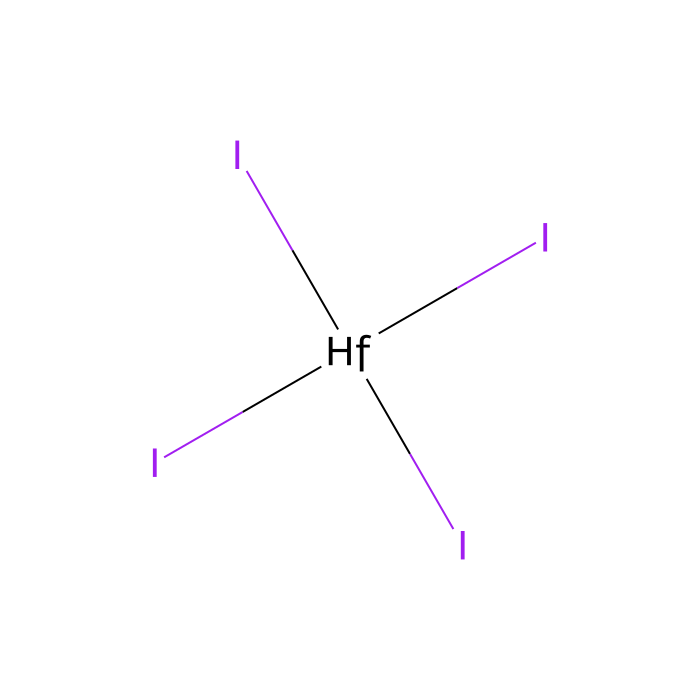
Hafnium iodide is an inorganic, binary metal halide commonly encountered as the tetraiodide of hafnium used in halide-transport purification and deposition processes.
Item-specific identifiers (Product Data):
SKU: H284105
Product Name: Hafnium iodide
CAS: 13777-23-6
CID: 83726
InChIKey: 433577 (as provided)
SMILES: Not specified for this item; refer to CoA/Spec Sheet.
Composition and structural features (literature/general):
Coordination/structure: In the gas phase, discrete tetrahedral molecules are reported; in the solid state, polymeric halide-bridged networks are common among group-4 tetraiodides.
Bonding: Predominantly ionic/covalent Hf–I bonds with strong Lewis acidity at Hf.
Descriptive 2D “structure in words” (literature/general):
A central hafnium atom bound to four iodide ligands (nominally HfI4), arranged approximately tetrahedrally for the monomeric unit; extended halide bridging in the solid gives higher coordination about Hf.
Notes:
Where structural identifiers are missing from Product Data (e.g., SMILES), consult the product CoA/SDS or primary literature. All formula/structure details here are provided as general literature information and are not item-specific specifications.
Synthetic Utility
Hafnium iodide serves as a versatile inorganic precursor where the iodide ligands confer volatility and strong Lewis acidity.
Precursor to metallic hafnium (literature/general):
Key intermediate in the van Arkel–de Boer process, enabling purification and growth of high-purity Hf. The reversible formation/decomposition of HfI4 under temperature gradients permits controlled transport.
Entry point to hafnium materials:
Thermochemical conversion to HfN, HfC, or HfO2 under reactive atmospheres (NH3, CH4, O2/H2O), albeit chloride or organo-hafnium reagents are more common for thin films. Iodide’s higher atomic mass can aid certain transport equilibria.
Lewis acid catalysis/adduct formation (literature/general):
Like other group‑4 tetrahalides, HfI4 can form adducts with neutral donors (ethers, nitriles, phosphine oxides). These adducts may modulate volatility/solubility and have been explored as tailored transport precursors. Catalytic applications are less documented for HfI4 than HfCl4, but halide exchange strategies can translate methodologies.
Halide exchange and transhalogenation:
Iodide can be exchanged for chloride/fluoride in multistep schemes to access mixed‑halide hafnium species with tuned reactivity/volatility, or to generate anhydrous HfX4 starting from iodide routes.
Practical guidance:
Select HfI4 when volatility/iodide-transport is desired and equipment accommodates HI/I2 scrubbing. For solution-phase synthesis or ALD of oxides, consider organo-hafnium alternatives described in Green Alternatives.
Target Specificity
Not applicable. This product is an inorganic reagent (hafnium iodide) and is not an antibody, probe, or biologic. No antigen/epitope or species reactivity information applies.
Need help choosing the grade?
Our grade selection guide covers purity, stabilizer status, and application suitability for all variants in our catalog.
Wir verwenden Cookies, um die ordnungsgemäße Funktion der Website sicherzustellen und, soweit zulässig, Ihr Nutzererlebnis zu verbessern. Sie können Ihre Einstellungen jederzeit unter „Einstellungen“ verwalten. Weitere Informationen finden Sie in unserer Cookie-Richtlinie.
Dürfen wir Sie über Rabattaktionen informieren?
Später erinnern
Vielen Dank! Bitte überprüfen Sie Ihren E-Mail-Posteingang, um zu bestätigen.
Products are supplied to verified businesses, institutions, and qualified professionals for research and development use only. Not for use in humans, animals, diagnosis, or therapy.

 B2222224